Triage Split Exceptions in 24–48 Hours for Brokerage Payment Admins

Split exceptions management must guarantee one outcome: every flagged commission split gets validated, approved, and documented before a dollar moves, so payment only happens once services are proven and RESPA exposure is cleared. The immediate action for any admin facing a flagged split is to classify its risk tier and hold high-risk exceptions within 24 to 48 hours until a reviewer signs off. Platforms like BrokerPay build this hold-and-verify logic into the payout workflow itself.
TL;DR:
- Most split exceptions are repetitive, with common types including missing instructions, cap overruns, referral mismatches, ACH failures, post-close adjustments, and duplicate fees, each with specific detection signals.
- Exceptions involving unverified splits, nominal payments, or undocumented agreements pose the highest RESPA risk and require thorough compliance review before payment release.
- Implementing a structured, risk-tiered workflow from triage to documentation significantly reduces legal exposure and helps resolve exceptions efficiently within target timeframes.
- Automated platform solutions like BrokerPay integrate control mechanisms, approval workflows, and audit trails, minimizing manual errors and ensuring compliance with RESPA requirements.
- Training staff on exception recognition, proper documentation, and escalation procedures is critical to maintaining compliance and preventing costly errors during split payments.
Table of Contents
- Common types of split exceptions and how to detect them
- Why certain exceptions create RESPA risk
- Step-by-step resolution workflow: triage, verify, approve, pay, document
- Operational controls and documentation best practices
- How long resolution takes and what it costs the brokerage
- Connecting split exceptions management to loan origination and servicing systems
- Software and technology options for managing split exceptions
- Training staff to handle split exceptions without creating new risk
- How split exceptions affect the people waiting on payment
- Balancing speed of payout against RESPA risk
- How BrokerPay handles split exceptions for brokerages
- FAQ
- Sources
Common types of split exceptions and how to detect them
Most brokerages see the same handful of exceptions over and over, and recognizing the pattern early is what keeps a minor paperwork gap from turning into a compliance review. The exception types generally fall into six buckets, each with its own detection signal.
- Missing split instructions: a closing comes through with no documented split percentage, usually caught when the payment queue flags an incomplete record.
- Cap overruns: an agent exceeds their annual cap or brokerage fee threshold, typically surfaced by automated cap-tracking alerts.
- Referral or co-op mismatches: the referral agreement on file does not match the percentage requested for payout, often found during manual reconciliation against the MLS listing data.
- Failed ACH transfers: a payout bounces back with a returned-payment code, which is almost always an operational issue (wrong account number, closed account) rather than a compliance one.
- Post-close ad hoc adjustments: someone requests a split change after the file has already closed, a pattern that deserves scrutiny because retroactive changes are a classic red flag for disguised referral fees.
- Duplicate fee requests: the same service gets billed twice across two parties, usually caught by reconciliation software comparing invoice line items against disbursement records.
The quick triage test is whether the exception is operational or compliance-driven. A returned ACH because of a typo in routing numbers is a fix-and-resend problem. A referral split that does not match any signed agreement on file is a hold-and-investigate problem, and the two should never be routed through the same queue.
Why certain exceptions create RESPA risk
Some split exceptions are just clerical. Others touch RESPA Section 8, the federal rule that prohibits splitting charges for settlement services unless the split compensates someone for services actually performed. Regulation X states plainly that a charge for which no or nominal services are performed is an unearned fee and violates RESPA.
The CFPB’s own guidance on Marketing Services Agreements warns that these arrangements can conceal payments for referrals, and that lawful MSAs must reflect actual marketing services with payment reasonably tied to the market value of that work. The same logic applies to any commission split: if the payout looks nominal, duplicative, or disconnected from documented work, it is high risk regardless of what the parties call it.
- Payments that exceed what the documented services could reasonably be worth.
- Disclosures that are undated, unsigned, or missing entirely from the file.
- Splits created or changed after closing with no corresponding service explanation.
- Any split tied to an affiliated business arrangement lacking a current, signed ABA disclosure.
A split exception tied to an undocumented referral or an affiliated business arrangement should never clear for payment without a compliance review, because RESPA FAQs from the CFPB confirm that Section 8(b) prohibits unearned fee arrangements, with only narrow exceptions under Section 8© for bona fide salary or legitimate cooperative brokerage splits.
Step-by-step resolution workflow: triage, verify, approve, pay, document
A repeatable workflow is what turns split exceptions management from a judgment call into a defensible process. The sequence below works for brokerages of any size, though the people involved at each step will differ.
- Triage within 24 to 48 hours. Assign a risk tier (low, medium, high) based on the exception type and dollar value. A failed ACH is low. A post-close referral adjustment is high.
- Verify the evidence. Pull the signed listing or buyer agreement, the cooperative compensation agreement, any invoices for services rendered, cap statements, and MLS listing disclosures. No payment proceeds without a document trail that ties the split to work actually performed.
- Route through the approval matrix. Low-tier exceptions get sign-off from payment operations staff. Medium-tier exceptions need a compliance reviewer. High-tier exceptions, anything touching a referral fee question or an affiliated arrangement, require both the broker of record and legal counsel before release.
- Apply the payment rule. If services were fully performed and documented, release full payment. If only part of the work is verified, record a partial payment and hold the remainder in escrow pending the rest of the documentation.
- Close and retain the record. Store the approval chain, the supporting documents, and the final payment decision in an audit-ready file, not a scattered email thread.
Pro Tip: Build your approval matrix before you need it. Deciding sign-off authority during a live exception under time pressure is how brokerages end up approving payments they later have to claw back.
The timeline matters as much as the steps. A low-risk exception that sits in a queue for two weeks creates agent frustration and cash-flow complaints with no compliance upside. A high-risk exception that gets rushed through in an hour to avoid that same complaint creates legal exposure instead. The workflow exists to keep both failure modes from happening at once.

Operational controls and documentation best practices
Fixing exceptions one at a time is necessary but not sufficient. The brokerages with the fewest recurring problems invest in controls that catch issues before they reach the payment queue at all.
Preventive controls include validation rules at the point of data entry, enforced split templates that will not let a transaction proceed without a complete record, pre-close sign-off gates, and automated cap and override enforcement so an agent cannot be paid past their threshold by accident. Detective controls, the backstop for whatever slips through, include automated reconciliations between the transaction management system and the payout ledger, exception dashboards that surface patterns instead of one-off tickets, returned-payment analytics, and periodic reviews of exception trends by type and office.
The documentation standard that holds up under audit has three parts: an immutable change log so no one can edit a split after the fact without a trace, stored copies of every signed disclosure, and itemized descriptions that tie each payment to the specific service it compensates.
| Control type | Example | What it prevents |
|---|---|---|
| Preventive | Enforced split templates at entry | Missing split instructions |
| Preventive | Automated cap/override enforcement | Cap overruns |
| Detective | Exception dashboards and trend reviews | Recurring compliance patterns |
| Documentation | Immutable change log | Undocumented post-close adjustments |
Some commission payment platforms operationalize this structure: routing every split through an approval workflow with a stored audit trail, cap tracking against each agent’s threshold, and signed disclosures attached directly to the transaction record rather than living in a separate file.
How long resolution takes and what it costs the brokerage
A low-risk exception, like a returned ACH payment, typically resolves within one to three business days once the correct account information is on file. A medium-risk exception involving a mismatched co-op agreement usually takes a week or more, since it requires pulling the original cooperative compensation agreement and confirming the percentage against the MLS record. High-risk exceptions involving a possible referral or unearned fee question can take several weeks, particularly when legal counsel needs to review the disclosure history before approving release.

The cost of a slow resolution is not just agent frustration. Every day an exception sits unresolved is a day the brokerage carries liability for an undocumented payment, and a backlog of exceptions makes it harder to spot the pattern that signals a systemic problem rather than a one-off error. The cost of a fast but under-verified resolution is worse: a payment released without adequate documentation is exactly the scenario Regulation X was written to catch, and unwinding an improper payment after the fact is far more expensive than holding it for an extra week up front.
The practical target most brokerages should aim for is resolving low and medium-risk exceptions within the same payroll cycle, while accepting that high-risk exceptions may legitimately extend beyond it. Rushing a high-risk exception to meet a payroll deadline is the single most common way brokerages create RESPA exposure.
Connecting split exceptions management to loan origination and servicing systems
Commission splits do not happen in isolation. They are triggered by events in the loan origination and closing process, which means the exception workflow works best when it has visibility into that upstream data rather than waiting for a closing statement to arrive after the fact.
The practice changes outlined in NAR’s guidance on compensation disclosure made this integration more important, not less. With offers of compensation moved off the MLS and written buyer agreements now required to disclose compensation terms, a brokerage’s payment system needs a reliable feed of that agreement data to validate a split automatically instead of relying on a staff member to track it down manually.
Brokerages that integrate their split exception workflow with loan origination and title or escrow systems get two benefits. First, exceptions surface earlier, often before closing instead of after, which gives more time to resolve documentation gaps without delaying payout. Second, the reconciliation itself becomes more accurate because the system is comparing the actual closing disbursement against the agreement on file rather than relying on a manually entered split percentage. Brokerages still using spreadsheets or informal payment apps for this step are working from the weakest version of that integration, since there is no system of record to reconcile against in the first place.
Software and technology options for managing split exceptions
Brokerages generally fall into one of three technology postures when it comes to handling split exceptions, and the posture determines how much manual work the admin team absorbs.
The first is manual tracking: spreadsheets, email approvals, and peer-to-peer payment apps like Venmo or Zelle used to move funds between agents. This approach has no built-in audit trail, no cap enforcement, and no systematic way to flag a mismatched referral split before the money moves, which is precisely the exposure that led the CFPB to focus supervisory attention on marketing services agreements in the first place.
The second is a general accounting or transaction management system adapted for commission payouts. These tools can track payments but typically lack purpose-built exception detection for real estate-specific issues like cap overruns or co-op mismatches, so the brokerage ends up building manual workarounds on top of software not designed for the job.
The third is a dedicated commission payment platform purpose-built for brokerage splits, referral fees, and co-op commissions, with exception detection, approval workflows, and documentation storage built around the RESPA compliance requirement rather than bolted on afterward. Dedicated commission payment platforms routing every split through brokerage-controlled accounts with audit trails and cap tracking built into the payout process fall into this category.
Training staff to handle split exceptions without creating new risk
A good exception workflow fails if the people running it do not understand why each step exists. Training should start with the regulatory “why” before the operational “how”: staff who understand that an unearned fee can be a federal violation, not just a bookkeeping error, handle gray-area exceptions with more care.
Effective training programs cover three things. First, how to recognize each exception type on sight, using real examples from the brokerage’s own transaction history rather than generic case studies. Second, exactly what documentation is required at each risk tier, so staff are not guessing whether a signed cooperative agreement is sufficient or whether they also need an itemized service description. Third, when to escalate rather than decide, since the biggest training failure is a well-meaning staff member who approves a borderline payment because they did not realize it needed a second signature.
Change management matters just as much when a brokerage moves from manual processes to an automated exception workflow. Staff accustomed to approving payments by email often resist a structured approval matrix because it feels slower, even when it is actually faster for the majority of low-risk cases. Framing the change around what it removes, like chasing down documents after the fact or explaining a payment to an auditor months later, tends to land better than framing it around new steps to follow.
How split exceptions affect the people waiting on payment
The term “split exceptions management” can make the issue sound purely internal, but every held payment has a person on the other end waiting for their check. Agents whose commission gets delayed because of a documentation gap experience that delay the same way regardless of whether the hold is justified, and repeated delays erode trust in the brokerage’s payment process even when the brokerage is doing exactly what it should.
The same dynamic touches buyers and sellers indirectly. A referral fee dispute that drags on can create friction between the agents involved in a transaction, and that friction sometimes surfaces in how responsive those agents are to the client during an already stressful closing period. A brokerage that resolves low-risk exceptions quickly, while still holding genuinely high-risk ones for proper review, protects the client experience without compromising on the compliance work that actually matters.
The brokerages that handle this best are transparent with agents about why a hold exists and roughly how long it will take, rather than leaving a payment status unexplained. An agent who knows their split is held pending a signed disclosure, with an expected resolution date, is a far more patient agent than one who simply sees a missed payroll cycle with no explanation.
Balancing speed of payout against RESPA risk
Agents want to get paid fast, and that pressure is legitimate: a delayed commission check is a real financial hit for someone who just closed a deal. The mistake brokerages make is treating every delay as equally avoidable. Some exceptions genuinely need to move in a day. Others need to sit for a week while someone verifies a referral agreement actually exists.
My view is that the line should be drawn by risk type, not by how loudly an agent is asking. A returned ACH payment deserves same-day attention because there is no compliance question, only an operational one. A split tied to a referral fee or an affiliated business arrangement deserves to sit until legal or the broker of record signs off, full stop, regardless of how routine it looks.
Platformized controls make that distinction easier to hold the line on, because the system routes low-risk exceptions to fast resolution automatically and forces high-risk ones through the right reviewers without anyone having to remember to escalate manually. That is what reduces unnecessary holds without increasing legal exposure: not faster approvals across the board, but smarter routing of which exceptions deserve speed in the first place.
How BrokerPay handles split exceptions for brokerages
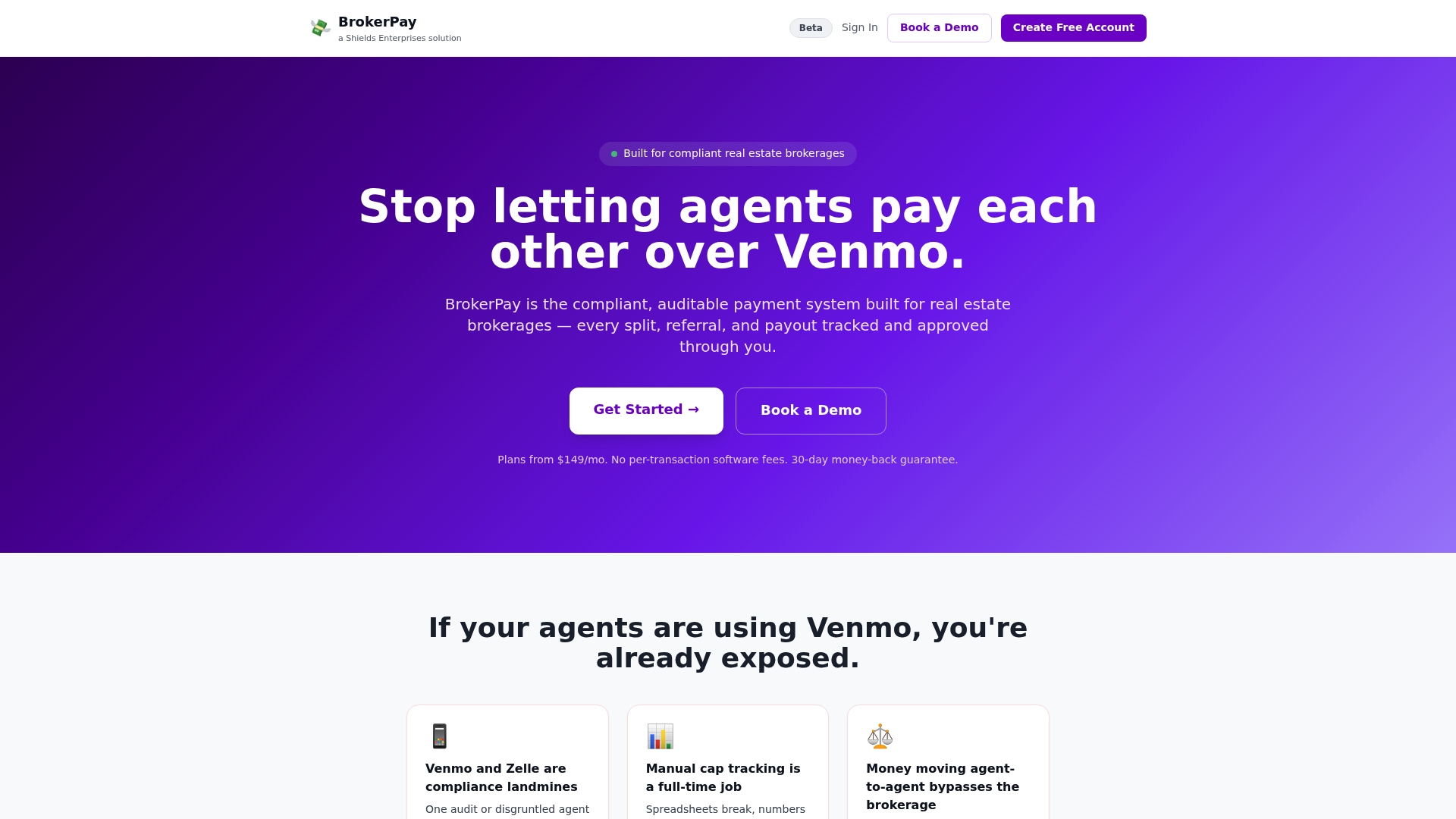
Every control described above, the audit trail, the cap tracking, the approval workflow, the signed document storage, is something we built directly into BrokerPay rather than treating as an add-on. When an agent closes a deal, we route the split through a workflow that checks cap status, flags missing disclosures, and requires sign-off at the right tier before funds move, with ACH payouts handled through brokerage-controlled accounts instead of informal apps.
- Automated cap tracking that flags an overrun before payment, not after.
- Built-in approval workflows that route low, medium, and high-risk exceptions to the right reviewer.
- A stored audit trail with signed disclosures attached directly to each transaction.
We offer three plans, Starter, Growth, and Enterprise, scaled to brokerage size, with flat monthly pricing and no per-transaction fees. If you want to see how the workflow fits your office, start with the BrokerPay product page to check plan details and get a demo.
FAQ
Should we hold payment on every split exception?
No. Low-risk operational exceptions, like a returned ACH payment, can usually be resolved and paid within a few days once corrected. High-risk exceptions involving referral fees or affiliated business arrangements should be held until compliance review confirms the split reflects services actually performed.
What documentation proves a split is RESPA-compliant?
A compliant split needs a signed listing or buyer agreement, a cooperative compensation agreement where applicable, and an itemized description tying the payment to specific services performed. CFPB guidance on MSAs confirms that payments must reflect actual services and reasonable market value rather than the value of a referral.
Who should approve a high-risk split exception?
High-risk exceptions, including any split tied to a referral or an affiliated business arrangement, should go through both the broker of record and legal counsel before release. Lower-risk exceptions can typically be cleared by payment operations staff or a compliance reviewer, depending on the risk tier assigned during triage.
How does BrokerPay help prevent split exceptions?
BrokerPay enforces cap tracking and split validation automatically at the point of payment, which catches many exceptions before they reach a manual review queue. The platform also stores signed disclosures and maintains an audit trail for every transaction, which shortens the documentation step when an exception does occur.
What makes an exception a RESPA violation instead of a clerical error?
The test under Regulation X is whether the payment compensates for services actually performed and is reasonably related to their market value. A payment that is nominal, duplicative, or tied to a referral rather than documented work risks being classified as an unearned fee violation.