Stop RESPA and 1099 Risk: Agent Team Override Tracking for U.S. Brokers

Agent team override tracking means recording every split, override, and cap adjustment at the transaction level, with a paper trail an auditor could follow without asking questions. The first action for brokerage staff is simple: require a signed team agreement and a collected W-9 before any override payment goes out, and log the entry at closing rather than later. Get that sequence wrong and you’re carrying both tax and RESPA exposure.
TL;DR:
- Accurate override tracking requires signed team agreements and current W-9 forms stored before any payments are made or recorded at closing.
- Transaction-level fields such as deal ID, split formula, cap status, and approval details must be captured immediately at closing to prevent reconstruction issues later.
- Automated systems should provide real-time cap tracking, approval workflows, immutable audit logs, and direct W-9 linkage to ensure compliance and simplify audits.
- Monthly reconciliation of cap balances and quarterly audits of override records help detect errors early, especially when agents leave or caps reset annually.
- Using purpose-built tools like BrokerPay addresses common pitfalls of manual tracking, reduces legal risk, and improves transparency, trust, and efficiency in team override management.
Table of Contents
- Why precise override tracking matters: compliance, tax, and dispute defense
- Essential records and fields to capture for every override and cap
- Process and approval workflow: implementing reliable override tracking
- Automation and best-practice approaches: what to require from tools and integrations
- How BrokerPay addresses these requirements
- Common challenges and solutions in agent team override tracking
- Legal considerations specific to different states or regions
- Impact of override tracking on team morale and performance
- Author perspective: quick priorities for brokerages fixing commission tracking
- BrokerPay as a path to compliant override tracking
- Sources
- FAQ
Why precise override tracking matters: compliance, tax, and dispute defense
Loose tracking does not just create messy spreadsheets. It creates legal exposure that surfaces months or years later, usually during an audit or a departing agent’s dispute over unpaid override balances.
NAR guidance states that brokers, not team leaders, carry responsibility for team oversight, and that written team agreements need to cover compensation, branding, classification, and dissolution terms. Without that document, a broker has little to point to when a team leader and an agent disagree about what percentage was owed on a closed file.
Tax risk compounds the problem. The IRS instructions for Form W-9 explain that mayors are required to collect a W-9 before making reportable payments, and a missing form can trigger backup withholding under IRC Section 3406. A brokerage that pays overrides without a current W-9 on file risks both an incorrect 1099-NEC and a withholding obligation it never budgeted for.
RESPA adds a third layer. 12 USC § 2607 bars referral fees and kickbacks tied to settlement services, though it permits cooperative brokerage splits when the payment is for services actually performed by someone acting in a brokerage capacity. An override that cannot be tied to actual brokerage work looks, on paper, like exactly the kind of arrangement RESPA was written to stop.
Transaction-level tracking addresses all three risks at once:
- It gives brokers documentation that a team agreement was followed as written.
- It creates the record an accountant needs to file 1099-NEC forms correctly.
- It shows regulators that a split was tied to a real transaction and real work, not a referral disguised as a commission.
A team agreement covering compensation, ownership, and dissolution is the baseline document NAR says brokers must maintain, and it is the first thing an auditor or a departing agent’s attorney will ask to see.
Essential records and fields to capture for every override and cap
Payroll and compliance staff need two kinds of records: the documents that establish the rules, and the transaction data that proves the rules were followed.
- Signed team agreements stored centrally, covering compensation splits, cap thresholds, ownership of leads and listings, and what happens to pending deals if the team dissolves.
- Current W-9s for every agent and team leader receiving override payments, refreshed whenever a name, entity structure, or tax ID changes, and linked directly to the payment record it supports for accurate 1099-NEC filing.
- Deal-level fields captured at closing: deal ID, gross commission, the split formula applied, cap status before and after the transaction, the reason for any override, the approver’s name, and a timestamp.
- Payment and delivery records: ACH confirmations, payment receipts, and proof that 1099-NEC forms were actually delivered to recipients, not just generated.
- Cross-reference notes linking each override back to the governing team agreement clause, so a reviewer can trace the payment to its authorization in under a minute.
Pro Tip: Store the team agreement clause number alongside every override entry so a compliance review never requires digging through the original contract to confirm authorization.
This structure matters most when an agent leaves a team mid-cap-year or a dispute surfaces over a split calculated six months earlier. Brokerages that keep these fields at the transaction level, rather than reconstructing them from bank statements after the fact, spend far less time on what industry commentary sometimes calls reconstruction season, the scramble to rebuild records ahead of tax filing or an audit.
Process and approval workflow: implementing reliable override tracking
A workflow only works if roles are clear before the first override is entered.
- Assign ownership. A designated compliance or office manager signs off on team agreements; a payroll or transaction coordinator enters override data; a broker or designated approver signs off on payment before funds move.
- Verify before you enter. Confirm the team agreement is current and the W-9 is on file before touching the transaction record.
- Enter the override at closing. Record the split formula, gross commission, and cap status in the same session the transaction closes, not weeks later.
- Let the cap update automatically. The system should reflect the new cap balance immediately so the next transaction calculates against current numbers, not stale ones.
- Route through an approval gate. No override payment releases without a named approver confirming the entry against the governing agreement.
- Pay and archive. Disburse via ACH and store the payment record, approval trail, and supporting documents together.
Reconciliation should run on a set cadence, not an as-needed basis:
- Reconcile cap balances monthly so errors surface before they compound across a full year.
- Run a fuller audit quarterly, checking a sample of overrides against their governing agreements.
- Verify every W-9 and 1099-NEC pairing at year-end, before filing deadlines force a rush.
Separation of duties matters here. The person entering an override should not be the same person approving its payment, and every change to a cap balance or split formula needs a logged exception with a reason, not a silent edit. An escalation rule (any override above a set dollar threshold requires a second sign-off) catches the errors that a single reviewer might miss.
Automation and best-practice approaches: what to require from tools and integrations
Spreadsheets and peer-to-peer payment apps are the default for a lot of brokerages, and both create the same underlying problem: no payment gateway built for oversight, no immutable log, and no easy way to prove to an auditor that a Venmo transfer labeled “commission” was for services actually performed under RESPA.
When evaluating a tool to automate override tracking, look for:
- Transaction-level split logic that calculates overrides and caps automatically from deal data, not manual formulas.
- Cap tracking that updates in real time and flags when an agent crosses a threshold mid-year.
- Approval workflows with a required sign-off before any payment releases.
- Immutable audit logs that record who entered, approved, and changed every entry, with timestamps.
- W-9 linkage tying tax documentation directly to the payment it supports.
- ACH pay-outs and accounting exports that eliminate manual re-entry into bookkeeping software.
Pro Tip: Pilot any new system on a single office or a single team before rolling it brokerage-wide, so data migration issues surface on a small scale rather than during a full cutover.
Integration priorities should follow the money: a tool that connects to your transaction management system, your accounting software, and your payroll or 1099 export process saves far more time than one that only handles the payment step in isolation. Migrating historical data takes planning, and switching from manual to automated payouts works best when the old records are reconciled once, cleanly, before the new system goes live.
How BrokerPay addresses these requirements
BrokerPay is built around the same checklist this guide walks through: transaction-level split and override calculation, automatic cap tracking, approval workflows before any payment releases, and audit trails that log every entry, approval, and change. W-9 collection ties directly to payment records, and disbursements move through ACH rather than informal transfers.
BrokerPay’s stated positioning is straightforward: it exists to eliminate the compliance risk that comes with agents and teams paying each other through peer-to-peer payment apps, replacing that workaround with a documented, RESPA-focused workflow where funds move through brokerage-controlled accounts.
For brokerages evaluating whether to build this process manually or adopt a purpose-built system, the tradeoff comes down to how much staff time goes into reconstructing records versus having them generated correctly the first time.
Common challenges and solutions in agent team override tracking
The most common failure point is timing: overrides get logged weeks after closing, once memory of the exact split has faded and the paperwork trail has gone cold. The fix is procedural, not technical: build override entry into the closing checklist itself, so it happens the same day the transaction closes.
A second recurring problem is orphaned agreements: a team’s compensation terms live in an email thread or a verbal understanding rather than a signed document the brokerage controls. When a dispute arises, there’s nothing to point to. The solution is treating the team agreement as a brokerage-owned file, stored the same way a listing agreement or purchase contract would be, not something the team leader keeps in a personal folder.
A third challenge shows up when caps reset annually but the tracking system doesn’t reset cleanly, leaving a lag between what an agent believes they’ve paid toward their cap and what the books show. Reconciling caps monthly, rather than waiting for a year-end surprise, catches this before it becomes a payroll dispute.
Finally, staff turnover in the payroll or compliance role often means tribal knowledge about how a particular team’s split works walks out the door. Documenting the split formula and cap rules in the transaction record itself, rather than relying on the person who set it up, keeps the process intact regardless of who’s running payroll that quarter.

Legal considerations specific to different states or regions
Real estate licensing and team structures are regulated at the state level, and requirements for team names, advertising disclosures, and who can legally supervise a team vary by jurisdiction. NAR’s guidance on team responsibility is a useful baseline, but it does not substitute for checking your state’s specific rules on team registration, required disclosures, and licensee supervision.
RESPA and its implementing rule, Regulation X, apply at the federal level and set the floor for what cooperative brokerage arrangements are lawful nationwide. The CFPB’s RESPA FAQs explain that marketing services agreements can violate the law if they function as disguised referral-fee arrangements, a review that depends heavily on the specific facts of each arrangement rather than a blanket rule.
Brokerages operating across multiple states need to layer state licensing and team-disclosure rules on top of federal RESPA constraints. A team agreement that satisfies one state’s advertising rules may not satisfy another’s, and a compensation structure that is lawful under RESPA can still run afoul of a state’s specific team-registration requirements. When structuring team agreements or reviewing compensation arrangements for a specific state, treat a real estate attorney licensed in that state, not a national guide, as the authoritative check.

Impact of override tracking on team morale and performance
Commission disputes are one of the fastest ways to damage trust inside a team. When an agent cannot see how their cap balance was calculated or why an override landed at a particular percentage, the ambiguity itself becomes a source of resentment, independent of whether the number was actually correct.
Transparent, transaction-level tracking removes that ambiguity. An agent who can see the exact split formula, the cap status before and after a deal, and the approval trail behind a payment has far less reason to suspect they’re being shorted. That transparency tends to reduce the friction that builds up around commission season, when disputes are most likely to surface.
There’s a performance angle too. Teams that know their cap status in real time can make better decisions about which deals to prioritize as they approach a cap threshold, rather than guessing based on a spreadsheet that’s out of date. Clear tracking also makes it easier for brokers to recognize which team structures are actually working, since the data reflects real splits rather than reconstructed estimates. None of this requires a specific tool. It requires the discipline of recording overrides accurately and making that record visible to the people it affects.
Author perspective: quick priorities for brokerages fixing commission tracking
Start with the paperwork, not the software. Get signed team agreements and current W-9s on file for every team before touching an automation tool. Second, stop informal payments immediately: put an approval gate in front of every override, even a manual one, while you figure out the rest. Automation can wait a quarter. An unapproved Venmo transfer labeled “commission” cannot.
Before year-end, run a remediation pass on every cap balance and name one person who owns reconciliation going forward. Split ownership is how these systems quietly fail.
— Wes
BrokerPay as a path to compliant override tracking
If your brokerage is still running overrides through spreadsheets and P2P transfers, the fastest fix isn’t a new policy memo, it’s removing the manual steps where errors creep in. BrokerPay handles transaction-level splits, cap tracking, and approval workflows in one place, with tax documentation tied directly to payment records and disbursements moving through ACH instead of informal transfers.
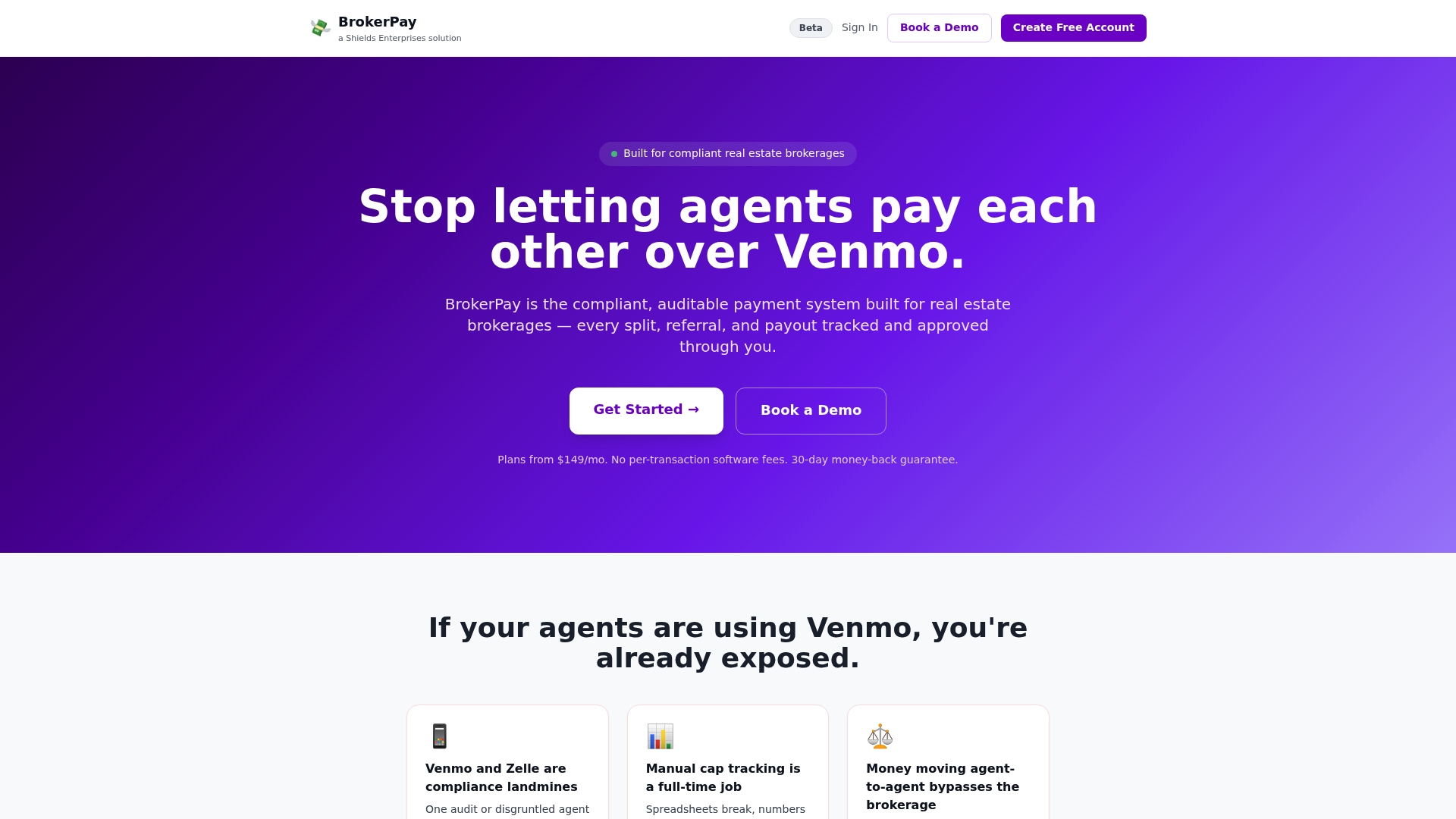
Brokerages weighing whether to keep reconstructing records by hand or adopt a system built for this exact workflow can view plan details and get started at BrokerPay.
Sources
For formal guidance beyond this article, consult NAR’s team responsibility resources, the IRS instructions for Form W-9, the RESPA statute and Regulation X, and the CFPB’s RESPA FAQs. Each is linked in the sections above where its specific claim is addressed, and a state-licensed real estate attorney should review any team agreement before it’s finalized.
- Who’s legally responsible for real estate teams? | NAR
- Instructions for the Requester of Form W-9 (IRS)
- 12 USC § 2607 - Prohibition against kickbacks and unearned fees (RESPA)
- Real Estate Settlement Procedures Act FAQs | CFPB
FAQ
What is agent team override tracking?
Agent team override tracking is the practice of recording commission splits, team overrides, and cap adjustments at the transaction level, with supporting documents like signed team agreements and W-9s. It creates an audit trail that shows how each payment was calculated and authorized.
What records does a brokerage need for RESPA compliance?
Brokerages need documentation showing that cooperative brokerage splits are payments for services actually performed by parties acting in a brokerage capacity, as required under RESPA Section 8. This includes the transaction record, the governing team agreement, and proof the payment matches an authorized split.
What happens if a brokerage doesn’t collect a W-9 before paying an override?
Missing a W-9 before an override payment can trigger backup withholding obligations under IRC Section 3406, as outlined in the IRS instructions for Form W-9. It can also lead to inaccurate 1099-NEC filings that create problems during tax season.
How often should a brokerage reconcile override and cap records?
A monthly reconciliation of cap balances catches errors early, while a quarterly audit of a sample of overrides checks them against governing team agreements. A full W-9 and 1099-NEC verification should happen at year-end, ahead of filing deadlines.
Does BrokerPay replace the need for a signed team agreement?
No. BrokerPay tracks splits, caps, and payments at the transaction level and stores documentation, but the signed team agreement itself, covering compensation, ownership, and dissolution terms, is a separate document brokerages must create and maintain per NAR guidance.