Fix Buyer Agent Commission Billing in 90 Days for U.S. Brokerages

Brokerages that pay buyer-agent commissions on a compliant footing use one rule: the Commission Disbursement Authorization triggers payment, not a spreadsheet estimate. That means funds move through brokerage-controlled accounts only after W-9 verification and documented approvals are complete. Getting this right protects against two distinct exposures: IRS reporting failures tied to Form 1099-NEC and RESPA Section 8 anti-kickback risk. Platforms like BrokerPay build these controls into the payment process itself.
TL;DR:
- Collect W-9 forms and verify TINs from all payees before generating the Commission Disbursement Authorization to avoid backup withholding and reporting failures.
- Use a controlled payment system with signed CDAs, approval routing, and ACH transfers to ensure compliance and create an audit trail.
- Disburse funds only through brokerage-controlled accounts, not peer-to-peer apps like Venmo or Zelle, to maintain transaction transparency and auditability.
- Maintain detailed records including the final CDA, buyer agreement, settlement statement, payment confirmation, and approval history for at least three to four years for IRS auditing.
- Implement a phased transition away from manual spreadsheets and P2P payouts within 90 days, emphasizing clear communication and enforceable workflows to prevent disputes.
Table of Contents
- Why compliance matters: IRS reporting and RESPA risks distilled for operations teams
- A step-by-step buyer-agent commission billing workflow operations teams can implement
- Core compliance checklist: filings, withholding, documentation, and retention
- Recordkeeping, audit trails, and reconciliation best practices
- Practical steps to move from spreadsheets and P2P apps to a compliant, auditable system
- Detailed explanation of typical buyer agent commission structures and rates
- How commission billing affects the buyer agent’s role and interactions with clients
- Legal requirements and variations by state or locality regarding buyer agent commissions
- Common disputes or challenges related to buyer agent commission billing and how to resolve them
- Implications of commission billing on client disclosures and transparency
- Publisher perspective and E-E-A-T proof points
- How BrokerPay helps
- Primary sources and reading list
- Sources
- FAQ
Why compliance matters: IRS reporting and RESPA risks distilled for operations teams
Two regulatory frameworks govern how brokerages pay buyer-agent commissions, and both carry real financial consequences when ignored.
The IRS requires brokerages to report nonemployee compensation of $600 or more on Form 1099-NEC, and firms filing a sufficient number of information returns must e-file rather than submit paper forms. Missing a W-9 at payout time, or failing to verify a Taxpayer Identification Number, can trigger backup withholding obligations the brokerage did not budget for.
RESPA Section 8 adds a separate layer of risk. It broadly prohibits giving or receiving anything of value in exchange for referring settlement service business. Marketing service agreements are only lawful when payments reasonably reflect the fair market value of services actually performed. A referral fee dressed up as a marketing arrangement does not escape scrutiny just because it was disclosed.
A $600 threshold on paper often becomes a $0 threshold in practice, since brokerages rarely know in advance which agents will cross it, so most firms collect W-9s from every payee at onboarding.
Three everyday habits create most of the exposure operations teams deal with:
- Paying agents through Venmo, Zelle, or similar peer-to-peer apps, which leaves no audit trail tied to the transaction file.
- Treating the CDA as a draft calculation instead of the final, signed authorization to release funds.
- Skipping W-9 collection until year-end, when a missing TIN becomes a scramble instead of a formality.
A step-by-step buyer-agent commission billing workflow operations teams can implement
A workflow that survives an audit has distinct stages, each with a named owner and a required document.
- Capture the agreement. Collect the buyer representation agreement and the offer of compensation from the listing side, then verify the payee’s W-9 and TIN before any split is calculated.
- Calculate splits inside a controlled system. Run commission splits and referral fees through the brokerage’s payment platform rather than a spreadsheet that can be edited after closing.
- Generate the CDA. Validate that settlement statements and supporting attachments are complete, then produce the Commission Disbursement Authorization as the single trigger for payment.
- Route approvals. Require signoff from the assigned roles, typically a transaction coordinator and an accounting or compliance lead, before the CDA is considered final.
- Disburse through controlled accounts. Move funds via ACH or a brokerage-controlled payment gateway rather than a personal account or a P2P app.
- Reconcile and prepare 1099 data. Confirm the payment cleared, log the ACH trace number, and roll the payout into year-to-date totals for 1099-NEC reporting.
Pro Tip: If split math is still happening at the moment the CDA is signed, the process is too manual, and it invites the kind of error that turns into a payout dispute later.
Core compliance checklist: filings, withholding, documentation, and retention
Assign each of these items to a named role so nothing falls through during a busy closing month.
- W-9/TIN on file before payout: owned by the transaction coordinator, checked before the CDA is generated.
- Annual payout totals tracked toward the $600 threshold: owned by accounting, reviewed monthly.
- E-file rules followed for 10 or more returns: owned by accounting, using the IRS’s IRIS or FIRE portals.
- Backup withholding applied when a TIN is missing or incorrect: owned by accounting, with withheld amounts reported on Form 945.
- Records retained for IRS audit purposes: owned by compliance, generally for a multi-year period consistent with IRS guidance.
- MSA structures reviewed against a value-for-service test: owned by compliance, flagged whenever a referral fee looks disguised as marketing.
Backup withholding, when triggered by a missing or incorrect TIN, is applied at a 24% rate, which is often more than the brokerage expects to withhold from a commission check.
Most brokerage payouts to individual buyer agents belong on Form 1099-NEC as nonemployee compensation; 1099-MISC applies to other payment categories such as certain rent or legal settlements, not standard commission splits.
Recordkeeping, audit trails, and reconciliation best practices
An auditable file holds six artifacts: the final CDA with approver metadata, the buyer representation agreement, the settlement statement, the W-9/TIN, the ACH payment confirmation, and the internal approval history showing who signed off and when.
- Validate the file immediately after closing, before any payout is released.
- Reconcile payouts monthly against the accounting ledger to catch mismatches early.
- Run an annual 1099 reconciliation, ideally as a dry-run in the fourth quarter, so surprises surface before filing deadlines.
Storage should be centralized and permissioned, with retention timelines matched to IRS recordkeeping guidance rather than left to individual agents’ inboxes. Version history on the CDA itself, showing edits and approvals in sequence, gives operations teams a defensible answer when an agent disputes a split months later.
Pro Tip: Keep ACH trace numbers attached to the transaction file, not just in the bank portal, since that’s the detail an auditor asks for first.
Practical steps to move from spreadsheets and P2P apps to a compliant, auditable system
A phased rollout keeps the transition manageable without stalling active transactions.
- Days 1 to 30: stop all P2P payouts for commission disbursements, require W-9 collection from every active payee, and draft an internal payout policy.
- Days 31 to 60: implement the CDA as the formal payment trigger, build out approval routing, and connect a brokerage-controlled ACH or payment gateway.
- Days 61 to 90: run a full 1099 dry-run against year-to-date totals, close the training loop with agents, and schedule a recurring compliance audit.
Communication matters as much as the mechanics. Send agents a written notice explaining the new payout policy, define an escalation path for disputed splits, and add compensation disclosure language directly into buyer representation agreements.
Pro Tip: Frame the change to agents as faster, more predictable payouts, not just a compliance mandate, since that’s what gets buy-in.
Detailed explanation of typical buyer agent commission structures and rates
Buyer-agent commissions are often structured as a percentage of the sale price, negotiated in a written representation agreement, and specified in an offer of compensation from the listing side or paid directly by the buyer under recent industry rule changes. Splits within the brokerage may involve graduated splits with caps, where agents retain a greater share after certain thresholds are met.
Referral fees add complexity because they require separate documentation and impact the commission split calculation.
None of these structures are set by statute. They vary by brokerage policy, by market, and increasingly by the terms buyers negotiate directly with their agents rather than assuming the listing side automatically covers the cost. For operations teams, the practical implication is that the billing system has to handle variable splits, caps, and referral deductions without manual recalculation at payout time, because that manual step is exactly where errors and disputes originate.
How commission billing affects the buyer agent’s role and interactions with clients
Commission billing is no longer something buyer agents can leave vague until closing. Industry guidance increasingly emphasizes written buyer agreements that spell out compensation terms before the agent shows a single property, along with clear disclosure of how that compensation is calculated and who pays it.
That shift changes how agents talk to clients. A buyer agent now needs to explain, early and in writing, what percentage or flat fee applies, whether the amount is negotiable, and what happens if the listing side’s offer of compensation does not match the amount the buyer agreed to pay. Agents are also limited in accepting compensation above what the buyer agreement specifies, which means the billing system on the back end has to enforce the same ceiling the client saw on paper.
For brokerage operations teams, this means the CDA and the buyer agreement need to reconcile automatically rather than get compared manually after the fact. A mismatch between what the client signed and what the agent expects to be paid is one of the most common sources of post-closing disputes, and it is far easier to catch before disbursement than after.
Legal requirements and variations by state or locality regarding buyer agent commissions
Buyer-agent commission practices are governed by a mix of federal rules, state real estate license law, and local MLS policy, and they do not look identical from one market to another. RESPA Section 8 applies nationwide and prohibits kickbacks or unearned fee splits tied to referrals, regardless of state.
Beyond that federal floor, state real estate commissions set their own requirements for written buyer agreements, disclosure timing, and what a licensee may accept as compensation. Local MLS rules have also shifted in recent years around whether and how offers of compensation are published, which affects how buyer agents structure their fee conversations with clients from the start.
Brokerage operations teams operating across multiple states or MLS regions should not assume a single commission structure or disclosure template works everywhere. The safest approach is to confirm current requirements with each state’s real estate licensing authority and the relevant MLS rather than relying on a policy built for a single home market, since a compliant workflow in one state can fall short of a different state’s disclosure or documentation standard.

Common disputes or challenges related to buyer agent commission billing and how to resolve them
Most commission disputes trace back to one of three gaps: a mismatch between the signed buyer agreement and the amount the listing side actually offers, a referral fee that was not documented before closing, or a split calculation that changed after the CDA was already treated as final.
The mismatch problem is the most common. When the offer of compensation from the listing side is lower than what the buyer agreed to pay, someone has to resolve the gap, either through a client conversation before closing or a documented adjustment that both parties sign off on. Waiting until the settlement statement is drawn up to notice this is far too late.
Referral fee disputes usually surface when the referring brokerage’s cut was agreed to verbally and never formalized. Resolving these after the fact means reconstructing intent from e-mails or phone calls, which is slow and often inconclusive. A documented referral agreement, attached to the transaction file before the CDA is generated, prevents this entirely.
Post-CDA changes are the most preventable category. Once a Commission Disbursement Authorization is signed, treating it as final rather than adjustable removes the temptation to “fix” a split after the fact without a new approval trail. Brokerages that gate every disbursement behind a locked CDA report fewer of these disputes simply because there is no informal channel left for a late change to slip through.
Implications of commission billing on client disclosures and transparency
How a brokerage bills commissions is no longer a back-office detail buyers never see. Recent shifts in industry practice have pushed compensation disclosure earlier in the client relationship, with written buyer agreements now expected to state the fee arrangement before representation even begins.
That transparency requirement has a direct operational consequence: the disclosure a buyer signs has to match the number the billing system eventually pays out. If a brokerage’s internal split calculation drifts from what the client agreement states, whether through a manual error or a stale spreadsheet, the brokerage is exposed to a client dispute and, potentially, a regulatory inquiry into whether the disclosed terms were accurate at all.
Treating disclosure as a compliance input rather than a sales formality changes how operations teams should think about their billing workflow. The CDA, the buyer agreement, and the client-facing disclosure should all trace back to the same underlying data rather than three separate documents that happen to agree most of the time. Brokerages that build this consistency into their payment system, rather than relying on staff to cross-check manually, reduce both the frequency of disputes and the time it takes to resolve the ones that still occur.

Publisher perspective and E-E-A-T proof points
Brokerages that gate CDAs as final approvals, rather than draft calculations, consistently report fewer post-close payout disputes and less time spent reconstructing who approved what. That is not a claim about any particular firm’s numbers, it is the logical consequence of removing the informal channel where late changes used to happen.
A compliant commission payment platform reflects this practitioner-level thinking directly: it enforces approval workflows, tracks splits and referral fees, routes funds through brokerage-controlled accounts, and removes the Venmo and Zelle workarounds that create the audit gaps described throughout this guide. For a deeper look at compliant co-op payment structures, see BrokerPay’s examples of compliant co-op payment workflows.
— Wes
How BrokerPay helps
If your team is still reconciling split math by hand at CDA time, the fix is not more spreadsheet discipline, it is a system that enforces the workflow automatically. A compliant commission payment platform handles split calculations, routes CDAs through approval before any payment fires, disburses funds through brokerage-controlled ACH transfers, and keeps an audit trail for every dollar, including cap tracking for agents approaching their annual threshold.
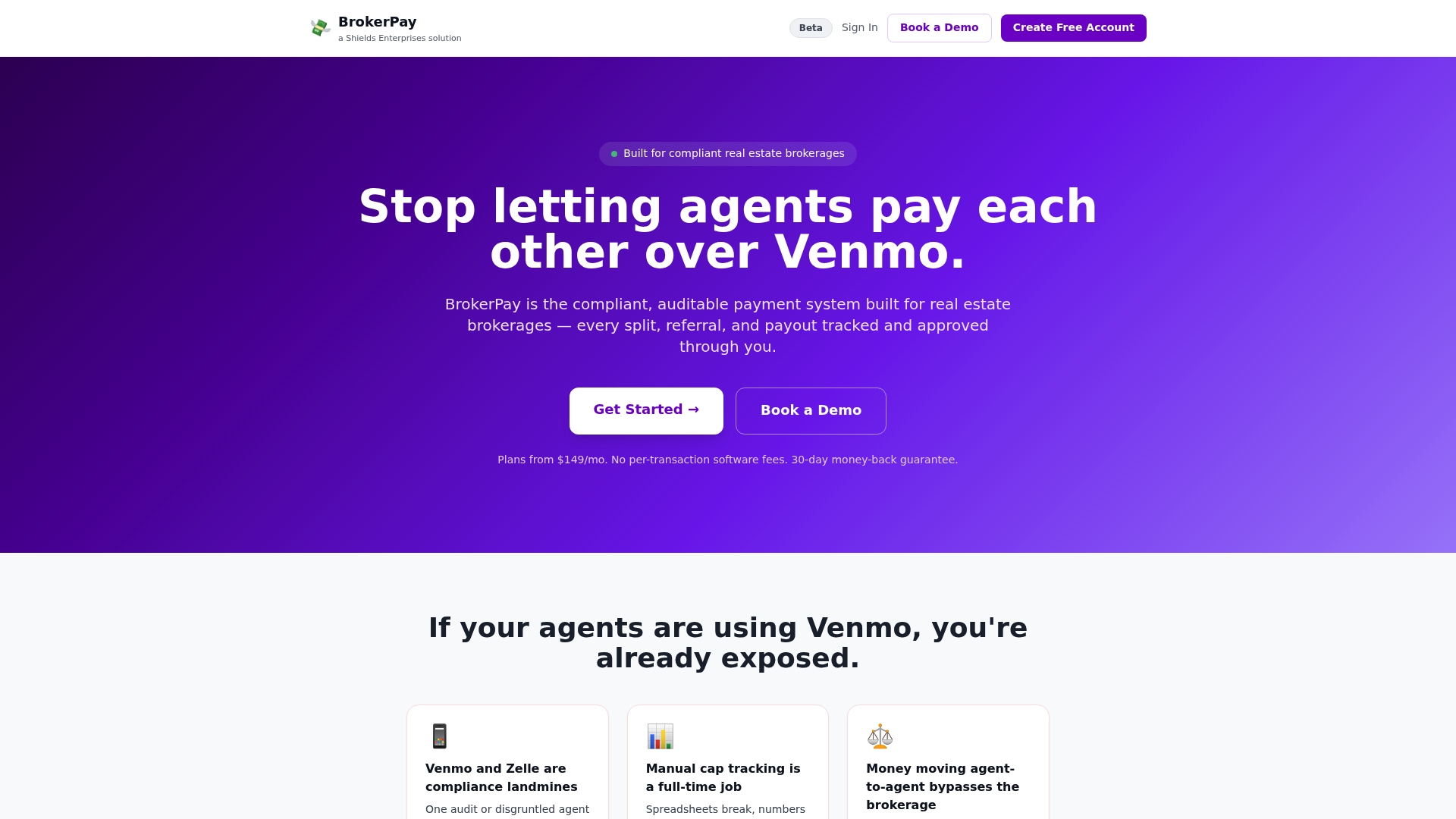
For teams migrating off spreadsheets or P2P apps, BrokerPay’s guide to switching from manual to automated payouts walks through the transition in more detail. The platform offers Starter, Growth, and Enterprise plans with flat monthly pricing and no per-transaction fees, backed by a 30-day refund guarantee. Explore BrokerPay’s plans or schedule a demo to run a 1099 dry-run on one office before rolling out brokerage-wide.
Primary sources and reading list
For further reading on the regulatory framework behind this workflow, see the IRS instructions for Form 1099-NEC, the CFPB’s RESPA FAQs, and legal analysis of RESPA Section 8 anti-kickback rules.
This article is general information, not a substitute for advice from a qualified financial advisor. Consult a qualified financial professional about your own circumstances before acting on anything here.
Sources
- Instructions for Forms 1099-MISC and 1099-NEC (Rev. April 2025)
- Reporting payments to independent contractors | Internal Revenue Service
- Real Estate Settlement Procedures Act (RESPA) FAQs | Consumer Financial Protection Bureau
FAQ
What is a Commission Disbursement Authorization (CDA)?
A CDA is the formal document that authorizes a brokerage to release commission funds to an agent, referral partner, or co-op recipient. In a compliant workflow, it functions as the final payment trigger, not a preliminary calculation, and it should carry approver metadata and supporting attachments before any funds move.
When do brokerages need to file Form 1099-NEC for agent payments?
Brokerages must report nonemployee compensation of $600 or more paid to an agent or referral partner on Form 1099-NEC. Firms filing 10 or more information returns in a year must e-file rather than submit paper forms.
How does RESPA Section 8 apply to buyer agent referral fees?
RESPA Section 8 prohibits giving or receiving anything of value in exchange for referring settlement service business, which includes disguised referral payments dressed up as marketing agreements. CFPB guidance makes clear that a marketing service agreement is only lawful when payments reasonably reflect the fair market value of services actually performed.
Why shouldn’t brokerages pay commissions through Venmo or Zelle?
Peer-to-peer apps leave no audit trail tied to the transaction file, which makes it difficult to prove who approved a payment, when, and against what supporting documents. This creates exposure during an IRS audit or a RESPA compliance review, since there is no documented link between the payment and the underlying CDA.
How long should brokerages retain commission payment records?
The IRS generally recommends retaining payment records for three to four years to support potential audits. Brokerages should store the CDA, buyer agreement, W-9, and payment confirmation together for each transaction to make retrieval straightforward if a question arises later.