No Venmo or Zelle: RESPA Commission Compliance Playbook for U.S. Brokers

No, under RESPA Section 8, brokers may not accept referral fees or kickbacks for settlement services unless the payment is bona fide compensation for actual services or falls under a compliant affiliated business arrangement. The CFPB confirms that “thing of value” covers far more than cash, and enforcement has intensified around marketing agreements and digital referral platforms. If your brokerage still moves referral or co-op money through Venmo or Zelle, stop and centralize those payments before reviewing every active arrangement.
TL;DR:
- Most RESPA violations stem from payments that increase with referral volume without providing actual services, including disguised platform placement fees or marketing agreements.
- Regulatory scrutiny continues to target digital platforms and marketing agreements that tie payments directly to referral counts, regardless of formal contract language.
- To stay compliant, brokerages must document every payment detail, including signed agreements, itemized invoices, deliverables, and market-based fees, stored for at least five years.
- Using brokerage-controlled accounts and automated workflows for approvals and record-keeping can prevent informal peer-to-peer payments and reduce RESPA risk.
- Enforcement cases, such as the Rocket Homes complaint, show that scale and platform mechanics do not shield brokerages from investigations or penalties for improper referral fee arrangements.
Table of Contents
- What RESPA covers and how the law defines a referral
- Section 8 in practice: referrals, splits, and unearned fees
- When payments are legal: the bona fide services safe harbor
- Why marketing services agreements draw regulatory scrutiny
- Affiliated business arrangements and the disclosure rules that keep them legal
- A practical compliance checklist for payment workflows
- Common violations, penalties, and what triggers an investigation
- An operational playbook for documenting every payment
- How to handle a consumer complaint about a RESPA violation
- What has changed in RESPA enforcement since TRID
- Compliance protects clients and your license, not just your legal position
- How BrokerPay helps brokerages stay RESPA-compliant
- Sources
- FAQ
What RESPA covers and how the law defines a referral
RESPA applies to federally related mortgage loans, meaning almost any residential purchase or refinance transaction involving a federally regulated or federally insured lender. The statute reaches beyond lenders to cover settlement service providers: title companies, escrow agents, real estate brokers, appraisers, and pest inspectors, among others.
The operative definitions come from 12 U.S.C. § 2607 and its implementing regulation, 12 C.F.R. § 1024.14. Regulation X defines a “referral” broadly: any oral or written action that directs a person to a particular provider counts, even a casual suggestion made without a formal agreement. “Thing of value” is defined just as broadly.
- Referral: any oral or written action directing a consumer toward a specific settlement service provider, including indirect or informal suggestions.
- Thing of value: money, discounts, commissions, stock, gifts, trips, or the opportunity to participate in a money-making venture, not only cash.
- Agreement or understanding: does not need to be written; a pattern of conduct can prove an unlawful arrangement existed.
That last definition matters more than most brokers realize. Regulators do not need a signed contract to build a case. If a title company consistently pays a broker’s office more when referral volume rises, that pattern itself is treated as evidence of an agreement, whether or not anyone ever wrote it down.
Section 8 in practice: referrals, splits, and unearned fees
Section 8(a) prohibits giving or accepting anything of value in exchange for referring settlement service business. Section 8(b) separately bars splitting a settlement fee unless the split reflects services actually performed. Both provisions get violated the same way in daily brokerage life: someone gets paid for sending business somewhere, not for doing work.
Three patterns account for most broker exposure.
- Percent-based referral models. Paying a flat percentage of a closing to a broker or agent for sending a buyer to a specific lender or title company, with no service performed in exchange.
- Gift and discount programs. Offering closing cost credits, gift cards, or service upgrades to agents who steer clients to a preferred vendor.
- Pay-to-play platform arrangements. Vendors paying for enhanced placement or guaranteed referral flow on a lead-generation or comparison platform used by agents.
A December 2024 enforcement complaint against Rocket Homes illustrates how far this reaches in real operations. The CFPB and DOJ complaint alleges that referral incentives, including gift cards and priority placement in referral flow, functioned as prohibited things of value tied directly to referral volume. The case shows that regulators treat platform mechanics, not just direct cash payments, as potential Section 8 violations.
A single enforcement action can span years of transactions and multiple defendants at once. The Rocket Homes complaint names referral incentive structures built into a national platform, showing that scale does not protect an arrangement from scrutiny; it often invites more of it.
For brokers, the lesson is structural. Any payment that moves in step with referral volume, whether disguised as a bonus, a marketing fee, or a platform placement charge, looks like a kickback to an examiner even if everyone involved calls it something else.
When payments are legal: the bona fide services safe harbor
Section 8©(2) creates a narrow safe harbor: payment for goods, facilities, or services actually furnished or performed is lawful, provided the amount reasonably reflects the market value of what was delivered. The referral itself can never be part of that value calculation. A vendor can pay a broker for marketing work, data entry, or property showings; it cannot pay more because those services came bundled with a steady stream of referred clients.
Regulation X frames this as a market-value test. Regulators ask whether an unaffiliated third party would pay the same amount for the same work, independent of any referral relationship. If the answer is no, the payment fails the safe harbor regardless of how the contract is worded.
Evidence that supports a market-value defense includes:
- Itemized invoices describing the specific service performed and the hours or units delivered.
- External benchmarks, such as rate cards from comparable vendors performing the same work.
- Deliverable proof, including completed marketing materials, photography, or signed service logs.
- Contracts that predate performance, showing the fee was set before any referral occurred, not adjusted afterward.
Pro Tip: Price every vendor service as if the referral relationship did not exist. If you cannot justify the fee to a stranger with no client ties, an examiner will not accept it either.
Why marketing services agreements draw regulatory scrutiny
Marketing services agreements, commonly called MSAs, let a title company, lender, or vendor pay a broker for advertising or promotional work. The structure is legal on its face, but the CFPB’s 2015 compliance bulletin warns that MSAs are frequently used to disguise referral fees behind a marketing label. The Bureau has stated that an MSA’s legality depends entirely on facts and implementation, never on the language of the contract alone.
The Bureau’s concern is not the existence of MSAs but their tendency to track referral volume rather than marketing output. A broker who receives a flat monthly retainer regardless of business sent looks very different from one whose payments rise and fall with closings referred to the paying vendor.

Digital comparison-shopping platforms raise a parallel issue. A 2023 CFPB advisory opinion states that platforms presenting providers non-neutrally, ranking or highlighting whoever pays more, may be collecting a prohibited referral fee disguised as an advertising or placement charge. Neutrality is the deciding factor: a platform that ranks providers by objective criteria available to all participants operates differently, in the regulator’s eyes, than one that sells position.
Watch for these red flags in any MSA or platform arrangement:
- Payment tied to referral counts, where fees rise as closed transactions from a specific source increase.
- Enhanced placement for a fee, where paying more buys better visibility to consumers or agents.
- Fee differentials across providers with no corresponding difference in the marketing work performed.
- Renewal terms linked to production, where continued payment depends on maintaining referral volume rather than marketing deliverables.
Before signing or renewing an MSA, require the counterparty to document neutral selection criteria, provide deliverables independent of referral outcomes, and price the agreement against comparable third-party marketing rates. Brokers evaluating outside marketing help can also work with vetted real estate SEO services that price work on deliverables and traffic metrics rather than referral counts, which keeps the arrangement outside Section 8’s reach entirely.
Affiliated business arrangements and the disclosure rules that keep them legal
An affiliated business arrangement, or AfBA, exists when a broker has an ownership interest in a settlement service provider, such as a title company or mortgage company, and refers business to it. RESPA permits this structure under Section 8©(4), but only when specific procedural conditions are met at every referral.
- Provide the AfBA disclosure using the format in Regulation X’s Appendix D, listing the ownership interest and estimated charges.
- Deliver the disclosure at or before the referral, not after the consumer has already selected the affiliated provider.
- Confirm no required use, meaning the consumer must have a genuine choice of providers and face no penalty for choosing a competitor.
- Retain a signed copy of every disclosure with the transaction file for at least five years.
The exemption fails most often on procedure, not substance. A broker with a legitimate ownership stake can still trigger a violation finding by handing over the disclosure late, using an outdated form, or failing to document that the consumer had a real alternative. Build the disclosure step into your transaction checklist rather than treating it as optional paperwork, and keep a dated log showing exactly when each consumer received it.
A practical compliance checklist for payment workflows
Most RESPA exposure at the brokerage level comes down to how money moves, not how contracts are worded. Fixing the workflow eliminates most of the risk.
Stop informal peer-to-peer payments immediately. Venmo, Zelle, and personal check payments between agents and vendors create a documentation gap that examiners treat as a red flag on its own. There is no invoice trail, no service record, and no proof the payment reflects anything other than a referral. Route every co-op commission, referral fee, and vendor payment through a brokerage-controlled account instead of letting individual agents settle up privately.
Require complete documentation before any payment goes out. For every payment tied to a referral relationship or vendor service, collect:
- A signed service agreement describing the work and the fee, dated before performance began.
- An itemized invoice matching the agreement’s scope.
- Deliverable proof, such as completed marketing assets, signed showing logs, or a data report.
- Time records where the fee is hourly or based on effort.
- A market-value benchmark showing the fee aligns with comparable third-party pricing.
Build approval and segregation controls into the payment process. A single person should never be able to request, approve, and release a payment without a second reviewer confirming the documentation is complete. Segregating those roles catches missing paperwork before money moves, not after an examiner asks for it.
Automate the audit trail. Every payment should generate a timestamped record showing who requested it, who approved it, what documentation supported it, and when funds were released. Manual spreadsheets and paper files get lost, and reconstructing a payment history two years after the fact is far harder than logging it correctly the first time.
Retain records for five years at minimum. Regulation X’s recordkeeping expectations support a five-year retention window for settlement-related records, and brokerages should apply the same standard to referral and co-op payment files.
Structure co-op splits as compensation for brokerage services, not referral rewards. A co-op commission paid between brokerages for a cooperating sale is standard practice and not a Section 8 problem on its own, but the split should reflect the work each side performed in the transaction rather than a fee attached to steering a client toward a particular vendor. Reviewing compliant co-op payment workflows side by side with your current process is a fast way to spot where documentation gaps exist.
Pro Tip: Treat every payment like it will be read by an examiner two years from now. If the file cannot answer “what was this for” without you explaining it verbally, the documentation is not finished.
Brokerages that still rely on manual approval chains often find that switching to automated payout workflows closes most of these gaps without adding staff time, since the documentation requirements get built into the payment request itself rather than chased down afterward.
Common violations, penalties, and what triggers an investigation
RESPA violations carry both civil and criminal exposure. Under 12 U.S.C. § 2607(d), a violation can result in a fine of up to $10,000 and imprisonment of up to one year, and courts can award treble damages to affected consumers along with attorney’s fees. Regulators and courts can also impose injunctive relief, barring a company or individual from the settlement services business entirely.
A single statutory violation can carry criminal penalties of up to $10,000 and one year in prison, on top of civil damages. The statute itself sets these thresholds per violation, meaning repeated payments compound the exposure quickly rather than being treated as a single event.
Investigators typically build cases around patterns rather than isolated transactions.
- Statistical spikes in referral volume to a specific vendor immediately following a new payment arrangement.
- Whistleblower tips from agents, loan officers, or former employees describing informal payment expectations.
- Missing documentation when a vendor cannot produce invoices or deliverables matching payments received.
- Contract language mismatches, where a marketing agreement’s terms don’t match how payments actually behaved over time.
The Rocket Homes complaint referenced earlier shows how these threads come together in a real case: incentive structures, referral tracking, and platform mechanics combined to build a pattern-based enforcement action rather than a single disputed payment.
An operational playbook for documenting every payment
Turning compliance theory into daily practice means treating every referral-adjacent payment the same way, regardless of who requests it or how small it seems. The documents and workflow below apply whether the payment is a co-op split, a vendor marketing fee, or an AfBA-related transaction.
For every payment, collect:
- A signed service agreement dated before work began, describing scope and fee.
- An invoice itemizing the work performed against the agreement.
- Deliverable evidence, such as a completed campaign, signed log, or report.
- Time records supporting any hourly or effort-based fee.
- Market-value support, a comparable rate from an unaffiliated vendor performing similar work.
The workflow that ties these together follows four steps: request, approve, pay, archive. A payment request enters the system with its supporting documents attached. A designated approver, separate from the requester, reviews the documentation against the market-value standard before releasing funds. Payment moves through a brokerage-controlled account rather than a personal one. The completed file, including every document and the approval timestamp, archives automatically for the five-year retention window.
A compliant payment platform built for brokerages can track and document agent splits, referral fees, and co-op commissions inside brokerage-controlled accounts, replacing informal transfers that leave no audit trail. Every payment request carries its supporting documentation, goes through an approval step, and archives with a timestamped record, which converts what used to be informal payment into a market-valued, evidence-backed transaction.
Pro Tip: If a vendor payment looks like an MSA, force it to behave like one on paper. Require a dated scope of work, a deliverable, and a rate comparison before the first payment goes out, not after a regulator asks for it.
This same structure works for co-op payments and cap tracking, not just vendor relationships. A brokerage that logs every split with its supporting file, rather than trusting individual agents to keep records, has an answer ready the day an examiner or auditor asks for one. Reviewing commission payment alternatives that distinguish legitimate compensation from prohibited referral fees is a useful next step for brokers still relying on informal arrangements.
How to handle a consumer complaint about a RESPA violation
A consumer who suspects a RESPA violation, such as being steered to a title company that paid their agent, can file a complaint directly with the CFPB, which accepts complaints through its consumer complaint portal. The Bureau reviews the complaint, may request a response from the company involved, and can refer matters to enforcement if a pattern emerges across multiple complaints.
Brokerages should have an internal process ready before a complaint ever arrives. That means designating a compliance contact who reviews the specific transaction file, pulls every document tied to the payment in question, and prepares a response showing what service was performed and how the fee was calculated. A brokerage with disorganized records at this stage looks guilty by default, even when the underlying arrangement was lawful, simply because it cannot produce proof quickly.
Internal complaints from agents or staff deserve the same treatment. Document the concern, review the payment file against the market-value standard, and correct the arrangement immediately if it does not hold up. Waiting for a regulator to raise the issue first turns a fixable process problem into a formal investigation.
What has changed in RESPA enforcement since TRID
The TILA-RESPA Integrated Disclosure rule, which took effect in October 2015, merged certain federal mortgage disclosures but did not change Section 8’s referral fee prohibitions. What has shifted since then is enforcement focus: regulators moved from disclosure-timing violations toward the payment structures behind digital platforms and marketing agreements.
The 2023 CFPB advisory opinion on digital comparison-shopping tools reflects that shift directly, addressing referral mechanics that didn’t exist in a meaningful way when RESPA was written. The 2024 Rocket Homes complaint continues that trend, targeting a national referral network rather than a single local transaction.
For brokers, the practical takeaway is that TRID-era disclosure compliance does not cover this ground. A brokerage can have flawless closing disclosures and still carry significant RESPA exposure through an MSA, a referral platform, or an informal payment habit that predates TRID by years.
Compliance protects clients and your license, not just your legal position
Referral revenue always feels smaller than the risk of losing your license or facing a federal investigation. The safest path is the boring one: document everything, price services at market value, and centralize payments so no single arrangement depends on memory or trust. Brokerages that build this discipline now spend far less time explaining themselves later.
— Wes
How BrokerPay helps brokerages stay RESPA-compliant
Every workflow described above, centralized accounts, documented approvals, audit trails, and five-year retention, is easier to run on a system built for it than on spreadsheets and personal Venmo transfers. A platform like this routes agent splits, referral fees, and co-op commissions through brokerage-controlled accounts with approval workflows and automatic documentation, which removes the manual record-chasing that turns a routine payment into a compliance question later.
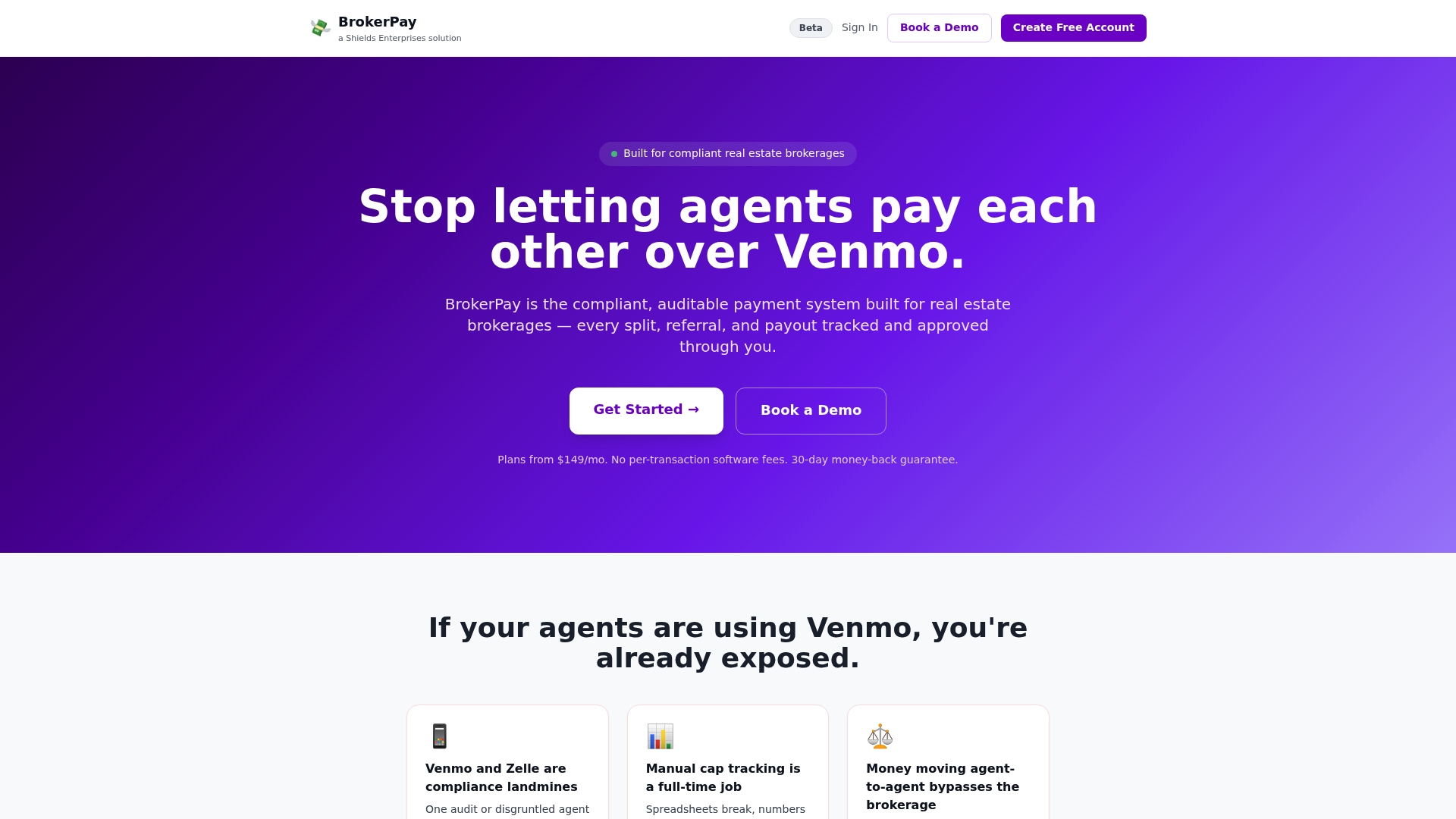
- Centralized payments replace peer-to-peer transfers with brokerage-controlled ACH routing.
- Approval workflows separate payment requests from payment releases automatically.
- Audit trails timestamp every document tied to a payment for five-year retention.
Brokerages evaluating their current payment process can review plan details at Brokerpay and start with the tier that matches office size.
This article is general information, not a substitute for advice from a qualified lawyer. Consult a qualified legal professional about your own circumstances before acting on anything here.
Sources
- Real Estate Settlement Procedures Act FAQs | Consumer Financial Protection Bureau
- eCFR § 1024.14 — Prohibition against kickbacks and unearned fees
- United States District Court Eastern District of Michigan — CFPB enforcement complaint (Rocket Homes)
FAQ
Who does RESPA not apply to?
RESPA applies to federally related mortgage loans and the settlement services tied to them, so it generally does not reach transactions with no federally regulated or federally insured lender involved, such as certain all-cash or purely private loans. It also does not regulate the amount of a real estate commission itself, only referral fees and kickbacks connected to settlement services.
What is the most frequent RESPA violation?
The most common violation pattern involves payments tied to referral volume rather than actual services performed, often disguised as marketing fees or informal peer-to-peer payments between agents and vendors. The CFPB has specifically flagged marketing services agreements as a structure frequently used to conceal these prohibited referral fees.
Does RESPA still exist?
Yes, RESPA remains fully in force and is actively enforced, with the CFPB continuing to bring enforcement actions against referral arrangements as recently as December 2024. Its core Section 8 prohibitions have not changed since the TRID disclosure rule took effect in 2015.
Which federal department regulates RESPA?
The Consumer Financial Protection Bureau holds primary rulemaking and enforcement authority over RESPA, including Regulation X and its referral fee prohibitions. The Department of Justice can also join enforcement actions, as it did in the Rocket Homes case, when violations involve broader civil or criminal claims.
How can a platform like BrokerPay support RESPA compliance?
A payment platform built for brokerage compliance centralizes referral and co-op payments into brokerage-controlled accounts with built-in approval workflows and audit trails, which replaces the undocumented Venmo and Zelle transfers that create RESPA exposure. BrokerPay applies this structure specifically to agent splits, referral fees, and co-op commissions for real estate brokerages.