Audit Ready Co Broker Commission Payments for U.S. Brokers, No Venmo

A co-broker commission payment is the share of the gross sale commission that flows to the cooperating broker’s firm at closing, not to an individual agent. The escrow or title company disburses seller-funded proceeds according to the closing disclosure, sending separate checks or wires to the listing brokerage and the cooperating brokerage. Each firm then pays its own agents under its internal split agreement, with the whole transaction documented for tax reporting.
TL;DR:
- Co-brokerage payments are disbursed to brokerage firms, not individual agents, and require clear documentation like signed agreements and W-9 forms before closing.
- Typical total commissions range from 3% to 6%, with splits negotiated deal by deal, especially since MLS no longer publicly displays buyer-agent compensation post-2024.
- Payment delays often stem from missing paperwork, such as the lack of a W-9 or improper payment routing, which can be avoided by proactive collection at offer acceptance.
- Accurate recordkeeping and automated workflows, including broker approval and ACH disbursement, are essential to maintain compliance and prevent audit risks.
- Using peer-to-peer payment apps like Venmo or Zelle for broker commissions is a legal and compliance red flag, as transactions must go through brokerage-controlled, auditable channels.
Table of Contents
- What Co-Brokering Means, and How It Differs From a Referral
- How the Money Actually Moves at Closing
- Split Models: 50/50, Lead/Support, and Referral Math
- Documentation and Tax Reporting You Cannot Skip
- Invoicing and Payment Timing That Doesn’t Slow Anyone Down
- What Belongs in Every Co-Brokerage Agreement
- Building a Compliance Workflow That Doesn’t Rely on Trust Alone
- A Few Rules of Thumb Worth Repeating
- Get Paid Without the Venmo Workaround
- Forms and Guidance Worth Bookmarking
- Sources
- FAQ
What Co-Brokering Means, and How It Differs From a Referral
A cooperating broker is the firm representing the buyer (or another party) in a deal where a different brokerage holds the listing. The listing broker controls the seller’s side; the buyer’s broker, sometimes called the co-broker, brings the buyer and shares in the commission for that work. A referral is different: one broker hands off a lead to another firm without doing the transactional work, and gets paid a smaller cut for the introduction.
The distinction matters because it drives both the math and the compliance exposure:
- Co-brokering (earned work): typically splits close to 50/50 between listing and buyer-side firms, though the exact ratio is negotiable per deal.
- Referral fees (unearned work): commonly run 15% to 30% of the receiving side’s commission, since the referring broker did no showing, negotiating, or paperwork.
Under RESPA and most state license laws, calling an unearned fee a “co-broke” payment when no real brokerage service was performed can create real regulatory exposure. Label the arrangement honestly in writing before the deal closes.
How the Money Actually Moves at Closing
Commission money follows a fixed path, and knowing it helps you spot exactly where things stall.
- The seller’s proceeds pass through escrow or the title company at settlement.
- The closing agent disburses the commission per the closing disclosure, sending separate payments to the listing brokerage and the cooperating brokerage, since state licensing rules generally require broker-to-broker disbursement rather than direct payment to an individual agent.
- Each managing broker then pays its own agents according to that firm’s internal commission agreement.
The friction almost never comes from a disagreement over the split percentage. It comes from missing operational details: no W-9 on file, no named accounts-payable contact at the cooperating firm, an invoice missing the MLS number, or an agent trying to route a payment through Venmo or Zelle because the paperwork wasn’t ready.
Pro Tip: Ask the cooperating brokerage for a signed W-9 and AP contact the moment the offer is accepted, not the week of closing. That single habit eliminates most payment delays before they start.
Split Models: 50/50, Lead/Support, and Referral Math
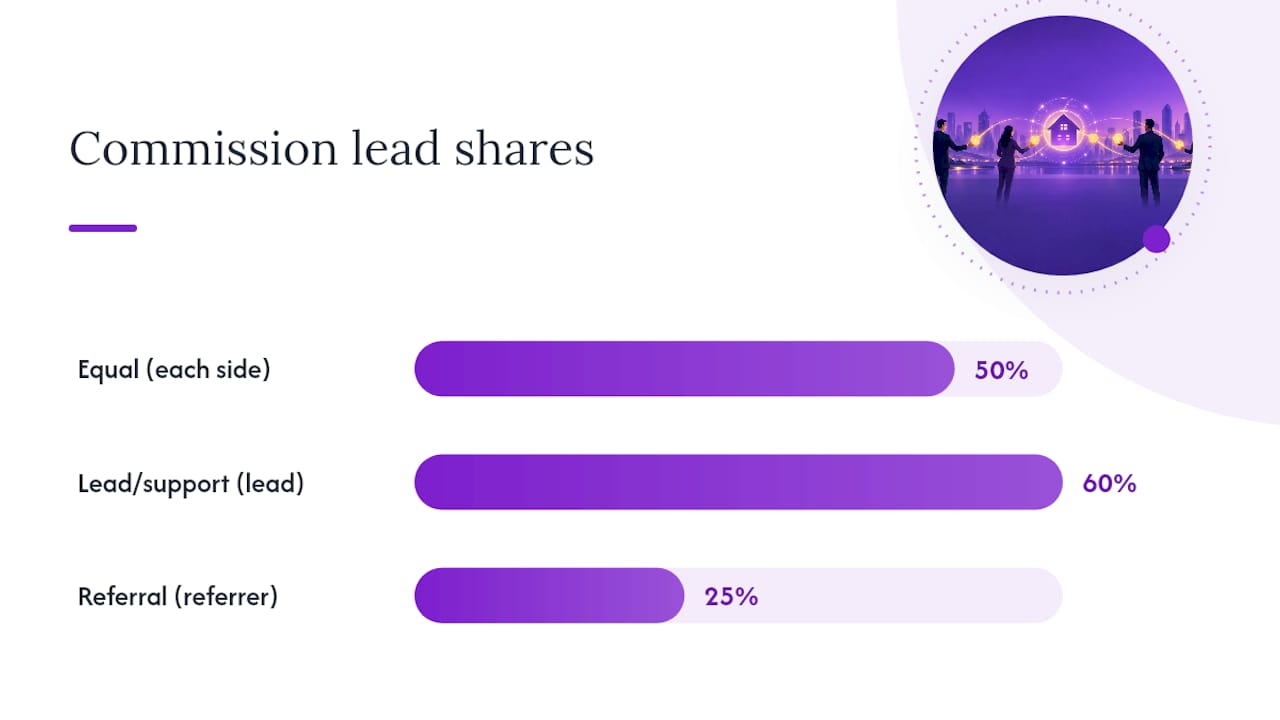
Total commissions typically run 3% to 6% of the sale price, and while 50/50 has historically been the default split between listing and buyer sides, the actual percentage is negotiated deal by deal. Since MLS listings no longer broadcast buyer-agent compensation after the 2024 NAR settlement changes, that negotiation has to happen explicitly and in writing before you assume anything.
Common patterns, especially in commercial deals, look like this:
- Equal partnership, 50/50: both sides contributed comparable work, sourcing, and negotiation.
- Lead/support, 60/40 or 70/30: the firm that brought the client or handled underwriting takes the larger share.
- Referral arrangement, 15% to 25%: one side simply introduced the deal and did no further work, with 25% often used as the residential starting point for negotiation.
Example: a $500,000 sale at a 5% total commission generates $25,000. Split 50/50, each brokerage collects $12,500 before internal agent splits. Shift that to a 60/40 lead/support arrangement and the lead firm nets $15,000 against $10,000 for support, a difference worth spelling out in writing before you start showing property.
Documentation and Tax Reporting You Cannot Skip
Every co-broker payment needs a paper trail that survives an audit, a licensing complaint, or a disgruntled agent’s phone call to their attorney.
Keep these on file for every transaction:
- The signed co-brokerage agreement, using a standard form where your state provides one, such as Pennsylvania’s Cooperating Broker Compensation Agreement (Form CBC).
- The closing disclosure showing the commission breakdown.
- The invoice (for non-closing payments) with commission math shown.
- A current W-9 from the receiving brokerage.
Brokerages must issue Form 1099-NEC for any commission or referral payment of $600 or more, and the record should tie back to the property address, MLS number, and closing date so an examiner or auditor can trace the payment in seconds.
Route every payment to the managing broker, never to the individual agent, since that’s the licensing requirement in most states and the only way to keep the audit trail clean.
Invoicing and Payment Timing That Doesn’t Slow Anyone Down
Most commission money at closing needs no invoice at all. The title company handles the split automatically through the closing disclosure. Invoices come into play for referral fees, broker price opinions, consulting work, or any payment that happens outside a closing table.
- Confirm whether the payment is a standard closing disbursement (no invoice needed) or a separate fee (invoice required).
- Build the invoice with the property address, MLS number, sale price, gross commission math, split percentage, and an attached W-9.
- Name a specific accounts-payable contact so the invoice doesn’t sit unanswered in a general inbox.
- Set Net 15 or Net 30 terms and use ACH over wire when the amount doesn’t justify wire fees, since ACH settles reliably without the manual reconciliation headaches that come from mismatched invoice and closing-disclosure figures.
Reconcile every invoice against the closing disclosure line item before you release payment. That single check catches most disputes before they become disputes.
What Belongs in Every Co-Brokerage Agreement
A co-brokerage agreement earns its keep only if it answers the questions that surface after the deal is done, not before.
- Split percentage, stated as a share of the gross broker fee, not a flat dollar guess.
- Scope of work, spelling out exactly what each side is responsible for.
- Payment trigger, typically “upon receipt of seller funds at closing.”
- Protection or tail period, commonly 30 to 180 days, covering buyers introduced before the agreement’s end.
- Signatures from both managing brokers, not just the agents involved.
- Dispute resolution language, naming mediation or arbitration before litigation.
If payment gets withheld, escalate to the paying brokerage’s AP department first. Commercial deals sometimes carry lien remedies unavailable in residential transactions, where a signed agreement and a collections letter are usually the strongest tools you have.
Building a Compliance Workflow That Doesn’t Rely on Trust Alone
A commission payment workflow that holds up under a state audit needs five things: an audit trail, broker approval steps before money moves, ACH disbursement instead of manual checks, upfront W-9 collection, and cap tracking so agents and brokers both know where they stand.
In practice, that looks like recording the co-brokerage agreement at contract, tracking the closing disclosure as it’s finalized, ingesting settlement funds when they arrive, running the split automatically, and generating 1099-ready records without anyone re-entering numbers by hand. Platforms like BrokerPay are built around exactly this sequence, replacing the manual spreadsheet-and-email chase that pushes some agents toward Venmo or Zelle out of pure impatience.
- Audit trail tied to each closing disclosure and invoice
- Broker-level approval before any disbursement fires
- ACH payout with W-9 and cap data attached automatically
A Few Rules of Thumb Worth Repeating
Put the split in writing before you show a single property, not after the offer is accepted. Collect the W-9 and AP contact the day the deal goes under contract, never the week of closing. And treat any suggestion to pay an agent directly through Venmo or Zelle as a compliance red flag, not a convenience, since it routes money around the broker-level controls RESPA and your state license law both assume are in place. For deeper operational detail, our commission payment alternatives breakdown walks through what manual versus automated workflows actually cost you in time.
— Wes
Get Paid Without the Venmo Workaround
The problems in this article all trace back to the same root cause: commission money moving through channels nobody can audit. Delayed payments, missing 1099 records, and agents settling splits through peer-to-peer apps all create the same exposure for a brokerage’s license and its RESPA compliance. BrokerPay routes every co-broker payment through brokerage-controlled accounts, with approval workflows, audit trails, and cap tracking built in from the first disbursement.
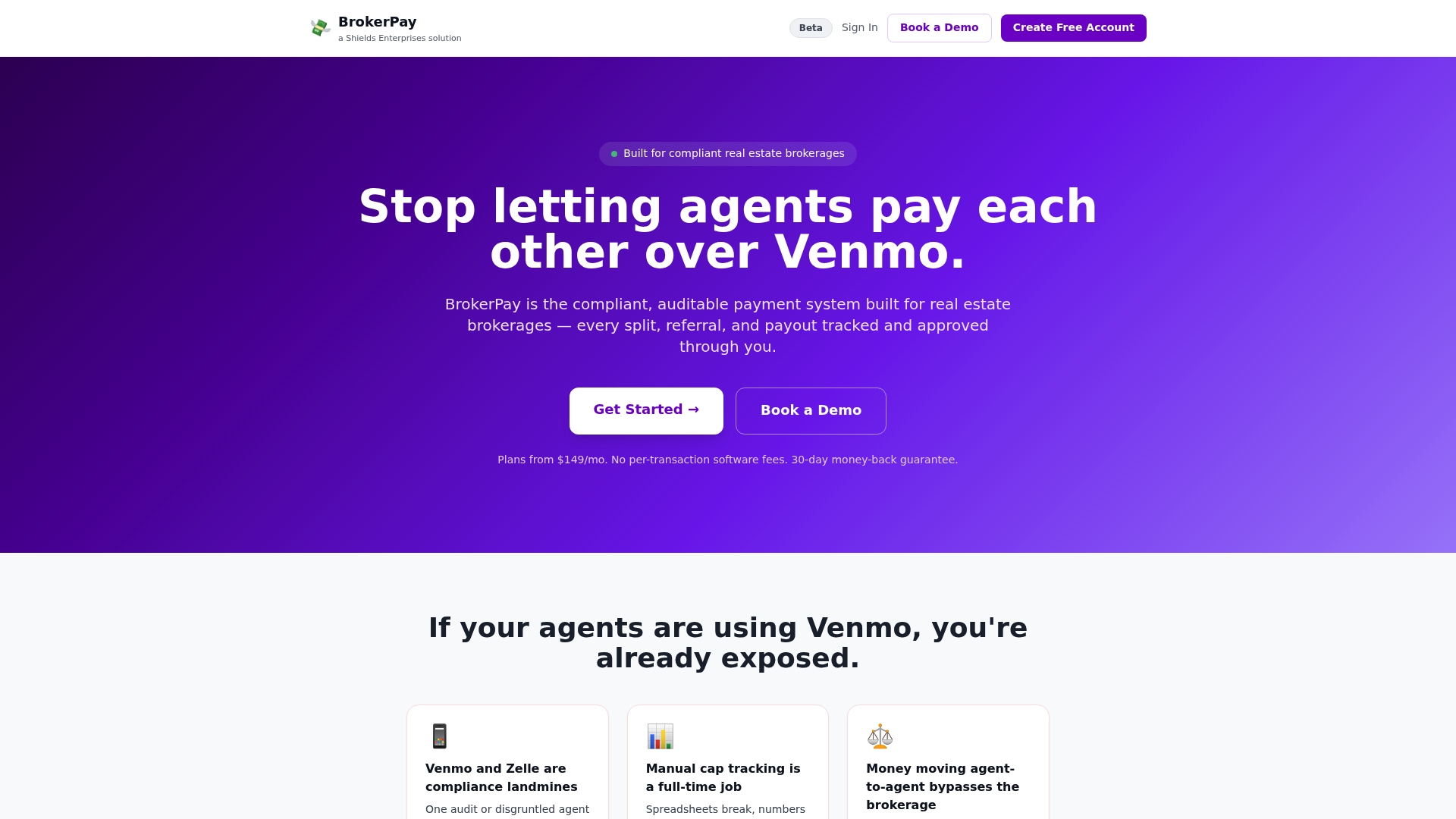
There’s no per-transaction fee eating into your split, just flat monthly pricing across the Starter, Growth, and Enterprise plans. If you’re still chasing down W-9s over email or explaining to an agent why they can’t Zelle a referral fee, visit BrokerPay to see how the workflow replaces that entirely.
Forms and Guidance Worth Bookmarking
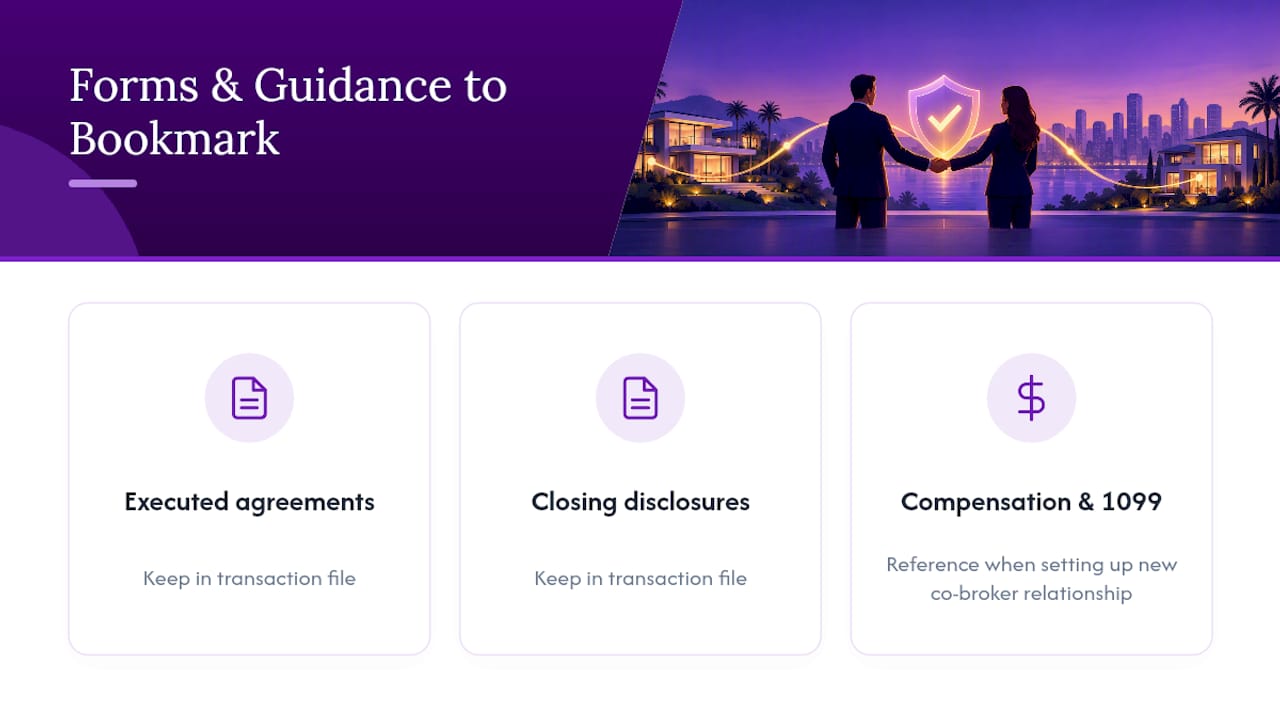
Keep executed agreements and closing disclosures in your transaction file, and reference the Cooperating Broker Compensation Agreement and 1099-NEC filing guidance whenever you set up a new co-broker relationship.
Sources
- Average Real Estate Commission Rates | ListWithClever
- Title & escrow tip: direct payment of realtor commissions | Saad Legal
FAQ
Will Realtors Work for 2%?
Some agents accept a 2% commission on the listing side, particularly on higher-priced homes or with heavily discounted brokerages, but it’s not the norm on the buyer side. Since total commissions typically run 3% to 6% and splits are now negotiated deal by deal, a 2% offer usually reflects a specific pricing model rather than a market standard.
Is a 70/30 Split a Good Deal?
A 70/30 split favors the party who supplied the client or led the underwriting work, and it’s a recognized pattern in lead/support arrangements. Whether it’s “good” depends on how much of the actual work you did relative to your partner brokerage; document the scope-of-work division before agreeing to it.
How Much Does a Broker Make on a $500,000 Deal?
On a $500,000 sale at a 5% total commission, the gross commission is $25,000. Split 50/50 between listing and buyer-side brokerages, each firm collects $12,500 before that firm applies its own internal agent split.
How Is the Broker’s Commission Usually Paid Out?
The escrow or title company disburses the commission directly to each brokerage at closing, based on the closing disclosure, since state law generally requires broker-to-broker payment rather than payment to an individual agent. Each managing broker then pays its agents under that firm’s own commission agreement, a workflow platforms exist to automate and document.