Audit Ready Monthly Earnest Money Reconciliation for U.S. Brokers

Earnest money reconciliation is the monthly three-way match between your bank statement, your general trust ledger, and the sum of every client sub-ledger, proving each deposit is separate, traceable, and untouched. Do it every month, deposit funds within your state’s statutory window, and keep a signed worksheet on file. BrokerPay and your state real estate commission are the two authorities that will eventually ask to see it.
TL;DR:
- Deposits must be made within one to three business days of receipt, with wire transfers confirmed immediately to prevent disputes.
- The earnest money liability should be recorded separately from operating cash, avoiding commingling and conversion risks.
- Monthly reconciliations require matching adjusted bank balances, trust ledgers, and individual client sub-ledgers, signed and kept on file for audits.
- Common errors include missing escrow receipts, incorrect deposit dates, stale sub-ledgers, and trust fund borrowings, which can be prevented by assigning accountability and automating receipt capture.
- Proper documentation for audits includes contract pages, escrow receipts, deposit confirmations, and signed reconciliation worksheets, all properly named and stored securely.
Table of Contents
- What Is Earnest Money, and Who Actually Owns It?
- When and How Should You Deposit Earnest Money?
- How Do You Run a Three-Way Earnest Money Reconciliation?
- What Reconciliation Errors Show Up Most Often?
- What Documents Do Auditors Actually Expect to See?
- What Happens to Earnest Money at Closing or Cancellation?
- Can Automation Reduce the Reconciliation Workload?
- Why Monthly Reconciliation Is the Single Best Defense You Have
- Automate the Parts of Reconciliation That Cause the Most Errors
- Where to Check State-Specific Rules and Legal Definitions
- Sources
- FAQ
What Is Earnest Money, and Who Actually Owns It?
Earnest money is the buyer’s property held in trust, not brokerage revenue. That distinction drives everything downstream. The buyer retains ownership until contract contingencies close out, and the funds only shift to the seller (or back to the buyer) once those conditions resolve, according to Cornell Law’s Legal Information Institute. If a broker treats it as income the moment it lands, that is conversion, and state regulators treat conversion cases far more harshly than a late reconciliation.
On the books, earnest money belongs on the liability side of your ledger, typically in a “Customer Deposits” or “Earnest Money Deposits” account, and it stays there until closing, according to TheRealEstateCPA. Recording it any other way risks accidental revenue recognition long before the deal is final.
A simplified entry pair looks like this:
- On receipt: Debit Trust Cash $5,000 / Credit Earnest Money Liability $5,000.
- At closing: Debit Earnest Money Liability $5,000 / Credit Buyer’s Funds Due at Closing $5,000.
- On termination: Debit Earnest Money Liability $5,000 / Credit Trust Cash $5,000 (funds returned to buyer).
Commingling those trust funds with operating cash, even briefly to cover payroll, is one of the fastest routes to license suspension. The principal broker carries that fiduciary weight personally, regardless of who on staff actually mishandled the deposit.
When and How Should You Deposit Earnest Money?
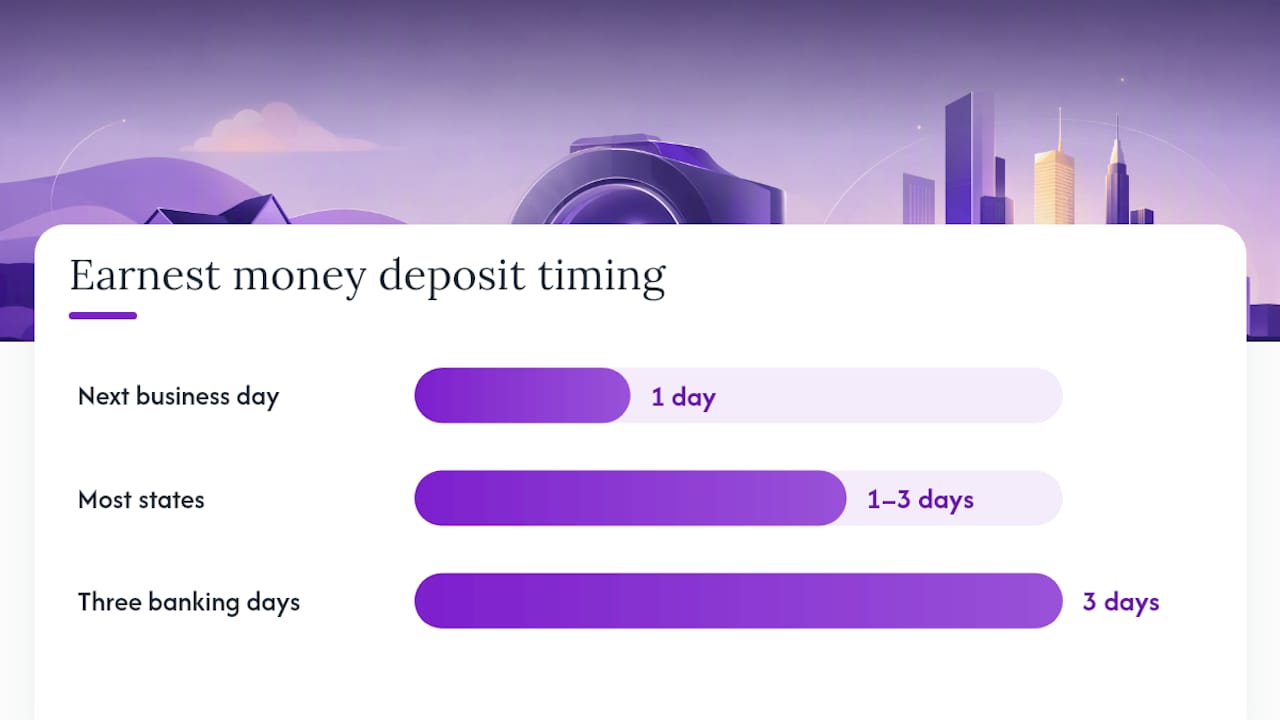
Deposit timing is not a suggestion; it’s a statute. Most states require deposit within one to three business days of receipt, though the exact language varies, so confirm your own commission’s rule before assuming a national standard applies, according to guidance from the South Dakota Real Estate Commission. Some states specify “next business day,” others allow three banking days, and a handful tie the clock to when the contract is fully executed rather than when the check physically arrives.
Practical handling matters just as much as the deadline. Checks should be made payable to your brokerage trust account or the escrow/title company named in the contract, never to an individual agent. Wire transfers post faster than checks but need immediate confirmation logging, since a wire that “should have arrived” is not the same as a wire your ledger can prove arrived.
When funds come in, run this intake sequence immediately:
- Record the contract page showing the earnest money clause and amount.
- Create a deposit task tied to that transaction file, with a due date matching your state’s window.
- Confirm the escrow or title company’s receipt, not just the buyer’s proof of sending.
- Attach the receipt PDF or deposit slip directly to the transaction record.
Pro Tip: Never accept a buyer’s forwarded confirmation as proof of deposit. Confirm the escrow holder actually received the funds, since that gap between “sent” and “received” is where most disputes and missed deadlines originate.
How Do You Run a Three-Way Earnest Money Reconciliation?
Three numbers have to match, to the cent, every month: your adjusted bank balance, your general trust ledger, and the sum of every individual client sub-ledger. Regulators expect exactly this comparison, documented on a signed worksheet, according to RealEstateExamTest’s trust accounting guidance. Auditors ask for that worksheet before they ask for anything else.
Here’s the sequence that produces a clean match:
- Pull the bank statement and adjust for outstanding checks and deposits in transit, giving you your true adjusted bank balance.
- Reconcile the general trust ledger against that adjusted balance, catching any posting errors or timing gaps.
- Total every sub-ledger individually. Each client’s deposit needs its own running balance, not a single pooled number.
- Run the match. Bank balance, GL balance, and sub-ledger total should be identical. If they’re not, stop and investigate before moving forward.
- Document any variance. Note the root cause, the fix, and the date it was corrected. Auditors will accept a documented remediation plan; they will not accept an unexplained gap, according to Beancount’s reconciliation guide.
- Sign and file the worksheet. The broker-in-charge signs and dates it, and that signed copy goes into your permanent compliance file, not a shared drive folder that gets reorganized every year.
The minimum worksheet should show the statement date, adjusted bank balance, GL balance, sub-ledger total, variance amount (ideally zero), remediation notes if any, and the signature line. Skip any of those fields and you’ve built a worksheet that looks complete but won’t survive a real audit request.
Pro Tip: Put the same calendar date on your reconciliation every month, like the 5th or the last business day. A fixed date turns reconciliation into a habit instead of a fire drill you remember only when an audit letter shows up.
What Reconciliation Errors Show Up Most Often?
Four mistakes account for most of the trouble brokers run into:
- Missing escrow receipts. The buyer’s proof of payment gets filed, but nobody confirms the escrow holder actually received it.
- Logging the wrong date. Recording the date a check was sent instead of the date it was deposited creates a false sense of compliance with statutory windows.
- Stale sub-ledgers. A closing happens, the GL updates, but the individual client sub-ledger never gets touched, so your three-way match fails for no real reason.
- Borrowing from trust funds. Even a short-term “loan” from trust cash to cover an operating shortfall is commingling, full stop.
The fix is structural, not just careful bookkeeping. Assign one accountable owner for reconciliation, not a rotating cast of whoever’s free that week. Lock in a fixed monthly date. Make receipt uploads mandatory before a file is marked “deposited” in your system, and escalate immediately when an escrow confirmation is missing for more than a day or two. Attaching the receipt PDF directly to the transaction record, along with three required fields (amount received, escrow holder name, and receipt date), closes most of these gaps before they ever reach your reconciliation worksheet.
What Documents Do Auditors Actually Expect to See?
An auditor’s first request is almost always the same: show me the file for this specific transaction, start to finish. That file needs four things at minimum:
- The contract page containing the earnest money clause and dollar amount.
- The escrow or title company receipt, on their letterhead, confirming funds were received.
- The deposit slip or wire confirmation showing the transaction actually posted.
- The signed reconciliation worksheet covering the month that transaction was active.
Retention windows typically run 3 to 7 years, but the exact number depends on your state commission’s own rule, so check it directly rather than assuming a national standard. Buried email threads don’t count as documentation; if the receipt exists only as an attachment three replies deep in someone’s inbox, it effectively doesn’t exist for audit purposes.
| Document | Where it should live | Why it matters |
|---|---|---|
| Contract page with earnest money clause | Attached to transaction record | Establishes the amount owed and terms |
| Escrow/title receipt | Attached to transaction record | Proves the escrow holder received funds |
| Deposit slip or wire confirmation | Attached to transaction record | Proves timely deposit within statutory window |
| Signed reconciliation worksheet | Monthly compliance file | Shows the three-way match and broker sign-off |
File naming matters more than people think. A consistent structure, like transaction address plus document type plus date, means you can produce a complete file in minutes instead of hours when a regulator calls.
What Happens to Earnest Money at Closing or Cancellation?
At closing, earnest money gets credited toward the buyer’s funds due, and the liability account clears out with a corresponding entry crediting the buyer’s closing statement. Clean and straightforward, as long as the liability was tracked correctly from day one.
Cancellation is messier. A refund requires documentation, either a signed mutual release, a contingency notice, or written return instructions from the escrow holder, before funds move anywhere. Never release funds on a verbal request from either party.
Forfeiture disputes are where brokers should exercise the most caution:
- Follow the escrow holder’s written instructions; don’t unilaterally decide who “deserves” the money.
- If buyer and seller disagree on entitlement, most contracts route the dispute to mediation or a hold period rather than broker discretion.
- When a dispute escalates past a simple contingency question, involve legal counsel before disbursing anything. Guessing wrong here creates liability that dwarfs the deposit itself.
Can Automation Reduce the Reconciliation Workload?
Manual reconciliation eats hours every month chasing down receipts that may or may not have actually landed at escrow. Automated systems that poll escrow inboxes, parse receipt PDFs, and log the confirmed received date eliminate the “buyer says they sent it” ambiguity that causes most disputes, according to US Tech Automations’ 2026 review of tracking methods.

The compliance upside runs deeper than convenience. Automated capture removes the temptation to text a check photo through Venmo or Zelle for speed, workarounds that create federal RESPA exposure with zero audit trail. A platform built around replacing manual commission and deposit workflows instead writes every confirmation straight to the transaction record, ready for your monthly worksheet.
Before rolling out automation brokerage-wide, run a small pilot:
- Select a handful of active transactions to test the workflow.
- Map every current manual touchpoint, from check drop-off to sub-ledger update.
- Enable receipt capture and confirm it correctly logs escrow-received dates.
- Keep human verification on any flagged exception. Automation catches the routine cases; a person should still review anything that doesn’t match.
Pro Tip: Run your pilot on closed files first, not live transactions. You’ll catch configuration gaps without risking a real deposit deadline.
Why Monthly Reconciliation Is the Single Best Defense You Have
Brokers tend to treat reconciliation as bookkeeping housekeeping. It’s closer to malpractice insurance. Every disciplinary case I’ve read about starts the same way: a broker who was confident everything was fine because no client had complained yet. Confidence isn’t evidence. A signed worksheet is.
Put reconciliation on a fixed calendar date, layer in automation where it makes sense, but keep a human checking the exceptions automation flags. Pilot it small on a few files before rolling it across your whole trust account, and let the results tell you where the gaps actually are before you scale.
— Wes
Automate the Parts of Reconciliation That Cause the Most Errors
Most reconciliation failures don’t come from bad intentions. They come from receipts buried in email, sub-ledgers that never got updated, and deposit dates logged from memory instead of confirmation. There are platforms built specifically to close those gaps for real estate brokerages by routing earnest money and commission activity through brokerage-controlled accounts with automated receipt capture, transaction-level sub-ledgers, and exports built for monthly three-way matches.

Some platforms replace Venmo and Zelle workarounds that create federal RESPA liability with a documented, auditable trail every time funds move, typically offering flat monthly pricing without per-transaction fees. If you’re tired of chasing escrow confirmations manually or want a system built for compliant co-op payment workflows. Take a look at the Starter, Growth, and Enterprise plans and see which fits your brokerage’s transaction volume. Brokerages that also want a tracking layer for client-side deposit records may find complementary tools like transaction and client tracking platforms useful alongside it. Visit the site to see a demo of how the reconciliation exports work before your next audit deadline arrives.
Where to Check State-Specific Rules and Legal Definitions
Confirm your own state’s deposit window through your state real estate commission, review NAR’s guidance on earnest money refunds and regulations, and consult Cornell’s Wex legal definition for contract-status questions.
Sources
- How to Account for Earnest Money Deposits — TheRealEstateCPA
- earnest payment — Wex (Legal Information Institute, Cornell Law)
- Trust account reconciliation — RealEstateExamTest
- Earnest money receipts: 3 tracking methods compared 2026 — US Tech Automations
FAQ
Who Decides if Earnest Money Is Returned?
The escrow or title holder disburses funds according to written instructions signed by both buyer and seller, or per contract contingency terms. A broker should never release funds on a verbal request; disputes that can’t be resolved by contract language typically go to mediation or require legal counsel.
How Much Is Earnest Money on a $400,000 House?
Earnest money amounts are negotiated per contract rather than set by a fixed percentage, but 1% to 3% of the purchase price is a common range in practice, putting a $400,000 deal roughly between $4,000 and $12,000. The exact figure depends on local market norms and what the contract specifies.
How Long Does a Broker Have to Deposit Earnest Money in an Escrow Account?
Most states require deposit within one to three business days of receipt, though the exact window varies by state, according to guidance from the South Dakota Real Estate Commission. Always confirm your own state commission’s specific rule rather than assuming a national standard applies.
How Should Earnest Money Be Deposited?
Checks or wires should go directly into a brokerage trust account or the escrow/title company named in the contract, never to an individual agent. Confirm the escrow holder’s actual receipt of funds, log the amount and date, and attach the receipt PDF to the transaction record, a workflow platforms like Brokerpay automate directly.
What’s the First Thing an Auditor Asks For During a Trust Account Review?
Auditors typically request the signed monthly reconciliation worksheet first, showing the bank balance, general ledger balance, and sub-ledger total in agreement. A brokerage that can produce that worksheet immediately signals a well-run trust account before the auditor even opens a transaction file.