Make Broker of Record Approvals Audit Ready: Six Steps for U.S. Brokers

A compliant broker of record approval is a documented, time-stamped sign-off, given by the broker of record or a pre-authorized designee, that ties a commission, referral, or co-op payment to a written contract or Compensation Disclosure Agreement (CDA) and a general ledger entry. Skip that link and you’ve got a payment, not a compliant one. BrokerPay is one example of a platform built to enforce that link automatically, and RESPA’s Section 8 safe harbor is the regulatory backbone, making broker-to-broker fee divisions defensible in the first place.
TL;DR:
- Broker of record approvals must be documented, timestamped, and linked to a contract or CDA to be considered compliant.
- Approval records should include deal ID, approver identity, timestamps, decision comments, and GL references for audit readiness.
- Common pitfalls include using peer-to-peer apps, paying unlicensed individuals, allowing single approvals without oversight, and commingling funds.
- Compliance is reinforced by enforcing role-based approval workflows linked to underlying contracts and by maintaining immutable audit trails.
- Regulatory standards from RESPA, CFPB, and state escrow rules demand clear documentation, proper approval routing, and transaction reconciliation to avoid penalties.
Table of Contents
- What Do Broker of Record Approvals Cover in Commission Workflows?
- What Records Make an Approval Workflow Audit-Ready?
- How to Build a Compliant Approval Workflow Step by Step
- What Are the Most Common Approval Pitfalls?
- How Do RESPA Safe Harbors and Escrow Rules Apply to Approvals?
- Why Broker Sign-Offs Should Anchor Your Compliance Program
- Automating Approvals Without the Compliance Guesswork
- Where to Verify Broker of Record Approval Rules
- Sources
- FAQ
What Do Broker of Record Approvals Cover in Commission Workflows?
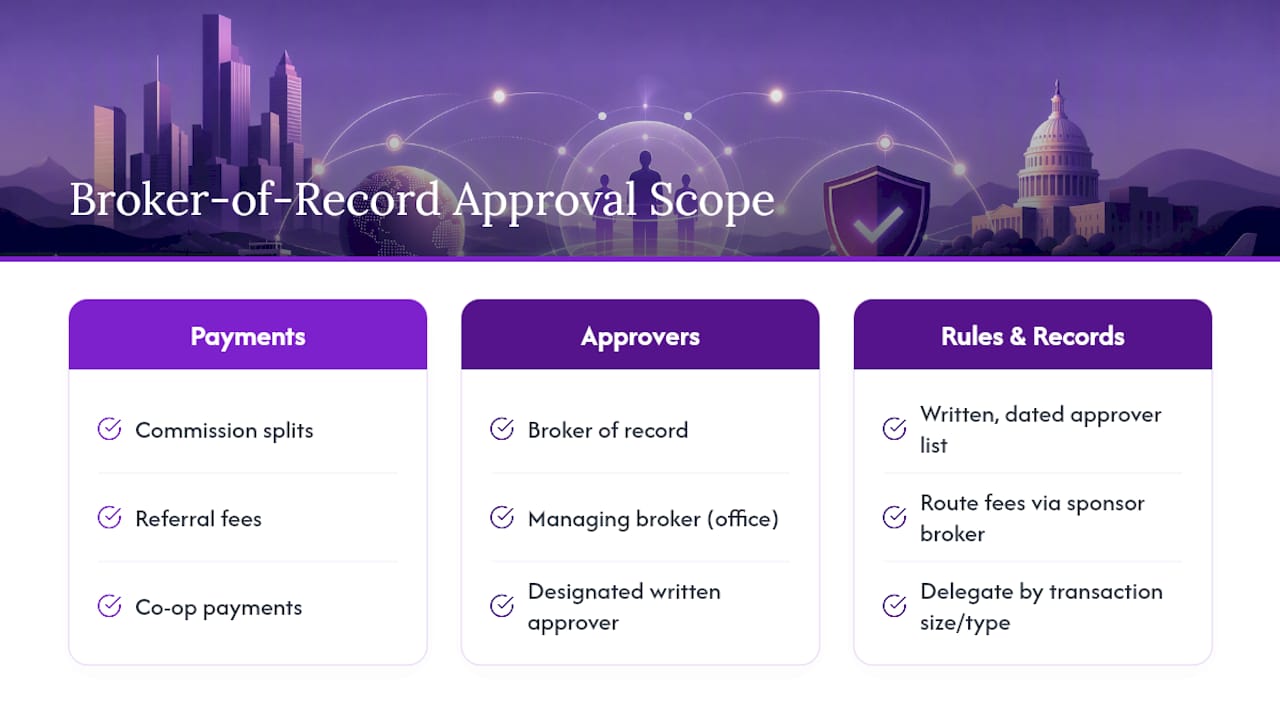
This is not about who holds a real estate license or represents a firm to a regulator. In this context, a broker of record approval is the sign-off required before a commission split, referral fee, or co-op payment gets released. Nothing more.
The approver is usually the broker of record, a managing broker overseeing a specific office, or a designated approver the brokerage has authorized in writing for defined payment categories. Smaller shops often route everything through one person. Larger, multi-office brokerages tend to delegate by transaction size or payment type, reserving high-dollar or unusual splits for the broker of record directly.
Whoever holds approval authority, the list needs to be written down and kept current. Referral guidance from LegalClarity notes that when agents initiate a referral, the firm’s managing broker or broker of record typically must approve it before a fee moves, and most states require that fee to route through the sponsoring broker rather than agent to agent. A published, dated list of who can approve what closes the gap auditors look for first.
What Records Make an Approval Workflow Audit-Ready?
Auditors and regulators do not ask whether a payment happened. They ask whether it was authorized before it happened, by someone with the authority to authorize it, against a document that justifies it. That distinction drives everything below.
Every approval record needs a specific set of fields captured at the moment of decision, not reconstructed later from memory or email threads:
- Deal ID linking the approval to a specific transaction
- A direct link to the underlying contract or CDA
- Approver identity and role
- Timestamp of submission and timestamp of decision
- The decision itself, plus any comments or conditions
- The corresponding GL reference number
Separation of duties matters as much as the fields themselves. The person who proposes a split or referral payment should never be the same person who approves it, and the approver should not be the one who executes the transfer. One operational guide for real estate commission tracking frames this as a single source of truth per deal: role-based access, split templates for recurring arrangements, and an exception queue for anything that does not fit a standard pattern.
An immutable history of every approval, including rejected or amended ones, is what turns a workflow from “trust us” into something a third party can verify independently.
Pro Tip: If your system lets an admin edit a past approval record without leaving a trace, you don’t have an audit trail. You have a liability waiting to surface during an examination.
How to Build a Compliant Approval Workflow Step by Step
Fixing a broken approval process, or building one from scratch, follows a predictable sequence. Skipping steps is how brokerages end up with workflows that look compliant on paper but fall apart under review.
- Map your approval matrix. Decide which payout types (standard splits, referrals, co-op checks) need broker sign-off versus a designated approver, and set dollar thresholds where escalation to the broker of record becomes mandatory.
- Trace the data flow. Follow the path from your CRM or transaction management system into the commission ledger, through the approval workflow, and out to finance for export. Every handoff is a place where documentation can get lost.
- Build split templates for recurring structures. Standard 70/30 splits, flat referral percentages, and repeat co-op arrangements should not require a manual approval memo every time.
- Set up exception handling and notifications. Anything outside a template routes to a queue with an automatic alert to the approver, not a stalled email chain.
- Run reconciliation dry runs. Process a handful of closed deals through the new workflow before going live, and confirm the GL entries match the approval records line for line.
- Define retention policy. Decide how long approval records, CDAs, and reconciliation exports stay accessible, and make sure that period meets your state’s record-keeping rules, not just your own preferences.
Ownership typically splits along a predictable line: operations handles deal intake and split application, while finance owns the final payout and export. Blurring that line is usually where broken payouts and refused referral checks come from.
What Are the Most Common Approval Pitfalls?
Most compliance failures in commission payments trace back to the same handful of habits, and none of them are exotic.
- Peer-to-peer payment apps. Venmo and Zelle move money fast, but they leave no contract link, no approval trail, and no GL reconciliation. That’s a federal exposure dressed up as convenience.
- Paying unlicensed individuals. Referral fees to anyone outside the sponsoring broker relationship, however informal, can violate the very safe harbor that protects legitimate splits.
- Single approver risk. One person with unchecked authority over every payout is a control failure waiting for a bad month.
- Commingling funds. Paying commissions straight out of a trust account, rather than a brokerage-controlled operating account, blurs a line regulators watch closely.
The fix is structural, not aspirational. Force all commission payments through brokerage-controlled routing, require CDA or contract evidence before any approval gets logged, and have the broker sign off on a monthly reconciliation, not just individual transactions.
Pro Tip: Set up an exception aging dashboard that flags any approval sitting unresolved for more than 48 hours. Stale approvals are where commingling and workaround payments quietly creep in.
How Do RESPA Safe Harbors and Escrow Rules Apply to Approvals?
RESPA’s Section 8 safe harbor, codified at 12 U.S.C. § 2607©(3), permits broker-to-broker cooperative and referral payments when all parties are licensed and performing actual brokerage functions. The safe harbor does not protect payments that skip documentation. It protects payments where the underlying agreement is on file and the money flows from the brokerage itself, not from an individual agent’s pocket.
State escrow rules add another layer of exposure. The California Department of Real Estate has flagged cases where brokers requested disbursements outside signed escrow instructions, sometimes to cover personal or business expenses. Altered CDAs and off-instruction disbursements are exactly the pattern examiners look for.
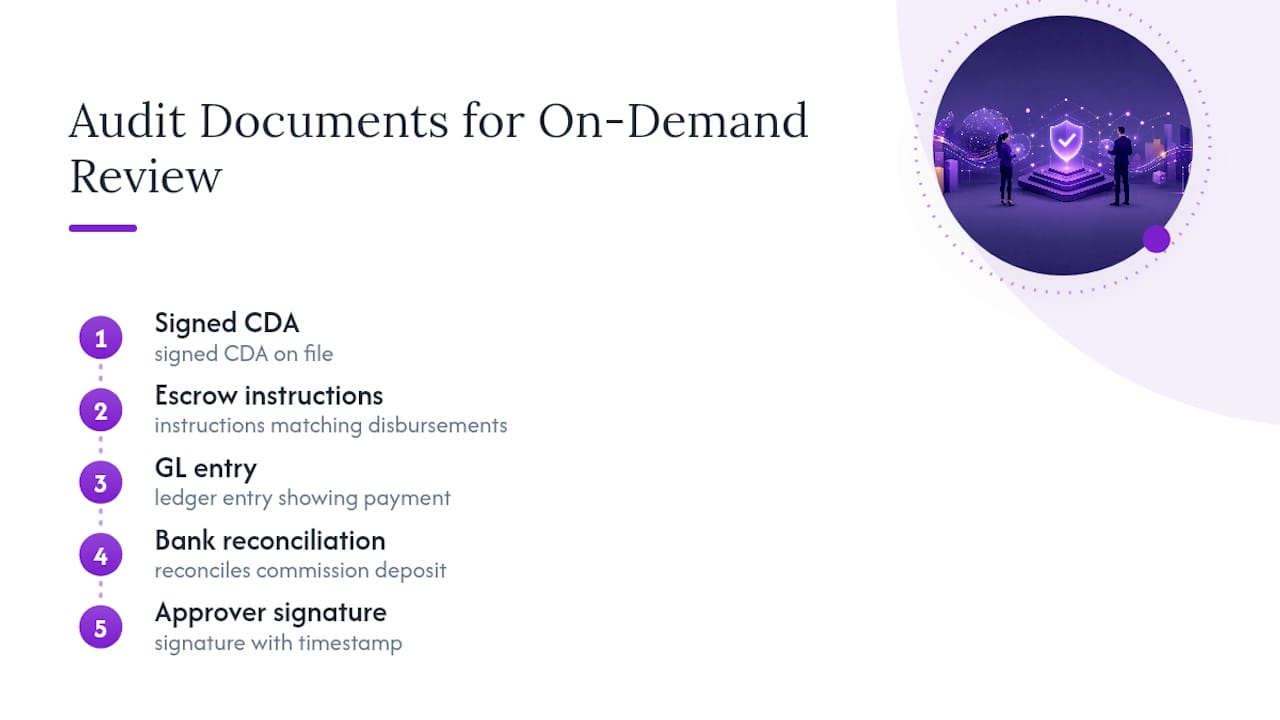
An auditor reviewing your commission payments will typically ask for five things: the signed CDA, escrow instructions where relevant, the GL entry, the bank reconciliation, and the approver’s signature with timestamp. The CFPB’s supervisory posture treats missing documentation as the default red flag, not the exception, which is why brokerages that can produce all five on demand rarely draw a second look.
Why Broker Sign-Offs Should Anchor Your Compliance Program
Most brokerages treat broker of record approvals as a bottleneck to route around. That’s backwards. The approval isn’t friction sitting on top of the “real” work of moving money. It’s the primary evidence that the money movement was legitimate in the first place.
Auditors don’t reconstruct intent from context. They look for a GL entry, ask whether it has a contract behind it and an approver’s name attached, and move on if it does. Brokerages that build their entire commission process around that question, rather than treating approval as a rubber stamp at the end, cut their own audit scope dramatically. Platforms like BrokerPay exist because manual, email-based sign-off chains cannot produce that evidence reliably at scale. The brokerages getting burned in examinations aren’t the ones with complicated commission structures. They’re the ones that never wrote down who was allowed to say yes.
— Wes
Automating Approvals Without the Compliance Guesswork
There are alternatives to spreadsheets, email chains, and Venmo workarounds for commission, referral, and co-op payments that route approvals through role-based sign-off, link directly to the contract or CDA on file, and record an immutable audit trail with a GL reference, ensuring payments have documented approval.
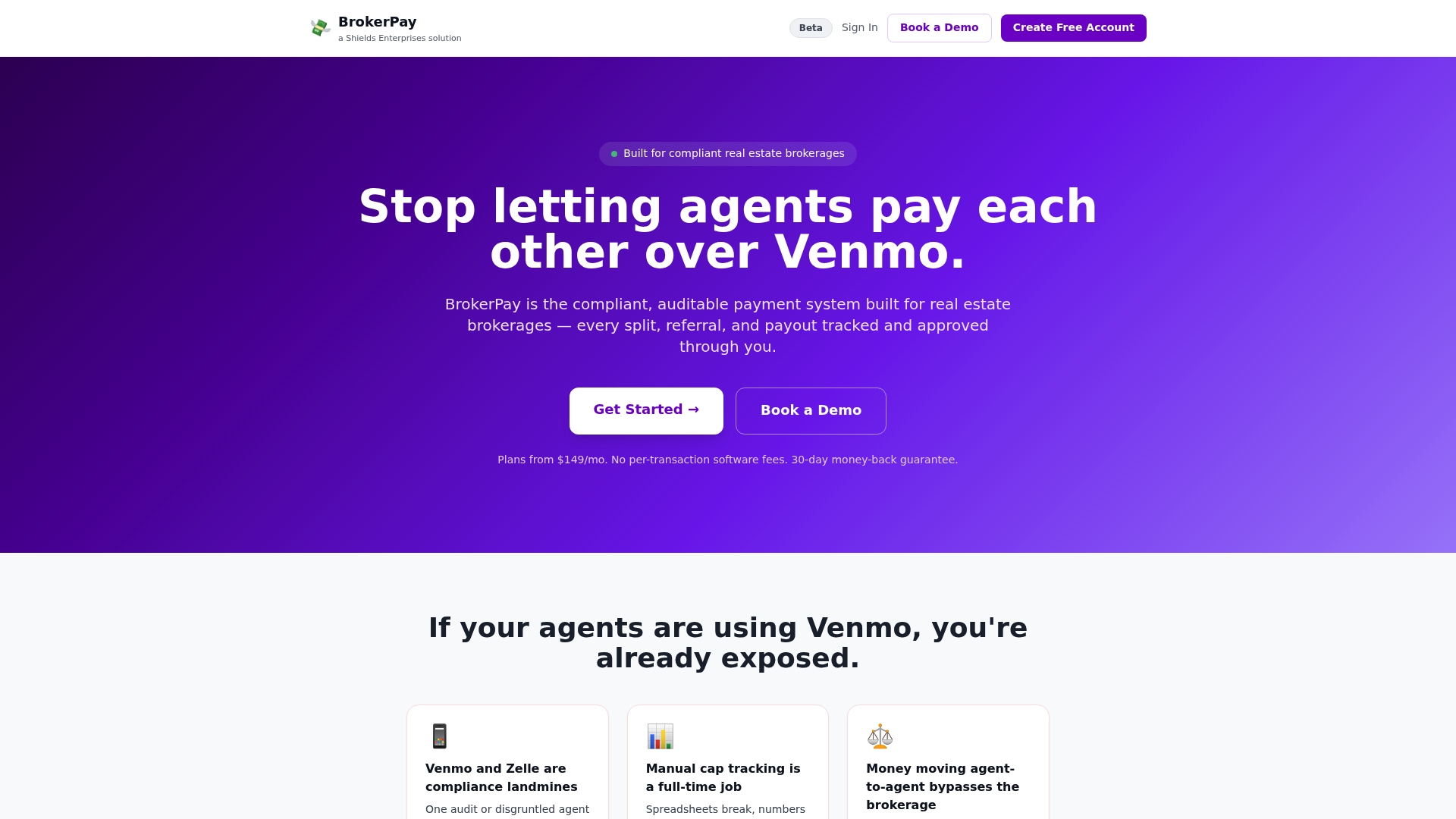
That structure matters most the day an examiner or a new broker of record asks for proof, not promises. Brokerpay keeps funds moving through brokerage-controlled accounts instead of personal payment apps, which closes the exact gap RESPA safe harbors and state escrow rules are built to catch. Such platforms may offer flat monthly pricing across different plans, without per-transaction fees and sometimes a refund guarantee period.
Check the Starter, Growth, and Enterprise plans and see which tier matches your brokerage’s agent count and approval volume.
Where to Verify Broker of Record Approval Rules
For anyone preparing an audit or compliance review, these primary sources carry the actual legal weight:
- RESPA Section 8 safe harbor language — the statutory basis for compliant broker-to-broker payments
- CFPB supervisory and enforcement resources — federal oversight expectations for documented payment practices
- California DRE licensee advisory on commission disbursements — a state-level example of escrow disbursement enforcement
Sources
- Referral Agreement Between Brokers: Terms, Fees, and Rules - LegalClarity
- Consumer Financial Protection Bureau (CFPB)
FAQ
What Is a Broker of Record Approval?
It’s a documented sign-off from the broker of record or an authorized designee, required before a commission, referral, or co-op payment gets released. The approval must be time-stamped and linked to a contract or CDA and a corresponding GL entry to hold up under review.
Who Can Approve Broker of Record Payments?
The broker of record, a managing broker, or a designated approver the brokerage has authorized in writing can typically approve these payments, depending on the payment type and dollar amount. Most brokerages set thresholds that escalate larger or unusual payments straight to the broker of record.
Why Do Referral Fees Need Broker Approval?
Referral fees generally must flow through the sponsoring broker rather than directly between agents, and the managing broker or broker of record usually approves the arrangement before payment. Skipping that approval can put the payment outside RESPA’s safe harbor protections entirely.
How Does BrokerPay Handle Broker Approvals?
BrokerPay builds role-based approval routing directly into its commission workflow, linking every payout to the underlying contract and generating an immutable audit trail with GL references. Pricing runs on flat monthly plans (Starter, Growth, Enterprise) without per-transaction fees, and current details are available on the BrokerPay site.
What Happens if a Commission Payment Has No Documented Approval?
An undocumented payment becomes a compliance exposure the moment an auditor or examiner asks for its supporting contract and approver record. Without that link, the payment can fall outside RESPA’s safe harbor and draw scrutiny under state escrow and trust account rules as well.