Six Step Agent Fee Deductions Workflow for RESPA Compliant Brokerages

Agent fee deductions are the commission splits, referral fees, desk and transaction charges, and other withholdings a brokerage applies to a gross commission before disbursing an agent’s net payout. The one rule that keeps every deduction defensible: encode a fixed commission waterfall, match every disbursement to a signed Commission Disbursement Authorization (CDA) and the HUD/ALTA settlement statement, and route payment only after principal broker signoff. Skip that sequence and you’re one referral-fee dispute away from a RESPA complaint.
TL;DR:
- Most commission disputes stem from sequencing errors, which occur when deductions are applied out of the standard order, leading to inconsistent agent net pay.
- Regulatory risks arise when referral payments or incentives are structured as disguised kickbacks, especially if payments scale with volume or lack documented services.
- Automating commission waterfall calculations with fixed logic and detailed audit trails significantly reduces errors and RESPA exposure, especially when using brokerage-controlled ACH transfers.
- Maintaining separate ledger accounts for each deduction and verifying the consistency of the CDA, HUD statement, and ledger before disbursing funds is essential for compliance and accurate recordkeeping.
- Implementing a formal, three-step approval workflow—covering CDA preparation, principal broker signoff, and accounting verification—fortifies defenses against disputes and regulatory audits.
Table of Contents
- What Order Should Agent Fee Deductions Follow?
- Where Does RESPA Exposure Actually Come From?
- How Should Brokerages Record Deductions in Their Books?
- What’s the Checklist From HUD Receipt to ACH Payout?
- How Compliant Payment Platforms Cut RESPA Risk
- How Do You Fix a Disputed or Incorrect Deduction?
- What Should a Documented Approval Workflow Look Like?
- Do State Rules Change How You Apply Deductions?
- The Real Fix Nobody Talks About
- A Compliant Way to Automate Every Payout
- Sources
- FAQ
What Order Should Agent Fee Deductions Follow?
Sequencing errors, not fraud, cause most commission disputes. When a brokerage calculates deductions ad hoc for each transaction instead of applying a fixed order, agents get paid different net amounts for identical splits, and nobody can explain why.
The standard commission waterfall runs in this order:
- Gross commission received — the total fee the brokerage collects at closing, before anything is subtracted.
- Co-broke split — the portion paid to the cooperating brokerage, calculated off gross, not off the listing side’s net.
- Referral fee — paid to the referring agent or brokerage, typically a percentage of the brokerage’s side of the commission, never a flat fee tied to volume.
- Franchise fee — a fixed percentage owed to the franchisor, deducted before the agent split is applied.
- Transaction or admin fee — a flat per-file charge covering the brokerage’s processing cost.
- E&O insurance fee — a per-transaction charge that funds the brokerage’s errors-and-omissions coverage.
- Desk fee — a flat monthly or per-transaction charge for agents on a desk-fee plan rather than a percentage split.
- Agent tier split — the final commission split, calculated against the agent’s current cap progress.
A common mistake: applying the agent’s split before the franchise fee comes out, which inflates the agent’s payout and understates what the brokerage owes the franchisor. Another: deducting E&O per file when the agent’s plan bills it quarterly, double charging the agent over a year. Cap tracking has to run alongside every step, because an agent who crosses the cap mid-transaction skips the tier split entirely for the rest of that fiscal period.
| Deduction | Applied against | Typical basis |
|---|---|---|
| Co-broke split | Gross commission | Percentage of gross |
| Referral fee | Brokerage’s side of commission | Percentage, documented services |
| Franchise fee | Post-co-broke commission | Fixed percentage |
| Transaction/admin fee | Per file | Flat dollar amount |
| E&O fee | Per file or per period | Flat dollar amount |
| Desk fee | Per agent | Flat monthly or per-file |
| Agent split | Remaining net after fees | Tiered by cap status |
Automating cobrokering and split tracking removes the ad-hoc calculation that causes most of these errors, since the waterfall gets encoded once and applied identically to every file.
Where Does RESPA Exposure Actually Come From?
RESPA Section 8(b) bars split charges or unearned fees for settlement services unless the payment covers services actually performed and priced at market value. Most brokerages don’t violate this on purpose. They violate it by treating a referral relationship like a marketing partnership, or by structuring a marketing services agreement (MSA) that functions as a disguised kickback.
Regulation X defines “thing of value” broadly, covering more than cash. Free office space, discounted services, or a marketing stipend tied to referral volume can all qualify as a prohibited payment under 12 C.F.R. §1024.14. Watch for these red flags:
- A payment amount that scales with referral volume rather than with documented work performed.
- An MSA with no deliverables, invoices, or evidence the marketing services actually happened.
- A referral fee paid to an unlicensed party for a service that requires a license.
- Consistent round-number payments that look more like a retainer than compensation for specific work.
The CFPB’s compliance bulletin on MSAs flags these arrangements as a recurring enforcement target precisely because they look legitimate on paper while functioning as referral schemes underneath. If your brokerage works with outside marketing vendors for property launches or campaigns, keep those contracts structured around deliverables. A firm like 121 Group that provides documented, itemized real estate marketing services gives you the paper trail regulators expect. Vague retainers do not.
Pro Tip: Require a separate invoice with a specific scope of work for every marketing or referral payment. If you can’t produce a document explaining what was delivered for that specific dollar amount, don’t send it.
How Should Brokerages Record Deductions in Their Books?
Every deduction needs its own ledger line, or your books will not reconcile with what agents actually received. Set up these accounts at minimum:
- Gross commission income — records the full fee at closing.
- Commission payable (liability) — holds the amount owed to agents and co-broke parties until disbursed.
- Franchise fee expense — tracks the recurring cut owed to the franchisor.
- E&O expense — isolates insurance costs from other operating expenses.
- Payout clearing account — a short-lived holding account that zeroes out once ACH disbursement clears.
A representative $10,000 gross commission might post like this: debit cash $10,000, credit gross commission income $10,000. Then debit gross commission income $10,000, credit co-broke payable $4,000, credit franchise fee payable $180, credit agent commission payable $5,320, credit E&O expense $50, credit admin fee income $450. Final step: debit agent commission payable $5,320, credit cash (payout clearing) $5,320 once ACH clears. These figures are illustrative, not a substitute for your own chart of accounts.
For 1099-NEC reporting, agents get the gross commission reported, not the net after deductions, since the IRS treats agents as independent contractors receiving full commission income before their own business expenses. Reconcile the payout clearing account to zero every pay cycle. A balance sitting there past 48 hours usually means a mismatched disbursement. Consistent tracking here is also what prevents downstream tax reconciliation problems for agents at filing time.
What’s the Checklist From HUD Receipt to ACH Payout?
The standard disbursement sequence runs in six steps, and skipping any one of them is where audit trails break down:
- Receive the HUD/ALTA settlement statement from the closing agent or title company.
- Populate the CDA, itemizing gross commission, every split, and every outbound referral or co-broke payee.
- Route for principal broker signoff, confirming the CDA figures match the settlement statement line by line.
- Verify in accounting that the CDA math matches the encoded waterfall before anything gets released.
- Initiate ACH disbursement from a brokerage-controlled account, never a personal or peer-to-peer app.
- Notify the agent with a payout summary showing gross, each deduction, and net.
Brokerage-controlled ACH is the standard for a reason: it creates a bank-level audit trail with timestamps and account records. Venmo and Zelle disbursements leave brokerages exposed, since personal payment apps offer no reconciliation trail and no way to prove a payment matched an approved CDA. ACH transfers typically clear in one to two business days, which sets a realistic expectation for agents asking when they’ll see funds.
Pro Tip: Keep four documents per transaction in your audit file: the signed CDA, the HUD/ALTA statement, the accounting entry, and the ACH confirmation. That packet alone answers most regulator or agent disputes without a single phone call.
How Compliant Payment Platforms Cut RESPA Risk
Automation earns its keep by removing the manual math where sequencing errors and undocumented referral payments creep in. A compliant platform encodes the waterfall once, tracks each agent’s cap progress in real time, and keeps co-broke and referral payments in separate, documented lanes rather than lumped together in one lump-sum wire.
The controls that matter operationally:
- Fixed waterfall logic applied identically to every transaction, removing per-file guesswork.
- Automatic cap tracking that adjusts the agent split the moment a cap threshold is crossed.
- Separate tracking for co-broke and referral payments, each with its own documentation trail.
- Built-in approval workflow requiring principal broker signoff before funds move.
- ACH disbursement from brokerage-controlled accounts, with a full audit trail attached to every payout.
BrokerPay is built specifically around this workflow: it tracks, documents, and processes agent splits, referral fees, and co-op commissions while maintaining the audit trail regulators and internal auditors both expect. The operational payoff shows up in fewer payout disputes, faster monthly accounting close, and a documentary record that holds up when a regulator or an agent asks for proof.
How Do You Fix a Disputed or Incorrect Deduction?
Disputes usually surface one of three ways: an agent flags a net payout that doesn’t match their expected split, accounting catches a reconciliation gap during month-end close, or an audit turns up a CDA that doesn’t match the HUD/ALTA statement. Whichever way it surfaces, the fix follows the same path.
Start by pulling the four core documents for that transaction: the signed CDA, the settlement statement, the accounting entry, and the ACH confirmation. Compare each deduction line against the encoded waterfall for that agent’s plan and cap status at the time of closing. Most disputes trace back to one of two causes: the wrong cap tier was applied because cap progress wasn’t updated in real time, or a franchise or referral fee was calculated against the wrong base (gross versus post-co-broke net).
Once you identify the error, correct it with a documented adjustment, not a quiet fix. Issue a corrected CDA showing the original figures, the corrected figures, and the reason for the change. Route the corrected CDA through principal broker approval again, exactly like the original disbursement. If the agent was underpaid, process a supplemental ACH payment tied to the corrected CDA. If overpaid, document the recovery method and get written agent acknowledgment before deducting it from a future payout.
Never resolve a dispute with a verbal agreement or an off-ledger side payment. That approach erases the audit trail you need if the same question resurfaces at tax time or during a compliance review, and it’s the exact kind of undocumented adjustment that turns a simple math error into a bigger problem.
What Should a Documented Approval Workflow Look Like?
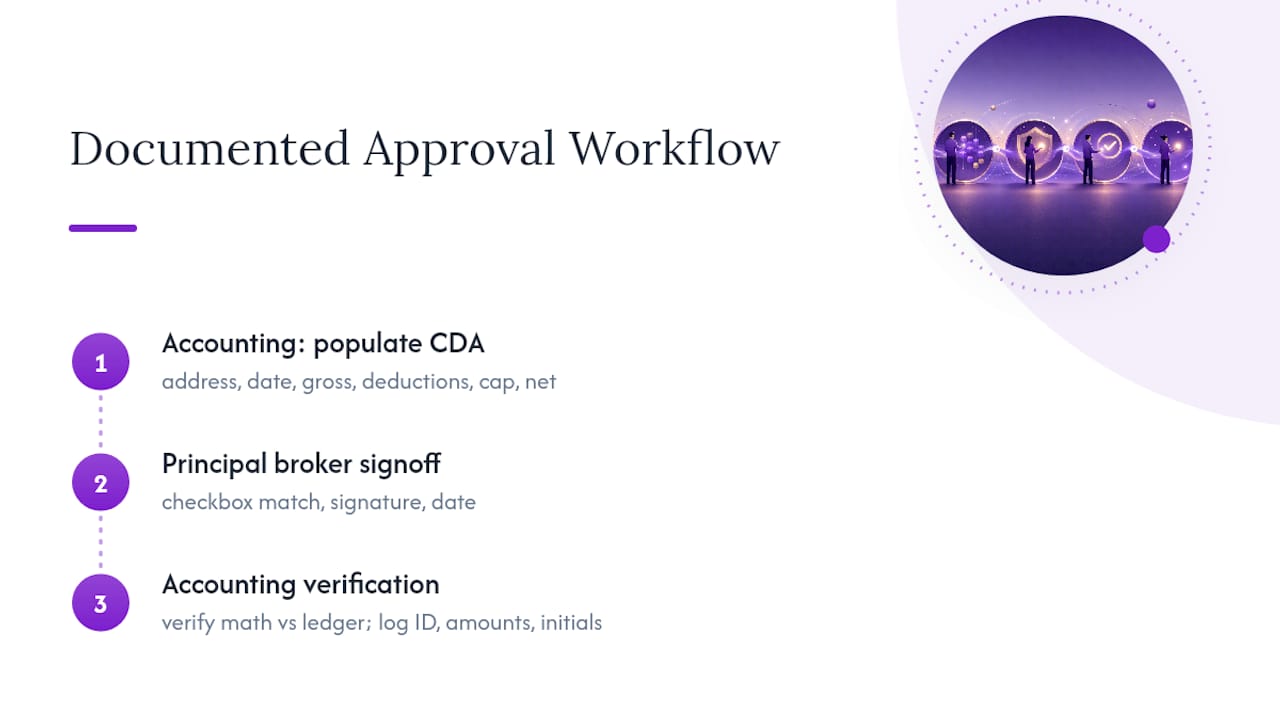
A defensible approval workflow has three checkpoints, and each one needs its own signature or timestamp, not a single blanket approval at the end.
The first checkpoint happens when accounting populates the CDA from the HUD/ALTA statement. This is where the sample CDA template should capture: transaction address, closing date, gross commission, itemized deductions (co-broke, referral, franchise, transaction fee, E&O, desk fee), agent cap status at time of closing, and calculated net payout. Every field ties back to a source document, never to a verbal estimate.
The second checkpoint is principal broker signoff. A usable approval form includes a checkbox confirming the CDA matches the settlement statement line by line, a signature line, and a date field. This step exists specifically to catch sequencing errors before money moves, not after.
The third checkpoint is accounting verification, where the bookkeeping team confirms the CDA math matches the ledger entries before initiating ACH. A simple verification log, listing transaction ID, CDA amount, ledger entry amount, and verifier initials, gives you a paper trail that takes seconds to produce during an audit.
Brokerages that build these three checkpoints into a repeatable template, rather than recreating the approval process from memory each time, catch mismatches before disbursement instead of after an agent complains. The documented commission disbursement process outlined by industry compliance guides follows this same three-checkpoint structure, and it’s worth modeling your internal form after it directly.
Do State Rules Change How You Apply Deductions?
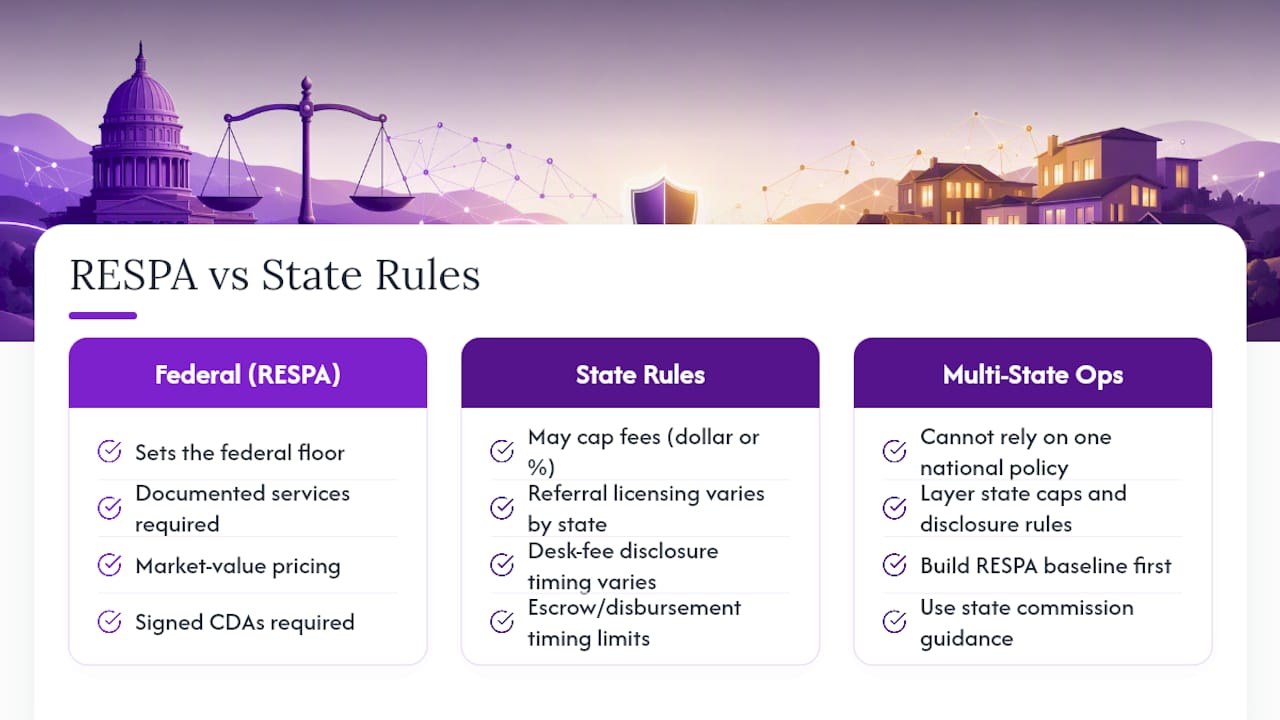
RESPA sets the federal floor, but state real estate commissions layer their own rules on top, and those rules vary enough that a workflow compliant in one state can fall short in another. Some states cap the dollar amount or percentage a brokerage can charge for administrative or transaction fees, while others leave that entirely to brokerage discretion.
Licensing requirements for referral payments differ by state as well. Some states allow a brokerage to pay a referral fee to an unlicensed individual under narrow circumstances, while others require the referring party to hold an active license regardless of the payment structure. Desk-fee models also face different disclosure requirements: several states require the fee structure to be disclosed in the agent’s independent contractor agreement before any deduction is applied, not just noted on the CDA after the fact.
Escrow and timing rules add another layer. Some states set a maximum number of business days for commission disbursement after closing, which affects how fast your approval workflow needs to move from HUD receipt to ACH transfer. A brokerage operating across multiple states can’t rely on a single national policy document. The safest approach is building the federal RESPA controls (documented services, market-value pricing, signed CDAs) as the baseline, then layering state-specific caps, disclosure rules, and timing requirements on top for each jurisdiction where the brokerage holds a license. When in doubt on a state-specific rule, the state real estate commission’s own published guidance is the primary source, not a national blog post written for a different jurisdiction.
The Real Fix Nobody Talks About
Most brokerages treat commission errors as one-off accounting mistakes. They’re not. They’re a symptom of running the waterfall from memory instead of from a fixed, encoded rule set. Fix the encoding once, require CDA and HUD matching on every single disbursement without exception, and most disputes disappear before they start.
The second fix matters just as much: retire any peer-to-peer disbursement workflow still running in your office. Brokerage-controlled ACH isn’t a nice-to-have process improvement. It’s the difference between having an audit trail and having nothing to show a regulator.
— Wes
A Compliant Way to Automate Every Payout
Brokerages that still calculate splits by hand or send agent payouts through personal payment apps carry exposure they don’t need to carry. Brokerpay replaces that manual process with a compliant commission payment platform built specifically for brokerage operations: it tracks agent splits, referral fees, and co-op commissions with full audit trails, then routes disbursement through brokerage-controlled ACH instead of Venmo or Zelle.
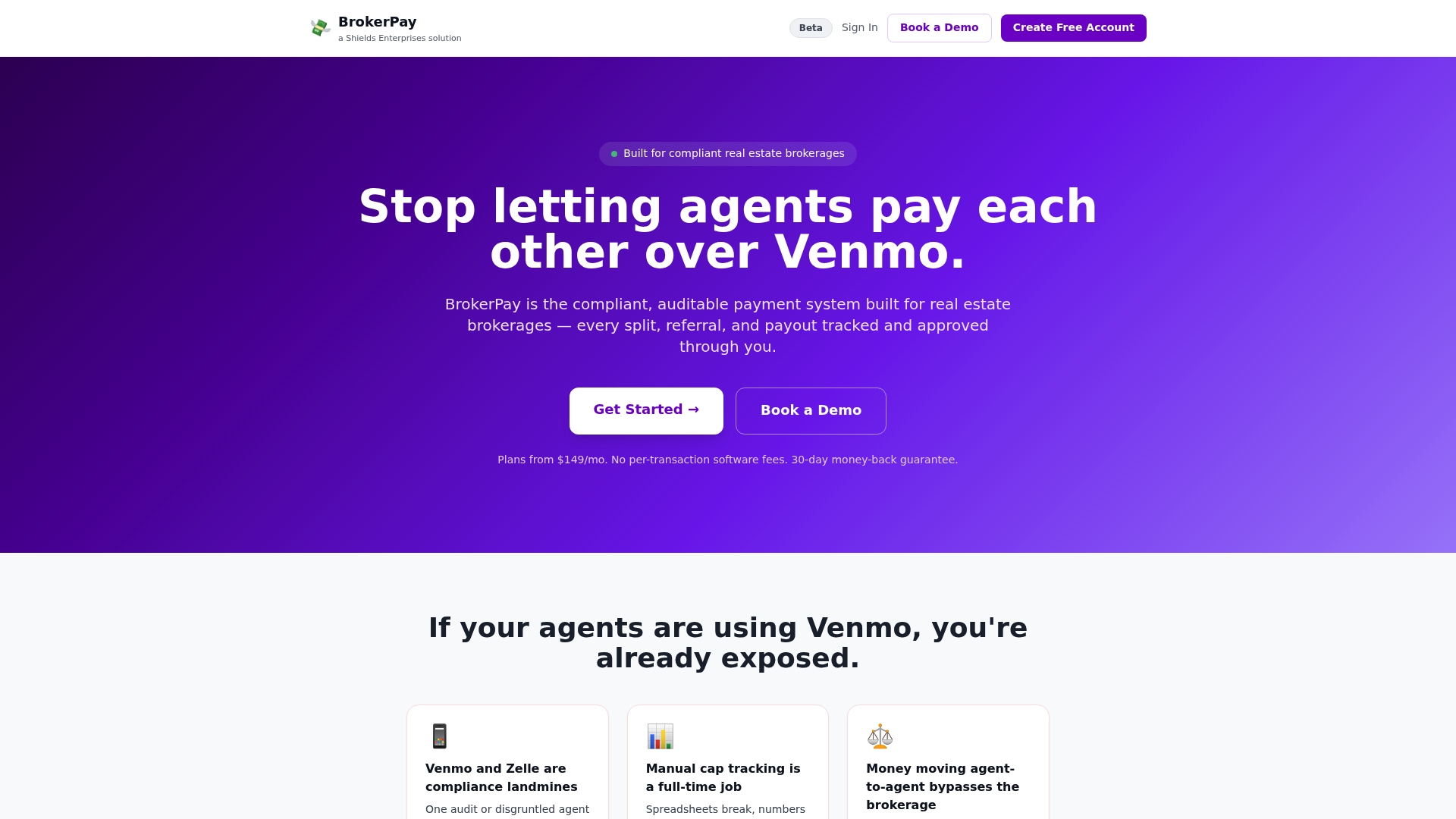
Every deduction runs through the same encoded waterfall on every transaction, with cap tracking and approval workflows built in so principal broker signoff happens before funds move, not after a dispute surfaces. Plans scale by agent count across various tiers, with no per-transaction software fees layered on top. If your current process still depends on spreadsheets and manual wire instructions, review the BrokerPay plans and see which tier fits your brokerage’s agent count and transaction volume.
Sources
- Real Estate Settlement Procedures Act FAQs | Consumer Financial Protection Bureau
- Section 1024.14: Prohibition against kickbacks and unearned fees | Federal Reserve
- RESPA compliance and marketing services agreements | CFPB compliance bulletin
- How the real estate commission disbursement process works - LegalClarity
FAQ
What Counts as an Agent Fee Deduction?
It’s any withholding a brokerage applies to a gross commission before paying the agent, including co-broke splits, referral fees, franchise fees, transaction fees, E&O charges, and desk fees.
Is a Referral Fee Always RESPA Compliant?
No. A referral fee only satisfies RESPA Section 8(b) when it compensates for services actually performed and priced at market value, not simply for sending a lead.
What Documents Should Match Before a Payout Is Released?
The signed CDA, the HUD/ALTA settlement statement, and the accounting ledger entry should all match line for line before ACH disbursement is initiated.
How Long Does ACH Commission Disbursement Take?
Brokerage-controlled ACH transfers typically clear in one to two business days after the payment is initiated, once the CDA is approved and verified.
Does BrokerPay Handle Referral and Co-Op Commission Tracking?
Yes. BrokerPay tracks agent splits, referral fees, and co-op commissions separately with documented audit trails, and current pricing for its Starter, Growth, and Enterprise plans is available on its website.