Settle Audit Disputes in 5 Minutes: Cap Audit Trails for Brokerages

A cap audit trail is a tamper-evident record of every agent’s commission cap progress, split calculation, referral fee, and co-op payment, tied to timestamps and approver identity. Its job is simple: give you verifiable proof for internal reviews and regulator audits, and remove any need for informal payments that create liability. If you run a brokerage, check right now whether your current system logs who approved each payout, when, and which transaction ID it settled against.
TL;DR:
- Systems must log who approved each payout, when, and link it to specific transaction IDs to ensure tamper-evidence and audit readiness.
- All records should include deal references, commission details, timestamps, approver signatures, and attached source documents for a complete audit trail.
- Regular monthly reconciliation between the ledger, bank statements, and settlement documents helps detect errors before they escalate, with quarterly checks on control metrics.
- Common audit failures often stem from mixing trust and operating funds or unsigned reconciliations, which can be prevented by strict account separation and signed reviews.
- Software like BrokerPay simplifies compliance by providing immutable logs, attaching crucial documents, and linking payments to bank records, reducing audit time and liability.
Table of Contents
- What Data Points Belong in a Cap Audit Trail
- How Do You Make a Cap Audit Trail Tamper-Evident?
- How Often Should You Reconcile Cap and Commission Records?
- Where Cap Audit Trails Break Down
- Why Tamper-Evident Trails Change What Audits Actually Find
- A Compliant Way to Keep Every Cap Record Audit-Ready
- Sources
- FAQ
What Data Points Belong in a Cap Audit Trail
Every commission event needs enough detail that a stranger, auditing your books six months from now, could reconstruct exactly what happened and why. That means linking each entry to the underlying deal, not just recording a dollar figure in isolation.
At minimum, your records should include:
- The deal ID and a reference to the settlement statement it came from
- Gross commission, the split percentage applied, cap status at the time of the deal, and any referral fee taken off the top
- The net payout amount, calculated after all deductions
- A timestamp for when the record was created and any time it was edited afterward
- The approver’s name and the timestamp of sign-off
- Attached documents: the commission disbursement authorization (CDA), signed split agreement, and any addenda
- The bank or ACH transaction ID tied to the actual payment, plus a flag indicating whether the payment counts toward 1099-NEC reporting
Miss any one of these and you’ve got a gap an auditor will find before you do.
How Do You Make a Cap Audit Trail Tamper-Evident?
A spreadsheet with a “final” tab isn’t an audit trail. It’s a liability with a filename. Real tamper resistance comes from a handful of specific controls, and none of them are exotic.
- Use a system with immutable logs or version history. No entry should ever be silently overwritten. When a number of years changes, the system should preserve the prior version and record who changed it and why, the same way commission tracking systems designed as workflows move records through draft, pending approval, approved, and paid states instead of letting anyone edit a live total.
- Require sign-off before money moves. No payout should clear without a named approver attached to a timestamp.
- Attach the source documents to the record itself. A signed CDA or split agreement should travel with the transaction it supports, not sit in a separate folder someone has to hunt for during an audit.
- Separate duties between entry, approval, and payment execution. The person who keys in a commission split shouldn’t be the same person who authorizes the payout.
- Add cryptographic checksums to exported ledgers when your state’s audit forms or an outside auditor demand proof a file wasn’t altered after export.
Pro Tip: Lock your split calculation templates so no one can hand edit a formula mid deal. If a number needs to change, force a documented override with a reason field, not a quiet edit to the cell.
Locking the source document to the transaction, as commission split tracking guidance recommends, also makes second reviews on unusual payments far faster.
How Often Should You Reconcile Cap and Commission Records?
Reconciliation isn’t a once-a-year scramble before tax season. It works best as a layered cadence, monthly, quarterly, and at year-end, each catching different kinds of errors before they compound.
Monthly, run a three-way reconciliation between your commission ledger, your bank statements, and the settlement statements from closed transactions. Someone other than the person who entered the data, ideally the broker of record, should sign off on it. This mirrors what state audit forms like Arizona’s Broker Audit Declaration expect: a documented action log and broker review within a set window.
Pull a handful of transactions each month and recalculate them independently. Confirm attachments exist and confirm the bank record matches the ledger entry.
- Independent recalculation of the split and cap math
- Verification that CDAs and split agreements are attached
- Bank transaction match against the recorded payout
Watch a few numbers every quarter that tell you whether your controls are actually working: how often figures get adjusted after the fact, how long approvals sit before sign-off, and how many disputes agents raise. A rising adjustment rate is usually the earliest sign that your entry process, not your agents, has a problem.
Agents leaving mid-year before hitting cap need special handling. The cap memo balance and the agent’s contract terms determine whether the brokerage keeps company dollars already earned, and that decision needs documented approval, not just a verbal call.
At year-end, confirm every chargeback and adjustment made it into the ledger and that your 1099-NEC vendor flags match what actually got paid. A single missed chargeback here creates a mismatch the IRS will eventually flag.
Where Cap Audit Trails Break Down
Most audit findings trace back to one of five habits, and every one of them has a fix that costs less than the fine or dispute it prevents.
- Mixing trust and operating funds. Keep the accounts separate and reconcile them independently. Regulators have flagged broker-directed disbursements from trust accounts used to cover personal or business expenses as a direct violation of escrow and real estate law.
- Unsigned reconciliations. A reconciliation nobody signed is a reconciliation that didn’t legally happen. Assign the sign-off to a specific person, every month, no exceptions.
- Spreadsheets with no version history. They’re fine for a two-agent shop. Past that, migrating to a system that logs every change is cheaper than the hours spent reconstructing what happened after a dispute.
- Paying out before approvals or documents are complete. Build a payout hold rule: no signed CDA, no payment, no exceptions for a rushed closing.
- Untracked chargebacks. Log every chargeback as its own approved adjustment, not a silent edit to a prior number, or your 1099-NEC totals won’t match reality come January.
Common bookkeeping failures like these, booking gross commission income without contra revenue separation among them, show up in almost every audit finding tied to capped commission structures.
Why Tamper-Evident Trails Change What Audits Actually Find
The brokerages that sail through an audit aren’t the ones with the fanciest software. They’re the ones where every record answers “who approved this, and when” without anyone needing to ask around the office.
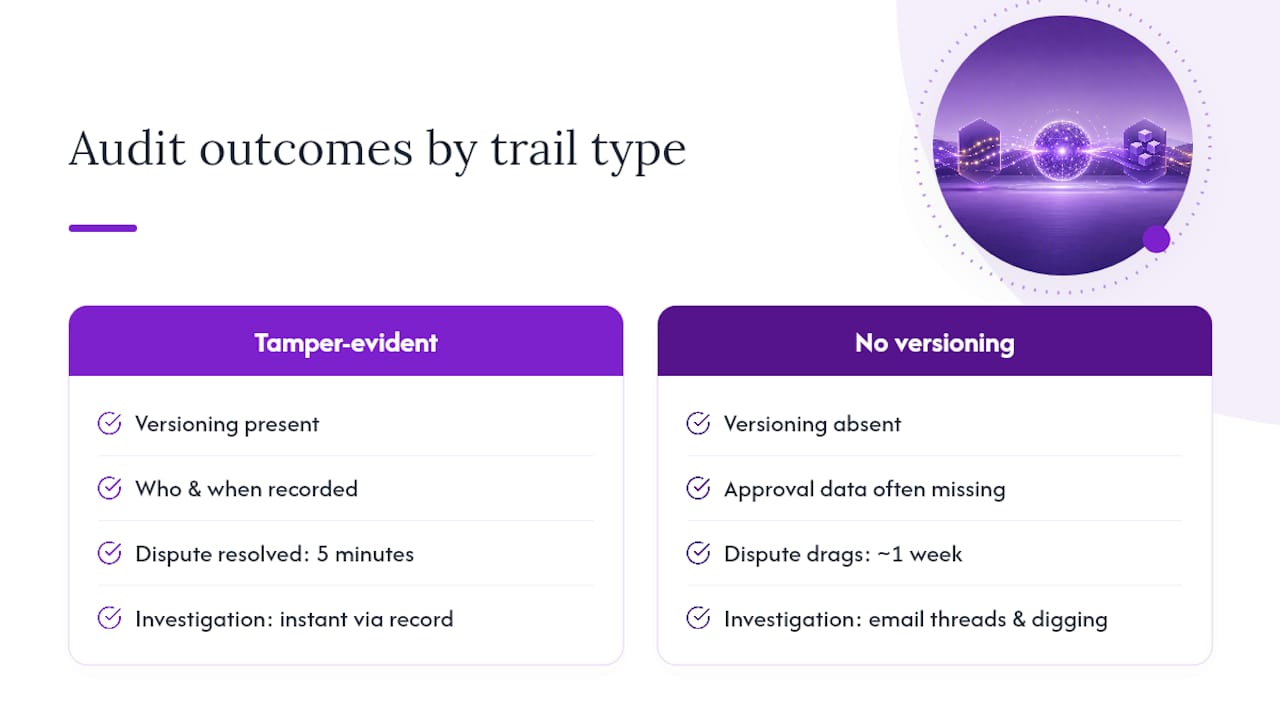
I’ve seen the pattern play out the same way over and over: a dispute comes up, an agent insists they hit their cap a month earlier than the ledger shows, and the entire argument gets settled in five minutes because a versioned record shows the exact date the split flipped and who signed off on it. No versioning, and that same dispute turns into a week of digging through email threads and a possible reimbursement nobody can fully justify.
The lesson isn’t complicated. Simpler, enforceable policies beat sophisticated ones nobody follows. If your approval workflow has six steps, half your staff will find a shortcut around step four. Keep the rules few, keep them mandatory, and the trail takes care of itself.
— Wes
A Compliant Way to Keep Every Cap Record Audit-Ready
Every control described above, immutable logs, approval sign-off, attached documents, bank-linked payments, is exactly what BrokerPay is built around. It replaces the Venmo and Zelle workarounds that quietly create federal RESPA liability with a payment platform that timestamps every split, cap hit, and referral fee, and requires sign-off before a dollar moves, aiming to reduce liability.

Instead of stitching together a spreadsheet, a bank export, and a folder of signed CDAs every time an auditor asks a question, some systems provide one record that links the approval, the document, and the ACH transaction ID. For a brokerage juggling cap tracking across dozens of agents, this can reduce audit time significantly.
Visit the BrokerPay product page to see the full feature list or request a demo and find out what a fully documented cap trail looks like for your office.
Sources
- Beancount
- Commission Split Tracking: Accuracy Guide - Modern Marks
- Commission Tracking for Real Estate Teams (US Guide) | AltStack
- DFPI and DRE Joint Bulletin: Real Estate Commission Disbursements
FAQ
What Is a Cap Audit Trail?
It’s a tamper-evident record showing an agent’s commission cap progress, splits, referral fees, and payments, along with timestamps and approver identity for every entry.
What Fields Should a Commission Record Always Include?
At minimum, the deal ID, gross commission, split percentage, cap status, referral fee, net payout, approver name and timestamp, and the linked bank transaction ID.
How Often Should Brokerages Reconcile Commission Records?
Run a three-way reconciliation monthly between the ledger, bank statements, and settlement statements, then check quarterly metrics like adjustment rates and do a full 1099-NEC reconciliation at year-end.
What’s the Most Common Cap Audit Failure?
Mixing trust and operating funds, along with unsigned reconciliations, shows up in the majority of audit findings tied to capped commission structures.
Can Software Like BrokerPay Replace a Manual Cap Tracking Spreadsheet?
Yes. BrokerPay logs approvals, attaches documents, and links payments to bank transactions automatically, removing the version control and sign-off gaps that spreadsheets create.