Audit Ready from ICA: Agent Onboarding Payments Setup for Brokerages

Agent onboarding payments setup has to accomplish four things before a single dollar moves: capture accurate agent and deal data, apply the correct split template, get the payout signed off by the right role, and leave behind a record that would survive an audit. Skip any one of those and you get what most brokerages already have: a spreadsheet, a Venmo transfer, and a compliance officer who doesn’t sleep well. The commission workflow, the approval trail, and the payout ledger are not separate projects. Platforms like Emergent’s Fullstack App treat them as one connected system, and that’s the standard worth building toward.
TL;DR:
- Most brokerages back into payment setups one agent at a time, leading to compounded errors; a systematic process starting from signed ICA prevents this.
- Deal records must include property details, gross income, participants, and specific split rules; adjustments require separate, auditable records rather than edits inside original payouts.
- Payouts should pass through distinct approval states with role-based permissions, dispute forms, and SLA enforcement; rejection reasons must be documented to avoid re-litigation.
- Disbursement methods like ACH, wire, and checks each have different timing and reconciliation requirements, with automation integrated into accounting systems for accuracy.
- Start with a small pilot and reconcile manually before automating fully; maintaining thorough documentation and audit trails reduces disputes and compliance risks.
Table of Contents
- How Do You Set Up Agent Onboarding Payments Step by Step?
- What Data Belongs in a Split Template?
- Who Approves Commission Payouts and What Happens During a Dispute?
- How Are Commission Payouts Actually Sent and Reconciled?
- What Does a Safe Rollout Actually Look Like?
- Why Documentation and Audit Trails Matter More Than Speed
- What Agent Information Do You Need Before the First Payout?
- How Do You Prevent Fraud in Commission Payment Processing?
- How Do You Train Agents on the New Payment Process?
- What Does Success Look Like at 30, 90, and 180 Days?
- Get Your Brokerage’s Payment Setup Running the Right Way
- Sources
- FAQ
How Do You Set Up Agent Onboarding Payments Step by Step?
Most brokerages back into their payment setup one agent at a time, which is exactly how commission errors compound. A better approach treats the signed independent contractor agreement (ICA) as the single event that kicks off everything else, including agent onboarding automation. Here’s the sequence that holds up under scrutiny:
- Trigger onboarding from the signed ICA. Capture the agent record once, at signature, rather than rebuilding it across three systems later.
- Collect license, E&O insurance, a signed commission schedule, and tax forms before the agent touches a live listing.
- Create a payment profile that pairs a W-9 with verified ACH instructions, not a text message with routing numbers in it.
- Build three to five split templates covering your most common deal types: standard buy-side, standard list-side, team splits, referral-in, referral-out.
- Pick your system of record and confirm the integration endpoints, whether that’s a commission platform syncing to QuickBooks or a manual export to your bank portal.
- Set approval notifications and a payout publication cadence so agents know when statements post and finance knows when signoffs are due.
None of this is exotic. It’s the same discipline agent onboarding checklists recommend for licensing and insurance, applied to money instead of paperwork.
What Data Belongs in a Split Template?
A split template is only as good as the deal record feeding it. Loose fields, missing effective dates, or an undocumented exception, and you’ve built a system that looks automated but still requires someone to double-check every payout by hand.
At minimum, a deal record needs:
- Property address and closing date
- Gross commission income
- Every participant (agent, team lead, referring party, brokerage)
- The specific split template applied to that deal
Template rules should specify whether a split is a percentage or a flat fee, when it takes effect, and any conditions that override the default, like an agent hitting their cap partway through the year. Adjustments, meaning corrections, credits, or clawbacks, need to live as their own separate records rather than edits buried inside the original payout. That separation is what makes the system auditable later: anyone reviewing a statement can see the original calculation and every change made to it, not a single overwritten number. The AltStack commission tracking model recommends exactly this structure: deals, participants, split rules, adjustments, and approvals as distinct, linked records.
Start with a small template set. Document exceptions as they happen so the eleventh agent asking “why is my split different” gets a written answer instead of a shrug.
Who Approves Commission Payouts and What Happens During a Dispute?
A commission payout should move through four states: draft, pending approval, approved, paid. Each transition needs an owner. The agent or team lead proposes the deal and split. Finance reviews it against the HUD or settlement statement. An admin or broker of record signs off before funds move. That sequence, borrowed from the commission tracking lifecycle model, keeps any single person from both creating and approving their own payout.
Role permissions should be explicit:
- Agents view their own statements and submit disputes
- Team leads propose splits for their group
- Finance verifies and approves against source documents
- Admins manage templates, exceptions, and system access
Role-based access controls matter here for a second reason: they keep sensitive comp data away from people who don’t need to see it. When finance rejects a payout, it should return to draft with a logged reason, not vanish into an email thread.
Disputes need a defined path too: a simple form, required evidence (the HUD statement, the signed split agreement), and a response SLA, typically within several business days. Adjustments from a resolved dispute append to the original statement as a new line, never a silent edit.
Pro Tip: Require every rejection and every dispute resolution to include a one-line written reason. Six months later, that single sentence is what saves you from re-litigating the same disagreement.
How Are Commission Payouts Actually Sent and Reconciled?
Payout execution comes down to three methods, each with its own timing profile. ACH transfers typically settle within a few business days and cost the least to process. Wires move same-day but carry higher fees, useful for time-sensitive referral payouts. Checks still make sense for agents without direct deposit set up, though they slow reconciliation.
On the accounting side, you have two practical paths: push transactions directly into QuickBooks Online, or export a batch file for your bank’s payment portal. Either way, automated disbursement pipelines verify the payout against HUD or ALTA settlement fields before money moves, then sync the result to your books automatically.
Every payout record needs metadata that makes reconciliation possible without a phone call:
- Transaction ID tied to the specific deal
- Memo line referencing the property address
- Agent or participant ID
- Payment method and date initiated
Referral fees and co-op commissions should never share a payout record with a standard agent split. Tracking them as separate payout events keeps your books clean and makes year-end 1099 reporting far less painful. BrokerPay’s approach to compliant co-op payment workflows follows this same separation.
What Does a Safe Rollout Actually Look Like?
Don’t automate everything on day one. Run a small pilot group, five to ten agents, and reconcile every payout by hand against your existing spreadsheet before you trust the system unsupervised.
- Select a pilot group representing your common deal types (standard splits, one referral, one team deal).
- Reconcile each payout manually against the spreadsheet you’re replacing, line by line.
- Track three KPIs: reconciliation error rate, approval aging (how long deals sit pending), and time-to-pay from closing to funds landing.
- Communicate the timeline to agents and finance staff before, during, and after the pilot, so nobody’s surprised by a new statement format.
- Set a post-rollout audit cadence, monthly for the first quarter, then quarterly, with exception reports flagging anything outside your normal split patterns.
Manual disbursement workflows tend to break down once brokerages grow beyond a small team size, which is precisely why the pilot matters. It’s cheaper to catch a template error with ten agents than to discover it after a full-office rollout.
Why Documentation and Audit Trails Matter More Than Speed
Every payout dispute a brokerage has ever fought comes down to the same root cause: nobody wrote the agreement down, or nobody kept the record after the fact. Signed commission schedules captured before an agent’s first transaction remove most disputes before they start.
For each payout, retain at minimum: the HUD or settlement statement, the approval trail showing who signed off and when, the commission statement sent to the agent, and the payment record itself. That’s four documents per deal, and skipping any one of them is what turns a routine question into a liability.
Paying agents through Venmo or Zelle might feel faster, but it creates exactly the kind of undocumented cash flow that raises RESPA red flags and leaves no audit trail if a regulator or a departing agent ever asks for one. A compliant platform needs to log every approval, every split calculation, and every payment method in one place, not scattered across personal payment apps and text confirmations.
Some commission payment platforms address this problem by tracking and documenting agent splits, referral fees, and co-op commissions with full audit trails, helping brokerages stay RESPA-compliant without relying on peer-to-peer workarounds that create federal liability.
What Agent Information Do You Need Before the First Payout?
Before any agent can be paid, you need a clean intake process that captures both identity and payment data at the same time, not in two separate scrambles later.
Start with the standard employment and licensing documents: a completed W-9, active real estate license number, and proof of current E&O insurance. Then move to payment specifics: verified bank account and routing numbers for ACH, a voided check or bank letter for confirmation, and the agent’s preferred payout method if you support more than one.
The signed commission schedule belongs in this same intake bundle. It should specify the agent’s base split, any cap structure, and how referral or co-op fees get handled when they’re the referring party rather than the closing agent. Collecting this alongside payment details, rather than as a separate compliance step weeks later, is what closes the gap between “agent is licensed” and “agent can actually get paid.”
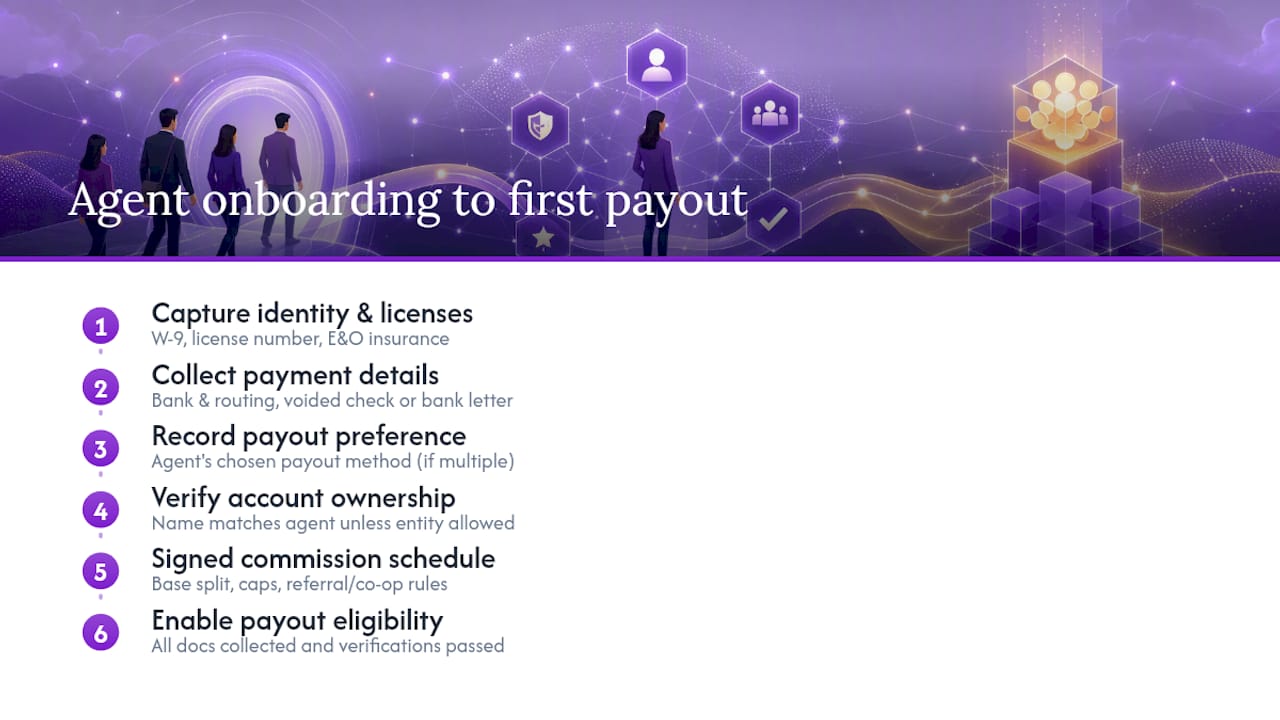
One detail brokerages miss: verify the bank account belongs to the agent, not a spouse or a business entity with a different name, unless your commission schedule explicitly allows entity payments. A mismatched name on a payout is a common source of delayed transfers and, in some cases, a compliance flag worth avoiding entirely. Build this verification into your profile creation step rather than discovering the mismatch after a payout bounces.
How Do You Prevent Fraud in Commission Payment Processing?
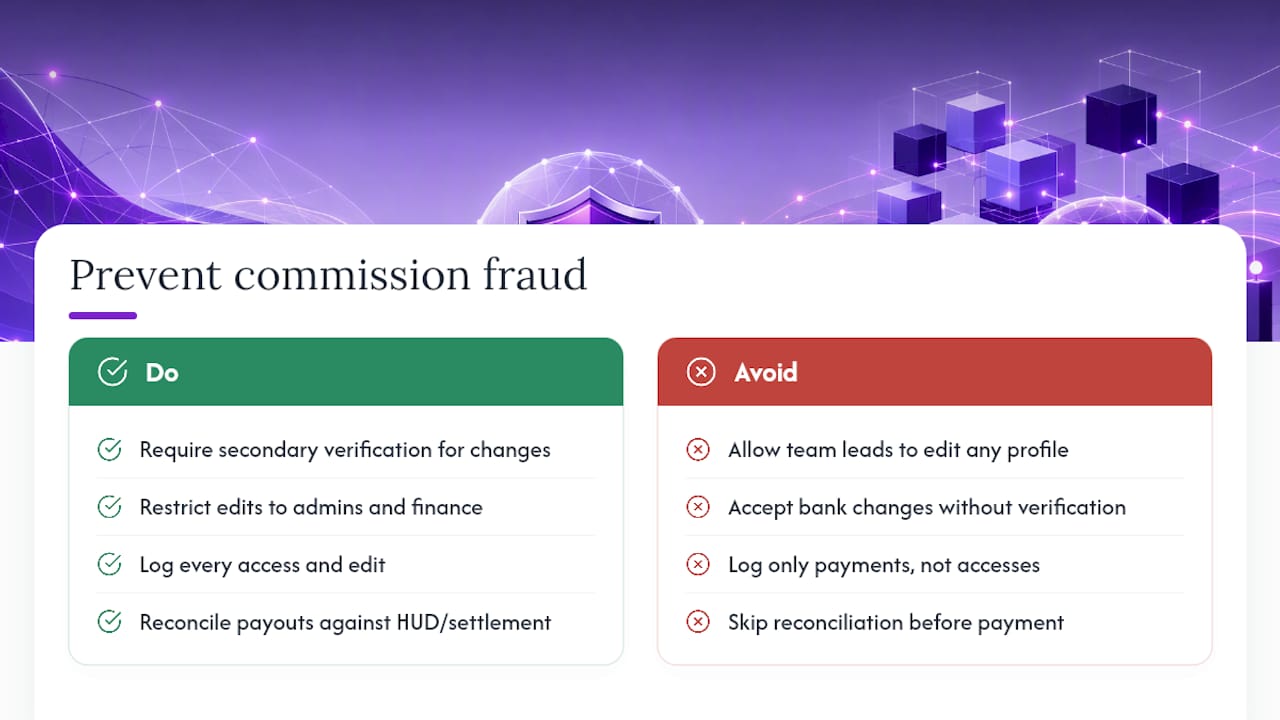
Commission payouts are a target for a specific kind of fraud: a fraudulent change of bank details submitted right before a large payout, timed to look like routine account maintenance. The defense is procedural, not technical. Require a secondary verification step, a phone call or a signed form, any time payment details change, especially in the days leading up to a scheduled disbursement.
Role-based access limits who can even view or edit payment profiles in the first place. If every team lead can edit banking details for agents outside their own group, you’ve built a wide-open attack surface. Restrict edit permissions to admins and finance, and give agents a self-service view that lets them submit change requests without directly modifying the record themselves.
An audit trail that logs every access and every edit, not just every payment, is your second line of defense. If a fraudulent change does slip through, the log tells you exactly when it happened and who was in the system at the time. Reconciliation against HUD and settlement statements before payment initiation, the same step automated disbursement pipelines already use to catch calculation errors, doubles as a fraud check: a payout that doesn’t match the closing paperwork gets flagged before it’s sent, not after.
How Do You Train Agents on the New Payment Process?
The biggest source of confusion during any payment system rollout isn’t the technology. It’s agents not knowing where their money is or why a split looks different than they expected. Solve that with a short, specific training session rather than a lengthy manual nobody reads.
Cover four things in onboarding: how to read a commission statement, how splits and deductions are calculated for their specific template, how to submit a dispute if a number looks wrong, and where to check payout status without calling the office. A fifteen-minute walkthrough during initial onboarding, paired with a one-page reference sheet, covers most of what agents actually need.
Ongoing support matters more than the initial session. Designate one point of contact, usually someone in finance or operations, for payment questions specifically, separate from general brokerage support. Agents who know exactly who to ask stop guessing and stop assuming the worst when a payout takes an extra day. Pair that with the milestone check-ins some onboarding automation frameworks recommend at day 1, day 7, and day 30, and you catch confusion before it becomes a formal dispute.
What Does Success Look Like at 30, 90, and 180 Days?
At 30 days, every pilot payout should reconcile against your spreadsheet with zero unexplained variance, and agents should have received a clear statement. At 90 days, approvals should be moving through the workflow with minimal manual intervention, and the number of manual override steps should be dropping. By 180 days, exception rates should sit low, disputes should follow a defined SLA, and payout timing should be consistent enough that agents stop asking when they’ll get paid.
— Wes
Get Your Brokerage’s Payment Setup Running the Right Way
Everything covered above, split templates, approval trails, audit-ready statements, is exactly what commission payment platforms aim to handle for independent and multi-office brokerages. Instead of stitching together spreadsheets, a bank portal, and a Venmo request when someone’s in a hurry, you get one system that tracks splits, referral fees, and co-op commissions with the documentation to back up every payout.
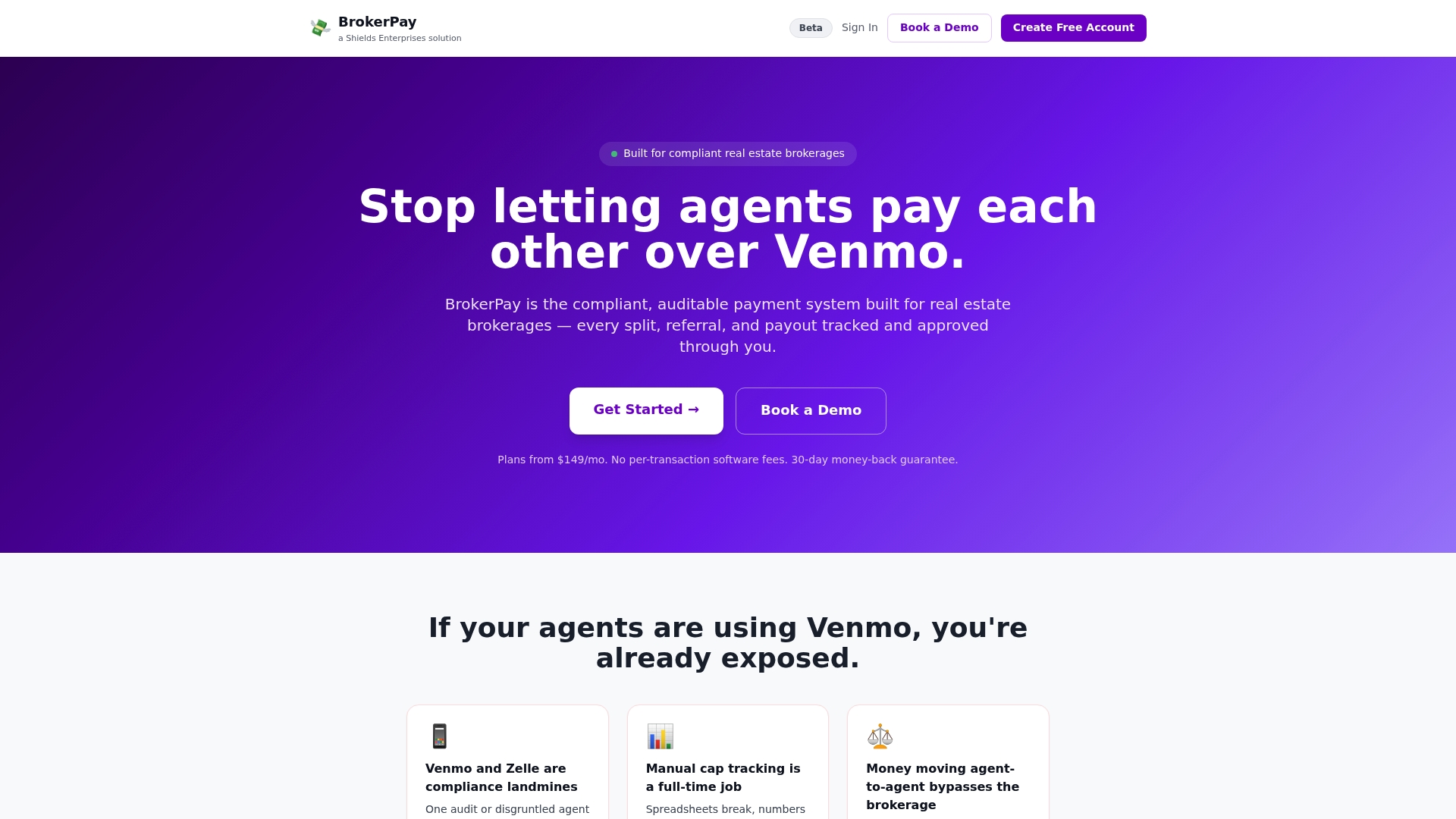
BrokerPay maps directly onto the workflow this article describes: role-based approvals, a documented split template library, and a full audit trail for every commission paid. If your brokerage is still one departing bookkeeper away from losing track of who approved what, visit BrokerPay to see how the platform handles agent payment onboarding from signed ICA to reconciled payout, and request a demo to walk through your own split structure.
Sources
- Commission Tracking for Real Estate Teams (US Guide) | AltStack
- Real Estate Agent Onboarding Checklist for Brokers | FirstHR
FAQ
What Triggers the Agent Onboarding Payment Process?
A signed independent contractor agreement should trigger the entire onboarding sequence, from license verification to payment profile creation, so the agent record is captured once instead of rebuilt across multiple systems.
How Many Split Templates Should a Brokerage Build?
Three to five templates covering standard buy-side, list-side, team, and referral deals typically cover most transaction types; add exceptions as documented cases rather than new templates.
How Long Does an ACH Commission Payout Take?
ACH transfers generally settle in one to three business days, making them the standard method for routine commission payouts, with wires reserved for time-sensitive cases.
What Should Happen When an Agent Disputes a Payout?
The agent should submit a dispute with supporting evidence like the HUD statement, and the brokerage should resolve it within a defined SLA, commonly five business days, with any adjustment appended to the statement as a new record.
Why Is Venmo or Zelle Risky for Commission Payments?
Peer-to-peer apps create undocumented payment trails that raise RESPA compliance concerns and leave no audit record if a regulator or departing agent challenges a payout, which is why platforms like BrokerPay track every split and approval formally.