Brokerages: Audit Ready Agent Cap Reporting in One Ledger

Agent cap reporting is a live, auditable record of what each agent has paid toward their commission cap and what’s left before their split changes. A platform built to handle all four requirements inside one compliance-focused system.
TL;DR:
- Accurate cap tracking requires real-time, auditable data on agent balances, deal splits, reset dates, and transaction fees to prevent disputes.
- Standard reports should include a YTD cap ledger, detailed deal breakdowns, a cap achievement dashboard, reconciliation records, and notification logs.
- Building a reliable system involves structured data encoding, automatic transaction pulling, live balance reading, precise crossing transaction splits, and documented approval workflows.
- Most errors stem from stale balances, incorrect deal splitting, mid-year plan changes, chargebacks, and rounding issues, all preventable with clear policies.
- Implementing centralized, automated cap reporting restores compliance, reduces manual effort, enhances transparency, and improves agent relations through clear progress tracking.
Table of Contents
- What Is an Agent Cap, and Why Does Reporting It Matter?
- What Reports Do You Actually Need for Audit-Ready Cap Tracking?
- How Do You Actually Build a Reliable Cap Reporting Process?
- Why Do Cap Calculations Go Wrong, and How Do You Fix Them?
- What Compliant Cap Reporting Actually Buys Your Brokerage
- How Brokerpay Handles Cap Tracking for You
- Sources
What Is an Agent Cap, and Why Does Reporting It Matter?
An agent’s cap is the maximum amount in commission split dollars the brokerage collects from that agent during a plan year. The bookkeeping mechanics behind capped models require a running per-agent total that resets on a fixed date, and getting that reset date wrong is one of the fastest ways to trigger an agent dispute.
Here’s where brokerages trip up most: caps reset either on the calendar year or on the agent’s individual anniversary date, and plenty of offices run both models at once for different agent tiers. That means the anniversary date has to live directly on the agent’s record, not in a spreadsheet tab someone updates manually every January.
A correct cap system needs to track:
- The cap amount itself, in dollars, per agent per plan year
- The pre-cap split percentage and the post-cap split or flat fee
- The reset trigger, whether calendar-based or anniversary-based
- Any post-cap transaction fees layered on top of the new split
Skip any one of these and you’re guessing at payouts. And guessing is exactly what gets brokerages into disputes, because agents talk to each other, and a mismatched cap balance between two agents on the same plan gets noticed fast. A timestamped, auditable ledger settles those conversations before they start.
What Reports Do You Actually Need for Audit-Ready Cap Tracking?
Cap reporting fails most often not because the math is hard, but because the data lives in five different places and nobody owns the reconciliation. The fix is a small set of standing reports, each pulling from a single ledger of record.
At minimum, your brokerage needs:
- Agent ledger showing YTD cap balance, the timestamp of the last update, and the agent’s anniversary date
- Transaction-level split breakdown that shows, for any crossing deal, exactly how many dollars were paid at the pre-cap rate and how many at the post-cap rate
- Cap-achievement dashboard for the full roster, so admins can see who’s close to capping without pulling individual files
- Reconciliation report that ties the HUD or ALTA settlement statement to the ledger entry to the actual payout
- Alert and notification history documenting every 80%, cap-hit, and reset notice sent to agents and admins
Commission tracking platforms that centralize plan configuration and pair it with agent-facing dashboards showing YTD production and cap progress cut down on the back-and-forth between agents and accounting. Giving agents that visibility directly, rather than making them ask, reduces administrative inquiries and tends to improve retention.
Pro Tip: Run your reconciliation report monthly, not quarterly. A three-month gap between a HUD statement and your ledger entry is exactly how a $400 discrepancy turns into a $4,000 mess by the time someone catches it.
None of these reports need to be complicated. They need to exist, update in real time, and pull from the same source every time someone asks.
How Do You Actually Build a Reliable Cap Reporting Process?
Building this system is less about software sophistication and more about sequencing. Get the order wrong and you’ll spend months fixing bad data instead of preventing it.
- Encode each comp plan as structured data. Cap amount, pre-cap split, post-cap split, post-cap fee, anniversary date, and rounding rule all need to be fields, not notes in a contract PDF. Treating the cap as a numeric field read at calculation time makes the logic repeatable instead of dependent on whoever’s doing payroll that week.
- Pull closed transactions automatically. Whether through an API or a scheduled export, you need sale price, gross commission income, close date, agent ID, and the underlying HUD or ALTA figures landing in your system without manual re-entry.
- Read the live YTD balance before every calculation. Never calculate a split against a balance that’s more than a few minutes old.
- Split crossing transactions at the cap line. If an agent is $3,000 short of their cap and closes a $5,000 commission deal, $3,000 gets the pre-cap rate and $2,000 gets the post-cap rate. Treating the whole deal as one side or the other is the single most common cap error, and it’s usually the one agents catch first.
- Write the result to the ledger of record with a timestamp and approver ID. No entry without documentation of who approved it and when.
- Set 80% and cap-hit alerts for both the agent and the admin team, plus a reset notice when the new plan year opens.
- Test the whole sequence against a fully closed prior year before trusting it with live transactions. Verifying crossing-transaction and reset logic against known-good historical data catches errors before they touch a real payout.
- Route exceptions to a human. Mid-year plan changes, negative adjustments, and referral carve-outs should never run through fully automated logic without review.
Offices running this manually for 25 or more agents typically burn 6 to 12 hours a month on disbursement alone. Automating the calculation and ledger update drops human review time down to a few minutes per transaction, which is the real payoff of doing steps 1 through 8 right the first time.
Why Do Cap Calculations Go Wrong, and How Do You Fix Them?
Most cap disputes trace back to five repeatable mistakes, and every one of them is preventable with a policy decision made in advance rather than improvised mid year.
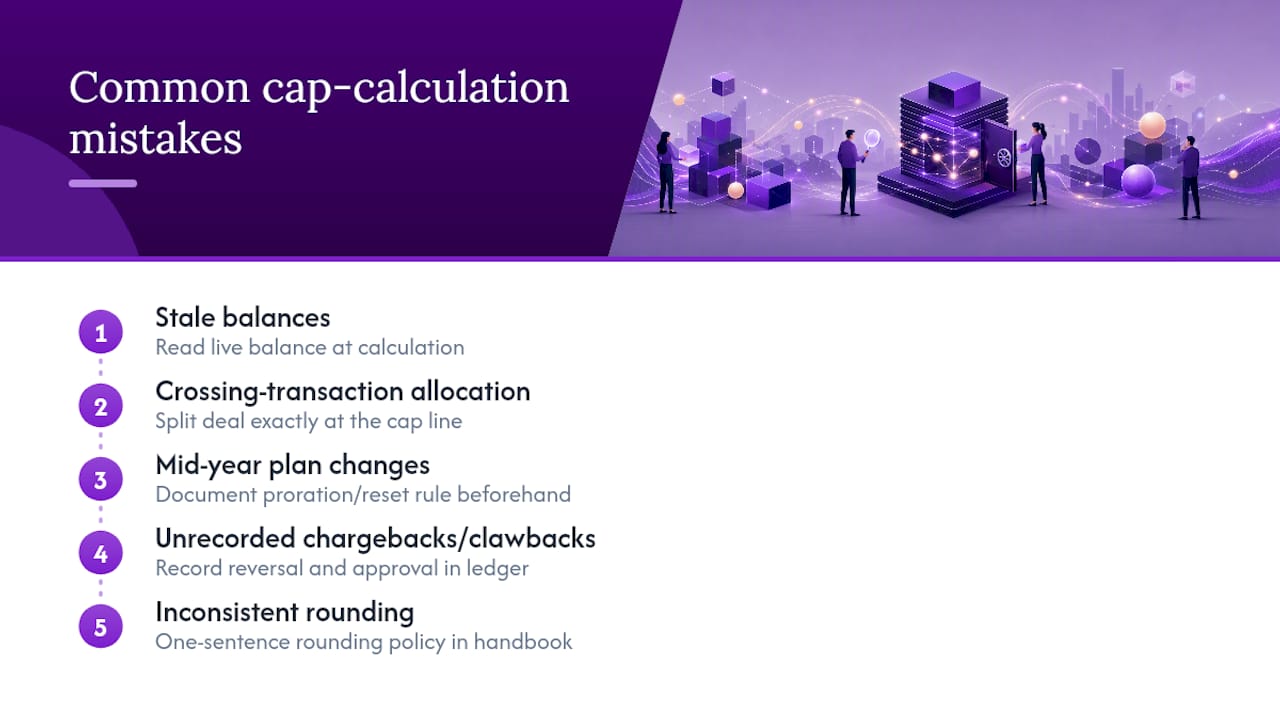
Stale balances top the list. If your system calculates a split against a balance that’s a day old, or worse, a week old, you’ll misclassify the next transaction. Always read the live figure at the moment of calculation, not from a cached report.
Crossing-transaction errors come next, and they’re almost always the same mistake: someone assigns the entire deal to either the pre-cap or post-cap bucket instead of splitting it exactly at the cap line.
Mid-year plan changes need a documented policy before they happen, not after. Decide whether a promotion or renegotiated split prorates the existing balance, carries it forward untouched, or resets it to zero, then apply that rule the same way for every agent.
Chargebacks and clawbacks from a fallen-through deal have to reflect the actual contract terms, with the reversal and its approval both recorded in the ledger. And rounding matters more than people expect. A $0.50 rounding difference across 40 transactions a year adds up to a number an agent will eventually ask about.
Pro Tip: Write your rounding policy down in one sentence and put it in the agent handbook. “All splits round to the nearest dollar” ends more disputes than any spreadsheet formula ever will.
What Compliant Cap Reporting Actually Buys Your Brokerage
Automation and audit trails don’t just prevent errors. They free admin time that used to go into chasing HUD statements and reconciling spreadsheets by hand, and they replace “trust me” conversations with agents with a documented number both sides can see.
The operational gains compound faster than most brokerages expect. Month-end closes faster because nobody’s manually cross-referencing three systems. Agent relations improve because a dashboard showing exact cap progress ends the guessing that fuels most disputes. And every approval sits in a timestamped record instead of an email thread someone has to dig up eight months later when a question comes up during a broker audit.
The brokerages that get this right treat cap reporting as infrastructure, not as a monthly chore someone squeezes in between closings.
— Wes
How Brokerpay Handles Cap Tracking for You
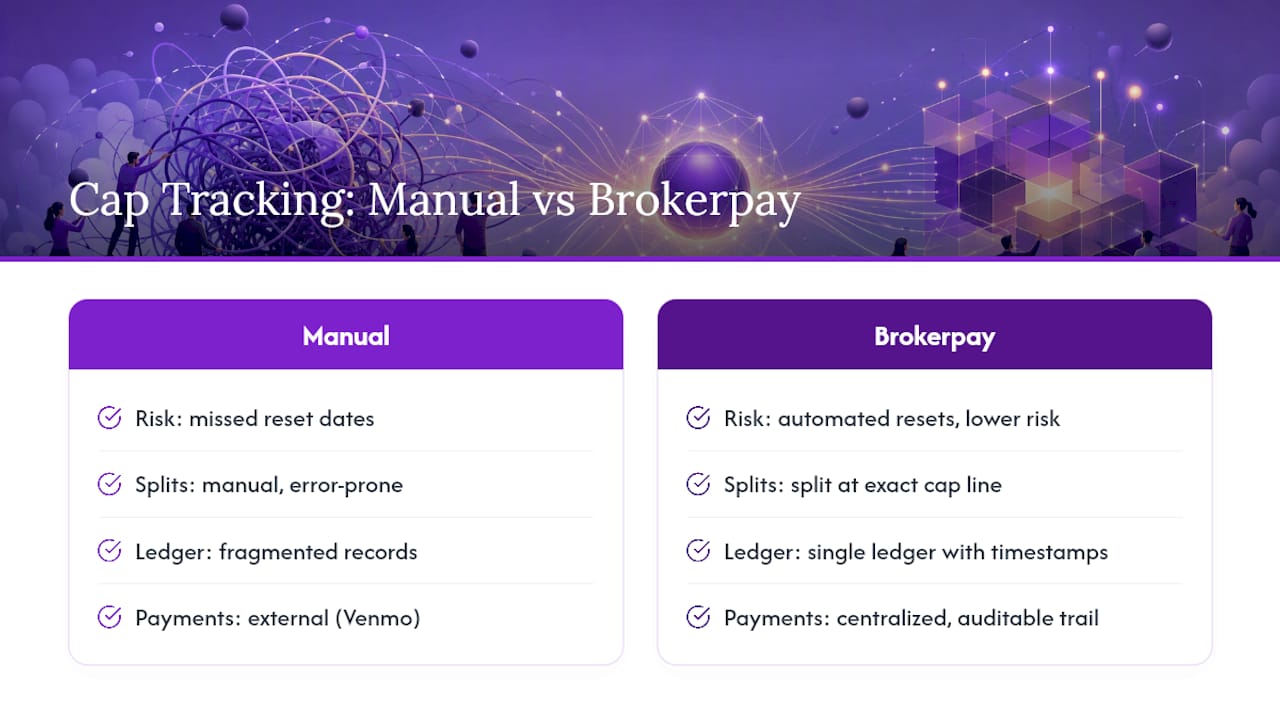
You’ve seen the checklist: a ledger of record, correct crossing-transaction splits, timestamped approvals, and threshold alerts. Building that in spreadsheets means someone owns the risk of a missed reset date or a miscalculated split every single month. A platform is built to run that checklist automatically, as one system instead of five disconnected ones.
The platform tracks each agent’s YTD cap balance against their plan, splits crossing transactions at the exact cap line, and writes every calculation to a single ledger with timestamps and approver records included. That matters beyond convenience. Every time an agent gets paid outside a documented, centralized system, whether through a peer-to-peer app or a manual check, the brokerage is carrying RESPA compliance risk it doesn’t need to carry. Centralizing the payment itself, not just the calculation, closes that gap and gives you one auditable trail from closing statement to payout.
If your brokerage is still reconciling caps by hand or watching agents settle co-op splits over Venmo, see how Brokerpay handles commission payments and get a walkthrough of the cap tracking and approval workflow before your next reset date hits.
Sources
For deeper detail on the bookkeeping side of capped commission plans, see Beancount’s guide to brokerage GCI and cap tracking. For the automation logic behind crossing transactions and resets, US Tech Automations’ cap automation guide walks through the full sequence. For platform-level dashboard requirements, Qobra’s commission tracking software guide covers agent-facing visibility standards.
- Beancount
- Automate brokerage cap and reset commission automation — US Tech Automations (2026)
- Real estate commission tracking software: Guide — Qobra