Audit Ready in a Quarter: Agent Split Automation for Brokerages

Agent split automation is the right next step the moment manual commission math starts producing errors, late payments, or agent disputes. A system built on a defined calculation engine, documented approval workflows, and an audit trail, like BrokerPay’s platform, replaces spreadsheets and Venmo transfers with something a regulator or a broker-owner can actually verify. Before switching, assess how complex your split rules are and how many transactions run through your office each month.
TL;DR:
- Agent split automation reduces errors and disputes by applying consistent, rule-based calculations for complex split structures like tiers, caps, and referral fees.
- Successful implementation requires thorough mapping of existing rules, data sources, and integration points, along with careful testing of edge cases before full rollout.
- The system supports compliance with regulations by maintaining an auditable trail of approvals, calculated amounts, and payment confirmations tied to the transaction record.
- Cost savings emerge quickly through reclaimed staff hours, fewer payout corrections, and faster agent payments, typically breakeven within a few months for moderate-sized brokerages.
- Handling edge cases such as mid-deal cap crossings or late referrals demands explicit policies and dispute workflows to prevent process disruptions.
Table of Contents
- What Does Agent Split Automation Actually Do?
- Which Commission Models Does Automation Support?
- How Do You Roll Out Agent Split Automation?
- What Does Agent Split Automation Cost, and When Does It Pay Off?
- Which Systems Need to Connect to Your Split Automation?
- How Does Automation Support RESPA Compliance and Audit Trails?
- How Do You Handle Split Automation Edge Cases?
- What Should Brokerages Realistically Expect From Implementation?
- Get Started With Brokerpay’s Commission Platform
- Sources
What Does Agent Split Automation Actually Do?
Agent split automation takes the math brokers used to do by hand or in a spreadsheet formula and turns it into a repeatable, rule-based process. The engine applies split percentages, caps, tiers, and overrides consistently, every single time, regardless of who’s processing the closing that week.
That consistency matters more than it sounds. A transaction-level commission record that links gross commission, split percentages, deductions, approvals, and payments cuts down on the errors and missed deductions that plague manual tracking. When every calculation ties back to a source document, nobody has to reconstruct what happened three months later during an audit.
The core capabilities break down into three layers:
- Calculation engine: applies split rules, caps, tiers, and referral deductions automatically based on the transaction’s stored parameters.
- Approval workflows: routes each payout to the right manager or broker for sign-off before money moves, with a timestamped record of who approved what.
- Payment routing: sends approved amounts through ACH rather than a personal payment app, generating a bank confirmation tied to the transaction.
Pro Tip: Run a side-by-side comparison for one pay cycle. Calculate splits manually and let the automated engine calculate the same transactions. Any mismatch usually points to a rule gap, not a software bug.
The operational payoff shows up fast: fewer agent disputes over “why is my check short,” faster days-to-pay, and records that hold up when a lender, auditor, or state regulator asks to see them.
Which Commission Models Does Automation Support?
Every brokerage runs some blend of split structures, and each one puts different demands on an automation system. Getting the rule logic right upfront saves you from a messy correction cycle later.
- Fixed splits (e.g., 70/30 or 80/20): the simplest case, but automation still needs to track effective dates if the split percentage changes mid-contract.
- Tiered or graduated splits: percentages shift as an agent crosses production thresholds. The system needs anniversary reset dates and a running year-to-date total per agent, not per transaction.
- Flat fee models: agents pay a set desk fee per closing regardless of price. Automation here mostly needs to confirm the fee posted and didn’t get skipped.
- Team and referral splits: multiple parties share one commission check, often with a referral fee carved out first. This is where manual spreadsheets fail most often, because the math has to happen in the right order.
No-code plan builders now let brokerage admins configure tiers, accelerators, and multi-role splits directly, without needing a developer to rewrite a formula every time a plan changes.
Before trusting any model to a pilot, run these tests: process a transaction that crosses a tier threshold mid-year, run a three-way team split with a referral fee, and simulate a plan change with a retroactive effective date. If the engine handles those cleanly, it will handle the routine 80/20 splits without a second thought.
How Do You Roll Out Agent Split Automation?
Implementation succeeds or fails based on how well you map your existing rules before you turn anything on. Rushing this step is the single most common reason pilots stall.
- Inventory your data sources. Identify where split rules, agent agreements, and transaction records currently live: your CRM, transaction management system, signed independent contractor agreements, and accounting software. Assign an owner for each source.
- Centralize and version your commission rules. Write down every split, cap, tier, and override policy with effective dates. If a rule changed in March, both versions need to exist with dates attached, since old transactions may still reference the prior rule.
- Build the integration plan. Decide how transaction data will flow into the automation engine and what fields have to match exactly (agent ID, transaction ID, closing date) to avoid duplicate or orphaned records.
- Test with a bounded pilot. Pick a handful of closings that represent your hardest cases: a team split, a referral, a capped agent. Don’t test only the easy 70/30 deals.
- Roll out in phases. Run automation and manual calculation in parallel for one full pay cycle, train agents on how to read the new statement format, then cut over completely once the parallel run matches.
- Set a reconciliation cadence. Weekly or per-pay-cycle reconciliation catches drift before it compounds into a bigger cleanup job.
Pro Tip: Treat your first pilot batch like a stress test, not a demo. Feed it your messiest transactions on purpose. If the system survives a three-way split with a late referral, it’ll handle everything else without complaint.
Large reconciliation batches sometimes benefit from splitting big jobs into smaller, bounded chunks that get merged back together, a pattern borrowed from modular task-processing systems that handle overflow without losing accuracy.
What Does Agent Split Automation Cost, and When Does It Pay Off?
Cost usually breaks into several buckets, including software licensing, integration or setup work, payment processing fees, and implementation services for mapping complex legacy rules.
The break-even math is more straightforward than most brokers expect. Say your office manager currently spends six hours per pay cycle reconciling splits by hand, and you run two cycles a month. That’s roughly 144 hours a year at an internal cost of, say, $30 an hour, which is over $4,300 in staff time alone, before you count the cost of a single payout error that requires a clawback conversation with an agent.
- Cost drivers: per-agent licensing fee, one-time integration setup, ACH processing costs, optional onboarding support.
- Savings drivers: reclaimed office-manager hours, fewer payout corrections, faster agent payments, reduced exposure during a compliance review.
- Metrics to track post-launch: reconciliation time per cycle, dispute rate per 100 transactions, and average days-to-pay from closing to funded payout.
Commission automation engines that run defined rules each pay cycle produce audit-ready statements without spreadsheet rebuilds, which is where a lot of the ongoing time savings compound month over month. A brokerage with a moderate number of agents processing several closings each month typically sees break-even within a few months once you account for reclaimed hours and avoided errors., though the exact timeline depends on how tangled your current split rules already are.
Which Systems Need to Connect to Your Split Automation?
Automation is only as good as the data feeding it. Five integration points matter most for a real estate office: your transaction management or closing platform, your CRM, accounting software, payroll, and a bank or ACH provider for actual fund movement.
Before any of those connections go live, run this data-hygiene checklist:
- Confirm every agent has a unique, unchanging identifier across all connected systems.
- Attach the signed split agreement to the transaction record, not to a separate agent file.
- Record effective dates on every rule change so historical transactions calculate against the correct version.
- Verify party attribution on co-op and referral deals before the transaction reaches the payout stage.
The most common breakage points are late-arriving referral agreements, duplicate transaction records created by manual re-entry, and mismatched agent IDs between the CRM and the accounting system. Automated platforms that calculate net firm revenue directly on the contract page reduce the guesswork that shadow spreadsheets used to paper over, but only if the underlying transaction record is clean before it hits the calculation engine.
How Does Automation Support RESPA Compliance and Audit Trails?
Ad-hoc payments through Venmo, Zelle, or Cash App create a documentation gap that most brokers don’t notice until a regulator or a lawsuit forces the question: where’s the proof this payment was approved, and why was it made? A personal payment app has no field for split percentage, no approval record, and no link back to the closing file.
A real audit trail needs to preserve specific records tied to the transaction:
- The signed commission or referral agreement.
- The approving manager’s identity and timestamp.
- The calculated split amount and the rule version applied.
- The ACH payment instruction and bank confirmation.
A defensible commission process connects the calculation logic, the approving manager, the payment instruction, and the bank confirmation, all timestamped and linked back to the signed agreement. That chain is what an auditor or a state regulator actually wants to see, not a Venmo memo line.
BrokerPay was built around exactly this chain: it tracks and documents agent splits, referral fees, and co-op commissions so the calculation, the approval, and the ACH payment all live on one record instead of scattered across text messages and personal accounts. That structure is what keeps a brokerage RESPA-compliant instead of hoping nobody ever asks for the paperwork.
How Do You Handle Split Automation Edge Cases?
The clean 70/30 deal isn’t what breaks automated systems. It’s the messy middle: an agent who crosses their cap mid-transaction, a referral fee that shows up after the file already moved to closing, or a co-op split where two offices disagree on the percentage.
Mid-deal cap crossovers need an explicit policy before you automate anything. Some brokerages hold the transaction for manual review the moment an agent nears their cap threshold; others let the system prorate automatically based on documented rules. Either works, but the system needs to know which one you’ve chosen. Without that control, agents end up disputing prorated amounts they don’t understand.
- Flag transactions nearing a cap threshold for manual review rather than letting the engine guess.
- Reconcile referral and co-op agreements before running the calculation, not after.
- Log every dispute with a timestamp, the agent’s query, and the resolution path.
- Record clawbacks as a separate line item with a clear explanation, not a silent adjustment.
Pro Tip: Build your dispute workflow before you launch, not after the first angry email. A defined escalation path with a stated response window prevents small disagreements from turning into trust problems with your agents.
What Should Brokerages Realistically Expect From Implementation?
Most brokerages underestimate how much time cleaning up existing data takes and overestimate how fast agents will trust a new statement format. The pilots that go sideways almost always trace back to one thing: nobody mapped the edge cases before launch, so the first capped agent or late referral becomes a fire drill instead of a routine test case.
Give yourself a full quarter before expecting smooth operation, not a single pay cycle. Communicate early and often with agents about what the new statements will look like, and keep a manual fallback ready for the first month. It’s cheaper than an angry agent group text.
— Wes
Get Started With Brokerpay’s Commission Platform
Some commission platforms replace Venmo requests and spreadsheet reconciliation with systems that calculate splits, route approvals, and send ACH payments, all tied to a documented transaction record. If your office is juggling caps, referral fees, and co-op splits across multiple agents, this is the checklist from above built into software rather than a manual process someone has to remember to run correctly.
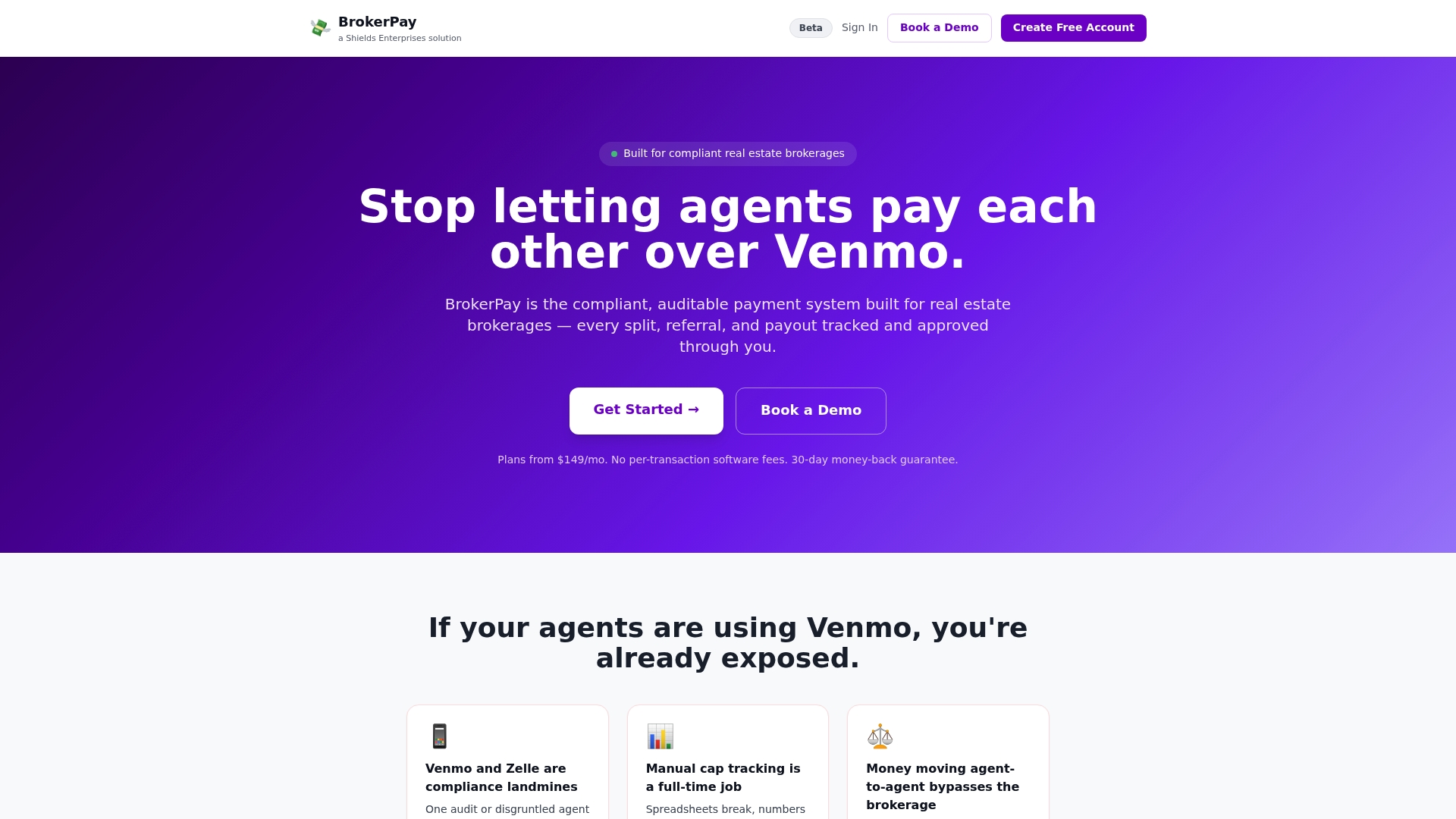
For a brokerage owner tired of chasing down approvals over text message, the fix isn’t a better spreadsheet template. It’s a system where the calculation, the sign-off, and the payment confirmation all live in one auditable place. Request a demo of Brokerpay to see how your current split rules would run through the platform before you commit to a full rollout.
Sources
- Commission Split Tracking: Accuracy Guide - Modern Marks
- Best Commission Software | #1 on G2 & Gartner | Everstage
- Commission Tracking for Real Estate Teams | REHomebase
- Automated Commission Calculation Software | Sequifi