Make Your Brokerage Audit Ready: 7 Steps for RESPA Section 8 Referrals

No, you may not pay or accept anything of value for referrals tied to a federally related mortgage settlement service, outside narrow, documented exceptions. That prohibition comes straight from 12 U.S.C. §2607 and 12 C.F.R. §1024.14. The immediate move for any brokerage still running referral fees or co-op splits through Venmo or Zelle: stop, and start documenting every payment that could touch a referral.
TL;DR:
- Sending or accepting referral fees through peer-to-peer apps like Venmo or Zelle is illegal unless documented under specific exceptions and workflows.
- Payments tied to referrals can trigger violations even without written agreements, and regulators may interpret reciprocal conduct as unwritten deals.
- The broad definition of a referral or thing of value includes almost any offer or transfer with economic worth, such as marketing materials, equipment, or exclusive data access.
- Legitimate exceptions require strict compliance, including written disclosures for affiliated business arrangements and actual services performed for bona fide compensation.
- Implementing auditable workflows with signed contracts, detailed invoices, and management approval significantly reduces the risk of RESPA violations.
Table of Contents
- What RESPA Section 8 Actually Prohibits
- What Counts as a Referral or a Thing of Value?
- When Are Referral Payments Legal? Understanding the Exceptions
- Why Marketing Services Agreements Draw Regulatory Scrutiny
- Building an Auditable Referral Payment Workflow
- Common Scenarios That Trigger RESPA Violations
- How Regulators Investigate and Penalize RESPA Violations
- What Brokerages Should Actually Fix First
- Replace Venmo and Zelle With a System Built for RESPA Audits
- Primary Sources on RESPA Section 8 and MSA Compliance
- Sources
What RESPA Section 8 Actually Prohibits
Section 8 of the Real Estate Settlement Procedures Act bars giving or accepting any fee, kickback, or thing of value in exchange for referring settlement service business connected to a federally related mortgage loan. That’s the plain-language version of 12 U.S.C. §2607, and Regulation X’s §1024.14(b) enforces it at the regulatory level with nearly identical language.
The statute doesn’t require a signed contract to trigger liability. An “agreement or understanding” can be written, spoken, or simply inferred from a pattern of conduct, according to the Federal Reserve’s own summary of the rule. If a title company routinely sends business to an agent who routinely sends business back, regulators can treat that reciprocity as evidence of an unwritten deal, even with no memo ever exchanged.
Penalties are not trivial. Violations can carry fines up to $10,000 per violation and up to one year in prison, on top of civil liability equal to three times the value of the improper charge. Regulators also have broad remedial tools beyond criminal referral:
- Cease-and-desist orders halting a specific payment arrangement
- Civil money penalties assessed against brokerages and individuals
- Consent orders requiring restitution to affected consumers
- Referral of matters for criminal prosecution in serious cases
None of this hinges on proving harm to a specific homebuyer. The rule targets the payment structure itself, not whether a consumer ended up overpaying.
What Counts as a Referral or a Thing of Value?
A “referral” under Regulation X is any oral or written action that directs a person toward, or away from, a particular settlement service provider, including any instance where “required use” of a provider is imposed as a condition of the transaction. That’s the standard set out in §1024.14(f), and it’s broader than most brokers assume.
A “thing of value” rarely looks like a check. The CFPB and Regulation X read this term expansively enough to cover almost anything with economic worth. Common examples that trip up brokerages:
- Free or discounted marketing materials, websites, or ad placements
- Loaned or gifted equipment, office space, or staff time
- Exclusive access to lead data or buyer lists
- Trips, event tickets, or entertainment provided at no cost
- Below-market rent for office space tied to referral volume
Referrals run in both directions. An agent who steers a buyer to a specific title company can violate Section 8 just as easily as a lender who steers borrowers to a specific agent. Consider a lender who hands a loan officer’s business card to every buyer who walks in, while that loan officer quietly pays the agent’s brokerage a flat monthly fee labeled “marketing support.” If no marketing work happens, that fee is a referral payment wearing a disguise, regardless of what the invoice calls it.
When Are Referral Payments Legal? Understanding the Exceptions
Section 8 carves out a handful of narrow paths where payment for a referral or related service is lawful, but each comes with conditions that have to be met exactly, not approximately.
- Payments to attorneys for actual legal services rendered in connection with a transaction, not referral fees disguised as legal fees.
- Bona fide salary or compensation paid for goods furnished or services actually performed, meaning the amount has to reflect real market value for real work, not a round number that happens to track referral volume.
- Cooperative brokerage arrangements, where two licensed real estate brokers split a commission for work both parties actually performed within their brokerage capacity, such as a listing broker and a buyer’s broker.
- Affiliated business arrangements (AfBAs), where a brokerage refers business to a settlement service provider it holds an ownership stake in, provided strict disclosure rules are followed.
The AfBA exception is the one most brokerages get wrong. It requires a written disclosure delivered to the consumer at or before the time of the referral, spelling out the ownership relationship, an estimate of the range of charges the affiliated provider generally charges, and a clear statement that the consumer isn’t required to use that provider. Skip the timing, and the disclosure doesn’t cure the violation. Cooperative brokerage has its own limit too: it only holds up when both brokers are performing genuine brokerage functions. A payment to someone who never touched the file doesn’t become legal just because everyone involved happens to hold a real estate license.
Why Marketing Services Agreements Draw Regulatory Scrutiny
Marketing services agreements, or MSAs, have become one of the most closely watched structures in RESPA enforcement, and for good reason; see how Sponsor Support Services can help structure and monitor these vendor partnerships properly. The CFPB’s compliance bulletin on MSAs states plainly that many of these agreements function as disguised referral-fee arrangements, with a marketing label slapped on top.
The test isn’t whether the agreement calls itself “marketing.” It’s whether marketing services were genuinely performed and whether the payment amount tracks fair market value for that specific work, a fact-intensive standard Regulation X applies regardless of how the parties labeled the deal. Red flags regulators and smart compliance officers watch for:
- Payment amounts that rise and fall with referral volume rather than with the marketing work performed
- No specific deliverables listed, or deliverables that are vague (“brand awareness support”)
- Compensation that exceeds what an independent marketing vendor would charge for the same scope
- No documentation showing the services were actually delivered on schedule
Pro Tip: Before signing any MSA, ask whether you’d pay the same amount to a vendor with zero referral relationship, doing the identical scope of work. If the answer is no, the agreement has a referral-fee problem hiding inside it.
Building an Auditable Referral Payment Workflow
Compliance with RESPA Section 8 isn’t really a legal question most days. It’s an operations question. Brokerages get into trouble not because they intend to violate federal law, but because their payment workflows leave no paper trail proving they didn’t.
Start with a written policy. Every brokerage handling referral fees, co-op commissions, or vendor payments tied to marketing should have a clear internal rule: no payment goes out that’s connected, directly or indirectly, to referral volume unless it fits one of the recognized exceptions. That policy needs teeth, which means requiring management approval before any new vendor contract or MSA gets signed, not after the first invoice arrives.
- Put every arrangement in writing. Verbal understandings are exactly the kind of “agreement or understanding” that Section 8 targets, so a written contract with specific terms protects the brokerage as much as it constrains it.
- Require itemized invoices for every payment. A vendor invoice that says “services rendered, $2,500” proves nothing. An invoice listing hours worked, deliverables completed, and dates of service gives you something to show an investigator.
- Demand proof of performance before authorizing payment. If a marketing vendor claims it ran a social media campaign, ask for the campaign report, not just the bill.
- Route payments through an auditable system rather than informal apps. A tool like BrokerPay can log approval chains, timestamp every transaction, and attach supporting documents to each payment record, replacing the peer-to-peer app trail that leaves nothing for a compliance officer to review later.
- Standardize your AfBA disclosures. Use the same disclosure template every time, track when it was delivered, and keep a signed acknowledgment or system log proving the consumer received it before the referral occurred.
- Train staff on what triggers scrutiny. Agents often don’t realize that splitting a commission with someone who did no work, or accepting a “gift” from a title company, falls under the same statute as a cash kickback.
- Monitor for patterns, not just individual transactions. A single referral payment might look fine in isolation. A pattern where the same two parties exchange payments every time a deal closes is what regulators are trained to spot.
Pro Tip: Keep a running log of every agent-to-agent and agent-to-vendor payment for at least three years. RESPA enforcement actions often review historical patterns, not just the most recent transaction, and a brokerage with clean records going back several years is in a dramatically stronger position than one that can only produce this quarter’s files.
Documentation habits also carry a benefit that has nothing to do with RESPA directly: they make tax season far less painful. Brokerages that track commissions consistently tend to avoid the scramble of reconstructing a year’s worth of splits from memory and bank statements.
The hardest part of any compliance program isn’t writing the policy. It’s enforcing it consistently when a busy agent wants to pay a referral partner the fast way, through an app, on a Friday afternoon, because the wire transfer feels slow. That’s exactly the moment a brokerage’s controls either hold or quietly fail.
Common Scenarios That Trigger RESPA Violations
Certain patterns show up again and again in enforcement actions and internal audits, and recognizing them before they become habits is half the battle.
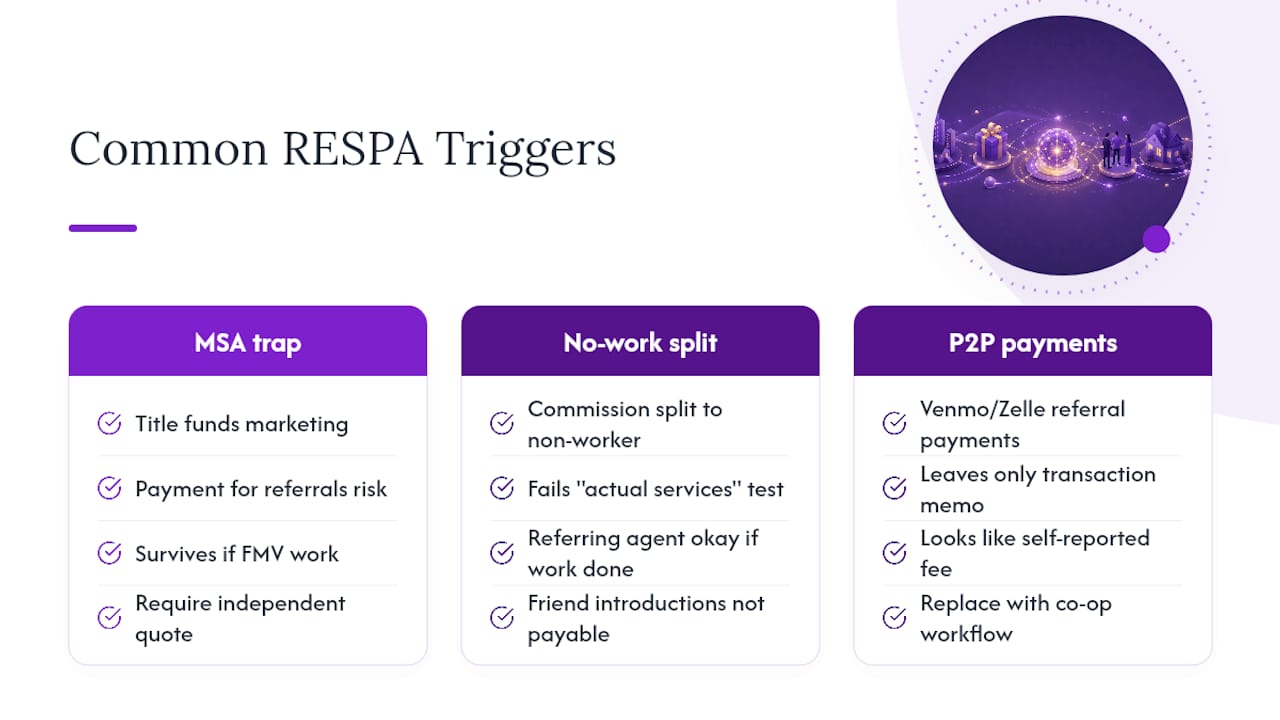
A title company funds an agent’s marketing budget in exchange for “preferred” status. This is the classic MSA trap. If the title company is genuinely running ads or producing content for the agent, and the payment reflects fair market value for that work, it can survive scrutiny. If the payment simply flows because the agent sends title business that way, no amount of paperwork saves it. The fix: get an independent marketing quote for comparable work, and make sure the invoice and deliverables match that scope exactly.
A commission gets split with someone who did no work on the file. This fails the “actual services” test built into the bona fide compensation exception. A referring agent who found the buyer and handed them off can be compensated. A friend who simply introduced two people at a barbecue, with no brokerage role in the transaction, generally cannot be paid a commission split under that exception.
Agents pay each other informally through Venmo or Zelle for referrals. This might be the single most common compliance gap in the industry today. These payments leave a transaction memo, not a contract, an invoice, or proof of services. When an examiner asks what the payment was for, “referral fee” typed into a peer-to-peer app is close to a self-reported violation. Structured co-op payment workflows that route these payments through the brokerage, with documentation attached, replace that risk with a defensible record.
How Regulators Investigate and Penalize RESPA Violations
Enforcement rarely starts with a single suspicious payment. Investigators look for patterns: does a vendor’s compensation correlate tightly with referral volume rather than actual output? Are deliverables missing or vague? Does the payment amount exceed what an arm’s-length vendor would charge for comparable work?
The CFPB has relied on whistleblower tips and data analysis to uncover MSA-based schemes that might never have surfaced through a routine audit. That means a disgruntled former employee or a competitor with access to payment records can be the trigger for a full-scale review.
Consequences scale with severity and intent:
- Civil money penalties against the brokerage and, in some cases, individual agents or brokers
- Consent orders requiring restitution to affected borrowers
- Injunctive relief barring specific payment structures going forward
- Criminal referral in cases involving willful, large-scale kickback schemes
Regulators generally aren’t looking for a single bad invoice. They’re building a case around a pattern that shows payments tracked referrals, not work performed.
What Brokerages Should Actually Fix First
Most brokerages don’t have a RESPA problem because someone is running a kickback scheme on purpose. They have one because nobody ever wrote down the rules, and informal habits filled the gap.
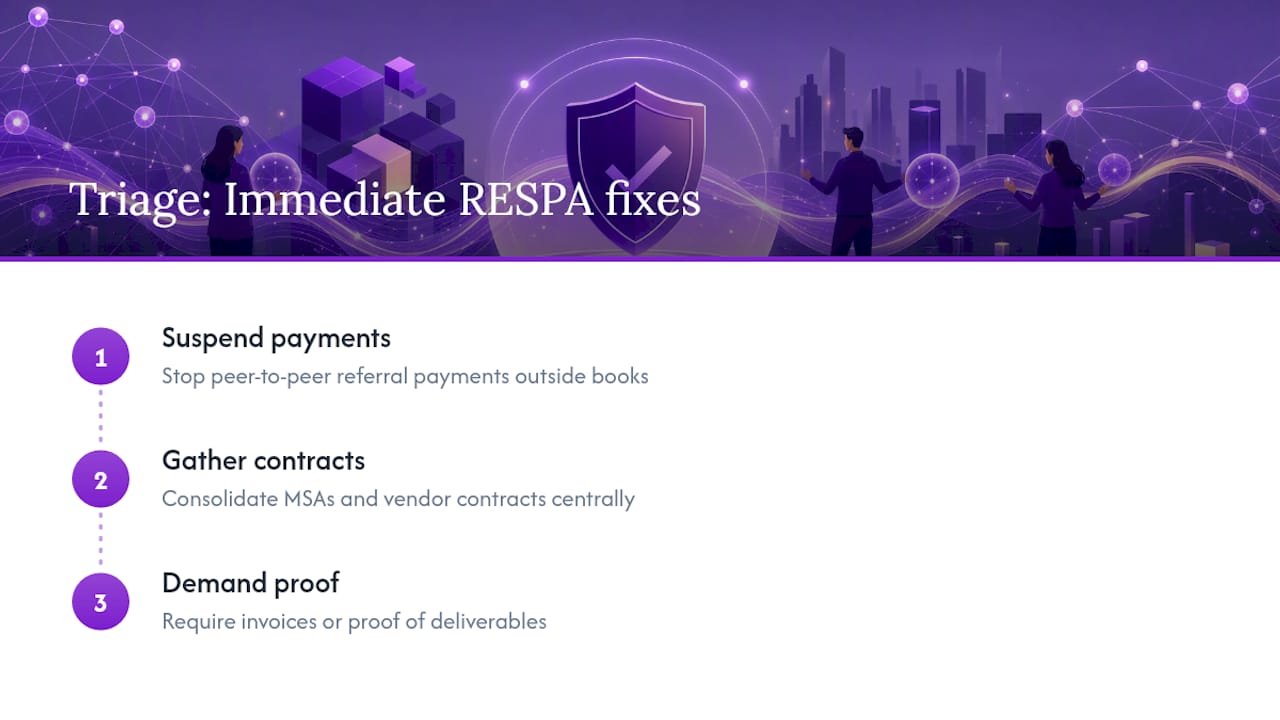
If you’re starting from zero, triage first: suspend any peer-to-peer referral payments happening outside the brokerage’s books, pull every MSA and vendor contract into one place, and demand invoices or proof of deliverables for anything that’s been running on autopilot. That alone surfaces most of the real risk within a week.
The medium-term fix is less dramatic but more durable: written policy, staff training, and a payment system built for the audit trail regulators expect. Compliance built into the workflow beats compliance enforced through memory every single time.
Replace Venmo and Zelle With a System Built for RESPA Audits
There are compliant alternatives to informal peer-to-peer payments for brokerages that need every referral, split, and co-op commission to hold up under regulatory review. Instead of a Venmo memo that says “referral fee” and nothing else, Brokerpay builds an approval workflow, an audit trail, and documentation retention directly into how commissions move.
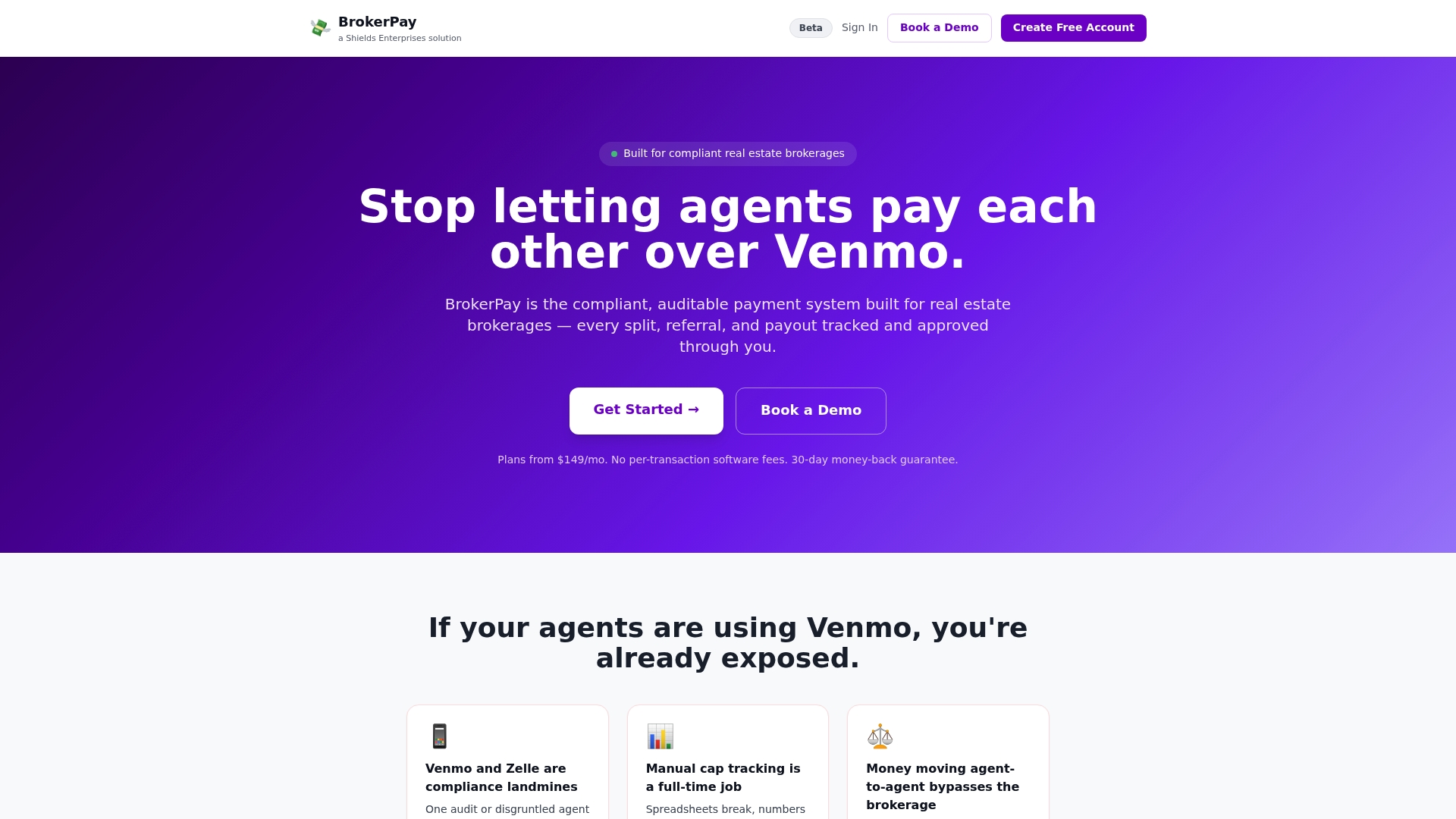
Some platforms support controls such as routing payments through management approval before they go out, tracking commission and referral splits with timestamps attached, and keeping records that can be pulled up instantly if a compliance officer or investigator asks for them. Such systems replace the app-based workaround that leaves brokerages exposed with a system built for the paper trail RESPA actually demands. If your brokerage is still settling referral fees over a payment app, see options for compliant commission payment workflows and get a look at what an auditable workflow looks like in practice.
Primary Sources on RESPA Section 8 and MSA Compliance
Read 12 U.S.C. §2607, Regulation X §1024.14, and the CFPB’s RESPA FAQs directly for the full statutory and regulatory text.
This article is general information, not a substitute for advice from a qualified lawyer. Consult a qualified legal professional about your own circumstances before acting on anything here.
Sources
- 12 USC 2607: Prohibition against kickbacks and unearned fees
- § 1024.14 Prohibition against kickbacks and unearned fees (Regulation X)
- CFPB Compliance Bulletin: RESPA Compliance and Marketing Services Agreements