Cut Audit Fieldwork: U.S. Compliance Prep in 60–90 Days

Compliance audit preparation comes down to five moves done early: lock the scope and framework version, centralize your evidence in one repository, test your riskiest controls before an auditor ever asks, assign named owners with deadlines to every gap, and run mock walkthroughs with the people who’ll sit in the interview chair. Start 60 to 90 days out for a first-time or complex audit under a standard like SOC 2, HIPAA, PCI DSS, or SOX, and closer to 4 to 8 weeks for a recurring one you’ve already survived audit prep checklist
TL;DR:
- Proper scoping and a risk-based approach prevent overly broad evidence requests and help focus remediation efforts on the highest-risk areas.
- Building a control-to-evidence matrix with clear ownership and recent artifacts enables faster auditor review and reduces fieldwork time.
- Conducting internal tests on key controls like access reviews and change management before fieldwork can significantly decrease surprises and findings.
- Early stakeholder preparation and mock interviews improve response consistency, reduce anxiety, and clarify question-answering during audits.
- Implementing a continuous readiness process with scheduled evidence updating and control testing eases future audits and minimizes last-minute scrambles.
Table of Contents
- Why Compliance Audit Readiness Matters
- Five Core Components Of Successful Compliance Audit Preparation
- The 7-Step Compliance Audit Preparation Checklist
- Timeline And Countdown: Sample 60- And 90-Day Plans
- Organize Evidence And Build The Auditor-Ready Package
- Test And Validate Controls Before Fieldwork
- Prepare Stakeholders And Run Mock Walkthroughs
- Audit Week: What To Expect And How To Keep Fieldwork Efficient
- Post-Audit: Remediation, Management Responses, And Continuous Readiness
- What Practitioners Get Wrong About Audit Prep
- BrokerPay: Reducing Payment-Related Audit Risk For Brokerages
- Sources
Why Compliance Audit Readiness Matters
An unprepared audit doesn’t just take longer. It costs money in auditor overtime fees, exposes gaps that turn into formal findings, and, depending on the framework, can trigger penalties from regulators like HHS for HIPAA violations or the SEC for financial-reporting failures. A messy audit also damages something harder to fix: the confidence of your board, your insurers, and your customers in how you run the operation.
Readiness works the other way. Auditors don’t bill by the finding, they bill by the hour, and every day of fieldwork they spend hunting for a policy document or waiting on a screenshot is a day added to the invoice. Teams that walk in with an organized control-to-evidence matrix routinely cut fieldwork by days, not hours.
Most auditors form their first impression in the opening session, before they’ve tested a single control. What they check in that first hour tends to be predictable:
- Who has access to sensitive systems, and whether that access list matches current employment records
- Whether logging and monitoring tools are actually turned on and retaining data
- How fast your team can produce the first requested evidence item
That last one matters more than people think. A clear prepared-by-client list and a single navigable folder structure set the tone for the entire engagement. If your first response takes three days, the auditor recalibrates their entire timeline, and usually not in your favor.
Five Core Components Of Successful Compliance Audit Preparation
Audit readiness isn’t a sprint you run once a year. It’s a program with five standing components that stay in place between audits, not just during them.
- Scoping and risk-based prioritization. Before anything else, define which systems, processes, and time periods fall inside the audit boundary, and rank your risks so effort goes where the exposure is highest, not where it’s easiest to document.
- Formal control documentation and policy currency. Every control needs a written policy behind it, and that policy needs a review date. Auditors flag stale documentation almost as often as missing documentation.
- Evidence organization and PBC readiness. A prepared-by-client list that maps directly to your control matrix means nobody scrambles when the request comes in.
- Control testing and monitoring. Controls that look good on paper but haven’t been tested internally are the single biggest source of audit-week surprises.
- Ownership, timelines, and remediation governance. Every open gap needs one named owner and one hard deadline. Gaps with no owner never close.
These five components reinforce each other. Weak scoping produces bloated evidence requests. Stale documentation undermines otherwise solid controls. Skip the testing step and you’re relying on hope. The core sequence auditors follow, scope, assess risk, gather evidence, test, remediate, and report, works the same way whether you’re preparing for SOC 2, PCI DSS, or an internal SOX walkthrough. Build your program around that skeleton and the framework-specific details become details, not obstacles.
The 7-Step Compliance Audit Preparation Checklist
This is the operational version, the actual sequence of work, with the deliverable you should have in hand at the end of each step.
Step 1: Define scope
Nail down the framework and its exact version. PCI DSS has moved through v4.0.x updates that changed specific control requirements, and regulatory guidance shifts often enough that assuming last year’s rules still apply is a real risk. Your deliverable here is a one-page scope document listing:
- Framework name and version number
- Reporting period (start and end date)
- Systems, business units, and locations in scope
- Explicit out-of-scope items, with the reasoning documented
Skipping the “out of scope” list is a common mistake. Auditors will ask why something was excluded, and “we didn’t think about it” is a worse answer than a documented, deliberate exclusion.
Step 2: Build the project plan and timeline
Once scope is locked, map it to a calendar. Assign a project owner, usually a compliance manager or audit coordinator, and set milestone dates for the internal assessment, remediation, evidence collection, and stakeholder prep. Set a weekly or biweekly status meeting with a fixed agenda: open items, blocked items, and anything at risk of missing its deadline.
Pro Tip: Put the audit kickoff date on a shared calendar the moment you have it, and count backward. Most teams underestimate how much of the 60 to 90 day runway gets eaten by other quarter-end priorities.
Step 3: Run the internal assessment
This is your dry run. Walk through every control in scope and score it against three states: fully operating, partially operating, or not operating. The output is a gap inventory, a simple spreadsheet mapping each control to its current state, the evidence that supports it, and a plain-language note on what’s missing.

Teams that run this kind of pre-audit self-assessment consistently surface fewer findings and finish faster than teams that wait for the actual auditor to find the gaps for them. It’s the difference between fixing a problem on your own schedule and fixing it on someone else’s.
Step 4: Assign owners and remediation deadlines
Every gap from Step 3 gets a name and a date attached to it. Build a simple priority matrix: rank gaps by severity (would this likely become a finding?) against effort (how long will the fix take?). High-severity, low-effort items get fixed first. High-severity, high-effort items get flagged early so there’s runway to address them before fieldwork starts.
- Owner: the individual accountable, not a department
- Deadline: a specific date, not “before the audit”
- Status: open, in progress, remediated, or verified
Without this structure, gaps sit in a spreadsheet until someone notices they’re still open the week before the auditor arrives.
Step 5: Implement fixes and re-test critical controls
Fixing a control and assuming it works isn’t enough. Re-test it the same way an auditor would. If you rewrote an access-review process, actually run the review and confirm the output matches what the new policy describes. This step is where teams most often cut corners, and it’s exactly the step auditors probe hardest during operating-effectiveness testing.
Step 6: Gather and tag evidence
Build your control matrix and PBC package in parallel. Every control needs its evidence artifact tagged with a location, a date, and an owner. This is also the point where a platform like BrokerPay’s control testing approach for financial transactions becomes relevant if your audit touches payment processes. A structured payment workflow generates its own evidence trail automatically, which is a very different starting position than reconstructing six months of email approvals after the fact.

Step 7: Coordinate with the auditor
Reach out before fieldwork begins to confirm the engagement letter scope matches your internal scope document, agree on logistics (on-site, remote, or hybrid), and set up access credentials for read-only evidence review. Send your finalized PBC list at least a week ahead so the auditor can review it before day one.
- Confirm the engagement letter’s stated scope against your own scope document
- Set up a shared, access-controlled folder for evidence delivery
- Agree on a communication channel and response-time expectation in advance
Getting this coordination right before fieldwork starts is what separates a smooth audit week from a chaotic one.
Timeline And Countdown: Sample 60- And 90-Day Plans
Most practitioner guidance settles on 60 to 90 days for a first-time or complex audit and 4 to 8 weeks when you’ve been through the framework before and your controls are already mature. Here’s how that time actually gets spent.
The 60-day sprint
- Days 60 to 45: Scoping and inventory. Lock the framework version, build the control inventory, and identify every stakeholder who’ll need to be interviewed.
- Days 44 to 30: Evidence sprint. Pull every artifact for controls already operating correctly. This is the bulk-collection phase, not the fixing phase.
- Days 29 to 15: Remediation. Fix and re-test every gap identified in the internal assessment. This window is your hard cutoff, anything not fixed by day 15 likely won’t be fully remediated before fieldwork.
- Days 14 to 7: Stakeholder prep. Run mock walkthroughs, finalize the PBC package, and confirm auditor logistics.
- Audit week: Fieldwork. Respond to requests same-day where possible and track every open item.
The 90-day plan for first-time or complex audits
A 90-day runway gives you an extra month up front, and that month should go entirely to running remediation in parallel tracks rather than in sequence. If you have IT, finance, and HR controls in scope simultaneously, don’t fix them one department at a time, assign a track owner per department and run all three at once. The added 30 days also buys room for a second internal assessment around day 45 to catch anything the first pass missed.
Set decision gates along the way: a hard cutoff by which any remaining high-severity gap gets escalated to leadership rather than quietly carried into audit week. Waiting until the week before to discover a control can’t be fixed in time is the single most avoidable failure in the entire process.
Organize Evidence And Build The Auditor-Ready Package
The PBC list is the spine of your audit. Every artifact an auditor requests should already exist in your repository, tagged and traceable back to a specific control.
A working control matrix needs at minimum these fields:
- Control ID: a unique identifier that stays consistent across audit cycles
- Description: a plain-language explanation of what the control does
- Owner: the person accountable for that control’s operation
- Evidence artifacts: the specific documents, logs, or screenshots that prove the control works
- Artifact location: the exact folder path or system link
- Last updated: the date the evidence was refreshed
Structure your repository with one top-level folder per control domain (access management, change management, incident response, and so on), with consistent naming conventions inside each. Grant auditors read-only access to a mirrored version of this repository rather than emailing files back and forth. It’s faster for them and it keeps your working files untouched during fieldwork.
Freshness matters more than most teams realize. A policy signed eighteen months ago with no review date attached looks stale even if nothing changed. Acceptable evidence generally includes recent access-review logs, timestamped screenshots of system configurations, and signed policy documents with a review date within the current audit period.
For each control, write a two- or three-sentence narrative: what the control does, how it’s monitored, and where the evidence lives — tools like paperless leasing software can help maintain consistent document trails and owner portals for evidence management. This narrative is what lets a new team member, or a different auditor next year, understand the control without a live walkthrough.
Test And Validate Controls Before Fieldwork
There’s a real difference between design effectiveness and operating effectiveness, and conflating the two is a common trap. Design effectiveness asks whether the control, as written, would actually prevent or detect the risk it’s meant to address. Operating effectiveness asks whether the control actually ran the way it was designed to, with real evidence proving it.
Internal testing generally borrows attribute sampling: pull a defined number of instances (a sample of access changes, a sample of change tickets) and check each one against the control’s stated requirement. Small samples carry real limitations, testing five change tickets out of five hundred doesn’t prove the control operates consistently, it only suggests it. Auditors know this, which is why sample sizes tend to scale with population size and risk level.
Three tests worth running internally before fieldwork:
- Access review re-performance: pull the last quarterly access review and confirm every account listed matches current HR records.
- Change management re-performance: select a handful of recent production changes and confirm each has an approval ticket that predates the deployment.
- Incident response tabletop: walk through a simulated incident with the response team and time how long it takes to hit each documented step.
Focusing internal effort on the handful of artifacts auditors check first, access reviews, change tickets, and monitoring logs, produces a disproportionate reduction in total fieldwork time. Document every test the way an auditor would: what you tested, the sample size, the date, and the result, so your own workpapers can be handed over directly if requested.
Prepare Stakeholders And Run Mock Walkthroughs
The people being interviewed during fieldwork are often more nervous about the audit than the compliance team is, and that nervousness shows up as inconsistent answers. A short prep session fixes most of it.
- Identify who needs prep. Typically, IT admins, HR for access-related controls, finance for transaction controls, and any department owner tied to a control in scope.
- Run a 30-minute prep session per role. Cover what the control is, why it exists, and what evidence backs it, so the answer in the interview matches the documentation on file.
- Walk through a mock interview. Ask the same questions an auditor typically asks: “Walk me through what happens when a new employee needs system access.” “Show me the last time this control failed and how it was caught.”
- Set interview ground rules. Answer only what’s asked, don’t speculate, and it’s fine to say “I’ll confirm and follow up” rather than guessing.
- Capture notes and follow-ups immediately. Any question the stakeholder couldn’t fully answer becomes an action item with an owner and a due date before the auditor’s next session.
Pro Tip: Record who answered which question during the mock walkthrough. If someone stumbles in the mock session, that’s exactly who needs a second prep round before the real interview.
Audit Week: What To Expect And How To Keep Fieldwork Efficient
Fieldwork usually runs in a predictable daily rhythm: morning kickoff on that day’s focus area, a batch of evidence requests logged against your PBC list, afternoon follow-up questions, and an end-of-day debrief on what’s still open.
Requests during this window tend to repeat: screenshots of configuration settings, logs covering a specific date range, and confirmation emails or tickets tied to a specific control. The faster you respond, the less the auditor has to hold multiple open threads at once, which shortens their total time on the engagement.
- Set an internal SLA of same-day response for simple requests and 24 hours for anything requiring pulling data from a system
- Keep a single running log of every open request, its owner, and its status, visible to the whole compliance team
- If you disagree with a preliminary finding, raise it immediately rather than waiting for the exit conference, most disagreements are resolved with additional context, not confrontation
- Use the exit conference to confirm you understand every finding correctly before the auditor leaves, not after the report is drafted
A tracked, visible open-items list is the single biggest lever for shortening how many days an auditor spends on site.
Post-Audit: Remediation, Management Responses, And Continuous Readiness
The audit report isn’t the finish line. What you do in the following weeks determines whether next year’s audit is easier or just as painful.
Every finding needs a written management response covering exactly what you’re fixing, who owns the fix, and the date it will be complete. Vague responses like “we will review our processes” read as weak to anyone who reads the report later, including your board or your insurer. Specific responses read as credible.
- Write each response with a concrete action, a named owner, and a hard date
- Schedule a follow-up verification, not just a self-reported “done,” to confirm the fix actually holds under a re-test
- Move from annual scrambling to a continuous readiness cadence: monthly evidence collection so nothing goes stale, and quarterly control tests so gaps surface long before the next audit
- Track two metrics month over month: number of open findings, and average time-to-remediate
Brokerages and finance teams that adopt this cadence tend to spend far less time in the 60-day scramble the next time around, because most of the work is already done by the time the audit letter arrives.
What Practitioners Get Wrong About Audit Prep
The biggest mistake I see is treating audit prep as a documentation exercise instead of an operating one. Teams write beautiful policies, then discover during fieldwork that nobody actually follows the policy day to day. Auditors test operating effectiveness precisely because paper compliance and real compliance are different things, and the gap between them is where most findings come from.
The highest-leverage shortcut isn’t a tool or a template. It’s running the internal assessment early enough that remediation has real runway, not a cramped two weeks before fieldwork. Teams that treat day 60 as day one of remediation, instead of day one of scoping, consistently walk into fieldwork calmer and with fewer open items.
For payment-heavy control areas specifically, manual approval chains and peer-to-peer payment workarounds are where I’ve watched otherwise well-prepared teams lose the most ground, simply because the evidence trail doesn’t exist in a form anyone can hand an auditor.
— Wes
BrokerPay: Reducing Payment-Related Audit Risk For Brokerages
Commission payments are one of the messiest evidence trails in a real estate brokerage’s audit scope, especially when agent splits and co-op fees move through Venmo, Zelle, or manual check runs with no consistent approval chain. BrokerPay replaces that with a documented, RESPA-focused workflow built for exactly this audit pain point.
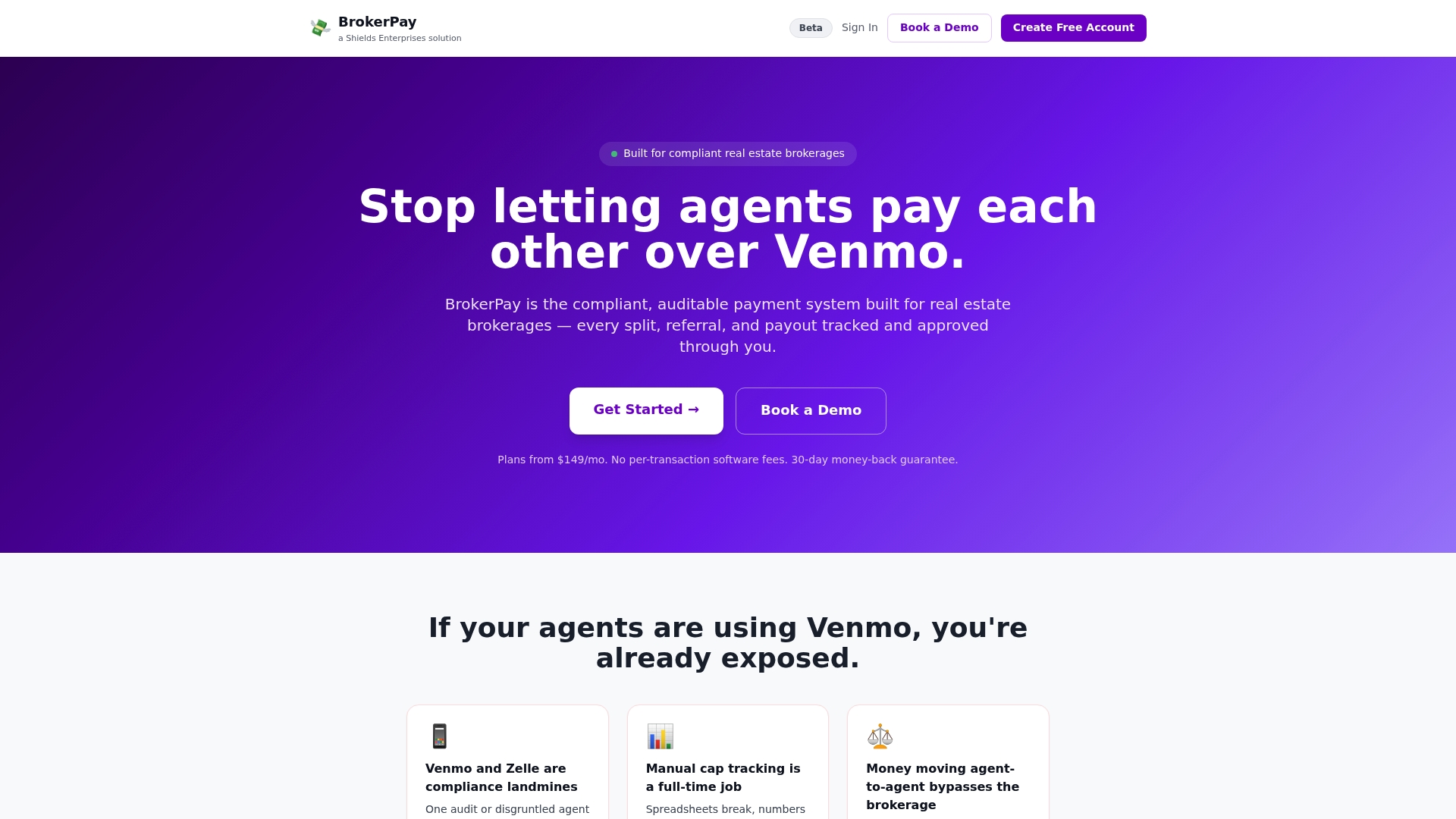
This platform automates commission payments, agent splits, referral fees, and co-op payouts, with an approval chain and an audit trail attached to every transaction. For an auditor asking “show me who approved this payout and when,” that’s a system-generated record instead of a search through email threads and text messages. It addresses the exact evidence gaps that tend to surface in payment-related findings: missing approval documentation, inconsistent commission calculations, and no clean chain of custody for co-op fees between brokerages. If your organization is heading into an audit cycle where payment controls are in scope, consider a demo to see how the audit trail maps to your existing control matrix, then run a proof of concept before any broader rollout. See how BrokerPay works and whether it fits your next audit cycle.