Cut Duplicate Payments to Under 0.05% in 90 Days for AP and Brokerages

Stop duplicate payments by layering three controls together: vendor master governance, automated pre-payment matching, and locked approval and payment execution controls. No single tool catches everything. A clean vendor file stops duplicate vendor records, automated three-way matching catches near-duplicate invoices before they’re paid, and segregation of duties stops one person from pushing a payment through twice. For commission-heavy operations, a platform like Brokerpay adds the same layered logic to agent splits and co-op payouts.
TL;DR:
- Automating vendor master cleanup and enforcing a single intake channel can reduce duplicate payments from the current industry range of up to 2.5% of disbursements to below 0.05%.
- Implementing three-way matching, fuzzy invoice matching, and idempotency controls decreases the chance of paying near-duplicates before they leave the system.
- Rapid response procedures, including collecting all documentation and requesting refunds promptly, help mitigate financial losses after duplicate payments occur.
- Combining multiple controls like vendor governance, purchase order enforcement, and locked approval workflows creates a layered defense that catches most discrepancies.
- For brokerages, centralizing commission and referral payments with a formal approval process prevents informal workarounds like Venmo or Zelle from creating RESPA compliance risks.
Table of Contents
- What Counts as a Duplicate Payment, and Why AP Teams Should Care
- How Do Duplicate Payments Happen in the First Place?
- Catching Duplicates Before You Pay Them
- What to Do When You Find a Duplicate Payment
- Building a Layered Defense Against Duplicate Payments
- The First 90 Days: A Concrete Rollout Plan
- Lessons From Watching Brokerages Build These Controls
- How Brokerpay Closes the Gap in Commission Disbursements
- Sources
What Counts as a Duplicate Payment, and Why AP Teams Should Care
A duplicate payment is any second disbursement made against an obligation that was already settled. That covers the obvious case, paying the same invoice number twice, and the less obvious ones: paying a slightly altered invoice from the same vendor for the same goods, issuing a manual check after an ACH run already cleared, or double-funding a commission split because two systems both thought it was still open.
The financial exposure is bigger than most finance leaders assume. Industry analyses put duplicate payments at roughly 0.1% to 2.5% of total disbursements depending on the organization and how tightly controls are run. On a brokerage or mid-size company processing tens of millions in payables and commission splits a year, even the low end of that range adds up to real money walking out the door.
Recovery costs more than prevention. Once a duplicate clears, you’re chasing a refund, filing a claim, or writing off the loss. Catching it before the payment file transmits costs you almost nothing.
Track your duplicate rate as a percentage of total disbursements, exceptions flagged per 1,000 invoices, and average recovery time. Those three numbers tell you whether your controls are actually working or just look good on paper.
How Do Duplicate Payments Happen in the First Place?
Most duplicates trace back to a handful of repeatable failure points, not random accidents. Understanding where they originate is the only way to design controls that actually close the gap instead of adding friction without fixing anything.
- Vendor master duplication. The same supplier gets entered twice under slightly different names (“ABC Corp” and “ABC Corporation”), and the system treats them as unrelated vendors with separate payment histories.
- Fragmented invoice intake. Invoices arrive by email, mail, vendor portal, and fax (yes, still), and nobody reconciles the channels against each other before entry.
- Manual entry errors. A keyed-in invoice number with a transposed digit slips past a matching rule built for exact string matches.
- Missing or bypassed purchase orders. Without a PO to match against, AP has no independent record to check the invoice against before releasing funds.
- Payment retries and gateway replay. A timeout or failed confirmation triggers a second submission of a payment that actually went through the first time.
- Manipulated or fraudulent invoices. A bad actor resubmits a real invoice with a changed bank account, or submits a near-identical fake one hoping it slips through as a legitimate resend.
Fraud is the smallest slice of this list numerically, but it’s the one with the highest cost per incident, and it’s the one that automated fuzzy matching catches most reliably.
Catching Duplicates Before You Pay Them
Pre-payment detection beats post-payment recovery on every axis that matters: speed, cost, and the vendor relationship. The most effective detection happens before the payment ever leaves the building, through validation rules, three-way matching, and fuzzy-match logic that catches near-identical invoices exact-match rules miss entirely.
Here’s how the layers stack, from first checkpoint to last:
- Automated capture and validation at intake. OCR pulls invoice number, vendor ID, amount, and date the moment the document lands, then checks that combination against every invoice already in the system.
- Three-way matching. The invoice, purchase order, and receiving record all have to agree before payment releases. This single control eliminates most duplicates tied to PO-backed spend.
- Fuzzy matching for near-duplicates. Algorithms flag invoices that are close enough to a paid record, off by a digit, a slightly reworded description, a date shifted by a day, to warrant a human look, even when they aren’t an exact string match.
- Idempotency controls at the payment gateway. Electronic payment rails can assign a unique key to each transaction so a retried or resubmitted request never generates a second real payment, even if the network hiccups.
- Post-payment audit as a backstop, not a strategy. Periodic reconciliation audits still matter for catching what slipped through, but they recover only part of the loss and take weeks longer than a pre-payment flag.
Automation earns its keep here. Tools that apply OCR and automated three-way matching catch the bulk of duplicates before a human ever sees them, and research from groups like APQC and Ardent Partners ties automated matching to lower exception rates and higher invoice throughput per AP staffer. Post-payment audits still have a role. They’re just the last line of defense, not the first.
What to Do When You Find a Duplicate Payment
Finding a duplicate after the fact isn’t a crisis if you have a process ready. It becomes one when nobody knows who’s responsible for the next step.
Start by pulling every piece of documentation tied to both payments: transaction IDs, the original invoice and any resubmitted version, the purchase order if one exists, and the full email or portal communication trail with the vendor. That packet is what you’ll need whether you’re requesting a refund, filing an internal report, or explaining the incident to an auditor later.
- Contact the vendor promptly with a clear, documented request for either a refund or a credit against a future invoice.
- Reverse or reclassify the duplicate in your accounting system with a proper journal entry, don’t just leave it sitting as an unexplained variance.
- Reconcile the correction against your bank statement in the same period you caught it, not the next close cycle.
- Set a materiality threshold that automatically escalates larger duplicates to a controller or audit committee review.
- Tie every remediation back to a specific control fix, if a vendor master error caused it, that record gets corrected and flagged, not just the payment.
The point of documenting all this isn’t just recovery. It’s building the case for whatever control gap let the duplicate through in the first place.
Building a Layered Defense Against Duplicate Payments
No single control stops every duplicate. The organizations with the lowest duplicate rates stack several controls so that a failure in one layer gets caught by the next one. Think of it less like a wall and more like a series of nets, each catching what the last one missed.
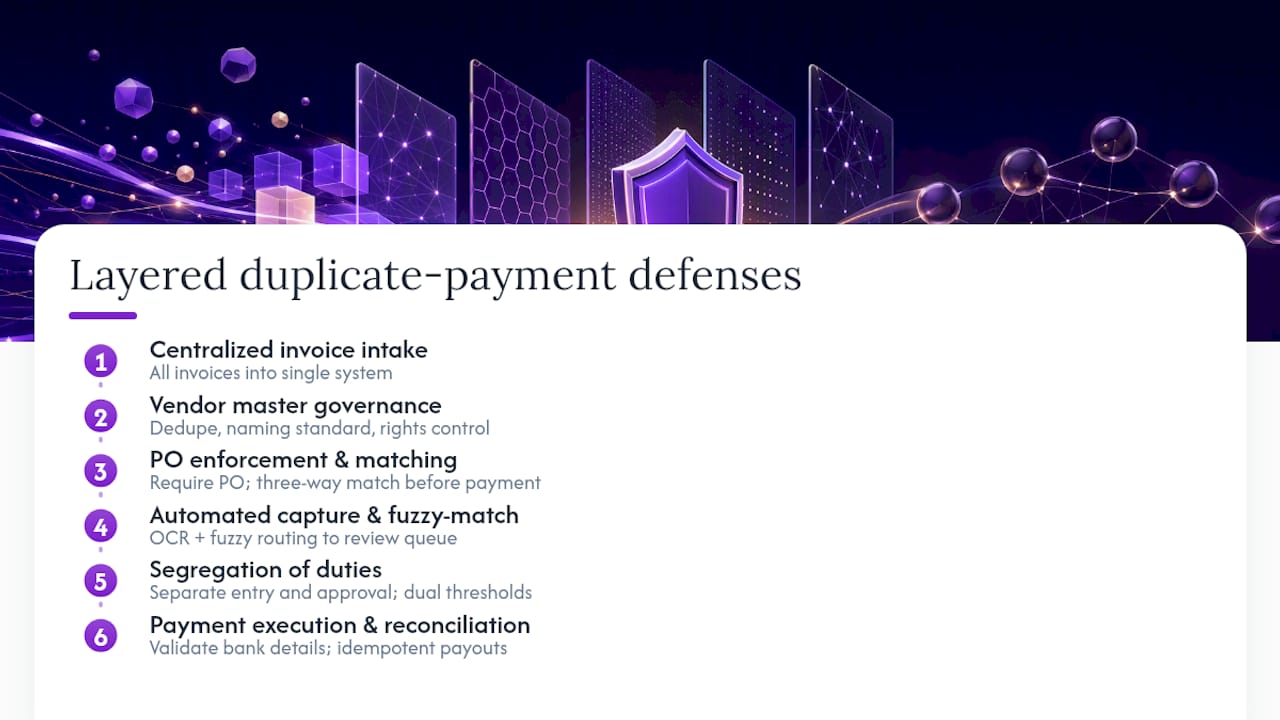
Centralized invoice intake. Every invoice, regardless of how it arrives, funnels into one system of record before anyone touches it. This single change eliminates the multiple-channel duplicate problem that fragmented intake creates, and it’s usually the fastest control to implement because it’s a process change, not a technology overhaul.
Vendor master governance. Run a periodic dedupe of the vendor master file, enforce a consistent naming standard, restrict who has rights to create a new vendor record, and validate bank account details before any new supplier gets paid for the first time. Auditors consistently recommend limiting vendor files to one record per supplier, and NetSuite’s guidance treats master-file hygiene, deactivating dormant accounts, standardizing formats, as a step that’s easy to skip and expensive to ignore.
Purchase order enforcement and three-way matching. Require a PO for spend above a set threshold, and don’t release payment until the invoice, PO, and receiving record all line up. This is the single most effective structural control for anything routed through procurement.
Automated data capture and fuzzy-match exception workflows. OCR handles the data entry so humans aren’t retyping invoice numbers by hand, and fuzzy-matching logic routes anything that looks close-but-not-quite to a review queue instead of letting it pass or blocking it outright.
Segregation of duties and locked approval authority. The person who enters an invoice should never be the same person who approves it or releases the payment. Dual approval thresholds for larger amounts, locked override authority so a single manager can’t bypass the workflow under pressure, and an immutable audit trail recording approver identity, timestamps, and policy version all work together to make the approval chain something you can actually reconstruct later.
Payment execution controls. Validate banking details before every disbursement, reconcile against a single source of settlement truth, and build idempotency into any automated payout system so a retried transaction never doubles as a second real payment.
Pro Tip: Run your vendor master dedupe and your three-way matching rollout in the same quarter, not sequentially. A clean vendor file makes automated matching dramatically more accurate, because the system isn’t trying to match invoices against ten variations of the same supplier name.
For brokerages specifically, the same logic applies to agent commission splits and co-op fees, which is where approval and segregation-of-duties practices matter as much as they do for vendor invoices. A payment gateway built for real estate disbursements applies the same validated-banking and reconciled-settlement logic that prevents duplicate vendor payments.
The First 90 Days: A Concrete Rollout Plan
Don’t try to fix everything simultaneously. Sequence it so early wins fund the harder changes later.
Immediate (week one): Centralize invoice intake into a single channel, run a full vendor master dedupe, and pause any ad-hoc or manual payment workaround that bypasses your standard approval path.
Days 1 to 30: Roll out automated OCR capture and basic validation rules. Enforce PO requirements for any spend above a defined threshold.
Days 30 to 60: Turn on three-way matching and fuzzy-match exception queues. Validate banking details for every vendor and agent on file, not just new ones.
Days 60 to 90: Layer in analytics and reporting so you can track duplicate rate as a percentage of disbursements, exceptions per 1,000 invoices, recovery rate on caught duplicates, and how long exceptions sit unresolved in the queue.
- Track your duplicate rate monthly, not annually, in the first two quarters after rollout.
- Loop in procurement, treasury, and IT early, control fixes that touch the vendor master or payment rails need all three at the table.
- Give vendor relations a heads-up before banking validation goes live, it prevents a wave of confused vendor calls.
High-performing operations that fix these upstream causes, centralized intake, master-file hygiene, automated matching, and idempotency, can push duplicate rates down from the 1% to 2% range to under 0.05% of disbursements. That’s not a theoretical ceiling. It’s what happens when the layers actually work together instead of operating as isolated checkboxes.
Lessons From Watching Brokerages Build These Controls
Most AP teams don’t fail because they lack tools. They fail because they run partial automation, three-way matching on some invoices but not commission disbursements, say, and leave a governance gap exactly where the informal workaround lives.
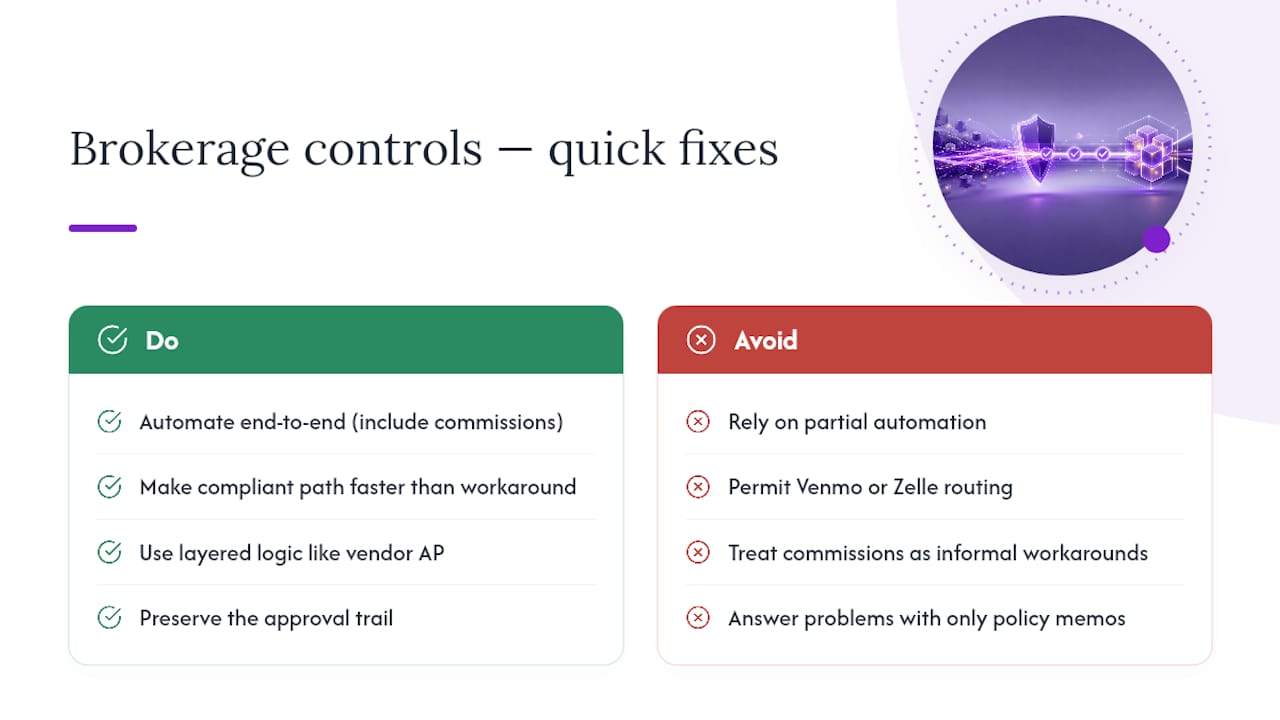
Brokerages have a version of this problem that’s specific to their business: commission splits and co-op fees. When the official system feels slow, agents route around it with Venmo or Zelle. That workaround doesn’t just risk a duplicate payment, it strips out the approval trail entirely and creates a real RESPA compliance exposure that a vendor invoice duplicate never would.
The fix isn’t more policy memos. It’s making the compliant path faster than the workaround, with the same layered logic vendor AP already uses.
— Wes
How Brokerpay Closes the Gap in Commission Disbursements
Vendor master governance and three-way matching solve the invoice side of duplicate payment prevention. Commission splits, referral fees, and co-op payouts need the same layered logic, and that’s a gap general ledger software rarely fills well.
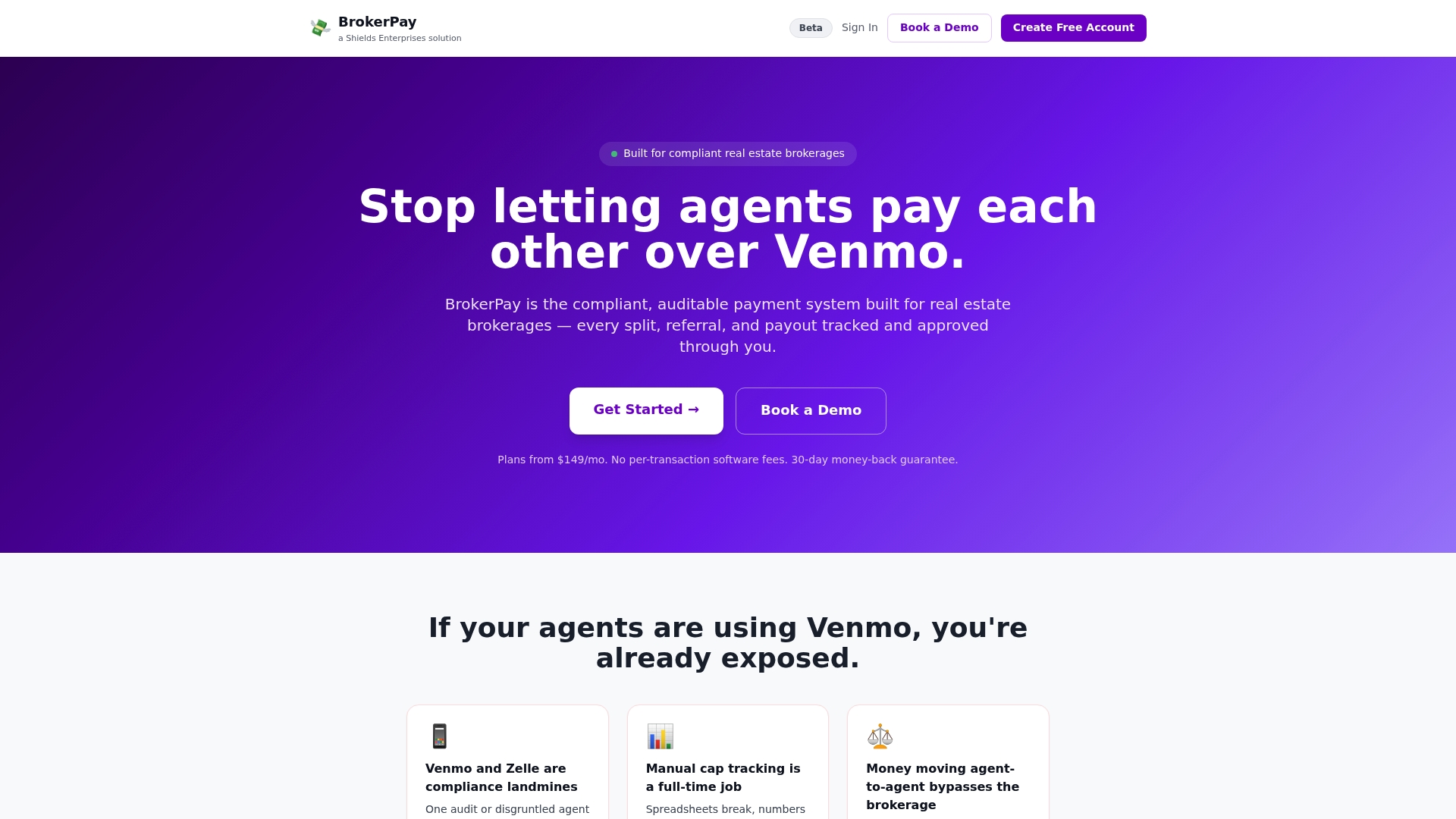
A platform built specifically for that gap centralizes commission and referral payment requests into one system instead of leaving them scattered across email threads and personal payment apps, applies enforced approval workflows so no split or co-op fee clears without the right sign-off, and keeps a full audit trail on every disbursement, timestamps, approver identity, and payment status, the same immutable record structure that prevents duplicate and unauthorized payouts in any AP environment. ACH transfers replace the Venmo and Zelle workarounds that create federal RESPA liability, and cap tracking keeps agent splits accurate without manual recalculation. If commission payments are still routed through informal channels, see how commission payment automation solutions handle this process and get a look at how the approval workflow maps to typical current processes.
Sources
For deeper detail on the mechanics covered here, NetSuite’s guide to fixing and preventing duplicate payments walks through vendor master cleanup in more depth, and Corpay’s breakdown of duplicate payment causes and detection covers the automation side well.
The Washington State Auditor’s Office publishes practical, plain-language guidance on preventing duplicate vendor payments that’s worth reading regardless of what state you operate in. For the audit trail and approval-logging side of the equation, Gruv.ai’s piece on internal payment audit trails is a solid technical reference for finance and audit teams building out compliance documentation.
This article is general information, not a substitute for advice from a qualified financial advisor. Consult a qualified financial professional about your own circumstances before acting on anything here.