Brokers: 5 Compliance First Controls for Team Split Management

Team split management is the process of tracking, documenting, and paying out agent commission splits, referral fees, and co-op commissions in a way that survives an audit. The compliance-first standard means every payout is approved, routed through brokerage systems, and backed by a paper trail, not sent agent-to-agent through Venmo or Zelle. RESPA Section 8 sets the federal floor, and platforms like Brokerpay exist to keep brokerages on the right side of it.
TL;DR:
- Require signed referral and commission agreements that specify parties, license numbers, fee amounts, and payment triggers before processing payouts.
- Ensure brokerage-controlled routing of funds, ideally through title companies at closing, to prevent agent-to-agent transactions that violate RESPA rules.
- Implement role-based approvals, cap tracking, and regular reconciliation within a structured workflow that records every step with audit logs.
- Maintain records of all documentation for at least three to five years in searchable, access-controlled storage to survive regulatory audits.
- Use compliant technology platforms that centralize agreement storage, cap management, approvals, and automated ACH payouts to reduce disputes and improve compliance.
Table of Contents
- What Belongs in Every Compliant Split Management Process
- How Does a Commission Split Move From Agreement to Payout?
- What Does RESPA Actually Allow for Referral Fees?
- Recordkeeping: What to Save, and for How Long
- Turning Policy Into a Working System
- Setting Splits That Keep Agents Motivated and Producing
- Resolving Split Disputes Before They Escalate
- State Rules That Go Beyond RESPA
- Why Split Structure Decides Whether Agents Stay
- Two Ways Brokerages Structure Splits Well
- What Actually Stops Payout Disputes
- A compliant commission payment platform centralizes signed agreements, cap tracking, approval workflows, and ACH payouts, all tied to an audit log instead of a paper folder or a group text. Instead of a broker manually matching a settlement statement to a spreadsheet and then wiring money by hand, the platform handles the split math, stores the agreement, and executes the payout with a record attached to every step.
- Sources
What Belongs in Every Compliant Split Management Process
If you strip out the software marketing and look at what a defensible split management process actually requires, it comes down to five components. Miss any one of them and you are exposed the moment a regulator, a departing agent’s attorney, or your own accountant asks for documentation.
Written referral and commission agreements. Every referral arrangement needs a signed agreement naming both parties, their license numbers, the fee percentage or flat amount, and the payment trigger. Industry guidance puts typical referral rates between 20% and 35% of the receiving brokerage’s gross commission, paid after closing.
Brokerage-controlled routing. Money should move from the title company or your brokerage’s operating account, never from one agent’s personal account to another’s. Title company disbursement at closing is often the cleanest option because it keeps referral fees out of agent hands entirely.
Role-based approvals, cap tracking, and payout timing. Someone with authority, a broker of record, an office manager, needs to sign off before funds move, and your system needs to know where each agent sits against their commission cap.
A documented audit trail. Settlement statements, referral agreements, and payout authorizations all need to live somewhere searchable, not scattered across email threads and desk drawers.
A reconciliation cadence. Weekly or biweekly reconciliation catches a missed split or a duplicate payment before it becomes a six-month-old argument.
Pro Tip: Tie every referral fee to its signed agreement inside the same transaction file before closing. Title companies move faster when the paperwork is already attached, and disputes drop sharply when there’s nothing to argue about.
How Does a Commission Split Move From Agreement to Payout?
The workflow below reflects how a well-run brokerage should structure the path from a signed referral agreement to money hitting an agent’s account. Skipping steps here is exactly how brokerages end up with unearned-fee violations or agents who feel shorted.
- Pre-closing. Execute the referral agreement in writing, collect license numbers for every party, and record the payment terms, including whether the fee is a flat amount or a percentage of gross commission.
- At closing. The referral or co-op split typically appears as a line item on the settlement statement, and many brokerages let the title company disburse the referral portion directly from closing funds rather than routing it through the brokerage’s own account first.
- Post-closing invoicing and approval. The referring broker or agent submits confirmation of the closing, an approval gate checks the agreement on file, and the payout gets scheduled.
- Payout timing. Referral fees are generally paid after closing and processed within 7 to 30 days, depending on the brokerage’s internal cycle and how quickly the title company releases funds.
- Internal split calculation. Where a referral fee applies, deduct it from the gross commission before calculating the agent’s split, not after. Calculating the agent’s cut first and the referral fee second is a common error that shorts the referring party.
- Reconciliation. Match the settlement statement, your internal ledger entry, and the actual bank payout. Flag anything that does not tie out within one billing cycle.
That 7 to 30 day payout window is worth tracking as a formal metric. Brokerages that measure time-to-payout alongside their exception rate tend to catch process breakdowns months before they turn into agent complaints or compliance findings.
What Does RESPA Actually Allow for Referral Fees?
RESPA Section 8, enforced through Regulation X, prohibits paying or accepting a fee for referring settlement service business unless that fee compensates services actually performed. It also bars splitting settlement-service charges except where the split reflects real work. This is the rule most brokerages misunderstand, not because it is complicated, but because they assume “everyone does it this way” is a legal defense. It is not.
Referral payments between two licensed real estate agents, where both hold active licenses and the fee comes out of a commission rather than being disguised as something else, are not automatically prohibited. But a payment tied to a settlement service, or dressed up as a “consulting fee” for work that never happened, can trigger a Section 8 violation regardless of what the parties call it.
The CFPB’s own RESPA guidance draws this line clearly, and NAR’s RESPA FAQ walks through real enforcement examples where a referral fee was recharacterized as compensation for a service that was never actually delivered.
Practical controls that keep you inside the lines:
- Confirm the cooperative-brokerage exemption applies: both parties are licensed, and the fee flows through brokerages, not directly between individual agents.
- Require state license verification before any referral agreement is executed, since most states also mandate that referral payments route through the brokerage of record rather than agent to agent.
- Document any claimed “services performed” with enough detail to survive a fair-market-value challenge.
- Disclose the referral arrangement to the client when required by your state.
Recordkeeping: What to Save, and for How Long
An audit request does not wait for you to reconstruct a paper trail from memory. The documents you need on hand for every split transaction:
- The signed referral or commission agreement, license numbers included
- The settlement statement showing the split line item
- The internal payout authorization and approval signature
- The ACH or wire receipt confirming the transfer actually happened
Most brokerages retain these for a minimum of three to five years, though state real estate commissions often set their own retention windows, so check your state’s specific requirement rather than assuming a national standard applies. Store them somewhere searchable and access-controlled, not a shared drive folder anyone in the office can edit.
On the accounting side, referral fees paid out generally reduce the brokerage’s gross commission income before it hits the books as revenue, and payments to unaffiliated referring brokers typically require a 1099 form at year-end. Commission tracking done properly prevents the scramble every January when your bookkeeper asks which payments were splits, which were referrals, and which were something else entirely.
Reconcile weekly if your transaction volume supports it, monthly at the outside. A simple checklist works: does the settlement statement match the ledger entry, does the ledger entry match the bank record, and does the payout timing fall inside your stated window?
Turning Policy Into a Working System
Fixing this starts with a policy change, not a software purchase. Ban informal P2P payouts outright, in writing, and require every referral or split payment to have a filed agreement before an approval gate will release funds.
Pilot the new process on one office or one transaction type first. Measure two things: average time from closing to payout, and how many payouts hit an exception. A manual-to-automated migration works best in small, measurable steps rather than an office-wide switch overnight.
Whatever tool you evaluate, it needs:
- Audit logs tied to every transaction
- Secure document storage for agreements and settlement statements
- ACH payout support, not manual check-cutting
- Cap tracking that updates automatically
- Role-based approval workflows
- Exportable reports for your accountant or a regulator
Pro Tip: Track your exception rate for 90 days before and after any process change. It is the single clearest number for proving the new system is actually working, not just feeling more organized.
Setting Splits That Keep Agents Motivated and Producing
A split structure only works if agents believe it is fair, and fairness is not the same as uniformity. Tiered splits tied to production volume, cap-and-graduate models, and team-lead overrides on team-generated leads all solve different retention problems. The mistake most brokers make is setting a split once and never revisiting it as an agent’s production changes.
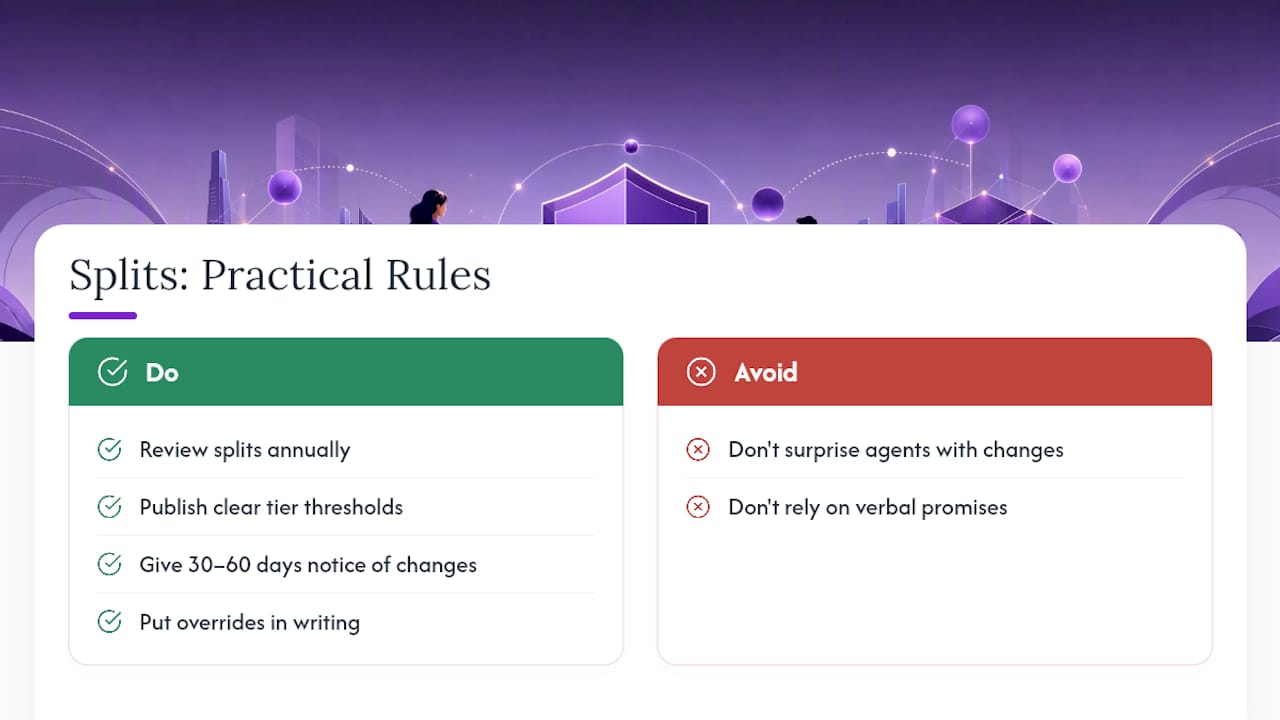
Review splits annually, tied to a clear production threshold rather than a subjective conversation. An agent who closed forty transactions last year and is still on a rookie split will notice, and they will start taking calls from competing brokerages. Publish the criteria for moving between tiers so nobody has to guess or negotiate individually, since inconsistent one-off deals are what generate the most resentment inside a team.
When adjusting a split, give agents advance notice, not a surprise on their next commission statement. Thirty to sixty days lets an agent plan around the change instead of feeling ambushed. And when a team lead takes an override on a referred or team-generated deal, put that override percentage in writing the same way you would a broker-to-broker referral agreement. Verbal promises about “how the team splits work” are exactly the kind of undocumented arrangement that turns into a dispute the moment someone leaves.
Resolving Split Disputes Before They Escalate
Most split disputes trace back to the same root cause: someone did not see the number coming. An agent expected a different tier, a referral fee got deducted in a way nobody explained, or a team lead’s override showed up on a statement without context.
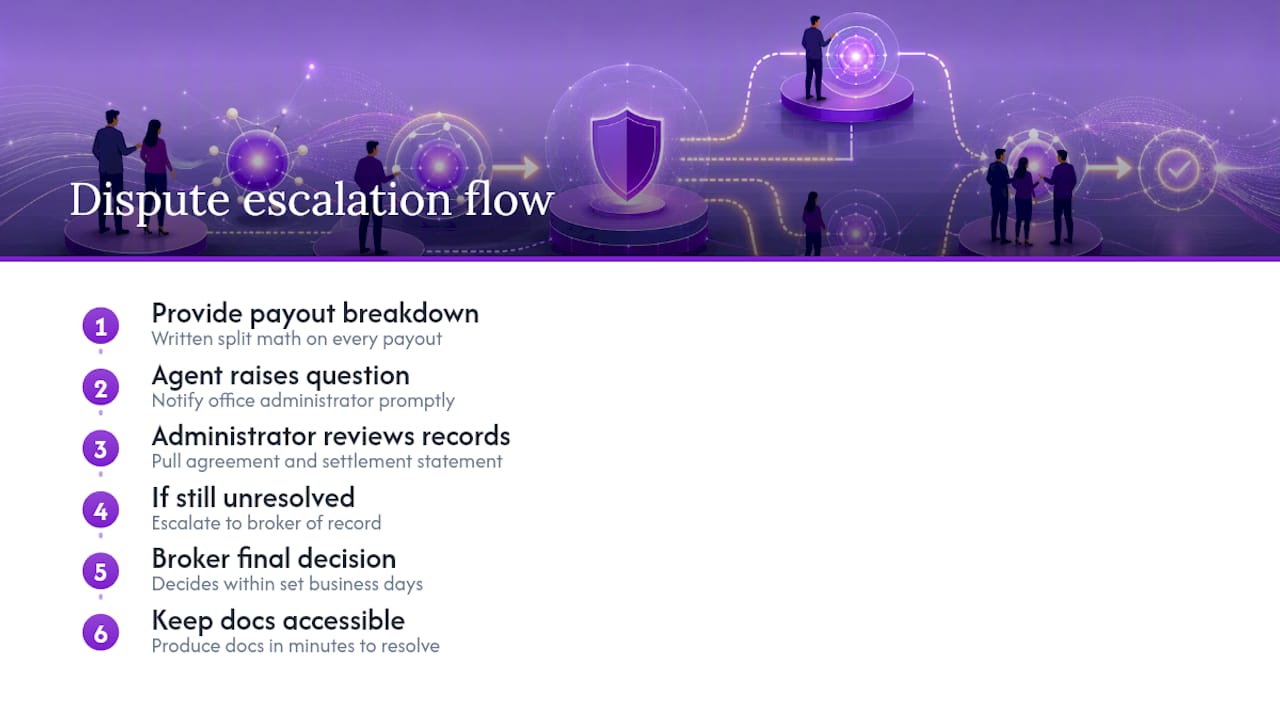
The fix is proactive communication, not reactive damage control. Send agents a written breakdown of how their split was calculated on every payout, not just the total. When the math is visible, most disputes never happen in the first place. For the ones that do, a brokerage needs a defined escalation path: agent raises the question with the office administrator, the administrator pulls the agreement and settlement statement, and if the numbers still do not reconcile, the broker of record makes the final call within a set number of business days.
Put that process in your policy manual so agents know disputes get resolved on a timeline, not whenever someone gets around to it. A brokerage that can produce the agreement, the settlement statement, and the payout authorization within minutes of a question being raised almost always resolves the dispute on the spot. One that has to dig through email threads turns a five-minute conversation into a week of frustration, and that frustration is what actually drives agents out the door.
State Rules That Go Beyond RESPA
RESPA sets the federal floor, but state real estate commissions layer their own requirements on top, and they vary enough that a one-size-fits-all policy across a multi-state brokerage is risky. Many states require that referral payments to out-of-state agents only go to a licensed broker, not directly to an individual agent, and some cap the referral percentage or require specific disclosure language in the agreement itself.
A handful of states also restrict how unlicensed referral sources (a past client who sends a friend your way, for instance) can be compensated, since most states require the recipient of any transaction-based fee to hold an active real estate license. Paying a finder’s fee to someone without a license, even a small one, can violate state law independent of anything RESPA says.
If your brokerage operates across state lines, build a lookup table of each state’s referral and split rules and check every out-of-state agreement against it before signing. Do not assume that what is legal in your home state carries over. A referral agreement that is standard practice in one state can be a licensing violation in another, and the broker of record, not the agent who drafted the agreement, generally bears the liability when it goes wrong.
Why Split Structure Decides Whether Agents Stay
Agents talk to each other, and nothing spreads faster in a brokerage than word that splits are inconsistent or slow to pay. A transparent, well-documented referral network signals to both new recruits and existing agents that the brokerage runs a tight operation, which matters more in recruiting conversations than most brokers assume.
Top producers evaluate a brokerage’s split structure the same way they evaluate its lead generation: as a direct input to their income stability. An agent who has been burned by a slow or disputed payout at a previous brokerage will ask pointed questions in an interview, and “we handle that case by case” is not the answer that closes the deal. A published, tiered split schedule with clear criteria for advancement gives recruiters something concrete to sell.
Retention works the same way in reverse. Agents rarely leave over the split percentage alone. They leave over unpredictability, a payout that showed up ten days late with no explanation, or a referral fee that got deducted differently than they expected. A brokerage that pays on time, every time, with a visible breakdown attached, builds the kind of trust that keeps a producing agent from taking a recruiter’s call in the first place.
Two Ways Brokerages Structure Splits Well
Consider two common models that hold up under scrutiny. The first is a graduated cap model, where an agent starts at a 60/40 split and graduates to 80/20 or a flat transaction fee once they hit a documented production cap for the year. Referral fees and co-op commissions get deducted before the split calculation runs, and the cap threshold resets every January 1. Agents know exactly where they stand because the criteria are published, not negotiated individually.
The second is a team-lead override model, common in team structures where a lead generates business and distributes it to buyer’s agents. The override percentage is written into each agent’s independent contractor agreement when they join the team, not decided deal by deal.
What both models share is the same underlying discipline: the math is written down before the first deal closes, not negotiated after the fact. Brokerages that retrofit documentation onto an existing informal system almost always find gaps, an undocumented side deal here, a verbal promise there, that surface at the worst possible time, usually when an agent is leaving and reviewing every commission statement from the last two years.
What Actually Stops Payout Disputes
The single most effective control in this entire process is boring: require a signed agreement before money moves, every time, no exceptions for “we trust each other.” Every dispute worth mentioning traces back to a missing or vague agreement, not a bad-faith actor.
Brokerages that build this into their approval workflow, rather than relying on individual agents to remember, see the payoff almost immediately in fewer escalations to the broker of record. The tools matter less than the discipline. A spreadsheet with a strict “no agreement, no payout” rule will outperform expensive software with a lax one. But once the discipline is in place, the right platform removes the manual chasing that makes brokers skip the rule under deadline pressure.
— Wes
A compliant commission payment platform centralizes signed agreements, cap tracking, approval workflows, and ACH payouts, all tied to an audit log instead of a paper folder or a group text. Instead of a broker manually matching a settlement statement to a spreadsheet and then wiring money by hand, the platform handles the split math, stores the agreement, and executes the payout with a record attached to every step.
That structure translates directly into fewer disputes, because agents see the same breakdown the brokerage sees, faster payouts because approvals do not sit in an inbox, and a stronger compliance posture because there is no P2P transfer for a regulator or a departing agent’s attorney to question. If your office is still running splits through Venmo, Zelle, or a shared spreadsheet, the fix is not a bigger spreadsheet. See how Brokerpay replaces those workarounds and get a walkthrough of what a compliant payout looks like for your office.
Sources
- Referral Agreement Between Brokers: Terms, Fees, and Rules - LegalClarity
- Real Estate Agent Referral Fee: Complete Guide to Percentages, Rules & Agreements (2026) | PropertyCEO
- SECTION 1024.14—Prohibition against kickbacks and unearned fees