Replace Venmo and Zelle: Commission Approval Matrix for Brokerages

A commission approval matrix maps who can authorize a commission amount and who can release the payment, organized by role, dollar threshold, and action type. Brokerages use one wherever a single agent shouldn’t be able to calculate, approve, and pay a commission alone. The right setup embeds roles, thresholds, and actions directly into the commission workflow rather than bolting approval on as a manual afterthought, and a platform like Brokerpay can automate that structure end to end.
TL;DR:
- Most brokerages should base approval rules on roles and transaction attributes rather than individual names, ensuring consistency despite staff changes.
- Approving a commission involves separate decisions for calculating the split, releasing funds, and posting to accounting, each requiring specific authorization.
- Building a simple approval matrix starting with actions and amount tiers, then expanding with additional dimensions, simplifies implementation and reduces errors.
- Automating the approval process within a single system reduces discrepancies and provides a clear audit trail, minimizing compliance risks.
- Regular testing and governance of the matrix, including version control and metrics tracking, prevent decay and ensure ongoing effectiveness.
Table of Contents
- What Is a Commission Approval Matrix?
- What Should the Matrix Actually Control?
- How Do You Design a Commission Approval Matrix?
- What Does a Commission Approval Matrix Template Look Like?
- How Do You Automate a Commission Approval Matrix?
- What Mistakes Break a Commission Approval Matrix?
- How BrokerPay Approaches Commission Approval Workflows
- Automate Commission Approvals Without the Manual Chasing
- Sources
What Is a Commission Approval Matrix?
A commission approval matrix is a documented set of rules that decides who can sign off on a commission transaction at each stage, based on role and amount rather than a person’s name. Finance teams sometimes call the broader concept a “schedule of authority,” a term borrowed from corporate governance that assigns spending and approval power to specific positions instead of individuals. A commission matrix is a specialized version of that schedule, built around the particular mechanics of real estate payouts.
It differs from a general purchase or expense approval matrix in a few concrete ways; understanding common commission split models helps clarify which commission events require special approval and why. Commission approvals have to account for agent splits, referral fees paid to outside brokers, co-op commissions shared between listing and buying sides, and cap tracking that changes an agent’s split once they hit an annual threshold. A $50,000 vendor invoice and a $12,000 commission split trigger different questions: Is the payee licensed? Has the cap been reached? Does the referral agreement on file match the percentage being paid? None of that shows up in a standard AP approval flow.
The payoff for getting this right isn’t abstract. Brokerages that formalize commission approval tend to see fewer payment errors, cleaner records for state audits, and a much easier time proving compliance if a regulator or a departing agent ever disputes a payout. Procurement teams see the same pattern: routing requests automatically by amount and category reduces confusion and gives finance a paper trail it didn’t have before. For brokerages, that paper trail also happens to be the difference between a clean RESPA compliance posture and a federal liability question nobody wants to answer.
What Should the Matrix Actually Control?
A working matrix has to define several dimensions at once, and skipping any one of them is usually where brokerages get into trouble.
Roles, not names. Rules should say “office manager” or “broker of record,” never “Sarah in accounting.” People leave, get promoted, or go on leave. A matrix built around job titles survives staff turnover; one built around names breaks the first time someone quits.
Thresholds and other request attributes. Dollar amount is the obvious dimension, but a commission matrix usually needs more: is this a new payee who’s never been paid before, does the payment route through ACH or a paper check, is it a co-op split involving an outside brokerage, or is it a referral fee crossing state lines? Design patterns for scalable approval matrices recommend mapping authority by amount, role, and risk together rather than amount alone, since a small referral payment to an unverified new payee can carry more risk than a large payment to a longtime agent.
Separate actions, not one blanket approval. This is the part most brokerages get wrong first. Authorizing a commission amount (confirming the math and the split percentage) is a different decision from approving the payment (releasing funds) and different again from accounting’s sign off on how it posts to the books. NetSuite’s commission workflow treats commission generation and authorization as distinct steps precisely because the person who verifies the split shouldn’t be the same person who releases the money.
- Amount tiers (e.g., small, medium, and large dollar amounts)
- Request type (agent split, referral fee, co-op commission, cap adjustment)
- Payee status (existing payee vs. first-time payee)
- Payment rail (ACH, wire, check)
- Approver role and their delegation window during absences
Separation of duties matters here more than in almost any other finance function, because commission fraud tends to happen when one person controls the whole chain. Add SLA timers so requests don’t sit untouched, an escalation rule for anything that stalls past the deadline, and an audit log that records who touched what and when.
Pro Tip: If your current process lets the same person calculate a split and release the payment, that’s not a gap in the matrix. It’s a missing matrix entirely. Fix that before adding any other rule.
How Do You Design a Commission Approval Matrix?
Building one from scratch feels harder than it is if you start in the wrong place. Most brokerages start by listing job titles and immediately get stuck. Start with actions instead.
-
List the actions, not the titles. Write out every distinct decision that happens to a commission dollar: authorize the split calculation, approve payment release, confirm accounting treatment, approve a referral agreement, sign off on a cap reset. Guidance on designing approval matrices for ERP-native payments makes this the first step for good reason: job titles change constantly, but the underlying actions rarely do.
-
Pick a small set of dimensions for the pilot. Don’t try to model every edge case on day one. Start with amount tiers and request type, run it for a month, and add dimensions like payment rail or payee status only once you’ve confirmed the basic structure holds up.
-
Map each action to a role, then check separation of duties. No single role should both authorize the amount and release the payment on the same transaction. Define who covers each role when someone is out, and set a delegation window (a hard end date, not an open-ended substitution) so temporary coverage doesn’t quietly become permanent.
-
Document one single source of truth. Write the rules down in one place, then implement them in whatever system actually owns the transaction. A matrix that lives in a spreadsheet while the payment system enforces something different isn’t a matrix. It’s a suggestion.
-
Test with edge cases before rollout. Run a payment that sits exactly on a threshold boundary. Run a batch with one bad record mixed into ninety good ones. Run a delegated approval during a manager’s vacation. If the matrix breaks under any of these, fix it before a real commission check depends on it.
-
Schedule reviews on a calendar, not a whim. Commission structures change when brokerages grow, add offices, or adjust splits. Revisit the matrix at least twice a year, or immediately after any change to cap structures or office count.
What Does a Commission Approval Matrix Template Look Like?
A generic template maps request type and amount to an approver role and a deadline. Here’s a starting structure most brokerages can adapt in an afternoon:
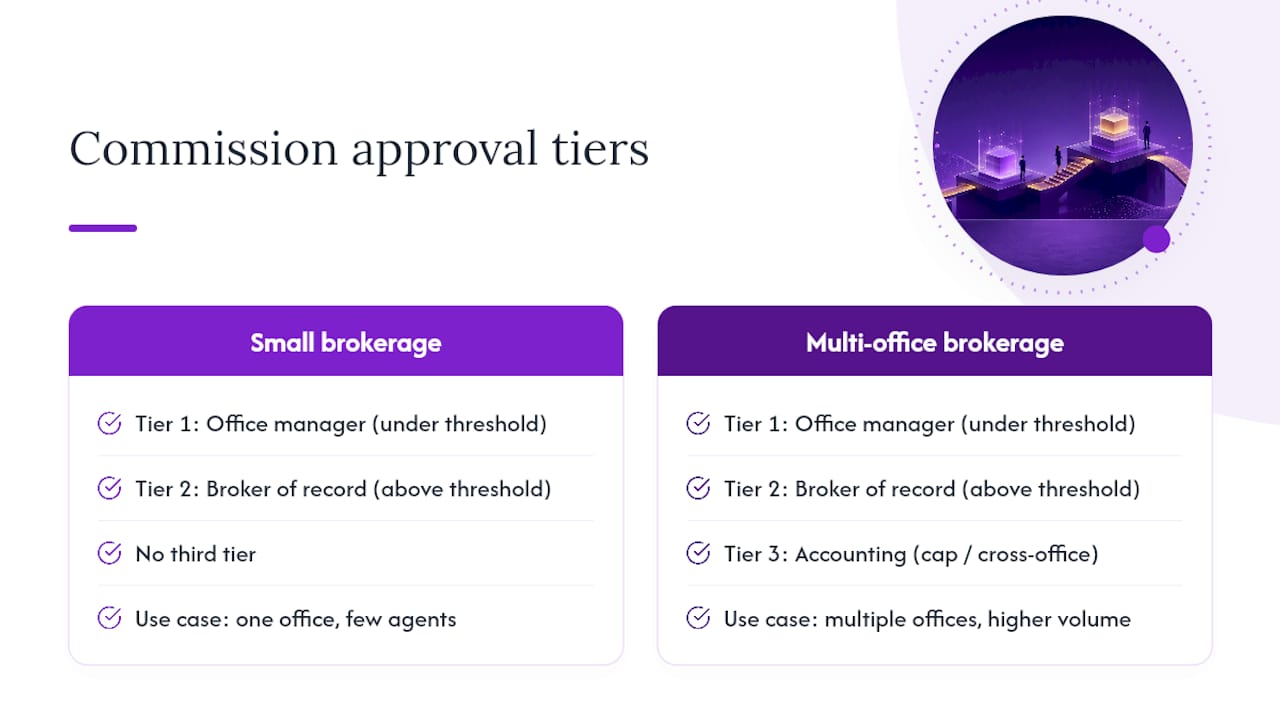
A small independent brokerage might only need two tiers: office manager approves anything under a defined threshold, and the broker of record signs off on everything above it. That’s often enough when there’s one office and a handful of agents.
A multi-office brokerage usually needs a third tier. Accounting has to approve anything that touches cap tracking or crosses office boundaries, and co-op commissions involving another brokerage typically get flagged for a compliance review before payment, not after. The dollar thresholds in the table above are a starting point, not a rule. Scale them to your transaction volume: a brokerage processing a lower volume of commissions can set tighter thresholds than one processing much higher volumes, where the threshold line would trigger reviews on a larger share of transactions.
How Do You Automate a Commission Approval Matrix?
The biggest automation mistake brokerages make is letting the rule set live in three places at once, spreadsheet, accounting software, and a payment app, each with a slightly different version of the truth. Pick one authoritative system to own the rules and enforce them everywhere else. When the ERP, the bank, and the payment platform each think they’re in charge, the matrix stops meaning anything.
Look for systems that support multi-level approvers with rising payment limits at each level, delegation windows for absences, and full audit logs. NetSuite’s payment routing is built this way: each approval level carries its own limit, and levels can be disabled when they’re not needed, which avoids stacking redundant approval steps on top of each other. Batch processing matters too. Commission runs often process dozens of payments at once, so the system should flag errors at the individual transaction level rather than blocking the entire batch.
The commission-specific wrinkle is what happens after authorization. NetSuite’s commission workflow generates the commission amount first, routes it to an authorization queue, and only then creates either a payable transaction or a payroll item, depending on how the brokerage classifies the payment. That queue step is exactly where a documented approval workflow between calculation and payout earns its keep.

What Mistakes Break a Commission Approval Matrix?
The named-approver trap tops the list: building rules around “whoever is the office manager right now” instead of the role itself, so the matrix silently fails the day that person changes jobs. Over-complex branching is the second most common failure. A matrix with fifteen conditional paths is one nobody follows correctly, and unfollowed rules are worse than no rules because they create a false sense of control. Missing separation of duties rounds out the top three. If the same login can authorize an amount and push the payment, the matrix isn’t protecting anyone.
Test the matrix the way you’d test any critical system, not just once at launch:
- Payments that land exactly on a threshold boundary
- A batch with one bad or incomplete record mixed into good ones
- A delegated approval triggered during a manager’s absence
- An edit made to a payment amount after it’s already been approved
That last case deserves special attention. If someone changes the beneficiary or amount after sign off, the system should invalidate the original approval automatically rather than letting a stale approval cover a changed transaction.
Governance is what keeps all of this from decaying over six months. Version the rules so you can see what changed and when, track metrics like average approval time and escalation frequency, and review audit findings on a set schedule rather than only after something goes wrong.
How BrokerPay Approaches Commission Approval Workflows
Brokerpay was built around the gap between calculating a commission and actually paying it out. The platform connects commission calculation, role-based approval routing, and payout into one auditable chain, so a split gets authorized by the right role before a dollar moves, and every step leaves a timestamped record. That structure is what replaces the ad hoc Venmo or Zelle transfer that too many brokerages still lean on, and the record it leaves behind is the difference between a clean file and a compliance headache.
— Wes
Automate Commission Approvals Without the Manual Chasing
Brokerpay is built for the exact gap this article covers: the space between calculating a commission and actually paying it, where manual approvals and Venmo workarounds create real RESPA exposure. It handles agent splits, referral fees, co-op commissions, and cap tracking with role-based approval routing and a full audit trail attached to every payout, not a spreadsheet someone has to reconcile later.

Whether you’re approving a straightforward split at a single office or routing a multi-office co-op commission through accounting review, the workflow logic in this article runs natively inside the platform instead of living in a document nobody checks. If your brokerage is still moving commission money through peer-to-peer apps or a manual sign-off chain, see how Brokerpay replaces that process with compliant, auditable ACH payments built for brokerages specifically.