U.S. Brokers: Assemble a Trust Account Audit Response in Days, Not Weeks

State real estate commissions audit broker trust accounts on a random rotating basis or after a complaint, license renewal flag, or consumer tip. Either way, you need to produce current bank statements, a master trust ledger, and client sub-ledgers that reconcile to the penny through a three-way reconciliation. Auditors don’t care whether a mismatch was intentional. A missing dollar is a violation whether it was theft or a typo.
TL;DR:
- Most states conduct random or cause-based audits requiring trust account records, including bank statements, ledgers, and detailed reconciliation workpapers.
- Three-way reconciliation must ensure bank balances match internal ledgers and client sub-ledgers each month, with timing differences logged separately.
- Common violations include commingling funds, disbursing without authorization, late or bulk posting, and unsubstantiated disbursements, increasing audit risk.
- Using automated trust accounting software that provides instant reconciliation reports and logs approvals minimizes errors and simplifies audit responses.
- Maintaining a consistent internal audit process, documenting all transactions, and adopting compliant workflows like ACH disbursements can prevent violations and enhance audit readiness.
Table of Contents
- What A Broker Trust Account Audit Involves
- Recordkeeping Standards: Columnar Ledgers And Three-Way Reconciliation
- Common Violations And Red Flags Auditors Look For
- State Rules Vary. Here’s Where To Find Yours
- Your Audit-Ready Checklist
- How Compliant Payment Workflows Cut Audit Risk
- What Happens If You Fail A Trust Account Audit
- Running Your Own Self-Audit Before The State Does
- Software And Tools That Support Trust Account Compliance
- Building A Daily Culture Of Audit Readiness
- A Compliant Alternative To Ad-Hoc Commission Payouts
- Sources
What A Broker Trust Account Audit Involves
Most state audit programs run two tracks: random sampling and cause-based review. Random audits pull a slice of licensed brokerages each cycle regardless of history, similar to how Kansas structures its trust account oversight. Cause-based audits follow a specific trigger: a client complaint, a bounced check, a whistleblower tip from a departing agent or an irregularity flagged during license renewal.
Once selected, you’ll get a notice with a response deadline. The Colorado Division of Real Estate’s broker audit process illustrates a common pattern: response windows often run several days to a few weeks, and the full audit can stretch across several weeks, with some states reporting audits that take multiple weeks to complete.
Expect the auditor to request:
- Bank statements covering the audit period, plus prior months for trend comparison
- Deposit slips and canceled checks tied to specific transactions
- Complete transaction files, including contracts and disbursement authorizations
- Your reconciliation workpapers showing how the bank balance ties to your ledgers
Recordkeeping Standards: Columnar Ledgers And Three-Way Reconciliation
Every state that licenses brokers expects three layers of records; to better understand how escrow fees impact these accounts, see What Is an Escrow Fee on a Home Sale? | HouseGoodbye Blog. The columnar bank record logs every deposit and disbursement chronologically, showing running balances. Beneficiary or transaction ledgers track each client’s funds separately, so you can prove exactly whose money makes up any given balance. And when funds are collected but legitimately not deposited into trust (an earnest money check held per contract terms, for example), you need a signed “funds not placed in trust” acknowledgment on file.
California’s Department of Real Estate spells this out directly in its trust fund guidance, requiring columnar records, separate beneficiary records, and monthly reconciliation, and treating any gap between the trust balance and total client liabilities as a potential trust shortage violation.
Three-way reconciliation is the mechanism that catches problems before an auditor does. Here’s how it works monthly:
- Pull the bank statement balance for the trust account as of month-end.
- Total the master ledger, every deposit and disbursement recorded internally.
- Sum every individual client sub-ledger.
- Confirm all three numbers match exactly. If they don’t, the discrepancy is a compliance issue until you find and document the cause.
The habits that prevent mismatches are boring but effective: post transactions the day they happen instead of batching them weekly, never write a disbursement check against a deposit that hasn’t cleared, and set a firm internal deadline (say, the 5th of each month) for closing the prior month’s reconciliation.
Pro Tip: Keep a separate log just for timing differences, deposits in transit or checks not yet cleared. When your three numbers don’t match on the first pass, that log tells you in seconds whether it’s a timing issue or a real error.
Common Violations And Red Flags Auditors Look For
Auditors have seen the same mistakes for decades, and they know exactly where to look first.
- Commingling: operating funds and client trust funds sitting in the same account, even briefly.
- Unauthorized withdrawals: disbursements that don’t tie to an executed contract or a documented authorization.
- Late or bulk posting: entering a month’s worth of transactions in one sitting, which erases the timestamped trail auditors use to spot patterns.
- Disbursing against uncleared funds: writing a check before the deposit it depends on has actually cleared the bank.
- Missing disbursement documentation: money leaving the account with no invoice, no closing statement, no paper trail explaining why.
- The scramble: frantic, last-minute reconstruction of records after an audit notice arrives. Auditors recognize this pattern immediately, and it tends to invite closer scrutiny of everything else.
State Rules Vary. Here’s Where To Find Yours
Trust accounting principles are consistent nationally, but the specifics are not. California requires specific columnar formats and deposit timing rules under its DRE guidance. Other states set different response windows, permitted bank fee handling, and audit frequency standards.
To find your state’s exact requirements:
- Search “[your state] real estate commission trust account rules” and go straight to the .gov domain, not a brokerage blog.
- Look for a published audit manual or broker compliance guide. Many commissions post one directly.
- Check for state-specific forms. California brokers, for instance, work from the DRE’s columnar record format detailed in its trust fund guide.
- Confirm your retention period. Three years is common, but some states require longer, and you should default to the longest period that could apply to any of your transaction types.
Your Audit-Ready Checklist
Being audit-ready isn’t a one-time project. It’s a maintained state you check into regularly.
- Close out a full three-way reconciliation every month, with workpapers saved, not just a final number.
- Build a transaction folder for every deal: deposit slip, check copy, executed contract, and client acknowledgment.
- Name one internal point person who owns trust account requests, so an audit notice doesn’t land on someone unprepared.
- Keep an indexed file structure (by month, then by transaction) so you can hand over documents within your state’s response window without a scramble.
- If you find a shortage or error during self-review, document it immediately and disclose it with a corrective plan. Regulators consistently treat proactive disclosure more favorably than a discovery made during the audit itself.
A broker who reconciles monthly and files transactions as they close can typically assemble a full audit response packet in a day or two. A broker who doesn’t can spend weeks reconstructing records that should have already existed.
How Compliant Payment Workflows Cut Audit Risk
Every dollar that moves through a bank-cleared ACH transfer with a logged approval step creates its own audit trail automatically. That’s the practical advantage of moving commission splits, referral fees, and co-op payouts off informal channels and into a documented workflow.
- Bank-cleared ACH records give auditors a timestamped, third-party-verified transaction history they don’t have to take your word on.
- Approval workflows show who authorized a disbursement and when, closing the “missing documentation” gap that shows up in nearly every violation list.
- Stored receipts and closing statements attached to each payment eliminate the scramble to find supporting paperwork after the fact.
Eliminating ad-hoc Venmo or Zelle payouts between agents matters here too. Those apps don’t distinguish trust funds from personal transfers, and they leave brokers with no reconciliation trail at all, exactly the commingling pattern auditors flag first. Compliance resources for regulated trust accounts, including ABA guidance on IOLTA account management, consistently point to the same fix: segregated accounts, qualified banks, and monthly reconciliation as non-negotiables.
Pro Tip: Set up your payment system to export a reconciliation package, bank ledger, approval log, and receipts, in one file. When an auditor’s notice arrives, you want to generate that packet in minutes, not assemble it from six different places.
What Happens If You Fail A Trust Account Audit
Penalties scale with severity, but even a small, unintentional discrepancy can trigger formal action. Most state real estate commissions treat any gap between your trust balance and your aggregate client liabilities as a reportable shortage, and they investigate it the same way whether it came from fraud or a bookkeeping slip.
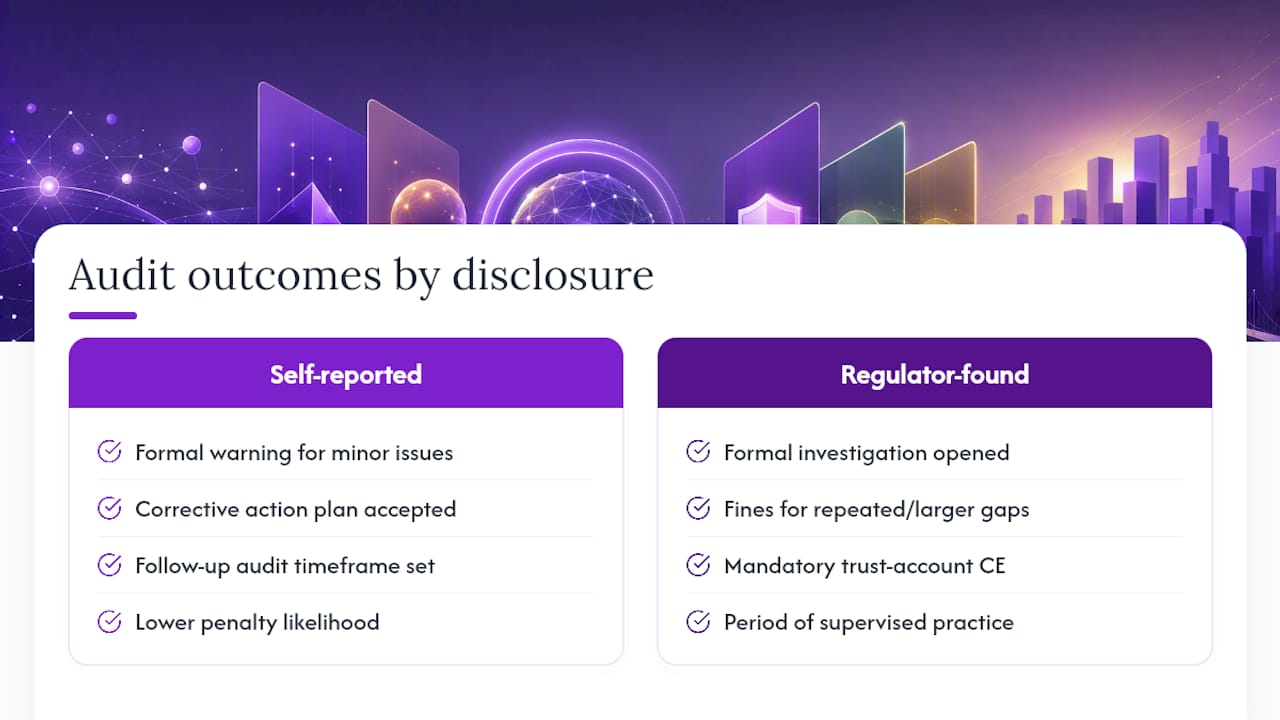
Consequences typically fall into a few tiers. A minor first-time finding, like a reconciliation that was a few days late or a documentation gap you can quickly correct, often results in a formal warning, a required corrective action plan, or a follow-up audit within a set period. Repeated or larger findings escalate to fines, mandatory continuing education in trust accounting, or a period of supervised practice.
The most serious cases, involving commingling, unauthorized withdrawals, or an unexplained shortage that isn’t promptly corrected, can lead to license suspension or revocation. Some states also refer clear misappropriation cases for criminal prosecution, since knowingly using client funds for personal or operating expenses can constitute theft under state law, separate from any licensing penalty.
Intent matters less than most brokers assume. Regulatory guidance and state bar commentary make clear that brokers are strictly responsible for trust account accuracy, and an honest administrative error still exposes you to discipline. “I didn’t mean to” is not a defense a commission accepts once the ledgers don’t match.
That’s why disclosure timing matters so much. A broker who finds a shortage during a self-review and reports it with a documented correction plan is treated very differently than one whose shortage surfaces during a regulator’s audit. Coming forward first, with the fix already underway, materially changes how a case gets handled.
Running Your Own Self-Audit Before The State Does
A self-audit is the same three-way reconciliation your state auditor will eventually run, just done by you, on your own schedule, with time to fix what you find.
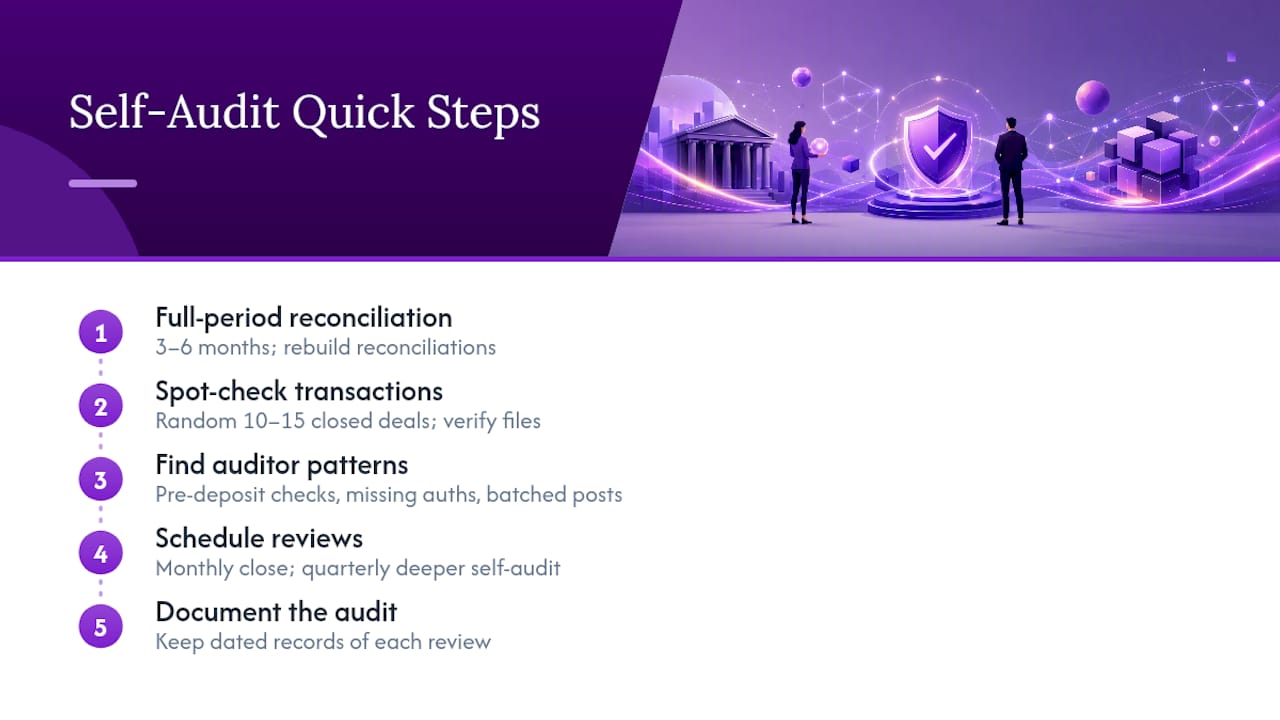
Start with a full-period reconciliation, not just the current month. Pull bank statements for the last three to six months and rebuild the reconciliation for each one, checking that your saved workpapers actually match what’s in the bank record. This catches slow-building errors that a single month’s check would miss.
Next, spot-check a sample of transaction files against your ledger entries. Pick ten to fifteen closed transactions at random and confirm each has a complete file: contract, deposit slip, disbursement authorization, and closing statement. If more than one or two are missing pieces, that’s a process gap, not a fluke.
Look specifically for the patterns auditors flag: any check written before its corresponding deposit cleared, any disbursement without a documented authorization, and any stretch of days where transactions were posted in a batch instead of as they occurred.
Put this on a calendar. Monthly reconciliation is table stakes, but a deeper quarterly self-audit, the kind that resamples old files and checks your own consistency, catches drift that a routine month-end close won’t. If your firm has multiple agents or offices, rotate which office or agent’s transactions get the closer look each quarter so no file goes unchecked for too long.
Document the self-audit itself. If your state auditor asks whether you have an internal compliance process, a dated record of your own quarterly reviews is exactly what they’re looking for.
Software And Tools That Support Trust Account Compliance
Manual reconciliation in a spreadsheet works until it doesn’t, usually right when transaction volume climbs or a second office opens. Purpose-built trust accounting software timestamps every entry, flags mismatches automatically, and produces reconciliation reports without you rebuilding a formula each month.
Look for a few specific capabilities when evaluating a tool. It should generate a true three-way reconciliation report, not just a bank feed. It should log approvals on every disbursement, not just record that a payment happened. And it should keep a separate ledger per client or transaction automatically, rather than requiring you to maintain that separation by hand in a shared spreadsheet.
Commission-specific platforms go a step further by tying payment tracking directly to tax and compliance documentation, so the same record that satisfies an auditor also feeds your 1099 reporting and cap tracking without duplicate data entry. That overlap matters more than it sounds. Every time you re-enter the same transaction into a second system, you create a new opportunity for the two records to drift apart, and drift is exactly what a reconciliation is supposed to catch.
Whatever system you choose, the test is simple: can it produce a complete, exportable reconciliation packet on demand, with no manual reassembly, the day an audit notice arrives?
Building A Daily Culture Of Audit Readiness
Audit failures rarely start with one big mistake. They start with small delays: a deposit posted three days late, a reconciliation pushed to “next week,” a disbursement approved verbally instead of in writing. Daily posting and a genuine monthly close, backed by occasional spot checks and real staff training on why the process matters, are what actually prevent the scramble auditors notice immediately.
Commission payment structures are where a lot of this discipline breaks down in practice, since referral splits and co-op payouts often move outside the trust ledger entirely if a brokerage isn’t deliberate about it.
— Wes
A Compliant Alternative To Ad-Hoc Commission Payouts
Brokerpay replaces the Venmo-and-spreadsheet approach to commission payments with one that produces its own audit trail automatically. Every agent split, referral fee, and co-op commission moves through a bank-cleared ACH transfer with a logged approval step and a stored receipt, the exact combination auditors ask for when they request disbursement documentation.
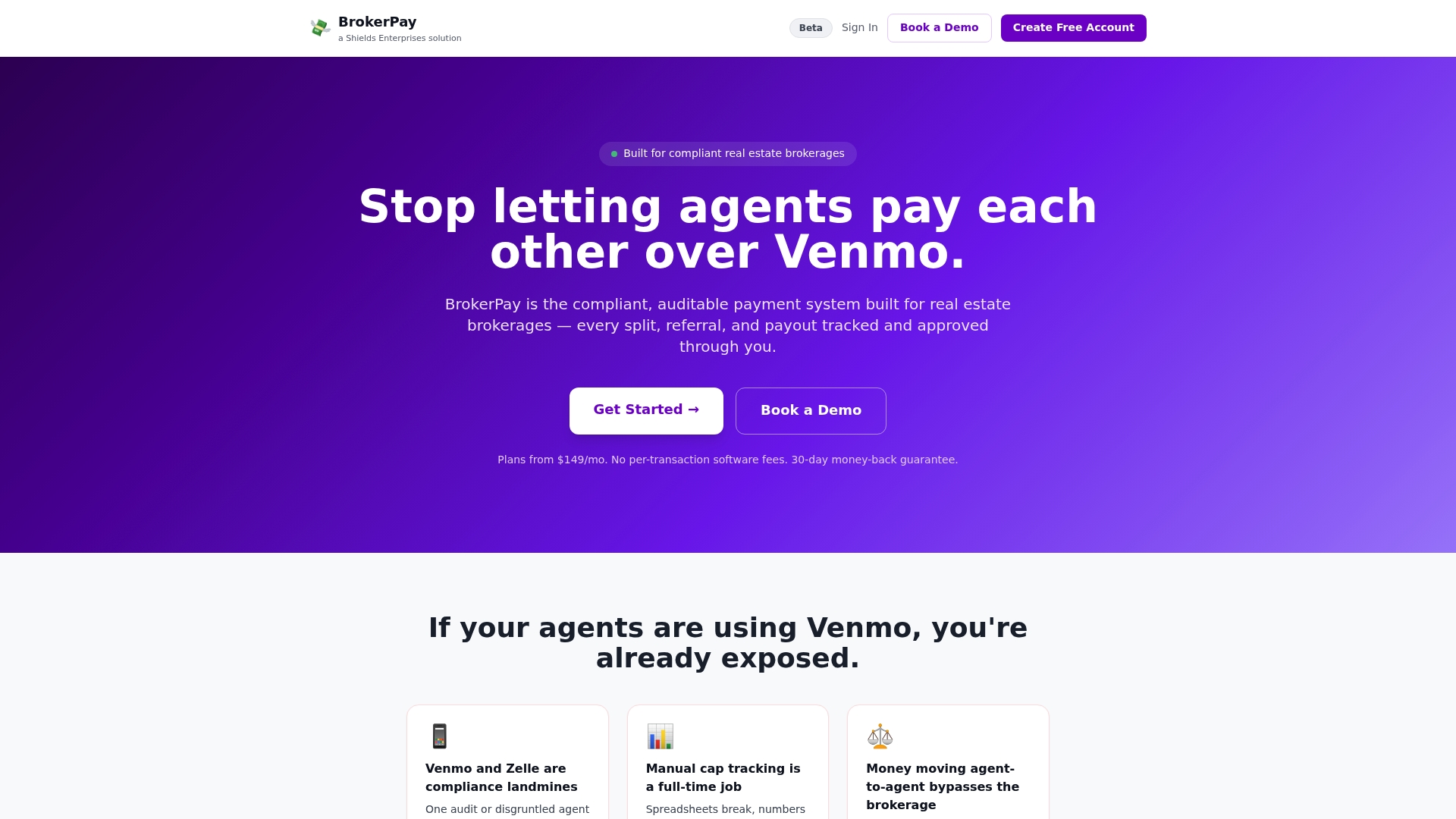
That structure maps directly onto what a state audit actually checks: banked transaction records instead of peer-to-peer transfers with no paper trail, an approval log showing who authorized each payment, and receipts attached to the transaction instead of scattered across text messages and email threads. It also closes the RESPA exposure that comes with informal referral payments, since every fee is documented at the moment it moves, not reconstructed after the fact.
For brokerages tired of rebuilding commission records by hand every time a compliance question comes up, Brokerpay is worth a look. Request a demo and see what a fully documented commission payment workflow looks like against your own transaction volume.
Sources
- Colorado Division of Real Estate — Broker Financial Audit Process
- California DRE — Trust Funds: A Guide for Real Estate Brokers and Salespersons (RE 13)
- North Carolina State Bar — Trust Accounting guidance