6 Steps to Reconcile Cap True Ups for Brokerage Accounting Teams

The cap true-up process is the procedure that reconciles an agent’s year-to-date cap progress, applies split calculations (including mid-deal splits when a transaction crosses the cap), and records an auditable Commission Disbursement Authorization (CDA) and ledger entry before funds move. Done right, every payout matches a running cap memo balance that both the brokerage and the agent can check. Platforms like BrokerPay now handle this calculation automatically, but the logic underneath is what you need to get right first.
TL;DR:
- Manual crossing transactions often lead to calculation errors because the entire commission is wrongly split using a single rate instead of a precise cutoff at the cap line.
- Always verify the agent’s live year-to-date cap balance and avoid using cached figures, as discrepancies cause over- or underpayment and disputes.
- Automating cap calculations with live data and separate CDA line items for pre- and post-cap splits reduces errors and enhances auditability.
- Proper controls require recording cap progress as a memo balance, not a general ledger entry, and conducting a three-way match before disbursing funds.
- Automated systems like BrokerPay handle cap true-ups accurately by encoding plans as structured data and calculating splits against real-time balances.
Table of Contents
- How Do You Reconcile Cap Progress Before Each Payout?
- How Do You Calculate and Post a True-Up?
- Why Crossing Transactions Trip Up Manual Systems
- Accounting Controls That Keep the Books Honest
- Handling Mid-Year Changes, Departures, and Clawbacks
- What Should You Automate, and How Do You Test It?
- A Practitioner’s View on Getting This Right
- How BrokerPay Handles Cap True-Ups Automatically
- Sources
How Do You Reconcile Cap Progress Before Each Payout?
Every payout cycle needs the same sequence of checks, run in order, before anyone releases funds.
- Verify the transaction against the ALTA settlement statement or closing disclosure to confirm the sale price and gross commission.
- Pull the agent’s live year-to-date cap memo balance — never a cached figure from last week’s report.
- Classify the deal: pre-cap, post-cap, or crossing (the transaction that pushes the agent past their cap mid-deal).
- If it’s a crossing transaction, compute the split at the exact cap line and apply the correct tier to each portion.
- Generate the CDA, run the three-way match, and route it for manager approval.
- Log the updated balance and fire any threshold alerts the update triggers.
Skip step two and you’ll pay an agent at the wrong split all year, not just once. That’s the single most common source of commission disputes in brokerages that still track caps in a spreadsheet.
How Do You Calculate and Post a True-Up?
Before you can compute anything, you need six data points for the specific transaction: sale price, gross commission, agent ID, close date, the agent’s comp plan (cap amount, pre/post splits, anniversary date), any referral obligations, and applicable transaction fees.
The calculation itself follows a fixed order:
- Read the agent’s live year-to-date cap balance.
- Compute the remaining cap headroom before this deal.
- Split the gross commission into a pre-cap portion (up to remaining headroom) and a post-cap portion (everything above it).
- Apply the plan’s pre-cap split percentage to the first portion and the post-cap split percentage to the second.
- Deduct referral fees, then fixed transaction fees, in that order, from the agent’s net.
A worked example: Say an agent has capped and has already paid in most of the cap amount for the year. A new deal closes with a significant gross commission. The remaining headroom gets split at the agent’s pre-cap rate, so the brokerage keeps a proportional share and the agent gets the rest. The agent nets the sum of these portions on this single deal.
The most reliable systems encode this as a function of remaining cap balance rather than a fixed schedule of tiers, which is what lets the same logic handle tiered, graduated, and flat cap plans without separate code paths for each plan type.
Round at the cent level, not the dollar, and write results in three places: the agent’s running ledger, the CDA line items (one line per split portion), and the accounting journal entry that records the brokerage’s share as revenue.
Why Crossing Transactions Trip Up Manual Systems
Applying one split percentage to the entire commission on a crossing deal is the single most common calculation error brokerages make, because the deal that pushes an agent over their cap isn’t “pre-cap” or “post-cap.” It’s both, in the same transaction.
The correct pattern splits the commission at the exact dollar where the agent’s cumulative paid-in amount hits the cap. Everything below that line uses the pre-cap split; everything above it uses the post-cap split. There’s no rounding to the nearest deal, no averaging the two rates. It’s a hard line, transaction by transaction.
Three system checks make this reliable instead of a guessing game:
- Always query the live year-to-date balance at calculation time, never a cached number from the morning report.
- Update the ledger the moment the CDA generates, not at month end.
- Write a separate CDA line item for the pre-cap and post-cap portions, so the audit trail shows exactly where the split happened.
Pro Tip: Test your crossing-transaction logic against a full prior calendar year of closed deals before trusting it on live payouts. If the recalculated totals don’t match what agents were actually paid, you’ve found a bug before it costs you a dispute.
The failures that show up most often are stale cached balances, using the wrong anniversary date as the reset basis, and letting plan changes auto-post without a human reviewing them first.
Accounting Controls That Keep the Books Honest
Cap progress should live as a memo balance, not a general ledger posting. The moment you start posting running cap totals to the GL, you’ve conflated a tracking metric with actual revenue recognition, and your books stop matching what happened financially.
Before any disbursement, run a three-way match between the CDA, the ALTA closing disclosure, and the bank wire confirmation. Mismatches here are where real money gets misplaced, and catching them before payout is far cheaper than unwinding a wire afterward.
On the P&L side, gross GCI booked as plain cash income without separating contra-revenue items misrepresents your liquidity. Referral fees, franchise royalties, and E&O premiums need their own line items, documented on the CDA so anyone reviewing the deal later can see exactly what was deducted and why.
- Record gross commission at full value, then break out referral fees, royalties, E&O, and transaction fees as separate contra-revenue entries.
- Schedule chargebacks or supplemental payments only after documenting the reason in the agent’s file, not as a silent ledger adjustment.
Handling Mid-Year Changes, Departures, and Clawbacks
Mid-year plan changes need one consistent policy, whether that’s prorating the cap, carrying the prior balance forward, or resetting entirely. Mixing approaches deal by deal is what generates the exceptions nobody wants to explain to an agent months later.
When an agent leaves, reconcile their final pay against the independent contractor agreement, including any unvested marketing co-op contributions or lead rebates that haven’t been earned out yet.
- Log clawbacks explicitly on the agent’s ledger and reflect them on the final settlement, not as a quiet subtraction.
- Preserve documentation on every clawback; it’s your protection if a former agent disputes the final number in small-claims court.
- Pause automation and route to human review whenever a plan change, referral carve-out, or unusual deduction shows up.
What Should You Automate, and How Do You Test It?
Start by encoding each agent’s comp plan as structured data: cap amount, pre/post split percentages, anniversary date, and any recurring fees. That structured record becomes the single source of truth every calculation reads from.
- Trigger the calculation off closed-transaction events from your transaction management system, and always query live year-to-date GCI rather than a cached figure.
- Set alerts at 80% of cap, at 100% (the cap itself), and at reset, and generate a plain-language statement the agent can read without calling the office.
- Before going live, run three tests: a full prior-year simulation against known payouts, a batch of crossing-transaction cases, and a journal-entry validation to confirm GL postings match the memo balances.
Pro Tip: An orchestration model, reading from your transaction system, computing the split, and writing results back to the ledger and CDA, lets you automate the cap logic without ripping out your existing accounting software.
A Practitioner’s View on Getting This Right
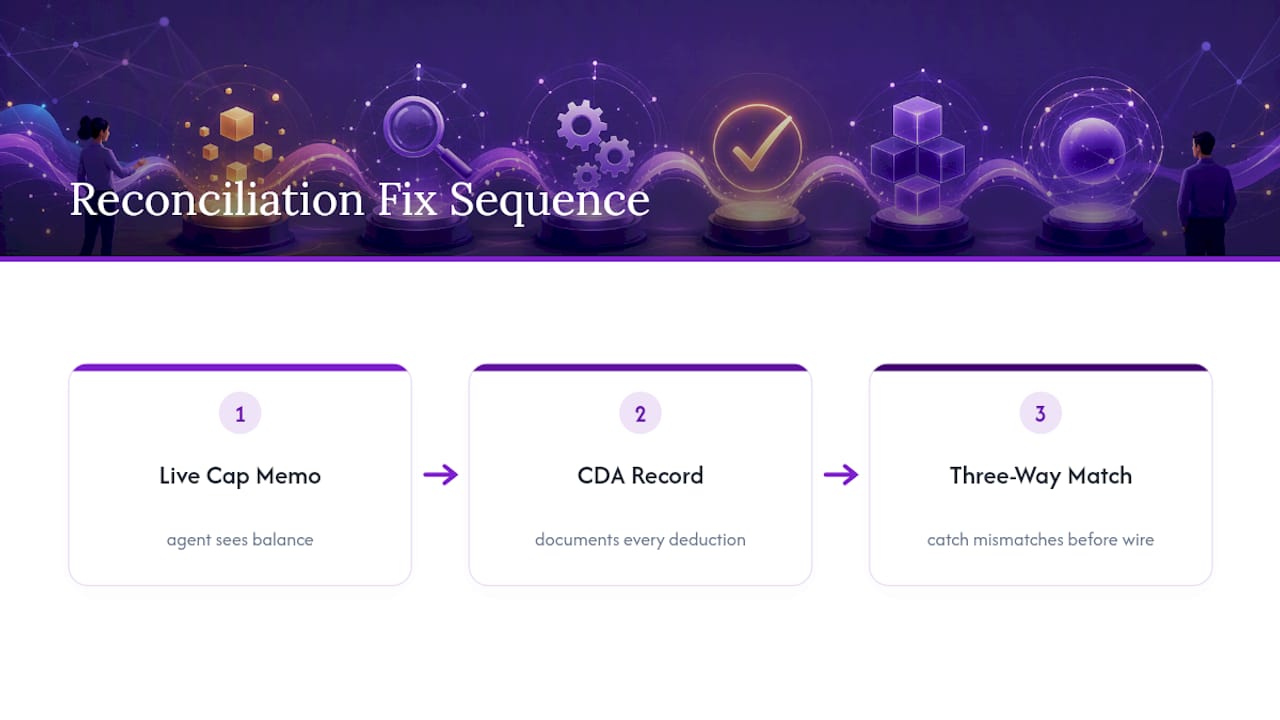
Most brokerages don’t have a calculation problem. They have a trust problem, and it usually starts with an agent who can’t reconcile their own check against what they thought their cap balance was.
The fix isn’t more spreadsheets. It’s a running cap memo balance the agent can see in real time, a CDA that documents every deduction, and a three-way match that catches mismatches before the wire goes out. BrokerPay was built around exactly that sequence, because the audit trail matters more than the software running it.
— Wes
How BrokerPay Handles Cap True-Ups Automatically
BrokerPay removes the manual math and the Venmo-and-Zelle workarounds that create RESPA exposure in the first place. Instead of a spreadsheet that goes stale the moment a deal closes, you get a system that reads each agent’s comp plan as structured data and calculates every split, crossing transactions included, against a live balance.
- Comp plans encoded once (cap, pre/post splits, anniversary date, fees) and applied automatically to every closing.
- Live cap tracking that updates the moment a transaction closes, not at month end.
- Auto-generated CDAs with a full audit trail for every deduction and split.
- ACH disbursement that replaces peer-to-peer payment apps with a documented, RESPA-compliant transfer.
If your office manager is still reconciling cap balances by hand or agents are getting paid through a personal Venmo transfer, see how BrokerPay automates the full payout workflow and get a walkthrough of how your comp plans would map into it.