Stop 6–12 Hours of Cap Reconciliation: Team Cap Tracking for Brokers

Team cap tracking is the live monitoring of an agent’s or team’s year-to-date gross commission income against their brokerage cap, triggering the correct split change and payout the moment they cross it. If your brokerage still runs this on a spreadsheet or trusts agents to Venmo each other for co-op payments, the fix is an automated, ledgered system that calculates split-at-cap in real time and produces an auditable record. Anything less carries real compliance risk.
TL;DR:
- Automated, real-time cap tracking reduces errors and saves each brokerage 6 to 12 hours monthly on reconciliation processes.
- A proper system must store structured compensation plan data, query live year-to-date earnings, and integrate with transaction management systems for accurate crossing calculations.
- Regular manual testing of crossing transactions and quarterly audits of live data are essential to prevent miscalculations and ensure correct split-at-cap logic.
- Failure modes include stale balances, all-or-nothing crossing deals, and fixed reset dates, which can lead to over or underpayment errors and regulatory risks.
- Replacing spreadsheets with ledgered systems like Brokerpay enhances compliance, streamlines disbursements, and provides verifiable audit trails for regulators and insurance providers.
Table of Contents
- Why Team Cap Tracking Matters for Time and Compliance
- What a Real Team Cap Tracking System Needs
- How Do You Set Up Team Cap Tracking?
- Where Cap Tracking Breaks (and How to Catch It)
- What We’d Fix First If We Were Starting Over
- Stop Tracking Caps in a Spreadsheet
- Sources
Why Team Cap Tracking Matters for Time and Compliance
Manual cap tracking costs more than most brokers realize. Brokerages running 25 or more agents on spreadsheets typically burn 6 to 12 hours a month just reconciling commission accounting, with each individual transaction eating 45 to 90 minutes of staff time. Automated systems cut that review window to 5 to 15 minutes per deal, with error rates that approach zero.
Time and Money at Stake: A mid-size office spending 10 hours a month on manual cap math isn’t just losing labor hours. It’s one missed threshold away from a split dispute that damages agent trust.
The errors themselves aren’t trivial rounding mistakes. Miss a cap crossing and you either underpay an agent who just earned a lower split, or overpay one who should have kept 100% past the line. Both outcomes generate disputes, and disputes eat into the goodwill that keeps agents from shopping their license elsewhere.
There’s a bigger issue underneath the math. When brokerages can’t track caps cleanly, agents often route around the confusion with side payments, Venmo transfers between team members, or informal referral fee arrangements that never touch the books. Those unledgered flows create real RESPA exposure. A ledgered, automated workflow doesn’t just save hours. It gives you a documented, timestamped trail for every dollar that moves, which is exactly what regulators and E&O carriers want to see.
What a Real Team Cap Tracking System Needs
A spreadsheet can add numbers. It can’t model a compensation plan or catch a crossing transaction correctly, and that gap is where most brokerages get burned. The right platform needs a specific set of capabilities, not just a running balance.
- Structured comp-plan data: cap amount, pre-cap split, post-cap split, anniversary or calendar reset date, transaction fees, and any override agreements, all stored as data rather than notes in a file.
- Live year-to-date GCI lookup: the system must query current YTD earnings at the moment of calculation, not a cached number from last week’s export, and correctly split crossing transactions at the exact cap line.
- Transaction system integration: triggers from your TMS (Dotloop, SkySlope, or similar) that fire the calculation the moment a deal status changes to closed.
- Approval and exception workflows: role-based access so a managing broker signs off before funds move, with a queue for anything that doesn’t compute cleanly.
- Audit trails: a timestamped record of every cap reset, split change, and payment for every agent, retrievable on demand.
- Agent-facing statements and alerts: automatic notifications at thresholds like 80% of cap and again when the cap is reached.
Industry-standard cap amounts vary widely by brokerage model, typically running from $12,000 to $35,000 a year, and whether the reset happens on the calendar year or an agent’s individual anniversary date changes how the system needs to track it per person.
Pro Tip: Keep your split templates and your per-deal allocation records as separate data objects. When a comp plan changes mid-year, you want to adjust the template going forward without rewriting history on deals already closed.
How Do You Set Up Team Cap Tracking?
Rolling out a real cap tracking system isn’t a weekend project, but it’s not a six-month IT initiative either. Here’s the sequence that keeps the transition clean.
- Audit every agent’s comp plan and encode it as structured data. Capture the cap amount, pre- and post-cap splits, whether the reset is calendar-based or tied to the agent’s join date, and any deductions like E&O fees or franchise royalties.
- Map your transaction system triggers. Identify the exact event, typically a
transaction.status_changedwebhook, that should fire the cap calculation, and confirm the calculation engine is pulling live YTD figures rather than a static import. - Test crossing-transaction scenarios explicitly. Run a deal that starts pre-cap and finishes post-cap through the system and verify it splits at the correct dollar line, not the whole deal at one rate.
- Build your approval roles and exception queue. Decide who signs off on payments, what routes to a human review, and how disputes get logged and resolved.
- Pilot with a small group of agents before full rollout. Parallel reconciliation against your existing manual process is the only way to catch a logic error before it touches everyone’s paycheck.
- Run both systems side by side until the numbers match consistently, then cut over completely.
| Implementation Phase | Primary Task | Who Owns It |
|---|---|---|
| Audit | Encode comp plans as structured data | Office administrator |
| Integration | Map TMS triggers and test live GCI pull | Managing broker / IT |
| Validation | Test crossing transactions and resets | Accounting lead |
| Governance | Set approval roles and exception queue | Broker owner |
| Pilot | Run parallel reconciliation with subset of agents | Office administrator |
The crossing-transaction test in step three deserves extra attention. It’s the single most error-prone calculation in the entire system, and getting the split-at-cap logic wrong on even one large transaction can mean hundreds of dollars of error that someone has to explain to an unhappy agent.
Where Cap Tracking Breaks (and How to Catch It)
Even automated systems fail when they’re built on bad assumptions. Watch for these specific failure modes.
- Stale YTD balances: a system that caches last month’s total instead of querying live data will miscalculate every split until someone notices the drift.
- Crossing deals treated as all-or-nothing: splitting the entire transaction at one rate instead of dividing it at the exact cap line, a mistake that inflates or shrinks payouts on larger deals.
- Hard-coded reset dates: assuming every agent resets on January 1 when your brokerage actually uses anniversary-based resets tied to hire date.
Verify quarterly, not just at year-end. Pull a sample of crossing transactions and manually check the math. Confirm the audit trail logged every reset and split change with a timestamp. Spot-check that threshold alerts actually fired at 80% and at cap.
Three numbers worth tracking monthly: how many agents got a cap-progress alert, what percentage variance shows up when you reconcile the automated output against a manual spot-check, and how long disputes take to resolve from flag to close. Rising numbers on the last two mean your system needs a second look before it costs you an agent’s trust.
What We’d Fix First If We Were Starting Over
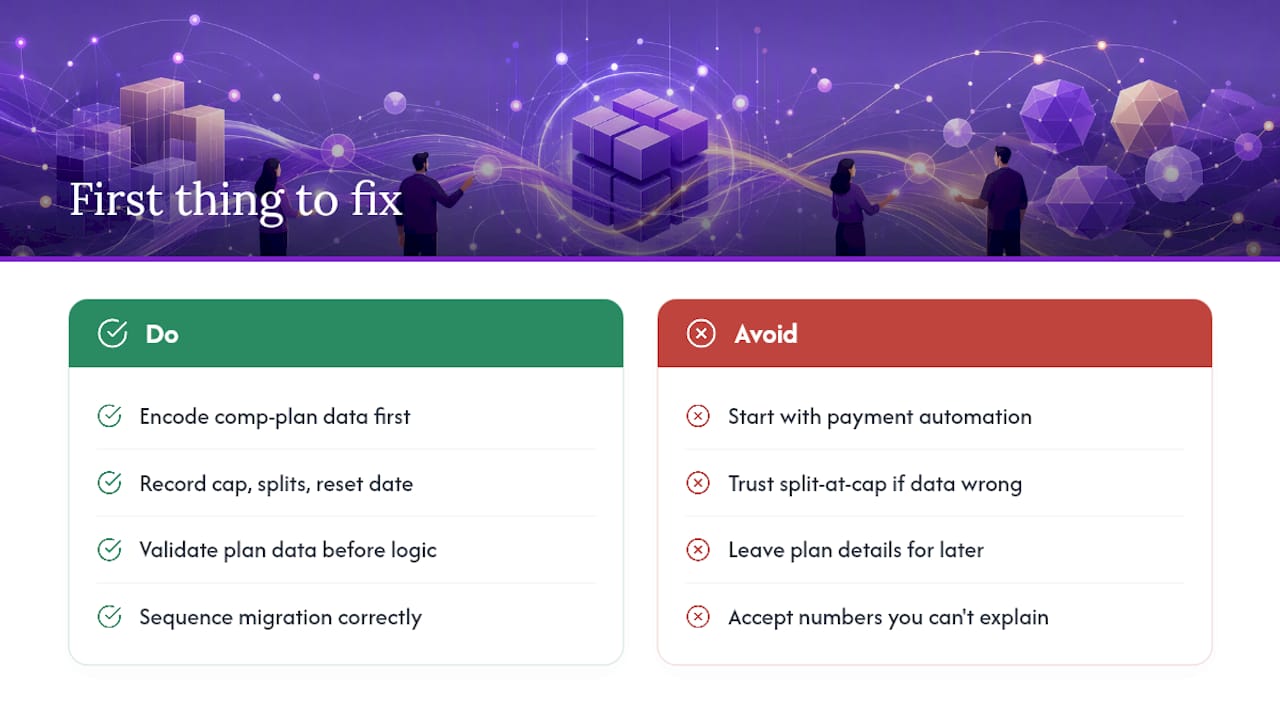
If you’re migrating off spreadsheets, start with the comp-plan data model, not the payment automation. Get every agent’s cap, splits, and reset date encoded correctly first, because split-at-cap logic is worthless if the underlying plan data is wrong. That sequencing matters more than most brokerages expect.
The brokerages that get this right report fewer end-of-month scrambles, cleaner handoffs to their accountant, and far fewer awkward conversations about a miscalculated check. The real payoff isn’t the hours saved, though those add up fast. It’s not having to defend a number you can’t fully explain.
— Wes
Stop Tracking Caps in a Spreadsheet
Brokerpay is built around the exact workflow this article just walked through: structured comp plans, live year-to-date cap progress, and split-at-cap calculations that handle crossing transactions correctly the first time.
Every payment runs through an approval workflow before it initiates, and every reset, split change, and disbursement lands in a timestamped audit trail you can hand to an auditor or an E&O carrier without scrambling. That matters most for the transactions manual systems handle worst. Brokerpay also replaces the Venmo and Zelle transfers many teams still use for referral fees and co-op splits, closing off the RESPA exposure those informal payments create. ACH disbursements move directly from a documented, ledgered record instead of a personal payment app.
If your brokerage is still reconciling caps by hand or worried about what an audit would find, request a demo of Brokerpay and see how the cap logic maps to your actual comp plans.
Sources
- Manual vs. Automated Commission Disbursement: 2026 Guide
- Commission Tracking for Real Estate Teams (US Guide) | AltStack