What Cap and Fee Offsets Mean for Brokerage Payouts

A fee offset is any credit, rebate, or referral reduction applied against a commission before or after that split calculation. The immediate action for any office manager: put every offset in writing inside the buyer or agent compensation agreement, reflect it on the closing disclosure, and track cap progress on a ledger someone could hand to an auditor tomorrow.
Three things need to exist before a check clears:
- A signed compensation agreement stating the offset terms
- A closing disclosure showing the credit line item
- An audit trail connecting the payout to both documents
Pro Tip: If you can’t produce all three documents for a payout within five minutes of being asked, your workflow has a gap. A platform like BrokerPay closes that gap by tying payment approval to the paperwork automatically.
Key Takeaways
Cap and fee offset compliance depends on documenting every credit in writing, reflecting it on the closing disclosure, and reconciling cap balances against GCI every month.
| Point | Details |
|---|---|
| Define your terms | A cap is the dollar ceiling before an agent’s split rises; an offset is any credit or rebate applied against commission. |
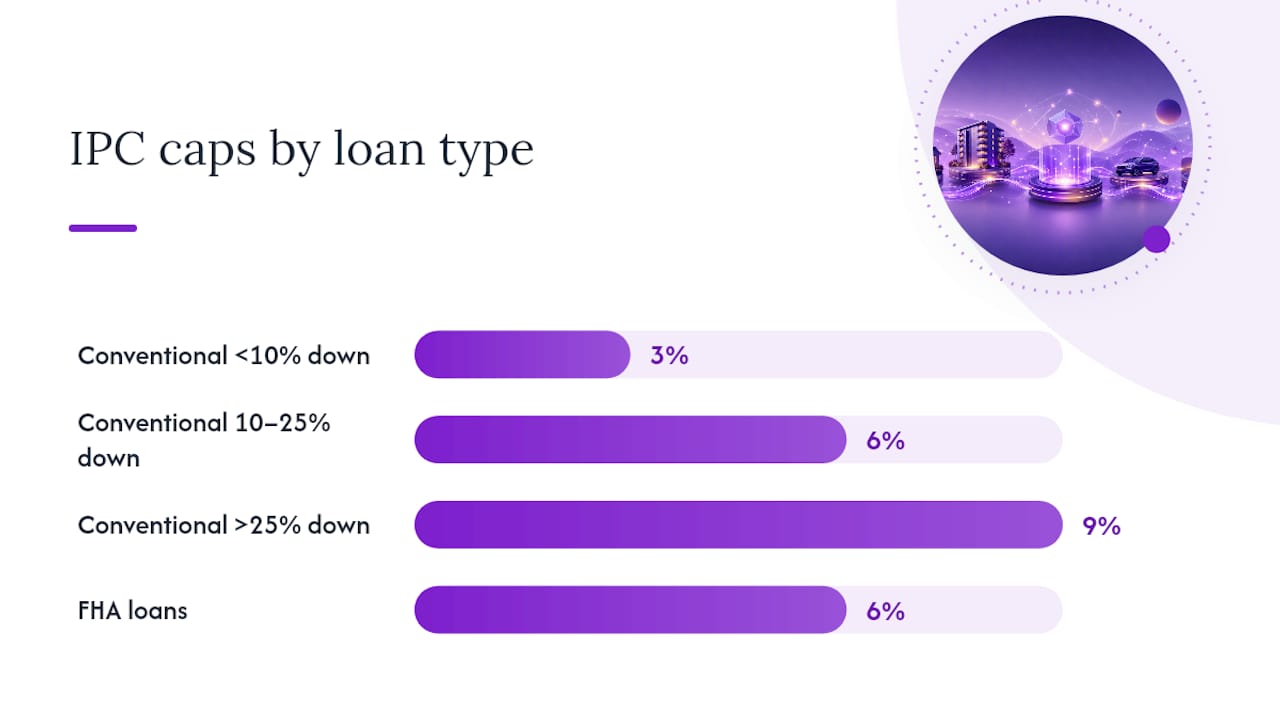
| Know your lender caps | Conventional IPC limits run 3% to 9% by down payment, FHA caps at 6%, and VA/USDA have separate rules. |
| Track cap as a memo balance | Reconcile agent cap progress to GCI monthly rather than at year-end. |
| Verify licensing at payout | Confirm license status when the payment is authorized, not just at onboarding. |
| Automate the audit trail | Platforms like Brokerpay attach agreements, closing disclosures, and licensing checks to every payout automatically. |
Table of Contents
- How Do Caps, Splits, and Fee Offsets Flow Through a Commission Check?
- Compliance and Lender Limits You Must Check Before Applying an Offset
- Bookkeeping and Cap-Tracking Best Practices
- Operational Workflows and Controls to Prevent Licensing or Underwriting Risk
- Worked Examples: Cap Progress, Proration, and Offset Math
- How BrokerPay Automates Compliant Cap Tracking and Offset Workflows
- What Most Brokerages Get Wrong About Offset Documentation
- Automating Compensation Compliance With Brokerpay
- Sources
How Do Caps, Splits, and Fee Offsets Flow Through a Commission Check?
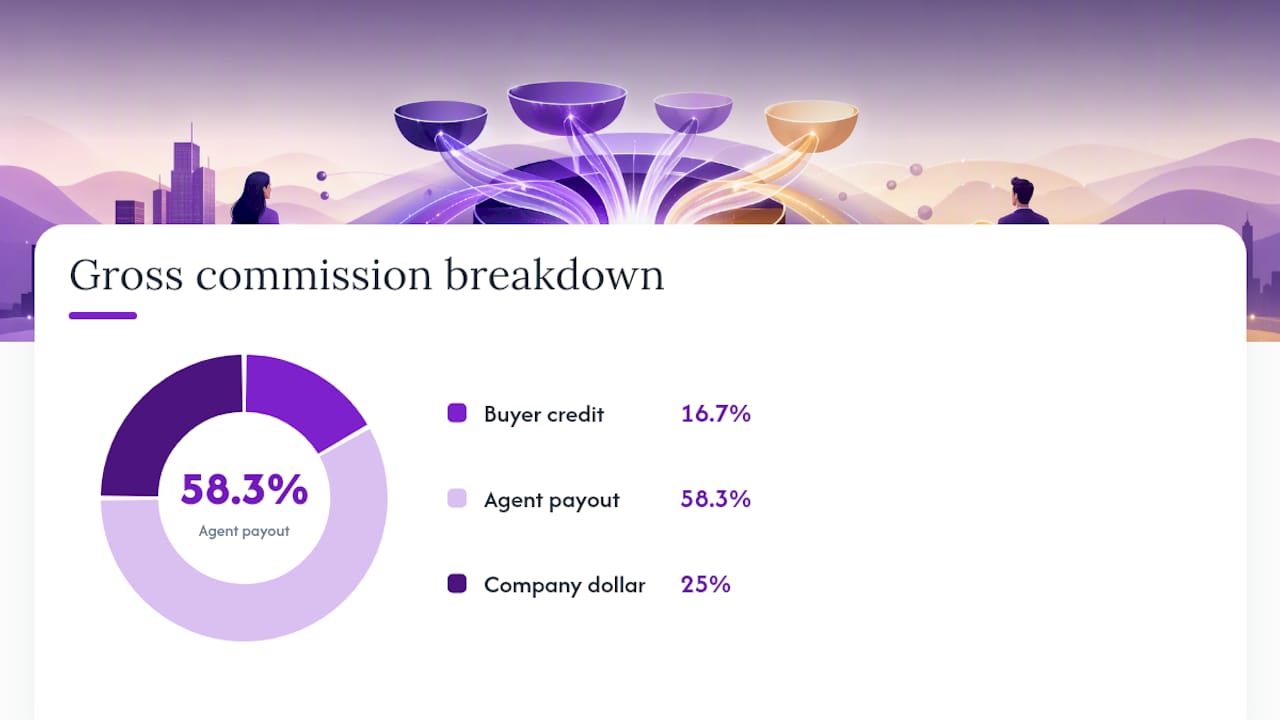
Three numbers matter on every closed deal: gross commission, company dollar, and agent payout. Company dollar is what the brokerage keeps before any cap credit. Once an agent’s cumulative company dollar contributions hit the cap, typically $12,000 to $35,000 depending on the brokerage, the split usually jumps to 100% for the remainder of the cap cycle.
Cap cycles run one of two ways:
- Annual cap, resetting on a fixed calendar date for the whole office
- Anniversary cap, resetting on the agent’s individual hire date
Where an offset lands changes the math entirely. A referral fee paid to an outside broker typically comes off the top, before the in-house split, which lowers both the company dollar and the agent’s payout proportionally. A buyer rebate or closing-cost credit, by contrast, usually reduces the agent’s payable commission line while leaving the brokerage’s company dollar untouched, since the agent is the one extending the concession to their client.
Proration gets messy when someone leaves mid-cycle. If an agent departs in month seven of a twelve-month anniversary cap, most brokerages prorate the remaining cap balance rather than resetting it. The bookkeeping consequence is real: an offset that reduces company dollar changes your revenue recognition, while one that only reduces the agent’s payable changes your accounts payable. Mixing those two up is how brokerages end up over-crediting cap progress that was never actually earned.
Compliance and Lender Limits You Must Check Before Applying an Offset
Every offset has to survive two separate scrutiny layers: RESPA and the lender’s underwriting rules. RESPA doesn’t ban credits or rebates outright, but it does require that anything of value exchanged in a transaction show up on settlement paperwork where a regulator, or a lender’s compliance team, can see it.
Lenders classify agent credits as interested-party contributions (IPCs), and each loan type caps them differently:
- Conventional loans: up to 3% with less than 10% down, up to 6% between 10% and 25% down, and up to 9% above 25% down
- FHA loans: capped at 6% of the sale price
- VA loans: governed by separate seller-concession limits rather than the standard IPC tiers
- USDA loans: subject to their own program-specific concession rules
Roughly ten states restrict or prohibit rebates entirely, which means the same offset that’s routine in one market can be a compliance violation in another. The workaround brokerages use most often is restructuring the credit as a seller concession or building it into the price adjustment rather than a direct rebate.
Pro Tip: Loop the lender in before you finalize any credit structure, not after. A credit that arrives as a surprise on the settlement statement is far more likely to get flagged during underwriting than one the lender saw coming.
Build rebate terms into the buyer representation agreement itself, since post-NAR settlement norms now expect compensation terms to be disclosed there rather than negotiated informally later.
Bookkeeping and Cap-Tracking Best Practices
Cap progress belongs in a memo balance per agent, reconciled monthly against gross commission income (GCI) and the payout ledger. Best-practice brokerage bookkeeping treats this memo balance as a living number that updates with every closed transaction, not a spreadsheet someone updates quarterly.
Franchise royalties and transaction fees need their own visible accounts too. Burying them inside a blended company-dollar figure makes it nearly impossible to see whether an agent’s cap math is accurate or whether a fee got double-counted.
For chargebacks, clawbacks, and mid-year departures, follow these steps:
- Reverse the original commission entry in the period it was booked, not the period the reversal happens
- Record the clawback against the agent’s memo balance immediately, so cap progress reflects reality
- Flag departed agents’ remaining cap balances as closed, with a note on why the cycle ended early
A commission disbursement authorization (CDA) should capture: gross commission, company dollar, agent gross, offsets applied, cap remaining, the approver’s name, and links to supporting documents. Storing all seven fields together, rather than scattered across email threads and folders, is what turns a payout into something you could defend in an audit.
Operational Workflows and Controls to Prevent Licensing or Underwriting Risk
License verification has to happen at the moment of payment, not at onboarding six months earlier. Licenses lapse, get suspended, or move between brokerages more often than office managers expect, and paying a commission to someone unlicensed at the time of the transaction creates liability that’s hard to unwind later.
Every payout workflow needs these checks built in:
- Verify current license status and save the verification record with the payment file
- Require signed compensation terms in the buyer or agent agreement before authorizing any offset
- Confirm the offset appears on the closing disclosure, since lenders often reject or flag post-closing payments that weren’t disclosed at settlement
- Route every offset through a named approver, not whoever happens to be in the office that day
Pro Tip: Keep an approval matrix on the wall, literally or digitally: who signs off on referral fees under $500, who signs off above that, and what documentation each tier requires. Ambiguity here is where “just this once” exceptions creep in.
A compliant co-op payment workflow usually spells out exactly which of these steps happen before versus after closing, which removes the guesswork for staff processing a dozen files a week.
Worked Examples: Cap Progress, Proration, and Offset Math
- Gross commission: $400,000 × 3% = $12,000
- Buyer credit deducted from agent’s side: $400,000 × 0.5% = $2,000
- Remaining commission to split: $10,000
- Agent’s 70% share: $7,000, applied against their cap balance
- Company dollar (30%): $3,000
| Input | Value | Applies To |
|---|---|---|
| Gross commission | $12,000 | Full transaction |
| Buyer credit (0.5%) | $2,000 | Agent’s payable |
| Commission after credit | $10,000 | Split calculation |
| Agent payout (70%) | $7,000 | Cap credit |
| Company dollar (30%) | $3,000 | Brokerage revenue |
For proration, take an agent on a $20,000 anniversary cap who departs after seven of twelve months, having contributed $9,000 in company dollar. The agent is under-capped relative to time elapsed, which matters if your brokerage prorates final settlements based on cycle completion rather than dollar contribution.
Rebate percentages in the 0.5% to 1.5% range are common enough to use as your default test case when auditing whether your systems handle offsets correctly.
How BrokerPay Automates Compliant Cap Tracking and Offset Workflows
BrokerPay tracks agent splits, referral fees, co-op commissions, and cap progress with a documented audit trail attached to every payout, so the CDA fields above populate automatically instead of living in someone’s inbox.
- Centralizes payment approval workflows, replacing the Venmo and Zelle transfers that create undocumented RESPA exposure
- Verifies licensing status at the point of payment, not just at onboarding
- Reconciles cap progress against GCI without a manual spreadsheet pass
A sensible pilot: run one office or team through BrokerPay for a full cap cycle, confirm the reconciliation reports match your existing bookkeeping, then expand.
What Most Brokerages Get Wrong About Offset Documentation
The mistakes I see repeated most: unsigned compensation agreements that get “fixed” verbally after the fact, rebates paid quietly after closing instead of on the settlement statement, and license checks that happened at hire but never again. None of these are exotic failures. They’re the boring, repeatable kind that pile up until an underwriter or a regulator asks a question nobody can answer cleanly.
The fix is almost insultingly simple: require written terms before the offer goes out, verify licensure at the moment of payout rather than trusting a file from last year, and reconcile cap balances monthly instead of waiting for year-end panic. None of that requires new technology. It requires someone deciding the paperwork happens before the money moves, not after.
— Wes
Automating Compensation Compliance With Brokerpay
Manual spreadsheets and after-the-fact paperwork are the two most common reasons cap credits and offsets get flagged during underwriting or audit. Brokerpay closes that gap by tying every payout to a documented agreement, a licensing check, and a closing disclosure line item automatically, instead of leaving your staff to reconstruct that trail after a lender asks for it.
The platform suits brokerages that are still routing referral fees and co-op splits through manual approvals, or worse, peer-to-peer payment apps that leave no defensible audit trail. If your office is tracking cap progress in a spreadsheet that only one person understands, that’s the exact failure point Brokerpay is built to remove. It centralizes agent splits, referral fees, and cap balances into one system that reconciles automatically and keeps license verification attached to every payment.
Start with a single office or team, run it through a full cap cycle, and compare the reconciliation output against what your bookkeeper produces manually. Take a look at BrokerPay to see how the payout workflow maps to your current cap and offset structure.
Sources
- Can a realtor contribute to closing costs? - LegalClarity
- Beancount
- Real Estate Commission Splits by Brokerage: Caps, Fees & Net Pay (2026)