Fixing Team Split Tracking Before It Becomes a Liability

The right move is straightforward: stop tracking agent splits, referral fees, and co-op commissions by hand and adopt a dedicated commission-tracking platform built for real estate compliance. A spreadsheet or a Venmo transfer doesn’t hold up to a state audit. A compliant system does. Before you evaluate any vendor, check for three things:
- A real calculation engine that handles tiers, year-to-date caps, and referral deductions automatically
- CDA generation with broker sign-off built into the workflow, not bolted on afterward
- Direct accounting export that ties every journal entry back to a specific transaction ID
Get those three right and the payoff is immediate: fewer disputes over who’s owed what, records that survive an audit request, and an end to the Venmo and Zelle workarounds that quietly expose brokerages to federal liability under RESPA.
Key Takeaways
Compliant team split tracking works because it replaces informal, undocumented payouts with a calculation engine, a signed CDA, and an accounting export tied to every transaction.
| Point | Details |
|---|---|
| Pick a real calculation engine | It must handle tiers, caps, referral deductions, and team overrides without manual reentry. |
| Require CDAs and broker sign-off | No payout should move without a signed disbursement authorization and an audit log entry. |
| Separate splits in your books | Track gross commission and split/referral deductions in distinct contra-revenue accounts. |
| Roll out in stages, not overnight | Inventory plans, wire up TMS triggers, then run parallel tests before full cutover. |
| Brokerpay maps directly to this checklist | It generates CDAs, calculation logs, and QuickBooks exports while replacing Venmo/Zelle payouts with ACH. |
Table of Contents
- Why Compliant Team Split Tracking Matters for Your Brokerage
- What a Commission-Tracking Platform Needs to Do
- How to Roll Out a Commission-Tracking System
- What Documentation Should Exist for Every Closing
- Getting Your Team to Actually Use the New System
- What Commission-Tracking Software Actually Costs
- Compliance and Legal Considerations You Can’t Skip
- What Brokerages Get Wrong About Commission Tracking
- Bring Your Team Split Tracking Into One Compliant System
- Sources
Why Compliant Team Split Tracking Matters for Your Brokerage
Peer-to-peer payment apps were never built for commission disbursement. When an agent sends a referral fee through Venmo, there’s no calculation record, no broker signature, and no link back to the closing that generated it. That gap is exactly what regulators and auditors look for.
Commission processing is already one of the more complicated corners of brokerage payroll. Multi-state operations, 1099 contractors, and variable splits combine to create meaningful tax and compliance exposure that manual tracking makes worse, not better. A missing signature or an unlogged rate change can turn into a bookkeeping headache come 1099 season.
- Audit trails and signed CDAs give you a defensible paper trail during state audits
- Consistent, on-time pay cycles reduce agent turnover and internal disputes
- Faster reconciliation means your bookkeeper isn’t chasing down screenshots of text messages
The operational upside is just as real as the compliance upside. Brokerages running automated split reconciliation report that routine disputes over commission math largely disappear once every calculation is logged and visible to the agent before the money moves.
What a Commission-Tracking Platform Needs to Do
Team split tracking isn’t just recording a percentage next to a name. It’s a full data model: split rules, cap thresholds, referral deductions, team overrides, and the accounting fields that let your bookkeeper close the books without guessing. Here’s what the system actually has to handle:
- A rules-based calculation engine. Tiered splits, capped commission structures, referral fee deductions, spiffs, and team overrides all need to run through the same engine without manual reentry. Look for a no-code plan builder that can represent a simple 70/30 split and a complex, multi-agent team structure with the same tool.
- Plan versioning tied to year-to-date GCI. Agent split plans change, sometimes mid-year. The system needs to track which version applied to which closing, and it needs a running memo balance of each agent’s gross commission income toward their cap.
- Transaction linkage. Every split calculation should reference the transaction ID from your transaction management system, and every CDA generated should be traceable back to that same record.
- Accounting-ready exports. Journal entries need to map to contra-revenue accounts for splits, referrals, and royalties, not get dumped into a single commission expense line.
- Agent-facing statements. Agents should see a clear breakdown of gross commission, every deduction, and net payout before the money hits their account.
- Approval controls. Broker sign-off, finance review, and a permanent audit log need to sit in front of every payout, not after it.
Pro Tip: Don’t accept a platform that treats caps as a static field. Cap thresholds and referral obligations shift throughout the year, and a system that can’t recalculate dynamically will eventually overpay an agent who crossed their cap two closings ago.
Agent-facing statements deserve extra attention here; you can easily Find a Trusted REALTOR® in Canada to ensure smooth commission tracking across your transactions. When agents can see exactly how their split ladder, referral deductions, and any team override affected their net, the phone calls asking “why is my check short” mostly stop.
How to Roll Out a Commission-Tracking System
Moving off spreadsheets and P2P transfers isn’t a weekend project, but it also shouldn’t take a quarter. Here’s a realistic sequence:
- Week 1: Inventory every split plan. Most brokerages keep agent plans scattered across spreadsheets, PDFs, and someone’s memory. The primary implementation delay is almost always standardizing these into one queryable format, not the software itself.
- Week 2: Wire up transaction management triggers. Connect your platform to whatever you use for transaction management, whether that’s SkySlope, Dotloop, or a similar TMS, so a closing status change automatically kicks off the calculation.
- Week 3: Encode calculation rules. Build out tiers, caps, referral deductions, and team overrides inside the platform, and validate each one against a real historical closing.
- Week 4: Configure the accounting push. Confirm journal entries land correctly in QuickBooks or your accounting system of choice, with contra-revenue accounts mapped and transaction IDs intact.
- Weeks 5 to 6: Run parallel tests. Process a handful of live closings through both the old method and the new system, and compare the output line by line before switching over fully.
Build in validation gates you won’t skip under deadline pressure:
- Hold any payout where a plan version is missing or ambiguous
- Require a broker-signed CDA before funds move, no exceptions
- Manually reconcile the first several live closings even after testing looks clean
The most common pitfalls aren’t technical. They’re process gaps: inconsistent plan records that never got updated when an agent’s split changed, TMS status updates that lag behind the actual closing, and teams that forget their internal split layer needs its own rule set separate from the brokerage-to-agent split.
What Documentation Should Exist for Every Closing
Every transaction should generate the same package, every time, without anyone remembering to build it manually.
- A signed commission disbursement authorization (CDA)
- A calculation audit log showing which plan version applied and how the numbers were derived
- An agent statement breaking down gross, deductions, and net
- An accounting journal entry referencing the transaction ID
Reconciliation means matching bank deposits against settlement statements and journal entries, with splits, referrals, and royalties held in separate contra-revenue accounts rather than one blended commission expense line. That separation is what lets your bookkeeper explain, in five minutes, why gross revenue and net payout don’t match.
| Document | Purpose |
|---|---|
| Signed CDA | Authorizes the exact payout amount and recipient |
| Calculation audit log | Shows plan version and math behind the number |
| Agent statement | Gives the agent a transparent breakdown |
| Accounting journal entry | Ties the payout to the transaction and ledger |
Automated reports that flag mismatches between expected and actual payouts do double duty: they catch errors before agents do, and they feed directly into 1099 reconciliation at year end. Keep the full package on file for as long as your state’s audit lookback period requires, organized by transaction ID so you can pull a complete file in minutes if a regulator asks.
Getting Your Team to Actually Use the New System
The best commission-tracking platform in the world fails if your agents route around it. Rolling out new software to a team that’s used to getting paid however feels easiest requires more than an email announcement.
Start with your office administrator or transaction coordinator, since they’re the ones entering data daily and will spot friction first. Run a pilot with a small group of agents on real, live closings before flipping the switch office-wide. Agents adapt faster when they see their own statement break down cleanly instead of hearing an abstract pitch about compliance.
Set a hard cutoff date for the old process. Running two payment systems in parallel indefinitely guarantees some closings slip through the cracks and get paid the old way, undermining the entire audit trail you’re building. Give your team a short reference guide covering exactly how to submit a closing, where to check split calculations, and who approves payouts, and post it somewhere they’ll actually see it.
Expect a rocky first month. Plan versions will surface inconsistencies nobody caught before, and that’s normal. Frame it to your team as fixing hidden errors, not adding red tape, and adoption tends to stick.
What Commission-Tracking Software Actually Costs
Pricing for commission-tracking platforms generally scales with agent count rather than transaction volume, which matters when you’re budgeting for growth. A ten-agent office and a two-hundred-agent brokerage have very different cost profiles, and a per-transaction fee structure can punish exactly the high-performing offices you want to reward.
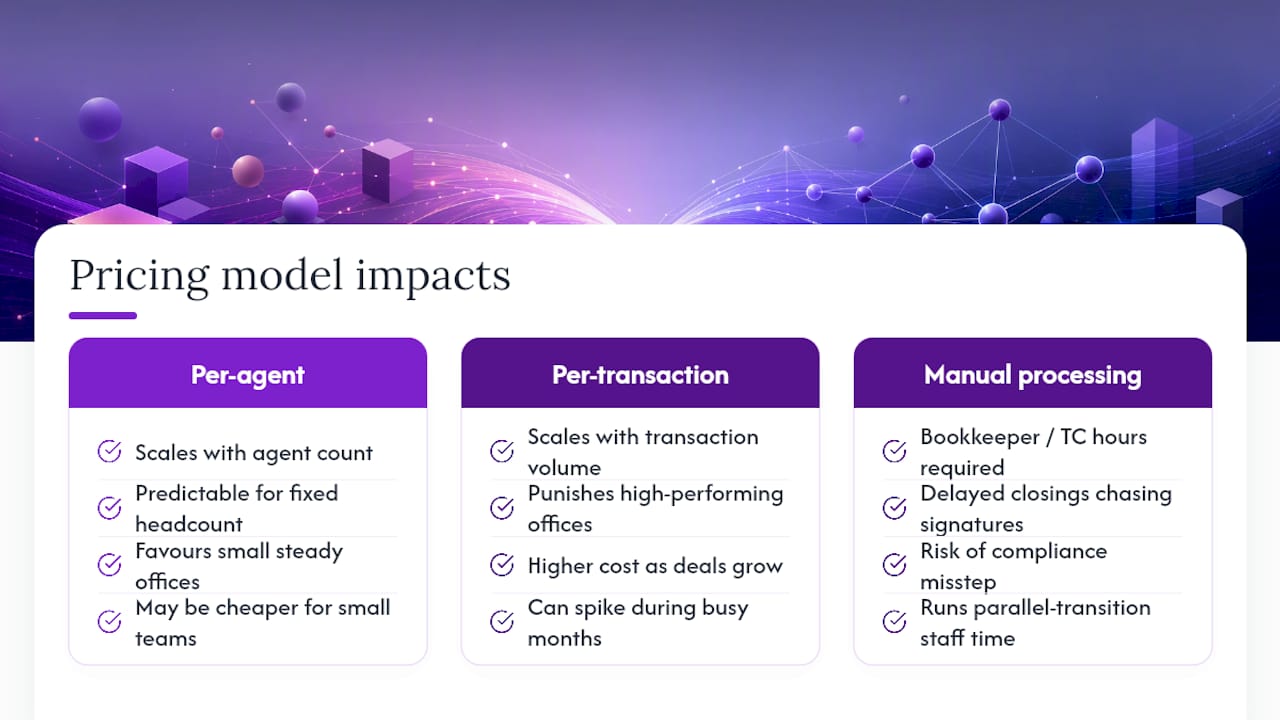
Weigh the subscription cost against what manual processing actually costs you today. Factor in the transaction coordinator or bookkeeper hours spent building CDAs by hand, the delayed closings caused by chasing signatures, and the very real cost of a single compliance misstep. A platform that eliminates hours of manual reconciliation per closing pays for itself quickly once you multiply that time savings across every transaction in a month.
Ask vendors directly whether pricing includes accounting integrations, or whether those are a separate add on. The same goes for CDA generation, audit log retention, and support during your rollout month. A low sticker price that requires a separate tool for accounting export isn’t actually the cheaper option once you add up the full stack.
Budget for a transition period too. Running parallel systems during testing has a real cost in staff time, and it’s worth planning for rather than treating as a surprise.
Compliance and Legal Considerations You Can’t Skip
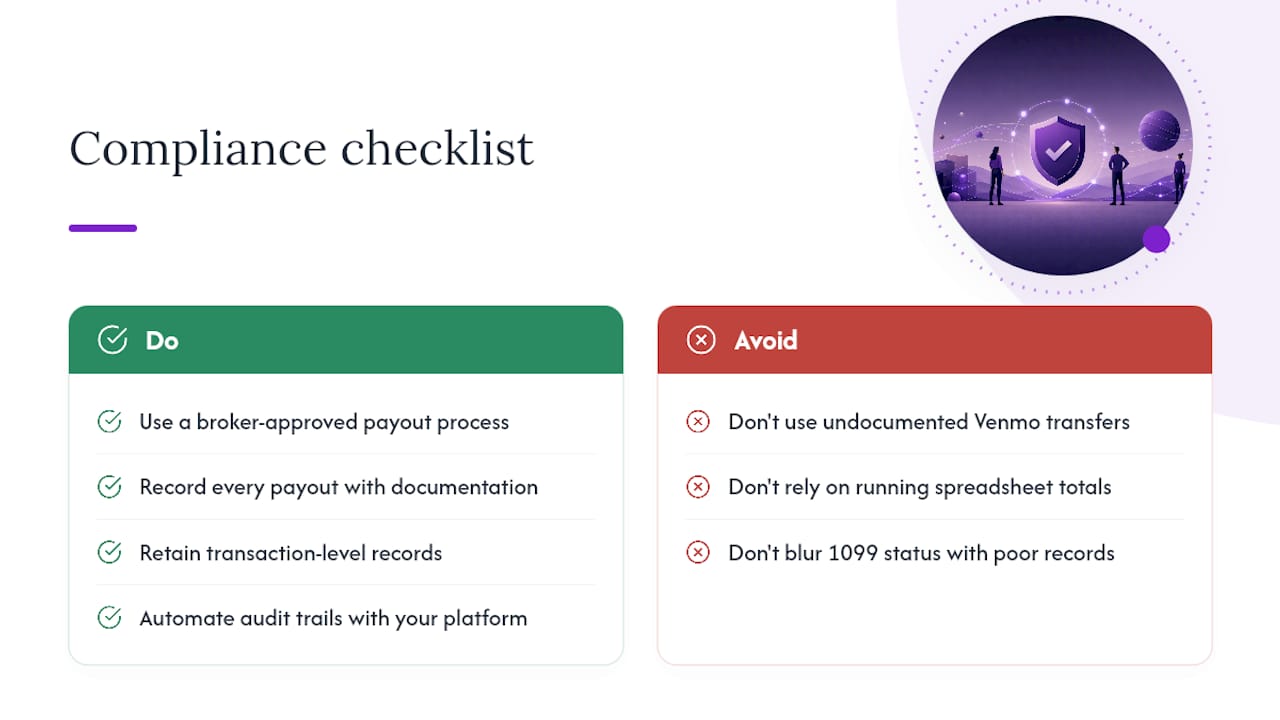
RESPA Section 8 restricts payments for referrals of business involving federally related mortgage loans, and that restriction is exactly why a documented, broker-approved payout process matters more than it might seem. An undocumented Venmo transfer between agents for a referral fee is the kind of transaction that draws regulatory attention precisely because there’s no record of what it was for or who approved it.
Correct worker classification adds another layer. Most agents are 1099 contractors, and consistent, well-documented commission records support that classification instead of blurring it. Your state real estate commission likely has its own recordkeeping requirements for commission disbursement on top of federal rules, and those requirements typically call for retaining transaction-level documentation, not just a running spreadsheet total.
None of this replaces guidance from your broker’s counsel or a qualified compliance advisor. What a good platform does is make the documentation part effortless: every payout generates its own audit trail automatically, so compliance stops depending on someone remembering to file the paperwork correctly.
What Brokerages Get Wrong About Commission Tracking
The brokerages that struggle most aren’t the ones with complicated split structures. They’re the ones with informal habits baked into daily operations: an agent Venmoing a referral fee because it’s faster than waiting for the office to process it, a split plan that changed six months ago but never got updated in the system anyone actually checks.
Automation doesn’t just calculate faster. It removes the incentive to route around the process in the first place, because the compliant path becomes the easy path.
— Wes
Bring Your Team Split Tracking Into One Compliant System
Brokerpay was built around the exact checklist this article opened with: a rules-based calculation engine for tiers, caps, and referral deductions, automatic CDA generation routed for broker sign-off, and accounting exports that map straight into QuickBooks with transaction IDs intact.
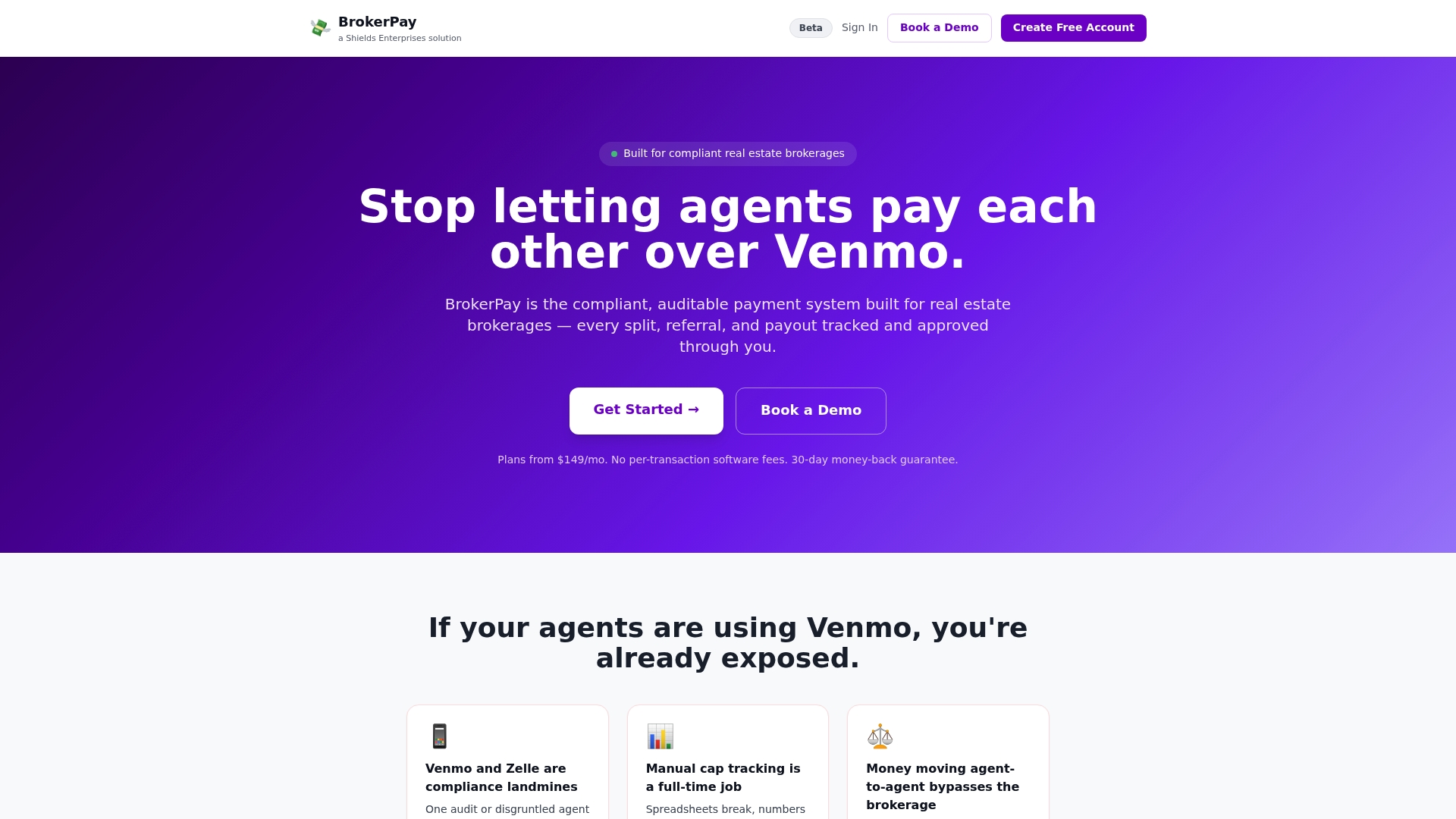
Every payout runs through an approval gate and lands in an audit log, then moves by ACH instead of a personal Venmo or Zelle transfer between agents. That single change closes the exact gap that creates federal liability under RESPA: no more untracked peer-to-peer transfers standing in for real commission disbursement. If you’re weighing this against your current process, a compliant co-op payment workflow shows what the documentation trail looks like in practice, and switching from manual to automated payouts is a smaller lift than most brokerages expect.
The practical next step: request a demo and run a pilot across five live closings before committing your whole office. Start at Brokerpay to see how the setup maps to your existing split plans.
Sources
- Automate Commission Split Reconciliation per Transaction 2026 | US Tech Automations
- Real Estate Commission Tracking Software: Guide - Qobra
- Payroll Challenges Real Estate Companies Face in 2026 (And How to Solve Them) | PayProNext
- Beancount