How Brokerages Handle Multi-State Commission Compliance

The rule is simple even when the paperwork isn’t: pay a broker-to-broker referral fee only when the recipient is licensed, actually performed a service, and the fee reflects fair market value for that work. Everything else touching settlement services runs straight into RESPA Section 8 exposure. That’s the core answer to how brokerages handle multi-state commission compliance, and it holds whether you’re closing a referral from Atlanta to Austin or splitting a co-op fee three states over.
The operational fix is less about legal theory and more about proof. If you can’t produce a signed agreement, a W-9, and a timestamped approval trail on demand, the payment doesn’t hold up under review regardless of intent. A platform like BrokerPay exists specifically to keep that evidence attached to the transaction instead of scattered across email threads and text messages.
- Only pay broker-to-broker splits tied to services actually performed, at market-based rates.
- Require a written referral agreement and W-9 before any funds move.
- Keep an immutable audit log connecting every payout to its closing file.
Key Takeaways
Multi-state commission compliance works when every referral or co-op payment is documented, tied to services actually performed, and processed through an auditable channel instead of a personal payment app.
| Point | Details |
|---|---|
| Apply the two-question test | Confirm the recipient performed real services and the fee matches fair market value before paying. |
| Route through settlement statements | Prefer title/closing agent disbursement so the fee is recorded at closing, not after. |
| Build a four-document file | Keep the referral agreement, W-9, settlement statement, and approval log together per transaction. |
| Eliminate P2P payouts | Venmo and Zelle lack settlement ties and audit trails regulators expect to see. |
| Centralize with a compliant platform | BrokerPay attaches agreements, W-9s, approvals, and ACH payouts to one auditable record. |
Table of Contents
- What Federal Law Actually Allows for Multi-State Commissions
- How Do You Process a Multi-State Commission Payment Compliantly?
- What Records Do Regulators Expect to See?
- Which Payment Channels Actually Hold Up in an Audit?
- What Policies and Training Actually Prevent Violations?
- State-by-State Variations That Trip Up Multi-Office Brokerages
- Fitting Compliance Into Existing Brokerage Systems
- Who Needs Training and What Controls Keep Them Accountable?
- A Platform Built for Multi-State Commission Compliance
- Sources
What Federal Law Actually Allows for Multi-State Commissions
RESPA Section 8 (12 U.S.C. §2607) and its implementing rule, Regulation X, prohibit giving or accepting a fee, kickback, or “thing of value” for referring settlement-service business tied to a federally related mortgage loan. That prohibition covers more than cash. Marketing perks, discounted services, and inflated referral splits can all count as a thing of value if they’re compensation for sending business rather than payment for work performed.
The escape hatch brokerages actually use is the cooperative-brokerage exception under 12 U.S.C. §2607©(3). It lets licensed real estate brokers and agents divide fees among themselves for brokerage activity, but the exception doesn’t extend to mortgage lenders, title companies, or anyone acting outside a licensed brokerage role. The CFPB’s RESPA FAQs make clear this exception has limits, not a blank check.
Before approving any split, run it through three questions:
- Did the recipient perform a real service, or just make an introduction?
- Is the fee reasonably tied to market value for that work?
- Was the recipient licensed and acting within that license in the state where the work happened?
Compliance callout: NAR guidance states plainly that a simple referral, with nothing more, is not a compensable service under RESPA. If the file shows nothing beyond a phone introduction, the fee is a liability, not a transaction cost.
How Do You Process a Multi-State Commission Payment Compliantly?
Treat every cross-state referral or co-op split as a five-step workflow, not a one-off favor between managing brokers.
- Intake. Require a written referral agreement signed by both managing brokers before any client contact happens. Spell out scope of work and fee structure, whether percentage or flat.
- Pre-close verification. Confirm the referring broker’s license status in their home state, collect a W-9, and attach the signed agreement to the transaction file.
- Disbursement routing. Where possible, have the title or closing agent pay the referral fee directly and record it on the settlement statement. This keeps the fee visible at closing rather than buried in a post-close transfer.
- Internal approval (if paying internally). If the brokerage pays the fee itself, require settlement-statement evidence and a documented internal sign-off before funds move.
- Reconciliation. Match the settlement statement, the internal ledger entry, and the payout record. Flag mismatches immediately rather than at month-end.
Pro Tip: Build the referral agreement template into your transaction management software so agents can’t skip it. A form nobody has to remember to use is a form that actually gets used.
Skipping step three is where most reconciliation debt starts. Once a fee moves outside the settlement statement, it becomes a manual tracking problem that compounds with every closing.
What Records Do Regulators Expect to See?
At minimum, a regulator reviewing a cross-state commission split wants four documents: the signed referral agreement, a W-9 from the paying or receiving broker, the final settlement statement (HUD-1 or ALTA), and an internal approval log showing who signed off and when. Missing any one of these turns a defensible payment into a guess.
An audit trail worth the name has a few non-negotiable features. Timestamps need to be immutable, not editable after the fact. Every action needs a user ID attached to it, not a generic “system” entry. Change history has to show what was modified and by whom. And every record needs an attachment linking it back to the specific closed transaction, not a loose folder of PDFs sorted by month.
Monthly reconciliation is what keeps this from becoming a scramble later. Sampling a percentage of closed files each month, running exception reports on anything that doesn’t match, and assigning a specific owner to resolve flagged items within a set window keeps small discrepancies from turning into a backlog no one wants to untangle.
| Record | Purpose |
|---|---|
| Referral agreement | Establishes scope, fee, and mutual consent between brokers |
| W-9 | Confirms tax identity for 1099 reporting |
| Settlement statement | Ties the fee to an actual closed transaction |
| Approval log | Shows internal sign-off with identity and timestamp |
Which Payment Channels Actually Hold Up in an Audit?
Not every payment method carries the same paper trail, and that difference is what regulators and auditors actually look at.
Direct disbursement through the title or closing agent is the cleanest option available. The fee shows up on the settlement statement itself, which means the record exists the moment the transaction closes, with no separate step to forget.
Brokerage ACH transfers through a compliant payout platform are the next best option, particularly when the platform enforces approval workflows and collects W-9s automatically before releasing funds.
Peer-to-peer apps are the option to eliminate entirely. Venmo and Zelle payments have no tie to the settlement statement and no built-in approval or attachment trail, which means every payout becomes a manual reconstruction project if a regulator ever asks for evidence.
| Channel | Settlement tie | Audit trail strength |
|---|---|---|
| Title/closing agent disbursement | Direct | Strong |
| Brokerage ACH via compliant platform | Indirect, but documented | Strong |
| Peer-to-peer apps (Venmo, Zelle) | None | Weak |
The practical fix is a policy, not a suggestion: route every post-close payout through a broker account or compliant platform, full stop.
What Policies and Training Actually Prevent Violations?
A workflow only works if every office follows it the same way, which means the policy has to exist on paper before it exists in practice.
Four elements belong in every brokerage’s compliance policy: a standard referral-agreement template nobody can improvise around, an approver matrix naming exactly who signs off on payouts, payment routing rules that name the required channel, and a retention schedule specifying how long audit documents stay on file.
Training has to go beyond a slide deck on RESPA basics. Agents and staff need to know how to complete the referral form correctly, how to document what services were actually performed, and who to escalate to when something doesn’t fit the standard pattern.
- Referral-agreement template required for every cross-state split.
- Named approver matrix, not “ask your broker.”
- Documented escalation path for exceptions.
Pro Tip: Run a quarterly spot check on five random closed files per office. It surfaces gaps in minutes that a full audit might not catch for months.
State-by-State Variations That Trip Up Multi-Office Brokerages
Federal law sets the floor, but state licensing boards layer on their own rules, and that’s where most multi-state mistakes happen. Some states require the referring broker to hold an active license in that specific state to receive any fee at all, even for a pure referral with no local activity. Others recognize referral fees paid to out-of-state brokers as long as the receiving broker never engages in acts that require local licensure, like negotiating terms or showing property.

The gray zone is what trips up admins most often: a referring broker who stays involved in coordinating marketing or fielding buyer calls after making the introduction. That’s no longer a referral. It’s brokerage activity, and if that broker isn’t licensed in the property’s state, the fee arrangement can void the RESPA cooperative-brokerage protection entirely.
License reciprocity agreements between states complicate this further. A broker licensed in one state might have limited reciprocal privileges next door, but reciprocity for licensing doesn’t automatically extend to fee-sharing eligibility under a given state’s real estate commission rules. Brokerages operating across five or six states can’t rely on a single national policy. The safer approach is a state-specific reference sheet, reviewed with legal counsel, that documents exactly what a referring broker in each state can and cannot do without crossing into unlicensed activity. For context on how commission structures vary by market, regional coverage of local practice can be a useful starting point, though it should never substitute for a state bar or licensing board review.
Fitting Compliance Into Existing Brokerage Systems
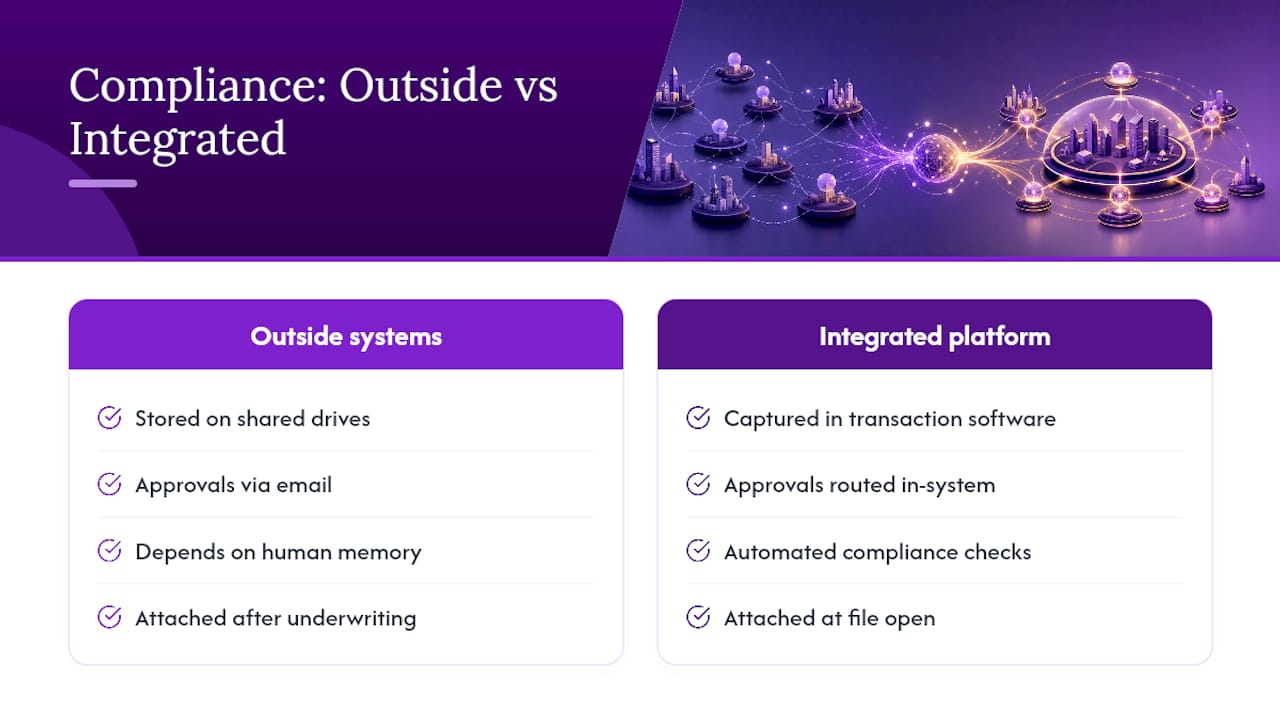
Multi-state commission compliance fails most often not because the rules are unclear, but because they live outside the software agents and admins already use every day. If the referral agreement lives in a shared drive and the approval happens over email, you’ve built a system that depends on human memory to stay compliant.
The fix is integration, not addition. Referral-agreement capture, W-9 collection, and approval routing all need to sit inside the same transaction management or commission software your team already touches for every closing, not in a parallel process reserved for cross-state deals. A compliant commission payment workflow built into the transaction pipeline means the agreement gets attached the moment the file opens, not requested after underwriting flags a missing document.
This matters more for brokerages running multiple office locations under one brand, where agents in different states may use inconsistent versions of the same form. Centralizing the referral template and approval matrix inside one platform, rather than letting each office keep its own spreadsheet, closes the gap where most compliance failures actually originate. It also means a compliance officer reviewing five offices can pull one report instead of chasing five separate paper trails, which is the difference between a quarterly audit taking an afternoon versus a week.
Who Needs Training and What Controls Keep Them Accountable?
Compliance training for multi-state commissions can’t stop at managing brokers. Transaction coordinators, office administrators, and even agents who occasionally refer business out of state all need to understand the core test: was a real service performed, and is the fee tied to market value for that work?
Training should cover four specific skills rather than general RESPA theory: how to fill out a referral agreement correctly, how to document what work was actually done before requesting payment, how to recognize when a “referral” has drifted into unlicensed brokerage activity, and who to escalate to when a deal doesn’t fit the standard template.
Internal controls need to mirror that training. Segregating duties matters here: the person who approves a referral fee shouldn’t be the same person who initiates the payment. A second reviewer on payouts above a set threshold catches errors before they become violations. New agent onboarding should include a walk-through of the referral policy on day one, not buried in a handbook nobody reads twice. And every office, regardless of size, needs a named person responsible for the quarterly spot check, so accountability doesn’t dissolve when multiple offices assume someone else is watching.
Why the smallest brokerages get this wrong the most
The compliance failures I keep seeing aren’t at giant regional brokerages with legal teams. They’re at three-office operations where the managing broker still approves Venmo payments because “it’s faster” and nobody’s mapped where the reconciliation gaps actually live. Centralizing payouts through one system doesn’t just reduce risk. It surfaces the orphaned payments that had been quietly compounding for months. Enforceable written policy plus a platform that won’t let anyone skip a step is what scales across offices. Neither one alone does the job.
A Platform Built for Multi-State Commission Compliance
BrokerPay is the alternative to piecing together referral agreements, W-9 forms, and approval emails across a dozen inboxes: one system that ties every payout to the paperwork that makes it defensible. It captures the referral agreement at intake, collects the W-9 automatically, routes the payment through an approval workflow before funds move, and pays out over ACH with an immutable audit log attached to the closing file.
That structure directly addresses the RESPA risk this article has walked through: payments stay tied to settlement documents and recorded approvals instead of floating loose in a Venmo history no one can reconstruct six months later. For a brokerage running multiple offices across state lines, that means one compliance report instead of five inconsistent paper trails. If your current process still depends on someone remembering to attach a PDF, it’s worth seeing what a compliant commission payment platform looks like when the paperwork is built into the payout itself.
Sources
CFPB Regulation X covers kickback prohibitions; CFPB RESPA FAQs explain exceptions; NAR guidance covers referral practice; LII/Cornell text provides the statute itself.
- § 1024.14 Prohibition against kickbacks and unearned fees. | CFPB
- Tips to give and get referrals in a RESPA-compliant way | NAR