Commission Disputes Quietly Wreck Agent-Broker Trust

Commission disputes damage agent relationships because they turn a predictable paycheck into a contested variable, and once pay feels uncertain, agents stop trusting the system around it. The fallout shows up fast:
- Agents start auditing every statement instead of focusing on clients
- Teams get defensive, and information stops flowing freely between agents and management
- Hours that should go toward selling get burned on email chains and spreadsheet forensics
Pro Tip: Treat the first contested payout as a warning shot, not a one-off. The way you handle it sets the tone for every future disagreement.
The rest of this guide breaks down where these disputes come from, what they actually cost a brokerage, and how documentation and better payment systems stop them before they start.
Key Takeaways
Commission disputes damage agent relationships because unclear pay processes convert trust into suspicion, and only documented policy plus transparent payment systems reverse that.
| Point | Details |
|---|---|
| Disputes erode trust fast | One contested payout pushes agents into auditing every future statement. |
| Weak documentation drives litigation | Missing signed split agreements are the most common failure cited in commission lawsuits. |
| Small disputes cost more in aggregate | Recurring minor claims consume more ops and management hours than a single large one. |
| Evidence resolves claims quickly | Signed agreements, MLS logs, and timestamped communications settle most disputes fast. |
| Auditable systems prevent escalation | Platforms like BrokerPay give agents visibility into splits and payouts before disputes start. |
Table of Contents
- Why Commission Disputes Damage Agent Relationships and Trust
- Common Triggers Behind Commission Disagreements
- How Disputes Break Down Trust Between Agents and Brokers
- The Real Cost of Letting Disputes Pile Up
- What Evidence Protects You When a Dispute Arises
- Prevention Steps Every Brokerage Should Put in Place
- Resolving an Active Dispute Without Losing the Agent
- How Auditable Payment Systems Stop Disputes From Snowballing
- How BrokerPay Closes the Gaps That Cause Disputes
- Legal and Industry Resources Worth Bookmarking
- Sources
Why Commission Disputes Damage Agent Relationships and Trust
A commission dispute happens when two or more parties, agents, teams, or brokerages, disagree about who earned a fee or how much of it they’re owed. Legally, the most common flashpoint is procuring cause: the question of which agent’s efforts actually caused the buyer to close. Courts and arbitration panels lean heavily on documentation, and when that documentation is thin, the dispute becomes a legal exposure rather than an internal disagreement.
Litigation over commission splits often escalates because informal or verbal agreements, inconsistent policy enforcement, and undocumented team arrangements produce conflicting evidence once someone challenges the payout. Legal counsel frequently identifies the absence of an explicit, signed split agreement as the single biggest failure that leaves brokerages vulnerable.
- No signed agreement means no shared reference point when memories diverge
- Procuring-cause fights routinely pit teammates against each other, not just against outside brokerages
- A dispute that starts as a policy question can turn into a legal one within days
Common Triggers Behind Commission Disagreements
Most disputes trace back to a handful of repeat offenders. Undocumented splits top the list, followed by referral fee disagreements where one agent believes a lead was theirs. Mid-transaction departures create ambiguity over who did the work that closed the deal. Clawbacks on canceled or renegotiated deals catch agents off guard when the policy wasn’t spelled out in advance. Timing and recognition issues (which side of a monthly cutoff a closing falls on) generate more friction than most managers expect.
- Undocumented or verbal split agreements
- Referral disagreements with no signed referral form
- Agents leaving mid-deal without a clear handoff policy
- Clawback terms that were never put in writing
- Payout timing that doesn’t match closing dates
Pro Tip: When a dispute report comes in, triage it the same day. Ask for the paper trail first, before anyone explains their side verbally. Memory bends; timestamps don’t.
Small ambiguities compound quickly. One undocumented handoff becomes a pattern once agents realize nobody enforces the written policy, and each unresolved case makes the next one more likely.

How Disputes Break Down Trust Between Agents and Brokers
Once an agent gets shortchanged, or even just confused, on a payout, the behavior change is immediate and it rarely reverses on its own.
- Agents start auditing every commission statement line by line
- Referrals to teammates slow down because splits feel unpredictable
- Top performers quietly start fielding calls from other brokerages
- Recruiting gets harder once word spreads that “pay is messy” there
A broker mishandles one clawback on a canceled deal. The agent posts about it in a private Facebook group for local agents. Three recruiters reach out to that agent within the month. The brokerage never even knew the post existed.
Manual processes and delayed corrections push agents toward this kind of self-protective auditing, and repeated mistakes are what actually drive people to leave, not the first error itself. Client-facing fee disputes make it worse: when a client balks at a fee and the agent absorbs the blame, that resentment flows straight back into how the agent views the brokerage that set the fee.
The Real Cost of Letting Disputes Pile Up
Every contested payout eats hours that should go toward production, and the damage rarely stops at one dispute. Industry commentary on staffing and sales operations shows a single non-trivial dispute can consume several hours of finance, ops, and management time once you count the back and forth.
| Cost Category | What Drives It |
|---|---|
| Ops and finance hours | Manual reconciliation, pulling records, rechecking splits |
| Manager time | Mediating between agents, documenting the resolution |
| Delayed payouts | Frozen commissions while the claim gets reviewed |
| Legal fees | Counsel review when procuring cause or contract terms are contested |
| Attrition and recruiting | Replacing an agent who leaves over unresolved pay issues |
- Recurring small disputes cost more in aggregate than one large claim because each one restarts the same manual process
- Delayed resolution multiplies frustration, which is what drives resignations, not the dollar amount alone
What Evidence Protects You When a Dispute Arises
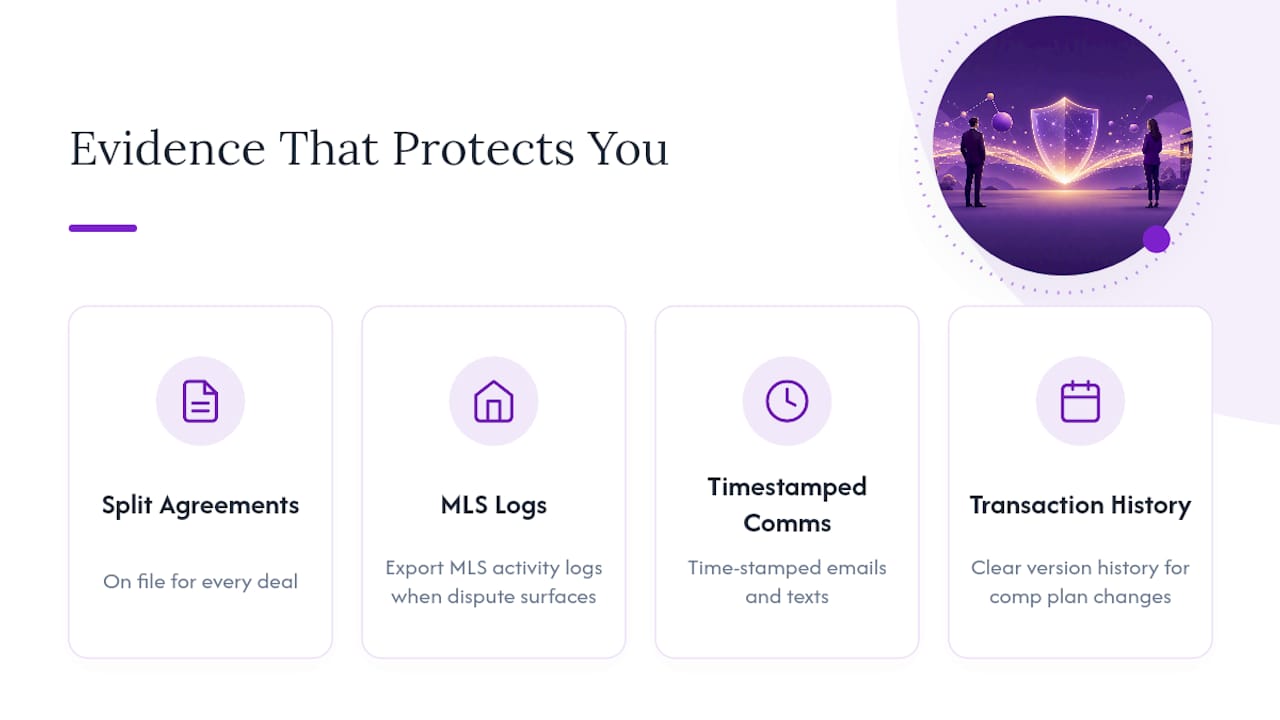
Strong documentation turns a “he said, she said” argument into a five-minute lookup. Keep signed split and referral agreements on file for every deal, MLS activity logs, time-stamped emails and texts, and a clear version history for any comp plan changes. Contracts, communications, and transaction timelines are exactly what strengthens a claim when someone challenges a payout.
Pro Tip: The moment a dispute surfaces, freeze and export every related record before anyone edits anything. A single system of record for splits and payouts removes most of the ambiguity that fuels these fights.
Prevention Steps Every Brokerage Should Put in Place
Fixing this starts with policy, not personality. Here’s a practical sequence:
- Require a signed split or referral agreement before a deal goes under contract
- Mandate buyer and broker representation agreements for every transaction
- Version every commission plan change and date it, so nobody argues over which rules applied
- Build an SLA for dispute handling, so agents know a claim gets a response within a set window
- Run pre-flight checks on payouts before agents ever see the statement
Assign ownership clearly: an ops analyst maintains the records, a neutral party (not the agent’s direct manager) investigates contested claims, and HR or legal only gets pulled in once a case involves a signed contract dispute or wage claim. Operational playbooks that build in anomaly detection and SLA-driven triage report meaningfully fewer disputes reaching formal escalation.
Pro Tip: Send pre-period statements before payday, not after. Agents who see the math coming rarely dispute it; agents who get surprised almost always do.
Resolving an Active Dispute Without Losing the Agent
When a dispute lands on your desk, speed and tone matter as much as the outcome.
- Acknowledge the claim within 24 hours
- Pull the full calculation lineage and supporting documents
- Route it to a neutral reviewer, not the agent’s direct manager
- Send a written explanation, correct or not
- Adjust and pay promptly if the agent is owed money
- Tier 1: quick triage against existing records
- Tier 2: neutral internal review if the answer isn’t obvious
- Tier 3: mediation, arbitration, or legal counsel for contract or procuring-cause fights
However the case resolves, explain the reasoning directly to the agent instead of letting them guess. That single conversation often matters more than the dollar amount.
How Auditable Payment Systems Stop Disputes From Snowballing
Software built specifically for brokerage payouts closes most of the gaps that create disputes in the first place. Look for a full audit trail on every payout, versioned comp plan support, built-in approval workflows, real-time dashboards agents can check themselves, and documented reasoning behind any adjustment.
- Full audit trail tied to every split and referral fee
- Comp plans that stay versioned instead of living in someone’s memory
- Approval workflows that require sign-off before money moves
- Dashboards agents can check without emailing anyone
A recommended dispute taxonomy, separating data-entry errors from rule ambiguity or system bugs, helps route fixes to the right owner instead of causing repeat rework. BrokerPay is one example of a platform built around this category of compliance and visibility; any vendor you evaluate should offer the same combination of audit trail, versioning, and self-service transparency.
A Managing Broker’s Take on Trust and Commission Clarity
I once watched a two-week payout delay, caused entirely by a missing signed referral form, turn into an agent’s resignation letter. The fix wasn’t complicated: we should have said, “Here’s exactly what happened, here’s the record we’re missing, here’s when you’ll be paid,” on day one instead of day twelve. Policy without transparency is just paperwork nobody trusts.
How BrokerPay Closes the Gaps That Cause Disputes
Every prevention step in this guide, signed agreements, versioned comp plans, SLA-driven review, comes down to one thing: a system of record agents can actually see into. BrokerPay replaces the Venmo and Zelle workarounds that create RESPA exposure with ACH-based payouts, built-in approval workflows, and a full audit trail on every split, referral fee, and co-op commission.
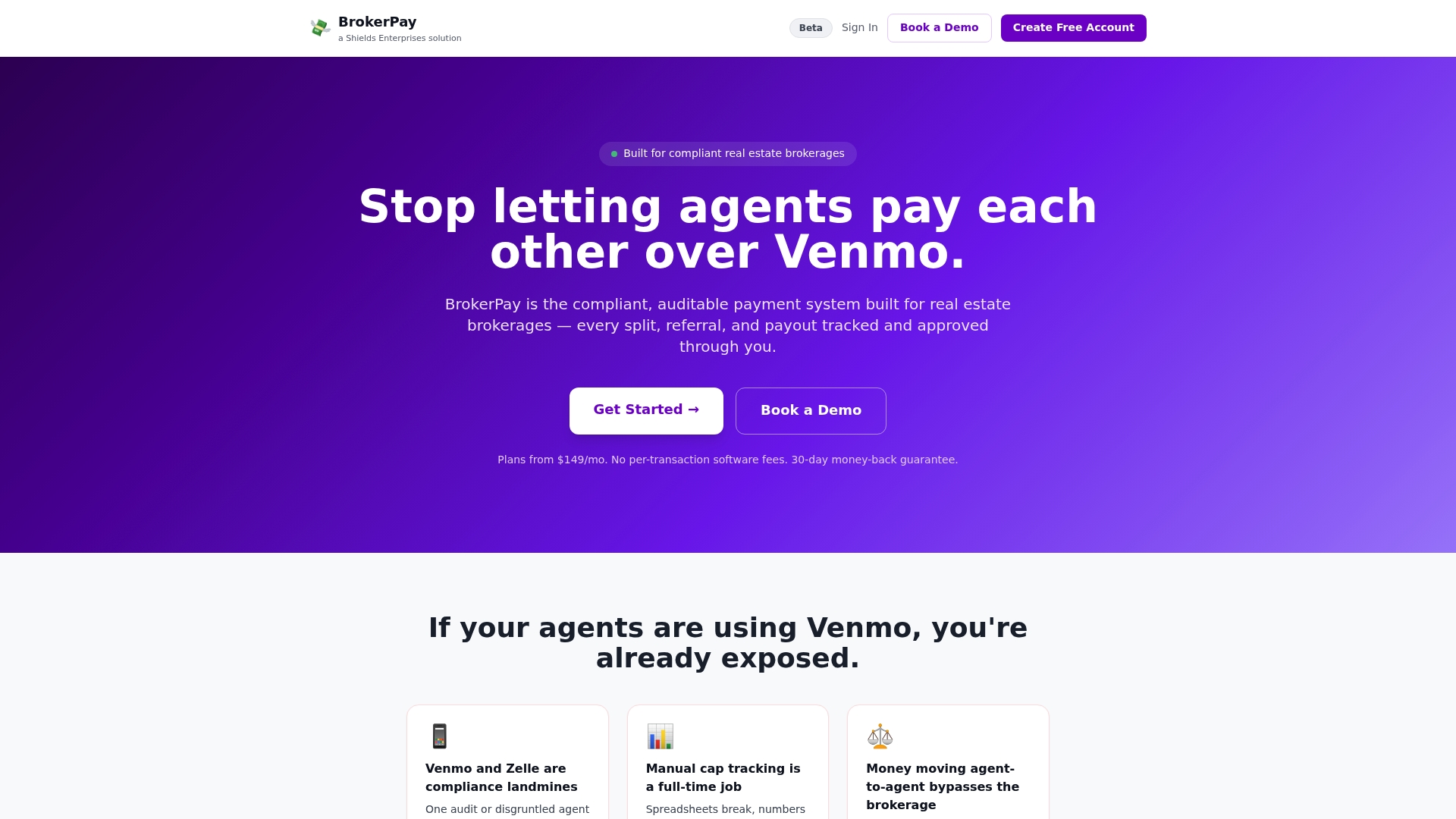
Instead of agents guessing why a check looks different this month, they see the calculation lineage themselves. If your brokerage is still resolving disputes by combing through email threads, request a demo of BrokerPay and see what a transparent payout workflow looks like from the agent’s side.
Legal and Industry Resources Worth Bookmarking
- Commission disputes and procuring cause litigation for the legal mechanics behind procuring-cause claims
- Brokerage agreement disputes for how weak documentation turns into litigation
- Safeguarding your brokerage from buyer-side commission compression for background on fee disclosure and client friction
Consult the legal sources above for jurisdiction-specific procuring-cause and contract questions, and bring in counsel directly for anything involving wage claims or clawback enforcement.
This article is general information, not a substitute for advice from a qualified lawyer. Consult a qualified legal professional about your own circumstances before acting on anything here.
Sources
- When broker commission splits go to court — Volpe Law LLC
- Brokerage agreement disputes — Levy Goldenberg
- Real estate commission disputes: What to do when you’re denied pay you earned — For The People (Morgan & Morgan)