What Is a Team Lead Commission Split for Real Estate Agents?

A team lead commission split is the portion of a closed deal’s gross commission that the team leader keeps before the agent gets paid, in exchange for leads, marketing, admin support, and mentorship. That share commonly varies substantially as a proportion of the agent’s post-brokerage commission, depending on who found the client and how much the team actually provides. On a $10,000 commission, a lead-heavy team taking a 50/50 cut leaves the agent $5,000 before taxes; an experienced agent working a self-sourced deal on an 80/20 split keeps $8,000.
- Ranges vary by lead source, brokerage fee structure, and services rendered
- The Real Estate Settlement Procedures Act (RESPA) governs how referral and split payments must be documented
- The IRS treats these splits as reportable income requiring accurate 1099 tracking
- Platforms like Brokerpay exist specifically to keep these payments compliant and auditable
Quick math: $10,000 commission, 50/50 team split = $5,000 to the agent, $5,000 to the team leader, before any brokerage cut is applied.
Key Takeaways
| Point | Details |
|---|---|
| Split ranges vary by lead source | Team-generated leads often run 50/50 to 60/40; agent-sourced leads favor the agent at 70/30 to 80/20. |
| Brokerage fees apply first | The “split-on-split” effect means your brokerage’s cut reduces the pool before the team split is even calculated. |
| Match split size to services | A 50% or higher team cut should correspond to real lead spend, marketing, and transaction coordination support. |
| Get terms in writing | Cap mechanics, lead attribution rules, and clawback policies belong in the contract, not a verbal agreement. |
| Documentation prevents disputes | Compliant payout platforms like Brokerpay replace informal Venmo transfers with auditable, RESPA-aware payment records. |
Table of Contents
- What Are the Common Team Commission Split Structures?
- What Does the Team Leader’s Share Actually Pay For?
- How Do You Calculate a Team Commission Split?
- How Do You Negotiate a Better Team Commission Split?
- What Tax and Reporting Rules Apply to Commission Splits?
- How Should Teams Pay Out Commission Splits Compliantly?
- What Would I Ask Before Agreeing to a Team Split?
- A Compliant Way to Handle Split Payouts
- Frequently Asked Questions
- Sources
What Are the Common Team Commission Split Structures?
Most teams use one of six structures, and the right one depends entirely on who’s doing the prospecting.
Fixed percentage splits are the simplest: the agent and team leader agree on one ratio and it doesn’t move. A 50/50 arrangement is standard when the team supplies most of the leads. Agents who generate their own business typically push for 70/30 or 80/20 splits favoring themselves, according to Follow Up Boss’s breakdown of real estate team splits.
Tiered or production-based splits reward volume. Close more deals in a calendar year and your percentage climbs, sometimes automatically, sometimes at renewal. The Listing Agent Podcast’s compensation model guide walks through example math for exactly this kind of ramping structure.
Capped splits work like a countdown. The agent gives up a set dollar amount to the team each year, and once that cap is hit, they keep nearly everything on subsequent deals until the year resets.
Lead-source differentiated splits are arguably the most common structure on modern teams, and the one agents misunderstand most often. A team-generated lead might carry a 50/50 or 60/40 split, while a lead the agent found themselves earns a friendlier 70/30 or 80/20. This dual-track system means the same agent can be on two different splits simultaneously, depending on the file.
Flat-fee-per-transaction models skip percentages entirely. The agent pays the team leader a set dollar amount per closing, regardless of price, which can favor agents closing higher-priced homes.
Overrides, sometimes called manager overrides, work differently than a split. Rather than taking a cut of an individual deal, the team leader earns a percentage of total team production, as Qobra’s guide to overriding commissions explains, often on a tiered scale that rewards the manager more heavily as the team’s overall numbers grow.
| Split Model | Typical Range | Best Fit For |
|---|---|---|
| Team-generated lead split | 50/50 to 60/40 (team-favored) | New agents relying on team leads |
| Agent-sourced lead split | 70/30 to 80/20 (agent-favored) | Experienced, self-prospecting agents |
| Capped split | Team share drops after annual cap | Agents with consistent production |
| Flat fee per transaction | Fixed dollar amount | High-price-point markets |
| Manager override | Percentage of total team revenue | Team leaders managing multiple agents |
Pro Tip: Ask whether your brokerage takes its cut before or after the team split is calculated. This “split-on-split” sequencing, documented in HomeSmart’s commission breakdown, can quietly shrink your effective take-home by several percentage points compared to what the headline split number suggests.
What Does the Team Leader’s Share Actually Pay For?
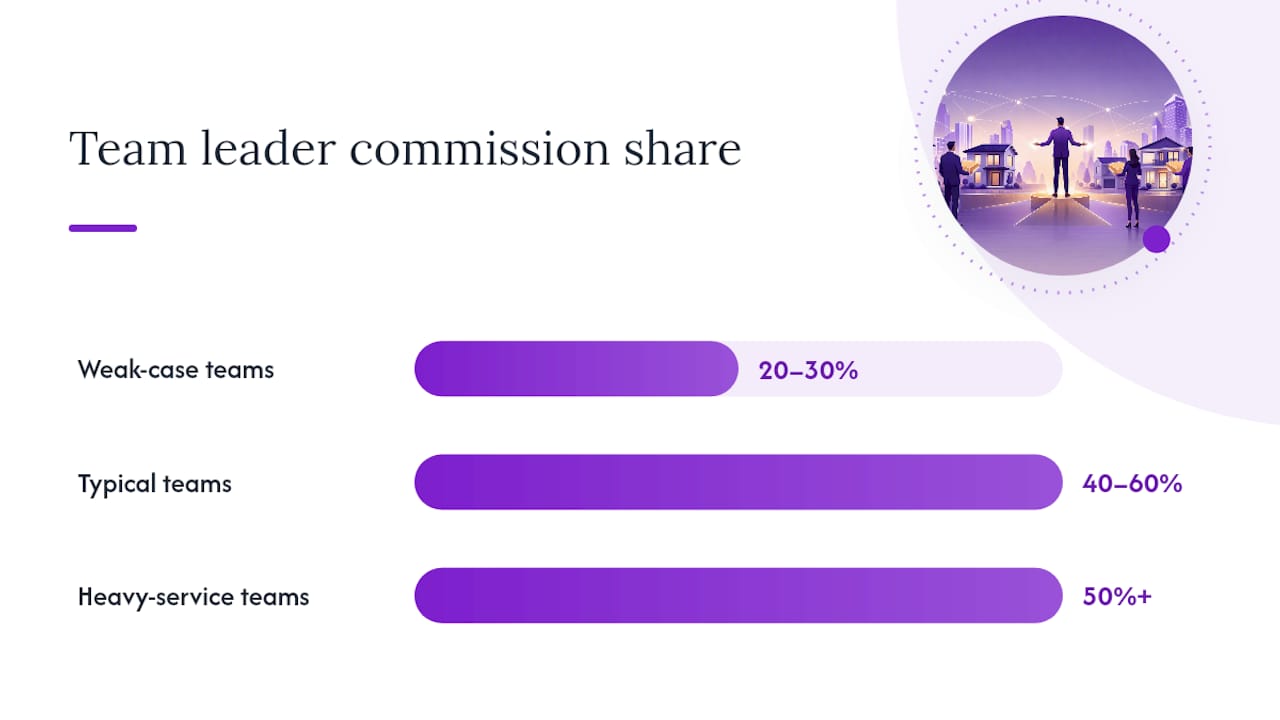
Teams that retain 40% to 60% of commission income are typically covering a real operating budget, not just padding a leader’s paycheck, according to DocJacket’s analysis of team commission structures.
That share commonly funds:
- Lead generation and paid advertising (Zillow Flex, Google Ads, social media campaigns)
- Branding, signage, and listing marketing materials
- Transaction coordination from contract to close
- Administrative support, including showings scheduling and paperwork
- CRM subscriptions and other tech stack costs
- Mentorship, coaching, and script training for newer agents
- Office space and shared overhead
- Contributions toward the team’s errors and omissions (E&O) insurance
Among these, lead generation, ad spend, and transaction coordination tend to be the costliest line items for a team to sustain, which is exactly why teams that run a heavy lead funnel justify a larger cut than teams that mostly hand agents a desk and a logo.
Pro Tip: Match the split to the intensity of the service. A team spending real money on paid leads and running a dedicated TC department has a legitimate case for 50% or more. A team offering little beyond a brand name and occasional floor time has a much weaker case for anything above 20% to 30%.
How Do You Calculate a Team Commission Split?
The math changes fast depending on lead source, brokerage fees, and where you land in a capped structure. Here’s how three common scenarios play out on a $600,000 sale at a 6% total commission, with the buyer and seller side commissions already separated, leaving $18,000 on the listing side after a typical co-op split.
- New agent, team-generated lead, 50/50 split. Starting commission: $18,000. Brokerage takes 20% off the top ($3,600), leaving $14,400. Team split at 50/50 gives the agent $7,200.
- Experienced agent, self-sourced client, 80/20 split. Same $18,000 gross, same $3,600 brokerage cut, leaving $14,400. At 80/20 in the agent’s favor, the agent keeps $11,520.
- Capped agent mid-year. Same $14,400 net of brokerage fees. If this agent already hit their annual cap, some capped structures allow them to retain 90% or more going forward, according to the Listing Agent Podcast’s cap mechanics breakdown, pushing take-home to roughly $12,960 on this single deal.
The gap between these two agents on the identical $600,000 deal is $4,320, entirely a function of who found the client and what split rule applies. Brokerage fees alone, before any team split touches the number, already reduced the payout by $3,600 on that sale.
How Do You Negotiate a Better Team Commission Split?
Walking into a split conversation with production numbers in hand changes the tone immediately. Bring your closed transaction history, a clear breakdown of which deals were team-sourced versus self-generated, and be specific about what you’re asking to change.
Before signing anything, confirm these contract terms in writing:
- How the agreement defines a “team-generated” lead versus an agent-sourced one
- Exact cap mechanics: what triggers the higher retention tier and when it resets
- Clawback or cancellation policies if a deal falls through after you’ve been paid
- How referral fees from outside agents or affiliates get split
- Duration of the agreement and what happens to pending deals if you leave the team
Watch for a few warning signs. Vague language like “splits are at manager discretion” with no written formula is a problem. So is a team that won’t show you where lead-source disputes get resolved, or one that can’t produce a marketing budget when you ask what your cut is actually funding. Clear documentation of these terms matters enough that the Qobra commission structure guide flags ambiguity as one of the top causes of team disputes.
Pro Tip: If a team leader pays splits through Venmo or Zelle instead of a documented payroll or software process, treat that as a red flag, not a convenience. It usually means there’s no audit trail if a dispute over lead attribution or a canceled deal ever comes up.
What Tax and Reporting Rules Apply to Commission Splits?
Every dollar that moves through a split needs a paper trail, both for your own tax filing and for disputes down the road. Keep these on hand:
- Commission statements for every closed transaction
- 1099-NEC forms from your brokerage (and from the team, if paid separately)
- Team profit-and-loss summaries showing what your cut funded
- Receipts for any marketing or advertising costs you contributed to or reimbursed
- Transaction coordinator invoices tied to specific deals
Most agents operate as independent contractors, so consult the IRS self-employment tax guidance directly rather than relying on a team leader’s informal summary, and loop in a CPA for split-specific nuances.
Pro Tip: Track net proceeds per transaction as you go, not just at tax time. A running year-to-date log makes it far easier to catch a miscalculated split before it becomes a hard conversation. Proper commission tracking also prevents tax headaches that surface months later when records don’t match.
How Should Teams Pay Out Commission Splits Compliantly?
Peer-to-peer apps like Venmo and Zelle were never built for commission payments, and using them creates real exposure. There’s no audit trail, no documentation tying the payment to a specific transaction, and no way to prove RESPA compliance if a regulator or brokerage audit ever asks.
A compliant payout process typically includes:
- A documented audit trail for every payment, tied to the transaction
- Brokerage approval workflows before funds move
- ACH transfers instead of informal peer-to-peer payments
- Automated cap tracking so nobody has to calculate tiers by hand
- Transaction-level documentation that satisfies RESPA recordkeeping expectations
Pro Tip: If your team leader is still sending split payments through a personal Venmo account, ask why. It’s not just sloppy, it’s the exact kind of unrecorded transaction federal compliance rules are designed to catch. Platforms like Brokerpay automate these split flows with documented audit trails built in, which is worth knowing about even if your current team hasn’t adopted one yet.
What Would I Ask Before Agreeing to a Team Split?
If I were sitting across from a team leader negotiating a split, I’d care less about the headline percentage and more about whether the lead attribution rules are written down anywhere. A verbal promise that “you’ll get credit for your own leads” means nothing the first time a dispute happens.
I’d also ask for real conversion numbers on team-generated leads, not just the volume they generate. A team handing out 50 leads a month that convert at 2% is a worse deal than a smaller team converting at 8%, even if the second team’s split looks less generous on paper. Dotloop’s guide to evaluating real estate teams makes a similar point about looking past headline splits to the actual support structure underneath them.
Last question, every time: how are the payouts documented? If the answer is “I just Venmo it to you,” that tells you more about the team’s operational maturity than the split percentage ever will.
A Compliant Way to Handle Split Payouts
Once you’ve negotiated a fair split, the next problem is making sure it actually gets paid correctly, every time, without relying on a spreadsheet and a Venmo transfer. Brokerpay is built specifically for brokerages that want to automate agent splits, referral fees, and co-op commissions without the compliance gaps that peer-to-peer apps create.
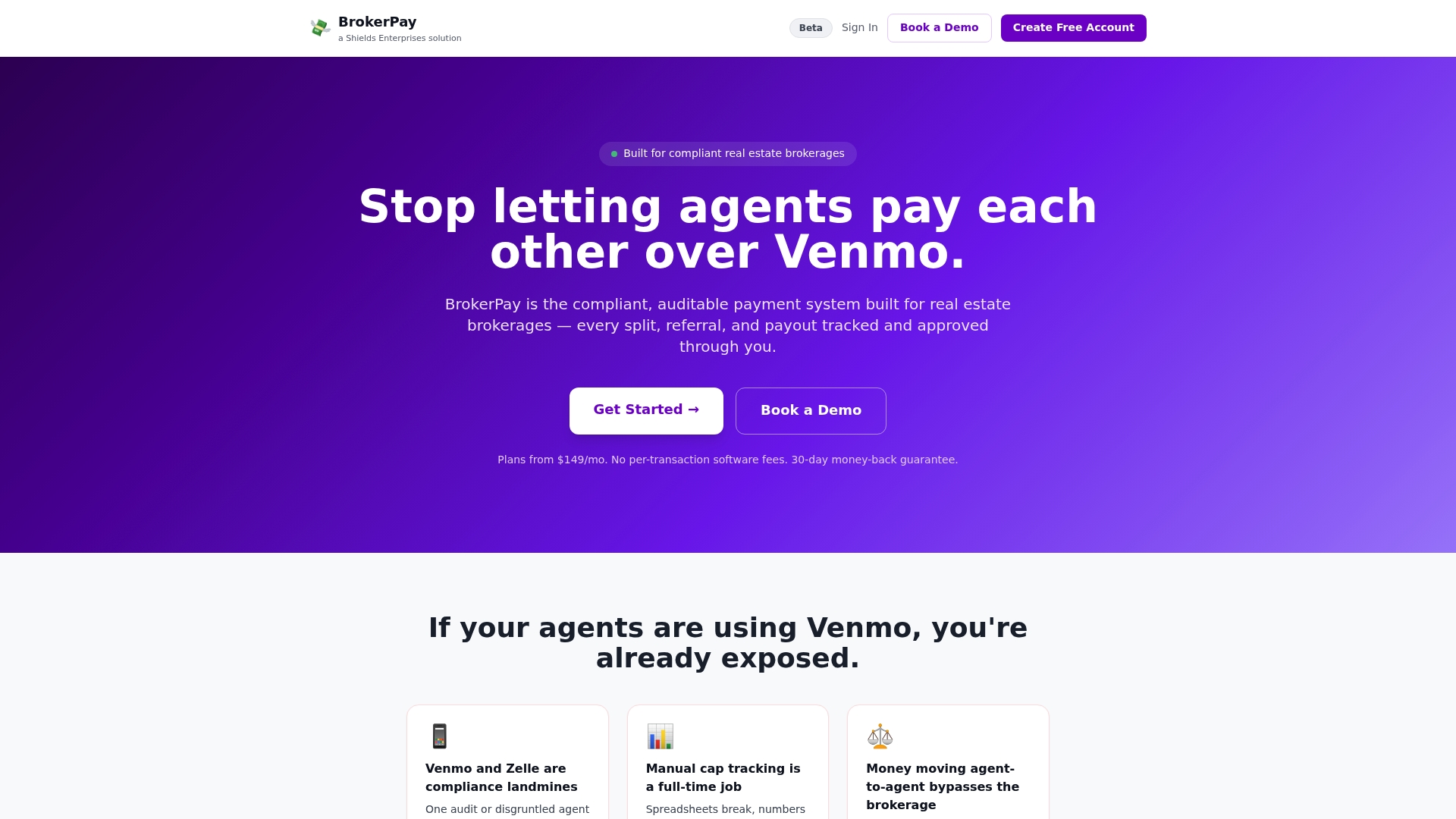
The platform tracks cap progress automatically, builds an audit trail for every transaction, and routes payments through ACH with brokerage approval workflows baked in, which matters far more than it sounds once you’ve lived through a disputed split or an audit request. It’s one compliant option among several, but it’s the one designed around exactly the split structures covered above. If your brokerage is still reconciling splits manually, see how Brokerpay handles commission payouts and what switching to an automated process actually looks like.
Frequently Asked Questions
What percentage does a team leader usually take from an agent’s commission? Most team leaders take a commission share that varies widely, depending on whether the lead came from the team or the agent, and on how much marketing and admin support the team provides.
Is a 50/50 commission split normal on a real estate team? Yes, especially for team-generated leads on teams that supply significant marketing and lead flow. Agents who bring their own clients typically negotiate a smaller team share, often 70/30 or 80/20 in their favor.
What is a capped commission split? A capped split lets an agent pay the team a set dollar amount each year.
How does the brokerage’s cut affect my team split? The brokerage usually takes its percentage off the gross commission first. The team split is then calculated on what’s left, which means your effective take-home is lower than the headline split percentage suggests.
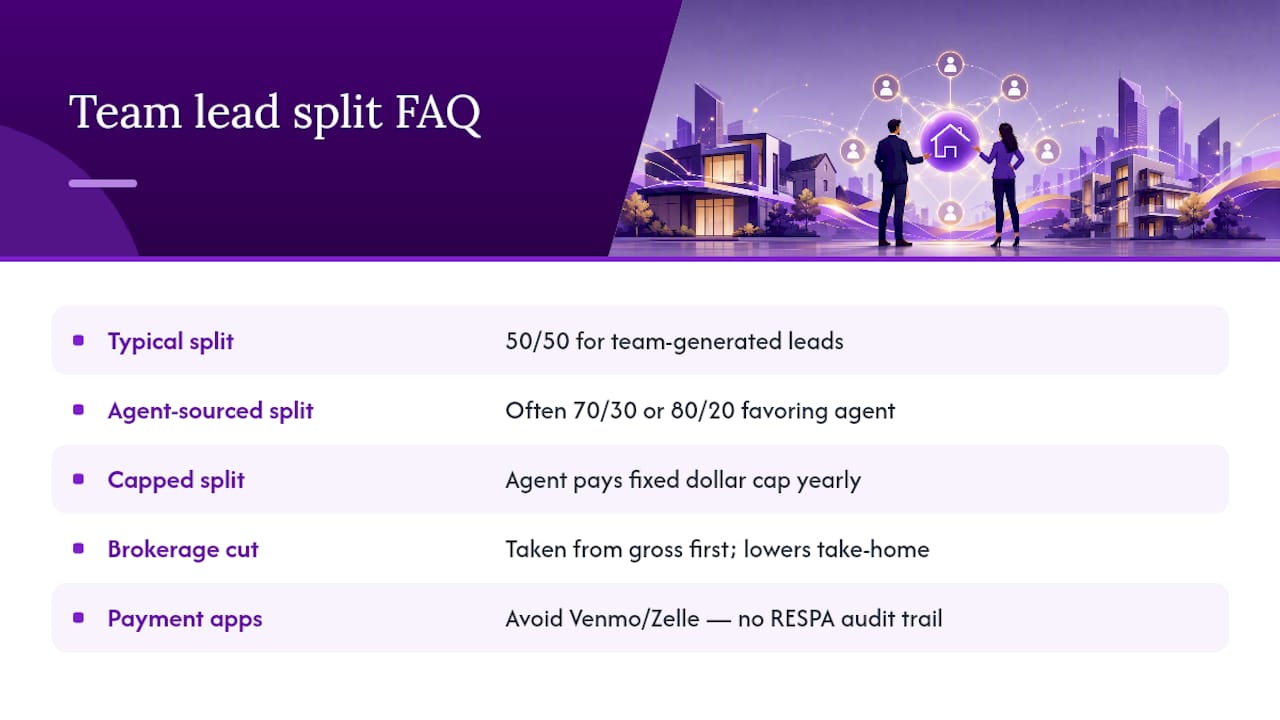
Should team leaders use Venmo or Zelle to pay commission splits? No. These apps don’t create the documented audit trail RESPA compliance requires, which creates real risk for both the agent and the brokerage if a payment is ever questioned.
Sources
- Real Estate Team Compensation Models: Splits, Caps, and Profit Sharing Explained – Listing Agent Podcast
- How real estate agents keep more commission (2026) — HomeSmart
- Real estate team commission split — Follow Up Boss
- Overriding commission: definition & calculation — Qobra
- The Ultimate Guide to Real Estate Teams — dotloop