Standardized Commission Agreements: Benefits for HR Teams

Standardized commission agreements cut disputes, speed up payouts, and keep compensation legally defensible. That’s the direct answer. The bigger benefits of standardized commission agreements show up in three places: clarity (everyone reads the same terms the same way), compliance (payments match state wage law instead of guesswork), and speed (routine deals close without a lawyer rereading them every time).
Businesses that adopt one standard template instead of negotiating each agreement from scratch typically see:
- Fewer wage disputes, since ambiguous earning triggers and payment timing cause most commission conflicts
- Faster contract cycles, because legal only reviews exceptions instead of every agreement
- Lower legal spend, since routine paperwork stops requiring counsel’s attention
- More predictable payroll forecasting, thanks to consistent formulas across every rep
Key Takeaways
Standardized commission agreements work because they replace verbal ambiguity and inconsistent paperwork with locked, enforceable language that cuts disputes and speeds up payment.
| Point | Details |
|---|---|
| Clarity beats flexibility | Locked earning-trigger and calculation language prevents the “but I was told” disputes that eat up HR time. |
| Compliance is non-negotiable | Written agreements addressing wage-payment timing and worker classification reduce misclassification and unpaid-commission claims. |
| Speed follows standardization | Routine agreements built from pre-approved templates close faster since legal only reviews true exceptions. |
| Amendments must be signed | Verbal or email changes to rates or triggers undermine enforceability and should always require a signed update. |
| BrokerPay operationalizes the playbook | BrokerPay locks template fields, stores signed agreements, and ties ACH payouts to agreed triggers for real estate brokerages. |
Table of Contents
- What Are the Benefits of Standardized Commission Agreements Compared to Ad Hoc Deals?
- Core Benefits of Standardizing Commission Agreements
- Key Clauses Every Standardized Commission Agreement Should Include
- Legal and Compliance Issues to Watch When Standardizing Pay
- How to Standardize Commission Agreements Safely
- Common Pitfalls and How Standardization Prevents Them
- A Practical Checklist and Sample Clause Snippets
- Bottom Line: When to Standardize and When to Negotiate
- Why I Recommend Standardization
- Put Standardized Agreements on Autopilot with BrokerPay
- Frequently Asked Questions
- Sources
What Are the Benefits of Standardized Commission Agreements Compared to Ad Hoc Deals?
A commission policy is the internal rulebook. It sets the company’s general approach to how commissions get calculated, when they’re paid, and what happens if a deal falls through. A commission agreement is the signed, individual contract between the business and a specific salesperson or contractor that applies those rules to their situation. A template is the reusable document skeleton legal approves once; a playbook is the operational guide that tells HR and sales ops how to fill in that skeleton correctly and consistently.
The distinction matters because businesses often confuse having a policy with having enforceable agreements. A policy document sitting in an employee handbook doesn’t bind anyone to specific payment terms. Only a signed agreement does that.
Policy vs. agreement, side by side:
- Purpose: A policy sets company-wide defaults; an agreement locks in terms for one person or role.
- Timing: Policies get written once and updated occasionally; agreements get signed at hire, promotion, or plan change.
- Who signs: Nobody signs a policy; every agreement requires signatures from both the business and the salesperson.
- Enforcement: Policies guide HR decisions internally; agreements are what a court or state labor board actually reads in a dispute.
A new hire on a standard inside-sales role typically gets a templated agreement pulled straight from the approved library. A large enterprise account executive with a custom quota structure might need a modified version with negotiated carve-outs, but even that modification should start from the same base template rather than a blank page.
Core Benefits of Standardizing Commission Agreements
-
Clarity and trust. When every rep signs language pulled from the same approved source, nobody can claim they were told something different verbally. This alone removes a huge share of the “but my manager said” disputes that eat up HR’s time.
-
Legal compliance and reduced litigation risk. Written agreements that clearly define rates, triggers, and territory rights help avoid misclassification penalties and unpaid commission claims. Standardized language means every agreement automatically includes the protective clauses legal already approved, instead of relying on whoever drafted a one-off deal to remember them.
-
Cost control and predictable payouts. Vague or flat commission structures cost real money. One analysis found that 51% of organizations using flat commission structures overpay their top performers, and 46% reported reps effectively setting their own rates because the plan language left too much open to interpretation. Standard formulas close that gap.
-
Speed and lower transaction costs. Organizations that standardize contracts reduce average execution time and cut legal involvement on routine paperwork. That’s not a minor efficiency gain. It’s the difference between a new rep starting to sell in week one versus week three while legal negotiates basic terms that should never have been negotiable in the first place.
-
Easier reporting and forecasting. Standard fields and consistent clause tagging let finance and HR pull portfolio-level reports on commission exposure without manually reading every contract.
Pro Tip: Track three numbers before and after you standardize: dispute rate per quarter, average days-to-pay on commission checks, and legal hours billed to commission-related questions. Those three metrics tell you whether standardization actually worked, not just whether it felt tidier.
Key Clauses Every Standardized Commission Agreement Should Include
The clauses below aren’t optional extras. Missing any one of them is how a routine commission dispute turns into a wage claim.
- Earning trigger (when commission is earned): Defines the exact event, contract signed, payment received, job completed, that creates the obligation to pay. Vague language here (“upon completion of the sale”) is the single biggest driver of disputes.
- Calculation formula: Spells out the math in plain language with a worked example, not just a percentage. Practitioners recommend sample calculations precisely because reps who don’t understand the math are reps who eventually contest their check.
- Payment timing: States the pay cycle and any lag between the earning trigger and the actual payout date.
- Chargebacks and clawbacks: Covers what happens if a deal cancels, a customer refunds, or a buyer defaults after commission was already paid.
- Territory and crediting rules: Resolves who gets credit when two reps touch the same account.
- Termination and post-termination commissions: Addresses whether commissions earned before a termination date still get paid, and on what schedule.
- Expense reimbursement: Clarifies whether commission calculations happen before or after business expenses.
- Worker classification language: States plainly whether the person is an employee or independent contractor, with distinct provisions for each.
- Amendment process: Requires any rate or trigger change to go through a signed amendment, never a verbal or email update.
- Signature and acknowledgment: Confirms the person actually read and accepted the terms, which matters enormously if a dispute ever reaches a labor board.
Legal and Compliance Issues to Watch When Standardizing Pay
State wage-payment laws frequently treat earned commissions as wages, not discretionary bonuses. That distinction changes everything about timing. The Department of Labor’s wage guidance makes clear that once a commission is earned under federal and state rules, it’s subject to the same payment-timing obligations as regular wages, including final-paycheck deadlines when someone leaves the company.
A few compliance basics every standardized template needs to reflect:
- Many states require commission terms to be in writing before an agreement is enforceable in a dispute.
- Final pay rules often require earned, unpaid commissions to be paid out on termination, on a strict timeline that varies by state.
- Employee and independent contractor agreements can’t use the same boilerplate. Using one commission document for both worker types is a common source of misclassification liability, since employees and contractors need different tax, benefits, and control-language provisions.
Pro Tip: Never let a manager change a commission rate or trigger over email or in a conversation. Require a signed amendment every time, even for a small mid-quarter adjustment. It’s the cheapest insurance you’ll ever buy against a wage claim.
How to Standardize Commission Agreements Safely
Rolling out standardization is a project, not a memo. Here’s a sequence that works without freezing your sales team mid-quarter:
- Inventory existing agreements. Pull every commission document currently in use and flag which clauses vary and why.
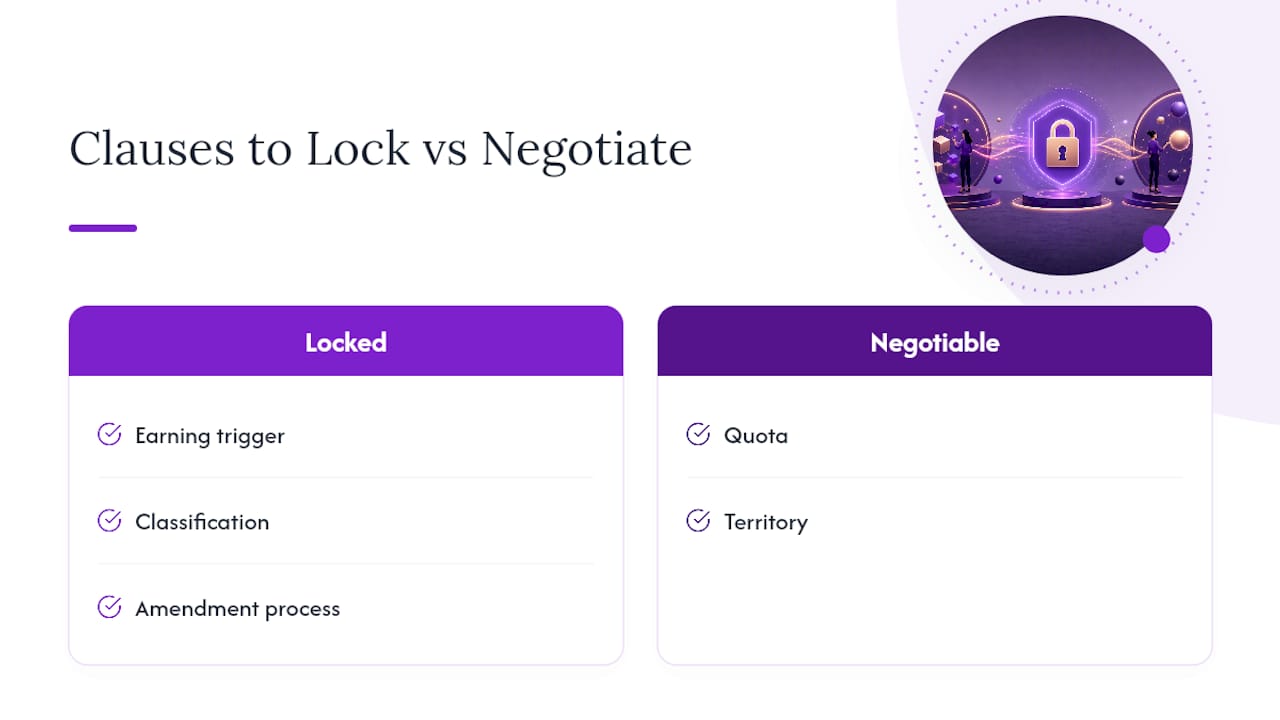
- Define locked vs. flexible fields. Decide which terms (earning trigger, chargeback rules, classification language) are non-negotiable and which (quota numbers, territory names) can vary per hire.
- Build a clause library. Have legal pre-approve each clause once so nobody drafts new language from scratch again.
- Establish an approval workflow. Anything outside the locked fields routes to legal or HR leadership before it goes out for signature.
- Pilot with one business unit. Test the new template with a single team or region before a company-wide rollout.
- Measure the KPIs. Track dispute rate, days-to-pay, and legal review hours before and after the pilot.
Picture the workflow as a straight line: template creation, legal lock, self-serve generation for HR and sales managers, an exceptions-approval branch for anything outside the standard fields, and a signed, stored record at the end.
Pro Tip: Use dynamic templates with smart fields and e-signatures rather than static Word documents. Automation and locked templates make standardization sustainable by forcing consistent metadata into every agreement, which is what makes audit trails and portfolio reporting actually possible later.

Common Pitfalls and How Standardization Prevents Them
Verbal rate changes are the most dangerous habit in commission management. Allowing email or verbal amendments to stand without a signed update undermines enforceability the moment a rep disputes what they were told.
Problem/solution pairs worth memorizing:
- Undocumented mid-quarter changes → require a signed amendment for every rate or trigger adjustment.
- Ambiguous earning triggers (“upon sale completion”) → define the exact event and date in plain language.
- Misclassified workers using one template → maintain separate employee and contractor versions.
- Spreadsheet-only tracking → move calculations into a locked template tied to signed terms.
Red flags in any existing agreement: vague trigger language, no clawback provision, and no signature or written acknowledgment page. Disputes that reach this stage usually escalate fast, from a verbal complaint to a demand letter to a state wage claim, and standardized documentation is what shortens that escalation before it starts.
A Practical Checklist and Sample Clause Snippets
Use this as a sign-off checklist before any commission template goes live:
- Earning trigger defined with a specific event and date
- Calculation formula with a worked numeric example
- Payment timing and pay cycle stated
- Chargeback/clawback terms included
- Territory and crediting rules covered
- Termination and post-termination pay addressed
- Worker classification stated explicitly
- Amendment process requires signatures
- Signature and acknowledgment section present
Sample snippets (always route to counsel for state-specific edits):
- Earning trigger: “Commission is earned upon the buyer’s execution of a binding purchase agreement and receipt of earnest money.”
- Payment timing: “Earned commissions will be paid within 15 days of the closing date.”
- Clawback: “If a transaction is canceled or funds are refunded within 30 days of closing, any commission paid on that transaction will be deducted from the next payout.”
How a Commission Payment Platform Operationalizes Standardized Agreements
A compliant payments platform enforces the template instead of just storing it. BrokerPay locks required fields like earning triggers and payment timing so nobody can generate an agreement missing a mandatory clause, then stores the signed document alongside the payout it authorized, creating one audit trail auditors and state regulators can actually follow.
- Start pilots with lower-risk templates, independent-contractor agreements or small-value order forms, before rolling standardized templates out company-wide.
Pro Tip: Link the signed agreement directly to the payout trigger in whatever system processes the payment. If the two live in separate places, someone will eventually pay a commission that was never actually earned under the signed terms.
Bottom Line: When to Standardize and When to Negotiate
Standardize anything high-volume and low-complexity: new-hire agreements, standard referral splits, routine order forms. Contracting guides consistently recommend templates for exactly this category of deal, while reserving real negotiation for situations where the standard terms genuinely don’t fit.
Keep these bespoke instead:
- Strategic partnership or channel agreements
- M&A-related earnouts or transition commissions
- Large custom enterprise deals with nonstandard quota structures
Why I Recommend Standardization
The businesses that struggle most with commission disputes aren’t the ones with complicated pay plans. They’re the ones with inconsistent paperwork, three versions of the “same” agreement floating around because someone edited a Word doc a year ago and nobody tracked it.
If you’re starting from zero, standardize your new-hire agreement and your independent-contractor agreement first. Those two cover the highest volume and the highest misclassification risk. Put HR or sales operations in charge of the rollout, with legal reviewing the locked clauses once rather than every individual signature.
Put Standardized Agreements on Autopilot with BrokerPay
Real estate brokerages face a specific version of this problem: agent splits, referral fees, and co-op commissions that too often get tracked in spreadsheets and settled through Venmo or Zelle, which creates federal RESPA exposure on top of the wage-law risk every business faces. BrokerPay replaces that workaround with locked templates, approval workflows, and ACH payouts tied directly to the signed agreement that authorized them.
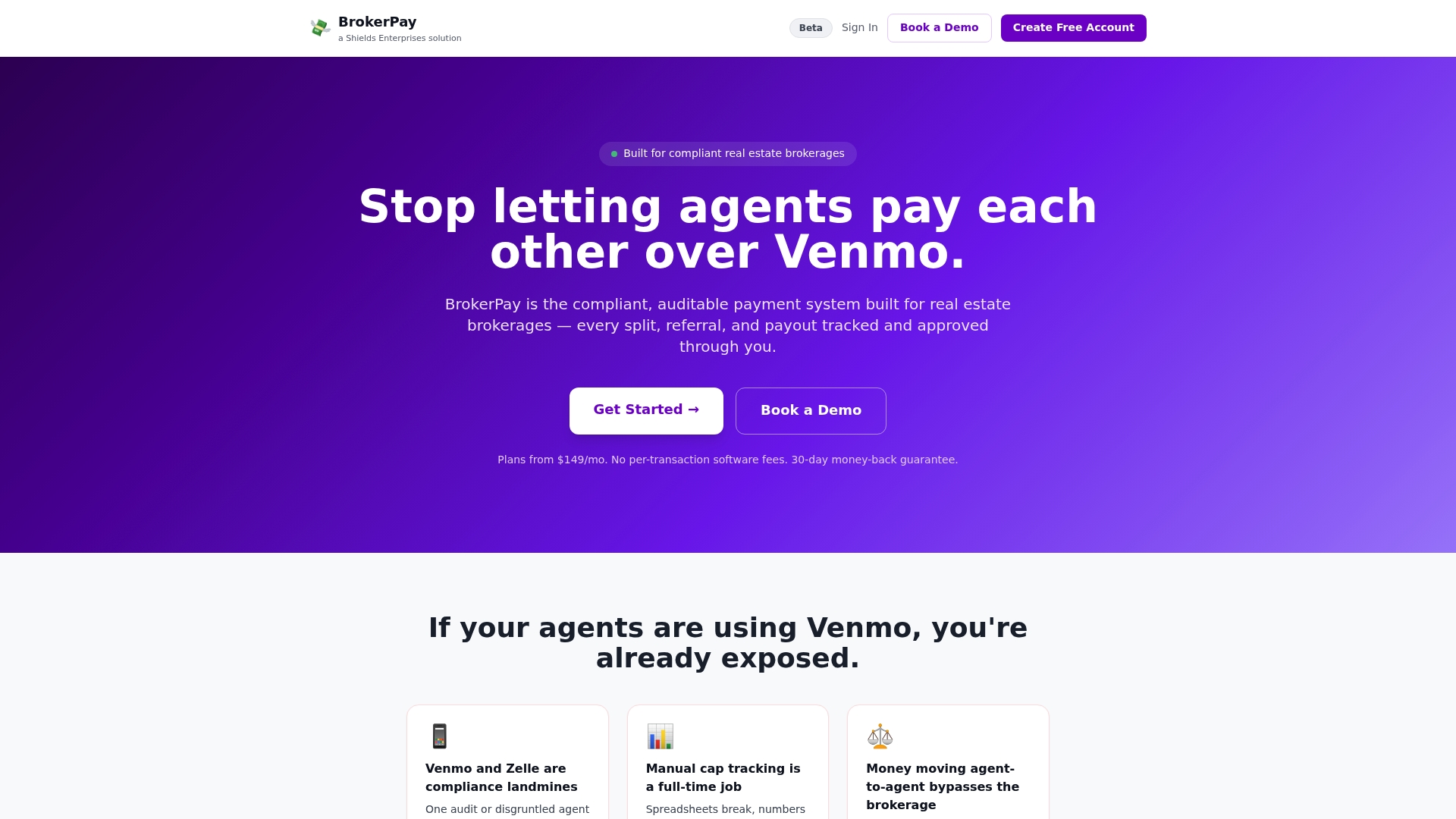
Every checklist item covered above, the earning trigger, the payment timing, the signature record, gets enforced automatically instead of relying on someone remembering to check a Word document. Payouts route through automated approval workflows instead of manual sign-off chains, and every transaction leaves a complete audit trail your compliance team can hand to a regulator without a scramble. If your brokerage is still moving commission dollars over peer-to-peer apps, visit the BrokerPay landing page and see what a compliant payout system looks like in practice.
Frequently Asked Questions
What are the main benefits of standardized commission agreements? The core benefits are clarity, legal compliance, dispute reduction, faster contract cycles, and more predictable payroll forecasting, since every agreement pulls from the same pre-approved language instead of one-off drafting.
Are standardized commission agreements legally required? Not universally, but many states require commission terms to be in writing to be enforceable, and federal wage guidance treats earned commissions as wages subject to payment-timing rules regardless of whether an agreement was formalized.
Can standardized agreements still allow for negotiated exceptions? Yes. The best approach locks the clauses that create legal risk (earning trigger, classification, amendment process) while leaving fields like quota or territory open for negotiation within an approved template.
How do standardized commission agreements reduce disputes? Most disputes trace back to unclear earning triggers or payment timing. Standardized language that defines both plainly, with a worked calculation example, removes the ambiguity that causes most conflicts.
What’s the difference between a commission policy and a commission agreement? A policy sets company-wide defaults internally; an agreement is the signed contract that applies those terms to one specific salesperson or contractor and is what actually gets enforced in a dispute.
This article is general information, not a substitute for advice from a qualified lawyer. Consult a qualified legal professional about your own circumstances before acting on anything here.
Sources
- Contract Standardization: From Chaos to Consistency | Ironclad
- Dol
- Standard Commission Agreement Forms – All 50 States | ILRG
- Commission Agreements: What Small Business Owners Need to…
- A guide to write a commission agreement that protects your business, motivates sales teams, and ensures compensation compliance