Brokerage Growth Financial Checklist: 8 Steps to Scale

The fastest way to scale a brokerage without blowing up your cash position is a single operating system: a 3 to 5 year financial plan, tied to a monthly cash rhythm, backed by documented compliance controls, running on automated commission infrastructure. Here’s the full checklist.
- 3 to 5 year strategic plan — Owner: Broker/Owner. Next step: build a base/upside/downside forecast this quarter.
- Capital segmentation — Owner: Owner/CFO. Next step: split operating reserve from growth capital in your bank structure.
- Monthly cash rhythm — Owner: Office manager. Next step: put a recurring cash review on the calendar.
- WSP and compliance controls — Owner: Compliance officer. Next step: pull your FINRA WSP checklist and audit for gaps.
- Commission automation — Owner: Operations lead. Next step: map your current commission workflow end to end.
- KPI dashboard — Owner: Broker/Owner. Next step: pick five metrics and start tracking weekly.
- 90/180/365 day timeline — Owner: Leadership team. Next step: assign deadlines to each checklist item.
- M&A due diligence criteria — Owner: Owner/CFO. Next step: document your standard financial due diligence checklist before any acquisition talks start.
Key Takeaways
A brokerage scales profitably when a 3 to 5 year financial plan, a monthly cash rhythm, documented compliance controls, and automated commission payouts all operate as one connected system.
| Point | Details |
|---|---|
| Build a 3 to 5 year plan | Base your forecast on real pipeline conversion and retention data, not blended averages. |
| Run a monthly cash rhythm | Tie runway, commission lag, and margin data directly to hiring and spending decisions. |
| Document WSPs and audit trails | Formalize AML checks, data security, and commission audit trails to reduce RESPA exposure. |
| Track five core KPIs | Monitor runway, commission lag, margin by office, productivity, and retention weekly to monthly. |
| Automate commission payouts | Brokerpay replaces informal P2P transfers with approval workflows, ACH payouts, and full audit trails. |
Table of Contents
- A 3 to 5 Year Financial Plan for Brokerage Growth
- How Often Should You Review Brokerage Finances?
- What Compliance Controls Protect Brokerage Growth?
- Why Commission Automation Improves Retention
- Which KPIs Matter Most for Brokerage Growth?
- A 30/90/365 Day Checklist for Scaling a Brokerage
- What I’ve Learned Watching Brokerages Scale
- Put Compliance-First Commission Automation to Work
- Frequently Asked Questions
- Sources
A 3 to 5 Year Financial Plan for Brokerage Growth
Strategic financial planning for a growing brokerage needs a 3 to 5 year horizon, not a single annual budget. It rests on four pillars: realistic forecasting, proactive capital planning, scenario analysis, and structured risk management. Skip any one of them and the plan collapses the first time a market shifts or an agent cohort underperforms.
Building the model is more mechanical than it sounds. Start here:
- Pull your current run-rate: revenue, gross commission income, and fixed overhead for the trailing twelve months.
- Layer in pipeline conversion rates by agent tier, not a blended average.
- Apply retention assumptions based on your actual agent churn, not industry averages.
- Map a hiring plan against expected production ramp time for new agents.
- Size capital needs and reserves against the slowest realistic growth scenario, not the fastest.
Pro Tip: Lenders and investors trust pipeline math more than growth stories. Show them agent-by-agent conversion history and retention curves, not a top-line percentage guess, and your forecast reads as underwritten rather than hoped for.
A workable scenario model sets a decision gate at each tier. If runway drops below three months in the downside case, hiring pauses immediately. If the upside case holds for two consecutive quarters, reserves fund the next office or recruiting push. Capital allocation should follow a strict order: fund the operating reserve first, then growth investments, never the reverse.
How Often Should You Review Brokerage Finances?
A monthly financial review is the mechanism that turns your 3 to 5 year plan into daily decisions. Without it, hiring, marketing spend, and commission timing get decided on gut feel instead of cash position. A consistent cadence — annual budget, quarterly forecast update, monthly review, weekly cash check when volatility is high — keeps financial data connected to operational choices.
Structure the monthly meeting around one owner and a fixed agenda:
- Owner: Broker/owner or office manager, meeting monthly, non-negotiable.
- Agenda: cash flow position, accounts receivable aging, commission lag, and variance against forecast.
- Dashboard inputs: runway in months, bank balance versus reserve target, commission payable, commission receivable, deal backlog, and gross margin by office and by agent.
- Decision gates: runway under three months pauses hiring; commission lag past your standard payout window triggers an investigation into approval bottlenecks.
What Compliance Controls Protect Brokerage Growth?
Documented Written Supervisory Procedures and clean audit trails for every commission and referral payment are non-negotiable once you’re scaling past a founder-run shop. Buyers and regulators both discount brokerages that can’t show their work.
Your WSP checklist needs to cover several categories at minimum:
- AML screening procedures for incoming and outgoing funds.
- Data security protocols for client funds and personally identifiable information.
- Documented audit trails for every commission split and referral fee payment.
- Formal approval workflows with named sign-off authority, not verbal go-aheads.
- Record retention schedules that match your state’s real estate commission requirements.
Regulators built these standards around brokerage models, but the RESPA exposure most independent brokerages carry doesn’t come from the WSP itself. It comes from informal peer-to-peer payment apps used to move commission splits and referral fees between agents. A Venmo or Zelle transfer leaves no documented audit trail, no approval record, and no way to prove a referral fee was disclosed and compliant. One brokerage’s undocumented payment habit, multiplied across dozens of agents and hundreds of transactions a year, is the kind of exposure that surfaces during an audit or, worse, an acquisition’s financial due diligence phase. Reviewing compliant co-op payment workflows is a fast way to see what a documented process actually looks like next to an informal one.
Why Commission Automation Improves Retention
Automating commission payments removes one of the most common operational bottlenecks in a growing brokerage, and it does more than save time. Growth strategies that reduce friction for the people generating revenue, rather than chasing transaction volume alone, produce more sustainable outcomes — and agents notice fast, accurate payouts more than almost anything else a brokerage does operationally.
A functional commission workflow looks like this:
- Transaction capture at closing, pulled directly from your transaction management system.
- An approval gate with a named reviewer, not an email chain.
- An automatic audit trail logging every split, referral fee, and approval timestamp.
- A scheduled ACH payout on a fixed cadence agents can plan around.
- Reconciliation against your general ledger before the books close each month.
Brokerpay was built specifically for this workflow. It tracks and documents agent splits, referral fees, and co-op commissions, runs them through an approval process, and pays out via ACH, all with an audit trail that holds up under RESPA scrutiny, replacing the ad hoc Venmo and Zelle transfers that create federal liability. If you’re weighing what a full switch involves, the practical migration checklist from manual to automated payouts is worth reading before you commit.
Pro Tip: Standardize your split coding before you automate anything. If your commission structure has five variations of “70/30” depending on who negotiated it, automation just digitizes the chaos faster.
Start with one office or one team as a pilot before rolling automation across the whole brokerage.
Which KPIs Matter Most for Brokerage Growth?
Track a compact set of metrics weekly to monthly, not a sprawling dashboard nobody checks. Brokerage KPI frameworks converge on five that matter most: runway, commission lag, gross margin by office or agent, agent productivity, and retention.
- Runway: cash on hand divided by average monthly burn. Target three to six months minimum at any growth stage.
- Commission lag: average days between closing and agent payout. Shorter is better for retention; anything trending upward needs investigation.
- Gross margin by office/agent: revenue minus direct costs, segmented so you see which units actually make money.
- Agent productivity: transactions or GCI per agent per quarter, benchmarked against your own historical average.
- Retention: percentage of agents retained year over year, the clearest early signal of a payout or culture problem.
Runway and commission lag belong on your weekly check. The rest fit the monthly dashboard, with a deeper quarterly review for retention trends.
A 30/90/365 Day Checklist for Scaling a Brokerage
Fix cash controls and commission approvals before you spend a dollar on marketing or recruiting. An operational fix that’s out of order just multiplies the mess as you grow.
- Next 30 days: Audit current commission workflows for approval bottlenecks. Owner: operations lead. Outcome: documented current-state map.
- Next 30 days: Segment operating reserve from growth capital in your banking structure. Owner: owner/CFO. Outcome: two clearly labeled accounts.
- This quarter (90 days): Build your first 3 to 5 year forecast with base/upside/downside scenarios. Owner: broker/owner. Outcome: a working model with decision gates.
- This quarter (90 days): Pilot commission automation on one office or team. Owner: operations lead. Outcome: measurable reduction in payout time.
- This year (365 days): Formalize WSPs and complete an internal compliance audit. Owner: compliance officer. Outcome: audit-ready documentation.
- This year (365 days): Set milestone triggers, such as pausing hiring below three months’ runway or accelerating recruiting once agent conversion improves for two straight quarters. Owner: leadership team.
Operational strain almost always shows up before a revenue plateau does, and founder-approval bottlenecks are one of the most common causes. Formalizing approvals early is what lets a brokerage actually absorb growth instead of choking on it.
What I’ve Learned Watching Brokerages Scale
Commission automation and monthly cash reviews produce the fastest visible lift, almost always faster than any marketing initiative. Small brokerages should start there before touching WSP documentation; multi-office firms need compliance controls first because their audit exposure is bigger. Never fund growth from the same account covering payroll and commissions. I’ve seen brokerages unlock real growth the moment they stopped routing every commission approval through one founder’s inbox.

Put Compliance-First Commission Automation to Work
Brokerpay exists to close the exact gap most of this checklist points at: commission approvals, referral fee documentation, and audit trails that hold up under RESPA scrutiny, without agents routing money through Venmo or Zelle.
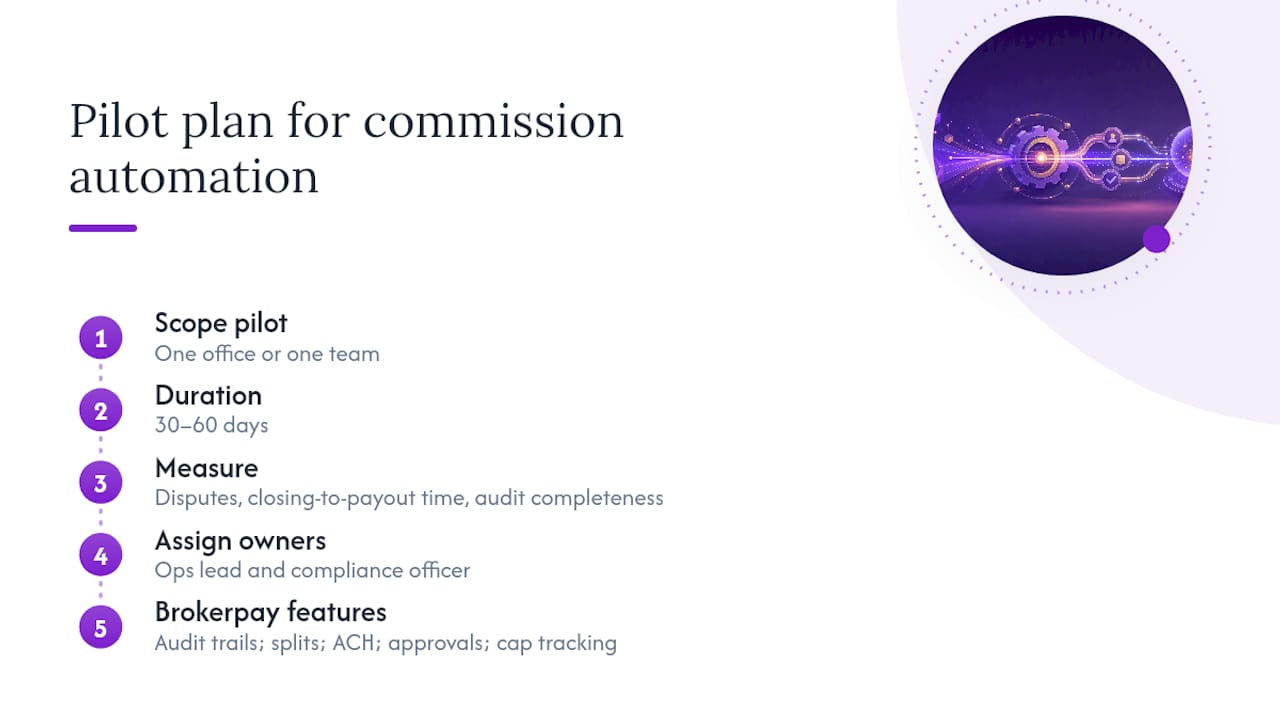
A pilot is the fastest way to see the impact. Scope it to one office or one team for 30 to 60 days, and measure three things: reduction in commission disputes, time from closing to payout, and audit trail completeness. Assign an operations lead to own the rollout and a compliance officer to sign off on the audit records before you expand it brokerage-wide.
Brokerpay handles the pieces that make this work: full audit trails, split and referral tracking, ACH payouts, structured approval workflows, and cap tracking, all built for brokerage compliance rather than adapted from a generic payments tool. If your commission process still runs on spreadsheets and personal payment apps, start a pilot with Brokerpay and see how fast an audit-ready payout process pays for itself.
Frequently Asked Questions
What is a brokerage growth financial checklist? It’s a structured set of financial actions, spanning strategic planning, cash rhythm, compliance controls, and commission infrastructure, that a brokerage works through systematically to scale without cash or regulatory surprises.
How far ahead should a brokerage plan financially? A 3 to 5 year horizon, built on realistic forecasting, capital planning, scenario analysis, and risk management, gives brokerages enough runway to plan hiring and capital needs without guessing.
Why does commission automation matter for compliance? Manual or peer-to-peer commission payments leave no audit trail and create RESPA exposure. Automated approval workflows and documented payouts close that gap while speeding up agent payments.
What KPIs should a growing brokerage track first? Start with runway and commission lag on a weekly basis, then layer in gross margin by office or agent, productivity, and retention as monthly and quarterly reviews.
This article is general information, not a substitute for advice from a qualified financial advisor. Consult a qualified financial professional about your own circumstances before acting on anything here.
Sources
- Five elements of strategic financial capital planning
- Financial planning for business growth: Connecting resources with strategy
- Business growth strategies