What Is a Real Estate Transaction Compliance Review?

A real estate transaction compliance review is a documented check of a transaction file, from executed contract to final closing, confirming that every required signature, disclosure, and payment record meets state licensing rules, RESPA/CFPB standards, and applicable federal reporting requirements. Do this now: run a standardized pre-close checklist against your current active files and attach a signed broker review form to each one before it reaches the closing table.
If you manage even a handful of transactions, you already know the stakes. State real estate commissions can suspend a license over a missing disclosure. The CFPB enforces RESPA disclosure timing down to the day. And since 2024, FinCEN has added a new layer of scrutiny for certain non-financed residential transfers to legal entities and trusts.
Here’s what a solid review actually confirms:
- Every required disclosure was delivered on time and signed
- Earnest money was deposited, tracked, and reconciled against trust account records
- The Closing Disclosure matches the HUD/ALTA settlement statement
- Commission splits and referral fees are documented and comply with RESPA’s anti-kickback rules
- The broker of record signed off on the file, creating a dated audit trail
Platforms like BrokerPay exist precisely because this last step, broker sign-off on payment workflows, gets skipped or handled through unofficial channels far too often.
Key Takeaways
A real estate transaction compliance review works best as a continuous, milestone-triggered process with documented broker sign-off, not a one-time checklist run before closing.
| Point | Details |
|---|---|
| Adopt a standard checklist | Use the same phased checklist (file open, mid-transaction, pre-close, closing, post-close) on every file to catch gaps consistently. |
| Assign clear accountability | Name a specific owner (coordinator, reviewer, or broker) for each checklist item so nothing falls through unassigned. |
| Run a post-closing audit | Check for the recorded deed, final Closing Disclosure, and title policy within 48 to 72 hours of closing. |
| Document broker sign-off | Attach a dated broker review form to every file recording items verified and corrective actions taken. |
| Automate commission documentation | A platform like Brokerpay logs commission splits and payment approvals automatically, replacing manual tracking and unofficial payment apps. |
Table of Contents
- What Does a Real Estate Transaction Compliance Review Cover?
- What Triggers a Real Estate Transaction Compliance Review?
- What Are the Most Common Violations Found in Compliance Reviews?
- How Do You Run a Real Estate Transaction Compliance Review Step by Step?
- How Long Should You Keep Real Estate Transaction Records?
- How Can Technology Make Compliance Reviews Continuous Instead of Periodic?
- What Regulations Govern Real Estate Transaction Compliance?
- Who Is Responsible for Broker Supervision and Sign-Off?
- What Happens When a Compliance Review Finds a Problem?
- Why Continuous Reviews Beat Periodic Audits
- How Brokerpay Supports Continuous Compliance Reviews
- Where to Go for Official Rules and Deeper Reading
- Sources
What Does a Real Estate Transaction Compliance Review Cover?
The scope of a review breaks into two buckets: documents that must exist, and verification tasks that confirm they’re complete. Conflating the two is where most reviewers go wrong. Deciding whether a particular disclosure is legally required is a licensee judgment call. Confirming that a required disclosure is actually in the file, signed and dated, is pure verification. When one person tries to do both at once, gaps slip through unflagged.
A standard residential file review checks:
- The executed purchase agreement and every addendum, with signatures on each page
- Agency disclosure forms confirming who represents whom
- Seller property disclosure statements
- Financing documentation, including the loan commitment letter
- The final Closing Disclosure and HUD or ALTA settlement statement, since Regulation X governs how these must align
- A copy of the recorded deed
- Confirmation of the title insurance policy
- Earnest money deposit receipts and trust account entries
- Commission agreements and any referral fee documentation
- Inspection reports and repair addenda
Institutional and commercial deals add a layer most residential brokers never touch: environmental due diligence. When a transaction involves a lender requiring environmental risk assessment or an institutional buyer, the file often needs a Phase I Environmental Site Assessment conducted under ASTM E1527-21, the industry standard for identifying recognized environmental conditions on a property.
| Document category | Required for | Reviewer verification task |
|---|---|---|
| Purchase agreement and addenda | All transactions | Confirm all pages initialed, dated, signed by all parties |
| Agency and property disclosures | All transactions | Confirm delivery timing and signatures |
| Closing Disclosure / HUD-ALTA | All transactions with financing or settlement | Match figures against final settlement statement |
| Earnest money receipts | All transactions with a deposit | Confirm deposit date and trust ledger entry |
| Commission/referral agreements | All transactions with co-op or referral fees | Confirm written agreement predates payment |
| Phase I ESA (ASTM E1527-21) | Institutional or lender-required deals | Confirm assessment completed before closing |
A tight residential checklist doesn’t need every row on that list examined in depth. It needs the top five checked on every file, every time.
What Triggers a Real Estate Transaction Compliance Review?
Some reviews happen on a schedule. Others get triggered by something going sideways, and knowing the difference determines how fast you need to move.
Routine triggers include periodic sampling (many brokerages audit a proportion of closed files monthly), license renewal preparation, and new-agent onboarding checks. These can wait for your normal review cycle.
Ad-hoc triggers demand immediate attention:
- A client complaint or a regulatory inquiry naming a specific transaction
- Title or escrow flags an irregularity, such as a discrepancy between the sale price on the contract and the settlement statement
- Unusual payment patterns, including large all-cash transfers to legal entities or trusts, which is exactly the scenario FinCEN’s final rule on residential real estate reporting was built to address
- Missing or delayed trust account receipts
- Commission figures that don’t reconcile between the agreement and the disbursement record
- An unexplained entity-to-entity transfer with no clear beneficial owner on file
Suspicious indicators worth flagging on sight: a trust deposit that never shows up in the ledger, a referral fee paid to an unlicensed party, or a buyer entity with no identifiable individual behind it.
Pro Tip: Use a two-minute triage rule before committing to a full review. If the issue involves money movement, an unidentified entity, or a regulator, escalate to a full review immediately. If it’s a single missing signature on an otherwise clean file, a limited fact-check and same-day correction usually resolves it without pulling the whole team in.
What Are the Most Common Violations Found in Compliance Reviews?
The same handful of problems show up again and again, and most of them are preventable with a quick checklist pass before a file gets filed away.
The recurring offenders: missing signatures on addenda, disclosure forms signed but never dated, an incomplete or absent final Closing Disclosure, earnest money documentation with no corresponding trust ledger entry, commission records that don’t match the actual disbursement, and title policy copies that never made it into the file. One milestone-based checklist study found that post-closing document gaps, especially the recorded deed and final Closing Disclosure, are consistently the most common failure point across brokerages that don’t run a formal post-close audit.
A file can look complete at closing and still be missing the one document that matters most six months later, when a regulator or a lawsuit asks for it. The gap almost never shows up until someone goes looking.
Not every finding carries the same weight. A missing initial on page four of an addendum is a process issue, fixable with a phone call and a corrected signature. Trust fund commingling, falsified disclosure dates, or a fabricated inspection report are a different category entirely. Those trigger state commission investigations, license suspension, and in serious cases, referral to law enforcement. Sort your findings into these two buckets from the start, because treating a signature gap with the same urgency as commingled trust funds wastes time you don’t have when the real problem surfaces.
How Do You Run a Real Estate Transaction Compliance Review Step by Step?
Treat the review as five checkpoints stretched across the transaction’s life, not one exhaustive pass at the end.
- File open. The transaction coordinator confirms the executed contract, initial disclosures, and agency agreement are logged within 24 hours of ratification. Evidence attached: signed contract PDF, disclosure delivery confirmation.
- Mid-transaction. The compliance reviewer checks financing progress, inspection reports, and any addenda generated from negotiations, typically at the halfway point between contract and closing. Evidence attached: lender commitment letter, inspection response addendum.
- Pre-closing. The broker of record or delegated compliance officer verifies the draft Closing Disclosure against the contract terms at least three business days before closing, matching RESPA’s disclosure timing rule under Regulation X. Evidence attached: draft CD, side-by-side comparison notes.
- Closing. The transaction coordinator confirms final signatures, the disbursement of earnest money, and the executed commission agreement before releasing the file for archiving.
- Post-closing (48 to 72 hours). The compliance reviewer runs a final audit confirming the recorded deed, final Closing Disclosure, and title policy have all landed in the file. This step catches the post-closing gap that trips up so many otherwise clean transactions.
A sample broker review form should capture six fields every time: reviewer name, date of review, specific items verified, any deficiencies found, corrective action taken, and a final sign-off line with date. Keep it as an attachment to every file, not a separate spreadsheet nobody opens again.
| Phase | Responsible role | Sign-off required |
|---|---|---|
| File open | Transaction coordinator | Coordinator initials |
| Mid-transaction | Compliance reviewer | Reviewer initials |
| Pre-closing | Broker of record or delegate | Broker signature |
| Closing | Transaction coordinator | Coordinator + broker initials |
| Post-closing (48-72 hrs) | Compliance reviewer | Reviewer signature, dated |
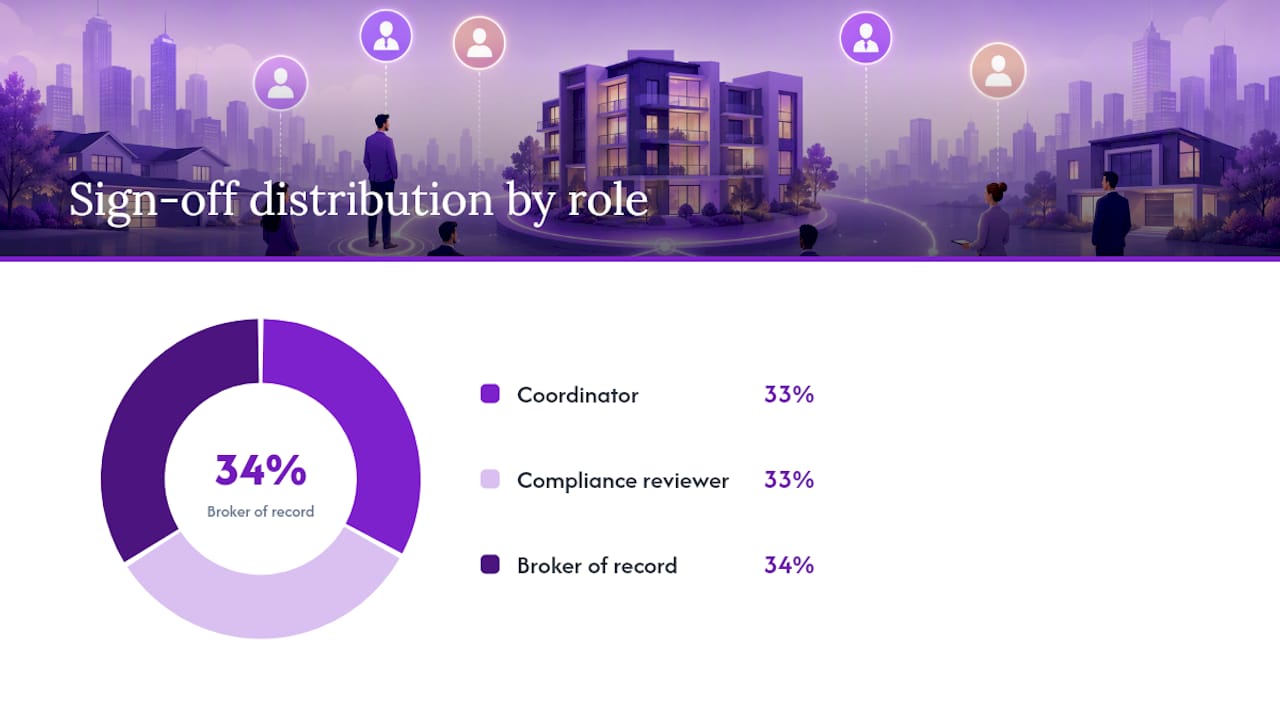
Firms that separate these roles cleanly, rather than letting one overloaded coordinator handle every step, catch far more deficiencies before they become liabilities.
How Long Should You Keep Real Estate Transaction Records?
Retention rules vary by state, and that variance trips up brokerages that assume a national standard exists. There isn’t one. Many states set a floor of three years from closing or from the listing date, whichever is later, but some states require longer, and a few tie retention length to the type of document rather than the transaction as a whole. Check your state real estate commission’s specific rule before setting a retention policy, because applying another state’s timeline to your files is a compliance gap waiting to happen.
What needs to be retained, at minimum: the executed contract and addenda, all disclosures, the final Closing Disclosure, earnest money and trust account records, commission agreements, and the broker review form itself. Electronic signature audit trails and version history count as retained records too, not just the final signed copy.
Practical storage habits that hold up under audit:
- Name files consistently: address, closing date, document type, so a reviewer can find anything in seconds
- Restrict file access by role, so only the assigned coordinator, reviewer, and broker can edit
- Back up documents in at least two locations, one of them off-site or cloud-based
- Tie your retention policy directly to your broker supervision documentation, so an auditor sees one coherent system rather than two disconnected practices
California’s Department of Real Estate guidance is a useful benchmark here: it requires the broker of record to maintain documented supervision and file review procedures, with the broker review form attached to every file as standard practice, not an optional extra.
How Can Technology Make Compliance Reviews Continuous Instead of Periodic?
Most compliance failures happen because the review is treated as a separate task bolted onto the transaction, done by someone flipping through a file after the fact. The fix is embedding the checklist into the software your team already uses for the transaction itself, so documentation becomes a byproduct of normal work rather than a reconstruction project weeks later.
Look for these features when evaluating a transaction management tool:
- Templated checklists that trigger automatically at each milestone (contract execution, financing approval, closing)
- Immutable audit trails that log who touched a document and when, with no ability to alter history after the fact
- Trust account reconciliation modules that flag mismatches between deposits and ledger entries in real time
- Automated document collection that pulls signed disclosures straight into the file without manual uploads
- Broker sign-off workflows built into the platform, so the review form isn’t a separate PDF someone forgets to attach
- Secure archival that meets your state’s retention timeline automatically
Here’s a concrete example of how this plays out: a brokerage that logs commission splits and referral fees through a dedicated payment platform, rather than a mix of checks and peer-to-peer apps, generates an audit trail as a natural side effect of paying agents. No one has to remember to document it separately. That’s the difference between compliance as an afterthought and compliance as infrastructure, a distinction covered in more depth in why commission tracking prevents tax issues for agents.
- Confirm the tool logs every document touch with a timestamp and user ID
- Check that role-based permissions actually restrict who can approve payments or edit disclosures
- Verify the platform supports RESPA-related safeguards around referral fee documentation
- Test integration with your title and escrow partners before committing
Pro Tip: Before signing a contract with any compliance software vendor, ask to see a sample audit log export. If it doesn’t show a clear timestamp, user identity, and unaltered history for every action, it won’t hold up if a regulator asks for it.
What Regulations Govern Real Estate Transaction Compliance?
A handful of authorities shape what belongs in every review, and staying current with each one matters more than most brokers assume, since guidance shifts more often than the underlying statutes do.
Your state real estate commission sets licensing rules, disclosure requirements, and file retention timelines specific to your jurisdiction. These pages are usually the first stop for any question about what a required disclosure looks like in your state.
RESPA, implemented through Regulation X, governs settlement disclosures and prohibits kickbacks or unearned fees tied to referrals. The underlying statute is worth reading directly if you handle referral agreements or co-op commissions, since the anti-kickback provisions are stricter than many brokers assume.
FinCEN’s newer reporting requirement targets non-financed residential transfers to legal entities and trusts, requiring a Real Estate Report that identifies beneficial owners in specified transactions. This doesn’t touch every deal, but if your brokerage handles cash purchases through LLCs or trusts, it belongs in your review checklist now.
The Fair Housing Act shapes how disclosures, advertising, and buyer interactions get documented, and a review that ignores nondiscrimination compliance is incomplete regardless of how clean the paperwork looks otherwise.
For institutional deals, ASTM E1527-21 sets the standard for Phase I Environmental Site Assessments, and lenders increasingly require it before closing on commercial or mixed-use properties.
Staying current means:
- Subscribing to your state commission’s bulletin or newsletter
- Following CFPB rule releases directly rather than relying on secondhand summaries
- Checking FinCEN guidance updates, since the residential reporting rule is still relatively new and subject to clarification
- Reviewing state bulletins at least quarterly, since retention and disclosure rules change more often than brokers expect
Who Is Responsible for Broker Supervision and Sign-Off?
The broker of record carries ultimate supervisory liability, full stop, even when a transaction coordinator or third-party service handles the day-to-day review work. Outsourcing the task doesn’t transfer the responsibility. One industry checklist resource makes this point directly: consistency improves when reviews are standardized or delegated, but the broker’s name is still the one on the license when a regulator comes knocking.
That’s why the broker review form matters as much as the checklist itself. Regulators increasingly expect documented evidence that supervision actually happened, not just an assumption that it did. A dated form showing what was verified, what was flagged, and what corrective action followed is the difference between “we have a compliance process” and “we can prove we have a compliance process.”
A defensible broker review form captures:
- Reviewer identity and role
- Date of review
- Specific items verified, listed individually rather than checked as a block
- Any deficiencies found, described specifically
- Corrective action taken and the date it was completed
- Final broker signature confirming the file is closed and compliant
Practical frequency: sign off at every phase listed in the step-by-step checklist above, not just once at the end. Delegation is fine, and often necessary at scale, but delegation rules should specify exactly which tasks a transaction coordinator can clear independently and which require the broker’s own signature before the file moves forward.
| Role | Can verify | Requires broker sign-off |
|---|---|---|
| Transaction coordinator | Signature presence, document completeness | No |
| Compliance reviewer | Disclosure timing, trust ledger match | No |
| Broker of record | Final file compliance, corrective action approval | Yes, always |
What Happens When a Compliance Review Finds a Problem?
Finding a deficiency is the easy part. What separates a brokerage that handles it well from one that doesn’t is the speed and documentation of the fix.
- Flag the specific deficiency in the file and notify the responsible licensee directly, not through a general team message
- Set a firm deadline for correction, typically 24 to 48 hours for a document issue, immediately for anything involving trust funds
- The compliance reviewer re-checks the file once the correction is submitted
- The broker of record confirms the fix and signs off on the closed loop
Material issues need a clearer chain than a simple correction request. Escalate from the compliance manager to the broker of record, and if the issue involves suspected fraud, commingled trust funds, or a transaction that triggers FinCEN’s reporting requirement, bring in legal counsel before deciding whether external reporting is necessary.
- Minor process issue (missing initial): same-day correction, no escalation needed
- Documentation gap (missing earnest money receipt): 48-hour correction window, compliance reviewer re-check
- Trust account discrepancy: immediate escalation to broker of record, legal counsel notified within 24 hours
- Suspected fraud or reportable activity: immediate escalation to legal counsel and broker of record, external reporting evaluated within days, not weeks
Every remediation step belongs in the file itself, dated and signed. A verbal correction that never makes it into the record is functionally the same as no correction at all if a regulator asks for proof later.
Why Continuous Reviews Beat Periodic Audits
The conventional approach to compliance treats the review as a checkpoint: something that happens at closing, or during an annual audit, separate from the actual work of running a transaction. That model is backwards, and it’s why so many brokerages get blindsided by findings that were sitting in a file for months.
Compliance works best when it’s embedded into the transaction itself rather than reconstructed after the fact. A checklist that only gets pulled out once a quarter is a checklist that misses the trust account discrepancy sitting in a file from six weeks ago. A checklist triggered automatically at each transaction milestone catches it the same week it happens.
The other piece people underestimate is accountability. A checklist without a named owner for each item is just a document nobody’s responsible for. The brokerages that actually maintain clean files are the ones that assign explicit ownership, transaction coordinator for document presence, compliance reviewer for timing and reconciliation, broker of record for final sign-off, and track two simple numbers: review completion rate and time-to-remediate when something’s flagged. Those two metrics tell you more about your actual compliance posture than any annual audit ever will.
How Brokerpay Supports Continuous Compliance Reviews
Brokerpay turns the broker sign-off and audit trail requirements covered throughout this guide into something your team does automatically, not something a coordinator remembers to attach after the fact. Instead of chasing down commission agreements and referral documentation across email threads and spreadsheets, every split, referral fee, and co-op commission gets logged with a timestamp the moment it’s processed.
Three things matter most for compliance reviewers specifically. First, an immutable audit trail on every commission payment, so when a review checks referral fee documentation against RESPA’s anti-kickback standard, the record already exists. Second, milestone-triggered approval workflows that require broker sign-off before funds move, replacing the informal Venmo or Zelle transfers that create federal liability under RESPA. Third, secure ACH-based payment processing that keeps trust and commission records separate from personal payment apps entirely, closing the exact gap regulators flag most often in commission-related findings. For a deeper look at what those workflows look like in practice, compliant co-op payment workflows walks through eight real examples.
If your brokerage is still tracking commission payments through a mix of checks, apps, and manual spreadsheets, see how Brokerpay handles commission compliance and book a walkthrough with your team this week.

Where to Go for Official Rules and Deeper Reading
Start with your own state real estate commission’s website for licensing rules, disclosure requirements, and file retention timelines specific to your jurisdiction, since these vary more than most national guides acknowledge.
For federal reporting on high-risk residential transfers, read FinCEN’s final rule directly rather than a summary, particularly if your brokerage handles cash purchases through LLCs or trusts.
For settlement disclosure requirements, Regulation X and the underlying RESPA statute cover Closing Disclosure timing and anti-kickback rules for referral fees.
For nondiscrimination requirements, the Fair Housing Act page from the Department of Justice is the primary reference.
For institutional or lender-required environmental due diligence, ASTM E1527-21 remains the recognized standard for Phase I Environmental Site Assessments.
If your brokerage handles remote closings or virtual transaction management, Haus Group’s safety resources cover practical best practices for secure remote document handling, worth reviewing alongside your compliance checklist.
This guide provides general information for real estate professionals and isn’t a substitute for legal advice. Confirm current requirements with your state real estate commission or a qualified attorney before finalizing your compliance procedures.
This article is general information, not a substitute for advice from a qualified lawyer. Consult a qualified legal professional about your own circumstances before acting on anything here.
Sources
- Govinfo
- Federalreserve
- California Broker Transaction File Review Requirements | Premier Courses
- Real Estate Compliance Checklist for Brokers
- The Real Estate Transaction Compliance Checklist (Contract to Close) - Empower Transactions