Net Commission in Real Estate: What You Actually Take Home

Net commission is the money an agent keeps after the brokerage split, transaction fees, business expenses, and taxes get pulled out of the gross commission check. It applies to every commissioned agent, whether you’re a 1099 independent contractor or a W-2 employee at a discount brokerage, and it’s almost always smaller than agents expect.
The formula looks like this:
Net commission = Gross commission − Brokerage split − Transaction/flat fees − Business expenses − Taxes
Here’s the number that surprises new agents most. On a $10,000 gross commission with a 70/30 split (you keep 70%), you start at $7,000. That’s 54% of the number your closing statement advertised.
A few things worth locking in before you go further:
- Gross commission is set by contract (sale price × commission rate); net commission is what survives every deduction after that.
- The deduction order matters: brokerage split first, then fixed fees, then variable expenses, then taxes.
- 1099 agents and W-2 agents calculate the tax piece completely differently, which changes the final net by thousands of dollars on the same gross number.
Key Takeaways
Net commission, not gross, is the number that determines whether an agent’s business model actually works, and it depends on splits, fees, expenses, and tax classification in roughly equal measure.
| Point | Details |
|---|---|
| Net formula | Net commission equals gross commission minus brokerage split, flat fees, business expenses, and taxes. |
| Splits alone mislead | A high split with no support can net less than a lower split at a brokerage covering marketing and leads. |
| Tax classification changes everything | 1099 agents owe 15.3% self-employment tax on top of income tax; W-2 agents have it withheld automatically. |
| New construction is different | Developer concessions can reduce the purchase price commission is calculated on before any split applies. |
| Automate payouts for accuracy | Brokerpay documents splits, fees, and ACH payments automatically, replacing manual or peer-to-peer payment workarounds. |
Table of Contents
- What Is a Net Commission in Real Estate, and How Does It Compare to Gross?
- How to Calculate Net Commission Step by Step
- Three Worked Examples: From Gross to Net in Real Dollars
- Deductions and Taxes That Quietly Shrink Your Commission
- Using Net Commission to Negotiate Splits and Build a Real Budget
- How Brokerages Should Document and Pay Commissions Correctly
- A Better Way to Handle Commission Payouts and Compliance
- Where to Verify the Numbers
- Frequently Asked Questions
- Sources
What Is a Net Commission in Real Estate, and How Does It Compare to Gross?
Gross commission is the total dollar figure generated by a sale, calculated as sale price multiplied by the agreed commission rate. If a home sells for $400,000 at a 3% listing-side rate, gross commission is $12,000. That number gets printed on the closing statement, and it’s the one most agents mentally attach to their income, even though it’s rarely what lands in their account.
Net commission is what’s left after everyone with a claim on that $12,000 takes their cut. The brokerage split comes out first, followed by transaction fees, marketing costs, referral or co-op fees if applicable, and finally taxes. Total commissions on a typical sale run between 5% and 6% of the sale price, split between the listing side and buyer side before either agent’s individual split even applies. By the time all of that resolves, an agent’s real take-home on a single transaction can be a small fraction of the headline number.
The deductions that convert gross into net generally fall into four buckets:
- Brokerage split — the percentage your brokerage keeps per your commission agreement.
- Transaction and flat fees — per-file fees, E&O insurance charges, or desk fees that don’t scale with sale price.
- Marketing and business expenses — signage, photography, staging, lead costs tied to that specific deal.
- Taxes — self-employment tax for 1099 agents, or withholding for W-2 agents.
Pro Tip: Stop asking your broker “what’s my split?” and start asking “what’s my net?” A 90/10 split with a $700 monthly desk fee and no marketing support can net less than a 70/30 split at a brokerage that covers your leads and signage. Industry commentary on commission splits versus net commission makes the same point: the split percentage alone tells you almost nothing about what you’ll actually earn.
How to Calculate Net Commission Step by Step
Start with gross commission: sale price × commission rate. A $350,000 sale at a 2.5% listing-side rate produces $8,750 in gross commission for that side of the transaction.
From there, work through the deductions in order:
- Transaction-side split — commission is typically divided between listing and buyer sides before it ever reaches your brokerage.
- Brokerage split — your individual agreement (50/50, 70/30, 90/10, or a capped model) applies to your side’s share.
- Team, referral, or co-op fees — if a referral sent you the client, or you’re on a team, that percentage comes off next.
- Flat transaction fees — many brokerages charge $195 to $495 per closed file regardless of price.
- Marketing and other business costs — anything you spent to win or close that specific deal.
- Estimated taxes — self-employment tax for 1099 contractors, or standard withholding for W-2 employees.
New construction and developer deals add a wrinkle. When a builder offers concessions (closing cost credits, rate buydowns, upgrade allowances), those concessions often reduce the net purchase price before commission is calculated rather than after. A $500,000 contract price with $20,000 in developer concessions might generate commission on a $480,000 net purchase price, not the full $500,000. That single detail can shrink gross commission before any split conversation even starts.
These figures assume a combined effective tax rate on the remaining balance after splits and fees, which varies significantly by state and filing status.
Three Worked Examples: From Gross to Net in Real Dollars
Under a 50/50 split, you keep $3,300. Subtract a $325 transaction fee and $150 in marketing costs, leaving $2,825.
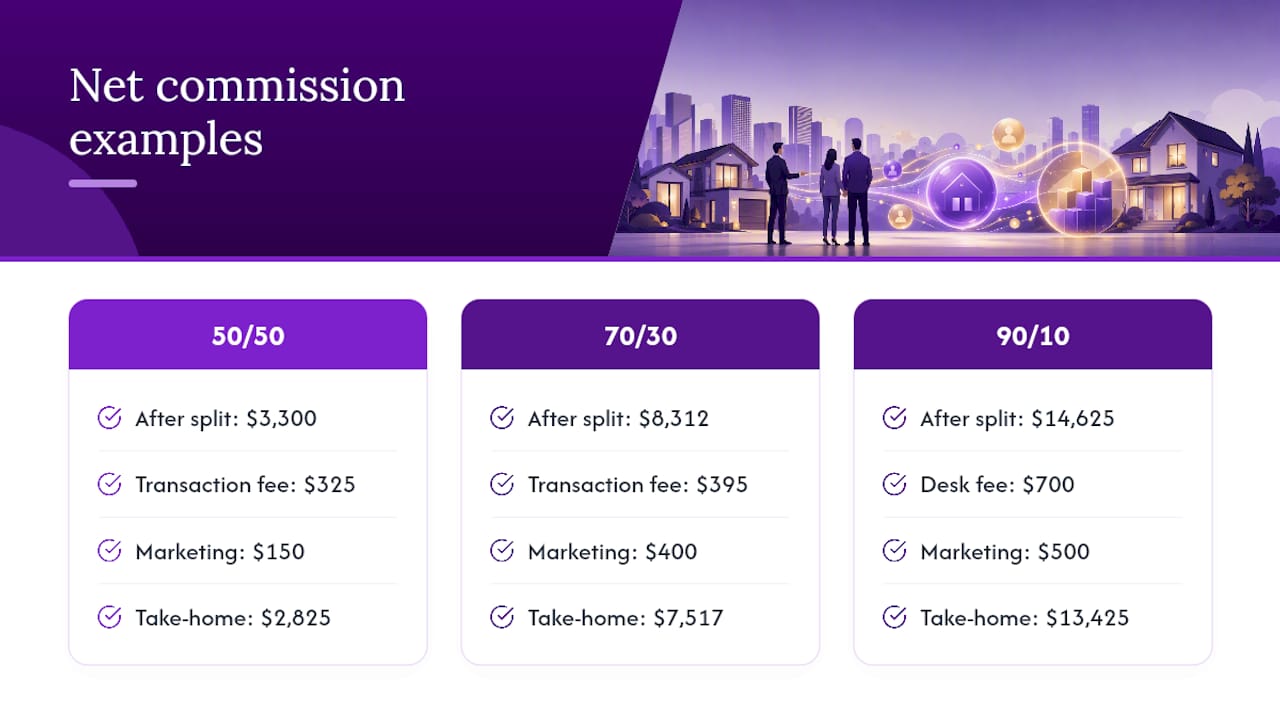
At a 70/30 split, you keep $8,312. A $395 transaction fee and $400 in marketing spend bring you to $7,517.
A 90/10 split model keeps $14,625 in your hands before overhead. Subtract a $700 monthly desk fee (allocated to this one deal for illustration) and $500 in marketing, landing at $13,425.
Notice the pattern: higher splits don’t guarantee higher effective take-home rates once fees and tax treatment are factored in. The percentage of gross you actually keep depends as much on fee structure and tax classification as on the split itself.
Deductions and Taxes That Quietly Shrink Your Commission
The deduction list is longer than most agents realize until they sit down and itemize a full year of closings. Common categories include:
- Brokerage split (the largest single deduction for most agents)
- Transaction or compliance fees charged per closed file
- MLS and association dues
- Marketing costs: signage, photography, staging, digital ads
- Referral fees paid to other agents or lead-gen services
- Errors and omissions (E&O) insurance premiums
- Technology or CRM platform fees
- Desk fees, if your brokerage charges a flat monthly overhead cost
Tax treatment is where the biggest gap between agents shows up. W-2 agents have payroll taxes and income tax withheld automatically, so their net commission on a paycheck already reflects most of that burden. 1099 independent contractors face a different math entirely: they owe self-employment tax at 15.3% on net self-employment income, on top of federal and state income tax, and none of it is withheld automatically.
Here’s a quick tax-impact example. On an $8,000 commission check after splits and fees, a 1099 agent owes roughly $1,224 in self-employment tax alone, before federal or state income tax touches that number. Skip quarterly estimated payments and you can owe a four-figure balance (plus underpayment penalties) the following April.
Reporting matters too. Listing only your net commission on a tax return, without itemizing the deductions that got you there, can forfeit legitimate write-offs like mileage, marketing spend, and home office costs.
Pro Tip: Keep a running spreadsheet or use commission tracking software that logs every deal’s gross, split, fees, and expenses in real time. Reconstructing a year of transactions from memory in March is how agents miss thousands in deductible business expenses.
Using Net Commission to Negotiate Splits and Build a Real Budget
A higher split percentage looks better on a recruiting flyer, but it doesn’t automatically mean more money in your account; here’s what sellers pay agent commissions can help explain the dynamics. A brokerage offering 90/10 with no marketing support, no lead flow, and a $600 monthly tech fee can net you less per deal than a 60/40 shop that covers your signage, photography, and CRM. Comparing services against fees, not just the split number, is the only way to know which arrangement actually pays better.
Before signing with any brokerage, walk through these questions:
- What is the exact split, and does it change after a cap is reached?
- Are there flat transaction fees per closed file, and how much?
- Is there a monthly desk fee or tech fee regardless of production?
- What marketing, leads, or admin support is included at no extra cost?
- How are referral and co-op fees handled when another agent or brokerage is involved?
- When does the cap reset, and what happens to my split once I hit it?
Budgeting off net commission, not gross, is the difference between a business that survives a slow quarter and one that doesn’t. If your average net per closing is $6,000 and you close eight deals a year, that’s $48,000 before you’ve built in any runway for months with zero closings. Real estate income is lumpy by nature. Model your monthly expenses against realistic closing frequency, not your best month, and keep at least three months of net income in reserve.
Negotiation leverage often comes from bundling requests rather than pushing on split alone.
How Brokerages Should Document and Pay Commissions Correctly
Every commission payout should leave a paper trail: the listing agreement, the closing statement, a brokerage payout record showing the split calculation, and an agent payout record confirming what was actually disbursed. Missing any one of these makes a commission dispute or an audit far harder to resolve.
Best practice documentation includes retaining every closing statement, logging referral and co-op fee agreements in writing, and keeping receipts for every deductible business expense tied to a transaction. Buyer-agent payment disclosure changes now mean many buyers sign written agreements specifying how their agent gets paid, which adds another document that needs to flow into your commission records.
Payment workflow controls matter just as much as the paperwork itself. Brokerages that route split payments through informal apps like Venmo or Zelle create real compliance exposure under RESPA, since those platforms don’t generate the approval trail or audit documentation regulators expect. Structured approval steps, ACH-based payments, and automated split calculations reduce both human error and legal risk.

Pro Tip: Build a simple per-transaction checklist: listing agreement filed, closing statement received, split calculated and approved, payment method logged, receipts for deal-specific expenses attached. It takes five minutes per file and saves hours at tax time.
Common mistakes that mislead agents on their own math
I see the same three errors again and again when agents try to estimate what a deal will actually pay them. The first is ignoring flat fees entirely, treating the split percentage as the whole story when a $395 transaction fee and a $600 desk fee can shave several points off the effective rate. The second is miscounting taxes, especially among newer 1099 agents who forget that self-employment tax stacks on top of income tax rather than replacing it. The third is assuming the buyer’s side will always cover their agent’s fee under a stable, predictable arrangement, when negotiated buyer-agreement terms now vary deal to deal.
Here’s a fix that costs nothing: before you count a deal as closed income, run it through the full formula, split, fees, expenses, taxes, and write down the actual net. Compare that number against your gross estimate. The gap tells you exactly which line item you’re underestimating, and it usually shows up in the same place every time.
The behavioral shift that matters most isn’t a smarter spreadsheet. It’s tracking net, consistently, on every single closing, until the real percentage you keep becomes second nature rather than a surprise each April.
A Better Way to Handle Commission Payouts and Compliance
The documentation and payment problems covered above (manual split calculations, missing audit trails, agents paying each other through apps that leave no record) are exactly what a compliant commission payment platform is built to eliminate.
Brokerpay automates the math your team is currently doing by hand: it calculates agent splits, referral fees, and co-op commissions automatically, then routes payment approvals and ACH transfers through a documented workflow instead of a text message and a Venmo request. That means every payout carries a full audit trail, every split calculation is consistent from file to file, and your brokerage has the RESPA-compliant records regulators expect if a dispute or audit ever comes up. If your team is still tracking splits in spreadsheets and settling co-op fees peer-to-peer, see how Brokerpay handles commission payouts and request a walkthrough for your brokerage.
Where to Verify the Numbers
- What Does Net Commission Mean? Definition & Calculation - LegalClarity: covers the core net commission formula and self-employment tax treatment for 1099 agents.
- Gross vs Net Commission: Which One Should You Report for Taxes? - Accounting Insights: explains tax-reporting differences between gross and net figures.
- Real Estate Commission Splits - The Close: details how developer concessions affect net purchase price and commission calculations.
- What Does Gross Commission Income Mean in Real Estate? - USRealtyTraining: defines GCI versus NCI with a clear breakdown of common deductions.
Frequently Asked Questions
What is a net commission in real estate, in one sentence? It’s the amount an agent actually keeps from a commission check after the brokerage split, transaction fees, business expenses, and taxes are subtracted from the gross commission.
How is net commission different from gross commission? Gross commission is sale price multiplied by the agreed rate, printed on the closing statement.
Do W-2 agents calculate net commission differently than 1099 agents? Yes.
Does a higher commission split always mean more net income? Not necessarily. A high split paired with steep desk fees, transaction fees, or no marketing support can net less than a lower split at a brokerage that covers those costs.
How do developer concessions affect net commission on new construction sales? Concessions can reduce the purchase price commission is calculated on before any split, lowering gross commission for both listing and buyer-side agents on that deal.
This article provides general educational information about commission calculations and is not tax or legal advice. Consult a licensed accountant or attorney for guidance specific to your situation.
This article is general information, not a substitute for advice from a qualified financial advisor. Consult a qualified financial professional about your own circumstances before acting on anything here.
Sources
- What Does Net Commission Mean? Definition & Calculation - LegalClarity
- Gross vs Net Commission: Which One Should You Report for Taxes? - Accounting Insights
- Real Estate Commission Splits - The Close