How to Standardize Commission Splits Across Offices

The most effective approach for multi-office brokerages is a single tiered-but-uniform split model with documented exceptions enforced through one central system. Start here: (1) audit every office’s current split agreements and cap rules, (2) draft a single canonical split framework with a written exceptions policy, (3) pilot automated reconciliation in one or two offices for 8 weeks before full rollout. The broker of record, at least one regional manager, and your finance lead must all be in the room within the first 30 days. Without finance at the table, the model looks clean on paper and breaks the moment a co-broke or referral fee hits.
Key Takeaways
A tiered-but-uniform split model with a documented exceptions policy and a central enforcement system is the most effective way to standardize commission splits across offices without disrupting local performance.
| Point | Details |
|---|---|
| Audit before you design | Pull every active agent agreement and cap schedule before drafting the canonical policy. |
| Model the financial impact | Backtest the proposed plan against two years of historical transactions to identify company dollar winners and losers by office. |
| Run a parallel pilot first | Test automated reconciliation alongside your existing process for at least four weeks before switching over. |
| Governance prevents drift | Daily reconciliation, quarterly sentiment checks, and a written escalation matrix keep exceptions from quietly eroding the policy. |
| Brokerpay enforces the workflow | Brokerpay centralizes split rules, automates ACH payouts, generates CDAs, and maintains an audit trail to keep the standardized policy compliant and enforceable. |
Table of Contents
- How do you standardize commission splits across multiple offices?
- Why does commission structure consistency matter across offices?
- What does a step-by-step rollout look like for multiple offices?
- How do you model the financial impact before you commit?
- What operational controls and compliance steps does standardization require?
- What pitfalls and agent objections should you prepare for?
- What KPIs and governance cadence keep the policy on track?
- The part of standardization most leaders underestimate
- Brokerpay makes the operational side of standardization work
- Sources
How do you standardize commission splits across multiple offices?
Before choosing a model, you need to know what you’re working with. Most brokerages run one of five structures, and each carries a different cost profile for the company and a different motivation signal for agents.
Fixed percentage splits are the simplest: the agent earns a set share of every commission dollar, regardless of volume. A 70/30 split on a $12,000 gross commission means the agent takes $8,400 and the company keeps $3,600. Easy to explain, easy to audit, and easy to replicate across offices. The downside is that it gives high producers no upside and low producers no urgency.
Tiered (progressive) splits reward volume. An agent might start at 60/40, move to 70/30 after $3 million in closed volume, and reach 80/20 at $6 million. On a $15,000 commission at the 70/30 tier, the agent nets $10,500. This structure motivates mid-level producers but requires accurate year-to-date GCI tracking across every transaction, which is where multi-office operations tend to break down.
On a $10,000 commission early in the year, the company keeps the full amount until the cap is met; after that, the agent keeps all further commissions. This model is popular with high-volume agents and franchise brands. The challenge for multi-office standardization is that cap amounts often vary by office, which defeats the purpose of a uniform policy.
Desk-fee and fee-adjusted models layer transaction fees, technology fees, or monthly desk fees on top of a base split. An agent on a 90/10 split might also pay $500 per transaction and $150/month in tech fees. Net agent pay can look very different from the headline split percentage, which creates confusion when agents compare notes across offices.
These are the hardest to standardize because they involve at least three parties: the brokerage, the franchise, and the team.
| Model | Best fit | Agent profile | Multi-office consistency |
|---|---|---|---|
| Fixed percentage | Smaller offices, newer agents | Mixed experience levels | High — simple to replicate |
| Tiered/progressive | Mid-size offices, growth markets | Mid-to-high producers | Medium — requires central GCI tracking |
| Cap-and-return | High-volume markets, experienced agents | Top producers | Medium — cap amounts need standardizing |
| Desk-fee adjusted | Urban offices, high transaction volume | Self-sufficient agents | Low — fee stacks vary widely |
| Franchise/team blend | Franchise brands, team-heavy offices | Team leads | Low — too many parties involved |
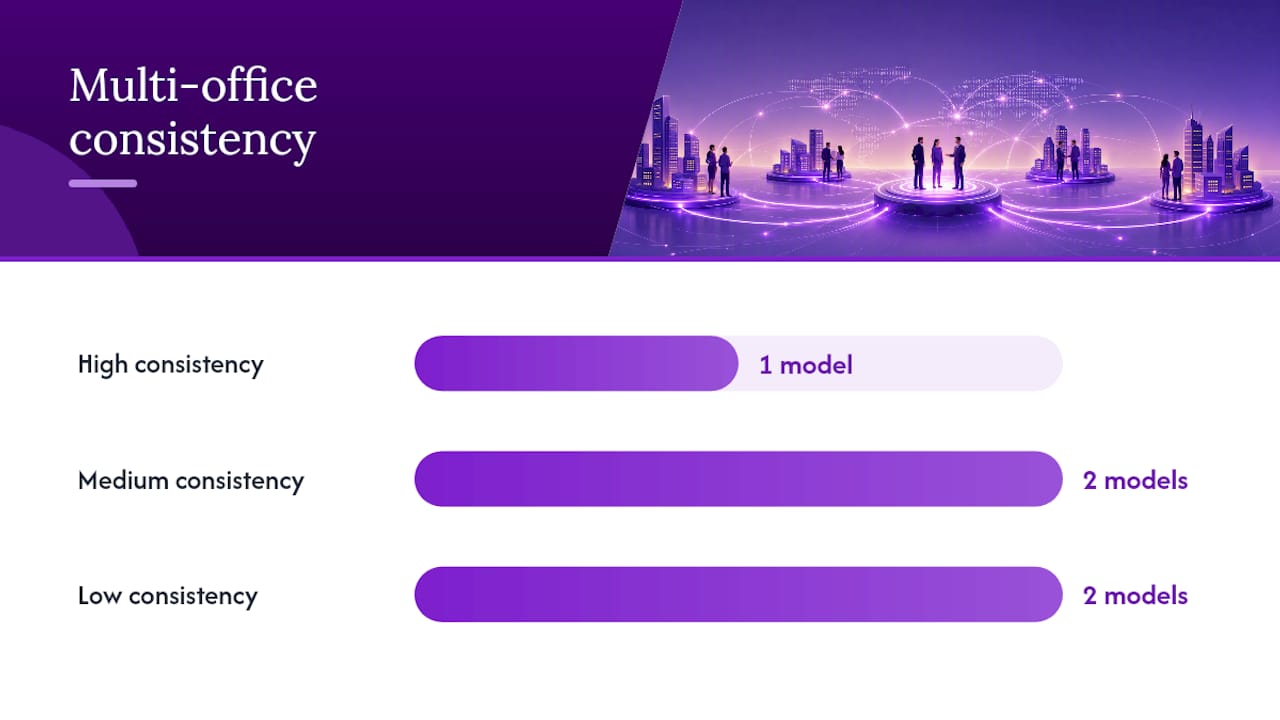
The science behind real estate commission structures confirms what most experienced brokers already know: no single model fits every office. But for standardization to work, you need to pick one primary model and treat the others as documented exceptions.
Why does commission structure consistency matter across offices?
Standardization delivers three concrete benefits: predictable company dollar across offices, fewer agent disputes, and auditable records that hold up under a compliance review. When every office runs a different version of the split policy, finance cannot produce a reliable P&L by office without manually reconciling each one. Recruiting becomes harder because agents transferring between offices face a different deal. And when a dispute arises, there is no single authoritative document to reference.

Centralized, automated commission rules reduce disputes and prevent spreadsheet drift by keeping split logic in one place rather than scattered across ad-hoc files. When agents build their own spreadsheets to verify their pay, that is a signal the official rules are unclear or inconsistently applied.
The tradeoffs are real. A high-cost urban market may genuinely need a different cap threshold than a suburban office with lower average sale prices. Legacy agents with negotiated splits that predate the current ownership structure are a political problem as much as a financial one. And in highly competitive recruiting markets, locking into a uniform structure can limit your ability to make a targeted offer to a top producer.
The questions leadership should answer before committing to full standardization: Can you model the financial impact on company dollar if every office moves to the new structure? Do you have at least two years of historical transaction data to backtest the plan? Are there any legacy compensation agreements that require legal review before modification? Is your current back-office system capable of enforcing a single set of rules across all offices, or will you need new tooling? If the answer to any of these is no, a phased approach with a defined end date is smarter than a hard cutover.
What does a step-by-step rollout look like for multiple offices?
A 12-week rollout is achievable for most brokerages with three to ten offices. The phases below assume you have already made the model decision.
-
Weeks 1–2: Audit. Pull every active agent agreement, cap schedule, and team split arrangement. Document the current state in a single spreadsheet: agent name, office, current split tier, cap amount, YTD GCI, and any side agreements. Flag every deviation from what you intend to standardize.
-
Weeks 3–4: Design. Draft the canonical split policy. Include the base model, tier thresholds, cap amounts, referral fee handling, co-broke rules, and the exceptions policy. Write the policy in plain language agents can read without a lawyer. Sample clause language:
-
Weeks 5–6: Pilot. Select one or two offices that represent different agent mixes. Run the new split calculations in parallel with your existing process. Do not change any payouts yet. Compare outputs and flag discrepancies. Automating per-transaction reconciliation is feasible in a 3–4 week window when split plans are centralized and the system can query YTD GCI for tiered calculations.
-
Weeks 7–8: Training. Brief every office manager on the new policy. Provide agents with a one-page summary and a sample pay calculation for a hypothetical transaction at each tier. Run a Q&A session per office.
-
Weeks 9–10: Full rollout. Activate the new split rules in your back-office system for all offices. Process all new transactions under the standardized model. Continue reconciling against the old model for the first two weeks to catch edge cases.
-
Weeks 11–12: First audit. Pull a transaction-level report across all offices. Verify that split tiers applied correctly, caps tracked accurately, and referral fees were captured and deducted before the split calculation.
Roles matrix: The broker of record owns policy sign-off. The regional manager owns agent communication and exception requests. The finance lead owns the reconciliation model and accounting push. An office administrator or transaction coordinator handles day-to-day CDA generation and file documentation.
Pro Tip: Run the pilot in parallel with your existing manual process for at least four weeks. Do not switch off the old process until the new system has matched outputs on at least 20 consecutive transactions without a discrepancy. This protects agent pay and gives you documented proof the new system works before you go live.

How do you model the financial impact before you commit?
Model the impact before you announce anything. A plan that looks fair at the policy level can quietly reduce company dollar in offices with a high concentration of top producers, or squeeze agent net in offices where average sale prices are lower.
Sample calculation for one transaction:
- Gross sale price: $500,000
- Total commission rate: 3% (listing side only)
- Gross commission income (GCI): $15,000
- Co-broke payment to buyer’s agent brokerage: $7,500 (50% of total deal commission)
- Referral fee paid to referring party: $1,500 (10% of listing-side GCI)
- Pre-split GCI (after deductions): $6,000
- Agent split tier: 70/30
- Agent net: $4,200
- Company dollar: $1,800
Run this calculation for every closed transaction in the past 24 months for each office. Then compare the company dollar total under the current model versus the proposed standardized model. Backtesting a proposed plan against historical data is the only reliable way to understand how many agents will earn above, at, or below their current pay under the new structure.
Sensitivity variables to stress-test:
- Average sale price by office (a 10% drop in ASP changes company dollar significantly in cap-based models)
- Referral rate (what percentage of transactions carry a referral fee, and at what average percentage)
- Cap attainment timing (agents who hit cap in Q1 generate no company dollar for three quarters)
- GCI growth rate (model a flat, +10%, and -10% scenario for each office)
Spreadsheet fields to build into your model:
deal_id, close_date, gross_commission, co_broke_pct, referral_fees, pre_split_deductions, split_tier_applied, company_dollar, agent_net, ytd_gci_for_caps
The before/after comparison below uses two hypothetical offices with different agent mixes to show how the same standardized model produces different financial outcomes.
Office B’s agents will push back. Office A’s managers will feel like they won. Both reactions are predictable, and you need to be ready for them before the announcement.
What operational controls and compliance steps does standardization require?
Standardizing the policy is the easy part. Enforcing it transaction by transaction, across offices, without creating RESPA exposure or payment-app liability, is where most brokerages underestimate the work.
The controls you need:
- Single authoritative split ledger. One system holds the canonical split rules for every agent. No local copies, no office-level spreadsheet overrides.
- Transaction-level audit trail. Every split calculation is logged with the inputs used: GCI, deductions, tier applied, and the date the calculation ran. This is your defense in a dispute.
- Broker approval workflow. No commission disbursement leaves the brokerage without a broker-of-record approval step. This is not optional under RESPA.
- Automated CDA generation. The commission disbursement authorization is generated from the same system that calculated the split, not typed manually from a separate spreadsheet.
- Accounting push. The final split figures flow directly to QuickBooks or your general ledger. Manual re-entry is where errors compound.
A consolidated broker dashboard depends on a canonical data schema and reconciliation logic between your CRM production data and the commission ledger. Without that mapping, co-listed deals get double-counted and split-rule mismatches go undetected until an agent calls to complain.
Sample payment workflow:
- Transaction closes in CRM
- System pulls GCI, applies co-broke and referral deductions
- Split tier is queried against agent’s YTD GCI
- CDA is generated and routed to broker for approval
- Broker approves; ACH disbursement is initiated
- Agent receives payment and a line-item statement
- Transaction is logged in the audit trail with all inputs preserved
The compliance check occurs at two points: before the CDA is generated (to verify deductions are correct) and before ACH is initiated (to confirm broker approval is on file). Using Venmo, Zelle, or any peer-to-peer app for commission payments bypasses both checkpoints and creates federal liability. Brokerpay is built specifically to enforce this workflow, replacing informal payment apps with a compliant ACH process that includes broker approval steps and a full audit trail.
For multi-state brokerages, the Uniform Law Commission provides context on how model acts create legal frameworks that states may adopt at different rates. This matters when your standardized policy must comply with state-specific licensing and compensation disclosure rules that vary across your footprint.
What pitfalls and agent objections should you prepare for?
The operational failures that derail standardization efforts are almost always the same ones.
- Inconsistent plan versions in circulation. An office manager emailed a modified split schedule six months ago and agents are still using it. Audit every document agents have received, not just what’s in your system.
- Spreadsheet-sourced rules. When the authoritative split plan lives in a shared Google Sheet, a single accidental edit produces wrong calculations that go undetected until a dispute surfaces. Spreadsheet-sourced split plans are a documented failure mode; the plan must live in a queryable back-office system.
- Ignored team splits. Team lead arrangements often sit outside the brokerage’s formal split policy. When you standardize, these need to be explicitly addressed or they become a carve-out that undermines the whole framework.
- Cap miscalculations. If YTD GCI is tracked in one system and the split calculation runs in another, cap attainment timing errors are almost guaranteed. One system must own both.
- Missing referral capture. Referral fees paid to outside parties must be deducted before the split calculation runs. When they are applied after, the agent’s net is understated and the company’s dollar is overstated. See compliant co-op payment workflows for practical examples of how this deduction sequence should work.
Common agent objections and responses:
“My current deal is better than the new standard.” Acknowledge it directly. If the agent is a high producer, the standardized model likely does reduce their take. Offer a documented transition period (90–180 days at the current rate) with a clear end date. Do not offer an indefinite exception — that recreates the problem you are solving.
“Why should I trust that the new system calculates correctly?” Show the math. Run a 30-second calculation demo using one of their recent transactions. Let them verify the output against their own records. This is the single most effective trust-building move in the rollout.
“Other offices are getting a better deal.” This objection disappears once the policy is actually uniform. Until then, have the written policy ready to share and be specific about the effective date.
Transition concession patterns that work: A grandfathered rate for 90–180 days with a written sunset clause. Phased cap reductions over two plan years rather than a single-year cut. Accelerated tier thresholds for agents who hit a volume milestone in the first year of the new plan. Sign-on bonus credits for agents who formally acknowledge and accept the new policy before the rollout date.
What KPIs and governance cadence keep the policy on track?
A standardized policy that is not actively monitored drifts back toward informal exceptions within 12–18 months. The governance structure is what prevents that.
KPIs to track by office:
- Company dollar per office (monthly and trailing 12 months)
- Percentage of agents earning above, at, or below their on-target earnings (OTE)
- Split-variance exceptions: count and dollar value of approved exceptions per quarter
- Dispute count and average time-to-resolution
- Cap attainment timing: what percentage of agents hit cap, and in which month on average
Audit cadence:
- Daily: Production reconciliation between CRM closed transactions and the commission ledger. Any transaction that closed without a matching commission record gets flagged immediately.
- Weekly: P&L join by office. Company dollar actual versus model. Flag any office where company dollar is more than 10% below the modeled figure.
- Monthly: Policy review. Are any new exception requests pending? Have any agents changed teams or offices in a way that affects their split tier?
- Quarterly: Agent sentiment check. A short survey or one-on-one with office managers to surface complaints before they become disputes or departures.
- Annually: Full backtest of the plan against actual transaction data. Modeling payout distributions against historical performance annually tells you whether the plan is still calibrated to your actual agent mix and market conditions.
Escalation matrix:
| Exception threshold | Approver |
|---|---|
| Below $500 company dollar impact | Office manager |
| $500 company dollar impact | Regional broker |
| Above $1,800 or structural change | Broker of record / CFO |
Any exception above the office manager threshold must be documented in writing before it takes effect. Verbal approvals are not exceptions — they are liabilities.
The part of standardization most leaders underestimate
The hardest part of making uniform commission splits stick across offices is not the policy design or the technology. It is the moment a regional manager quietly approves a verbal exception for a top producer and never documents it. Six months later, that agent tells two colleagues, and you have three undocumented side deals eroding the framework you spent 12 weeks building.
Transparency is not just a fairness principle — it is an operational control. When every agent can run a 30-second calculation on any transaction and get the same answer the system produces, the policy becomes self-enforcing. Disputes drop because there is nothing to dispute. The agents who push back hardest on standardization are almost always the ones benefiting most from the current opacity.
One tactic worth implementing immediately: require any proposed exception to be modeled in writing before it is approved. That means the regional manager must show the company dollar impact, the agent’s current tier, and the proposed deviation, all in one document. Most informal exception requests evaporate when someone has to write them down.
Brokerpay makes the operational side of standardization work
Running a standardized split policy without a purpose-built platform means your finance team is manually reconciling transactions, chasing broker signatures on CDAs, and hoping no one edited the cap schedule in the shared spreadsheet. That is not a compliance posture — it is a liability waiting to surface.
Brokerpay is built for exactly this rollout. It centralizes your split rules in one authoritative ledger, automates per-transaction calculations with YTD GCI tracking for tiered and cap-based plans, generates CDAs for broker approval, and disburses agent pay via ACH — with a full audit trail on every transaction. No Venmo, no Zelle, no undocumented payments. The recommended pilot scope is one or two offices, run in parallel with your existing process for eight weeks. If the outputs match and the workflow holds, you have everything you need to roll out across all offices with confidence. Start a pilot or request a demo to see how the platform fits your current setup.
Sources
The following sources back the guidance in this article and offer additional depth for brokerages building or refining their commission standardization approach.
- Sales Commission Structure Template & Best Practices | Xactly
- Automate Sc & Edge Cases — Automate reconcile commission splits per transaction 2026 | US Tech Automations
- Sales Compensation Design: What Sales Ops Needs to Know About Commission Structures — The GTM Advisor Group