RESPA Recordkeeping Requirements for Real Estate Brokerages

Every brokerage handling referral fees, agent splits, or co-op payments must maintain five categories of records to demonstrate RESPA compliance: a written agreement for each payment, an executed invoice or service description, proof that services were actually performed, a full payment trace (ACH ledger, closing statement line, or bank record), and all related communications. Retain every document for five years from the date of execution under Regulation X.
Start here:
- Route all payments through the brokerage ledger — never agent-to-agent directly.
- Execute a written agreement before any payment clears — verbal arrangements are not defensible.
- Capture proof of services performed — a dated deliverable, timesheet, or work log.
- Preserve the payment trace — ACH confirmation, title company check, or closing statement line item.
- Retain everything for five years from the date of execution.
The audit packet section below shows how to organize these documents when a CFPB or state examiner asks.
Key Takeaways
RESPA recordkeeping for brokerages comes down to one discipline: document every covered payment before it moves, route it through the broker, and keep the file for five years.
| Point | Details |
|---|---|
| Written agreement first | Execute and broker-approve a written agreement before any referral fee, split, or co-op payment is disbursed. |
| Route through the brokerage | All payments must flow through the brokerage ledger — never agent-to-agent via P2P apps. |
| Prove services performed | Attach a dated deliverable, timesheet, or work log to every payment file to satisfy the “actually performed” standard. |
| Five-year retention | Retain all covered documents for five years from the date of execution under Regulation X; extend for litigation holds or stricter state rules. |
| Brokerpay automates compliance | Brokerpay routes payments through the brokerage ledger, stores agreements, and produces indexed audit packets automatically. |
Table of Contents
- What do RESPA Section 8 and Regulation X require for brokerage records?
- Which brokerage payments must be documented under RESPA?
- What documents does each referral, split, or co-op payment require?
- How long must brokerages keep RESPA records?
- How do you prove services were actually performed at fair market value?
- What payment routing practices create RESPA risk?
- How do you prepare an audit packet for CFPB or state examiners?
- Practical checklist and sample agreement clauses you can use today
- What brokerages consistently get wrong — and how to fix it
- Brokerpay closes the recordkeeping gaps this checklist identifies
- Sources
What do RESPA Section 8 and Regulation X require for brokerage records?
RESPA Section 8 (12 U.S.C. § 2607) prohibits giving or accepting any fee, kickback, or “thing of value” in exchange for a referral of a settlement service. Regulation X (12 CFR § 1024.14) carries the implementing language, including the definitions auditors use and the recordkeeping obligation itself.
Three definitions drive almost every enforcement question:
Thing of value covers far more than cash. Under Regulation X’s definitions, it includes services, discounts, credits, trips, and any other benefit with economic value — meaning a free desk, a marketing credit, or a sponsored dinner can all trigger scrutiny.
Referral means any oral or written action that influences a consumer’s selection of a settlement service provider. A casual email saying “use this title company” qualifies.
Settlement service is broad enough to cover most services in a residential transaction, including brokerage services themselves.
The CFPB is the primary federal enforcer; state regulators run parallel oversight. Records are your only defense when either one asks why a payment was made. Without documentation, a lawful split looks identical to a kickback.
Key rule: Federal Reserve guidance confirms that the statutory exemption for cooperative brokerage arrangements applies only when all parties are acting in a brokerage capacity — not when one party is a settlement service provider such as a lender or title company.
Which brokerage payments must be documented under RESPA?
The short answer: any payment or benefit that flows in connection with a referral or a settlement service. That covers more ground than most admins expect.
In-scope payment types:
- Commission splits between co-operating brokerages
- Referral fees paid to referring agents or brokerages
- Co-op commissions on buyer-side transactions
- Team splits and override payments tied to referred transactions
- Bonuses or incentives linked to referral volume
Non-cash “things of value” auditors look for:
- Discounted or free services (office space, marketing, leads)
- Credits applied at closing
- Sponsored travel or entertainment
- In-kind benefits with a quantifiable market value
The line that trips up many brokerages: payments between licensees acting in a brokerage capacity fall under the cooperative-brokerage exemption in RESPA Section 8. Payments to settlement service providers — title companies, lenders, inspectors — do not. Misclassifying the relationship is one of the fastest paths to a violation.
What documents does each referral, split, or co-op payment require?
Build a transaction folder for every covered payment. Each folder needs:
- Written agreement — signed by all parties, dated before payment, specifying the service, the fee, and the payment route through the broker.
- Executed invoice — line-itemized, with the service description, hours or units, rate, and total.
- Proof of service delivery — a dated deliverable (report, showing log, marketing asset), timesheet, or written acknowledgment from the receiving party.
- Payment trace — ACH confirmation, title company disbursement check, or the closing statement line that shows the amount and recipient.
- Internal broker approval — a signed memo or system-generated approval record showing the broker reviewed and authorized the payment.
- Communications — email threads, text messages, or platform messages that discuss the arrangement, the service, or the payment.
File-naming example: 2024-11-TX-CLOSE-REF-SMITHJONES-$3500-REFERRAL.pdf
Capture these metadata fields in your document management system for every payment: transaction ID, MLS number or closing date, parties involved, payment amount, payment type (referral/split/co-op), and broker approval date. Industry practice, reflected in broker file-retention manuals, calls for uploading executed documents immediately rather than batching them at month-end.
Pro Tip: Require the written agreement to be signed and broker-approved before any payment is initiated. A folder missing its agreement is an automatic red flag in any audit.
How long must brokerages keep RESPA records?
The rule is direct: documents required under Regulation X must be retained for five years from the date of execution. That language comes from 12 CFR § 1024.14 itself.
Five-year retention is the federal floor — state rules or open investigations may require longer.
When does the clock start?
- Written agreements: the date all parties sign.
- Payment records: the date the payment clears.
- Closing-related documents: the closing date.
Three situations extend retention beyond five years:
- An open CFPB or state investigation names the transaction.
- Litigation is filed or reasonably anticipated (litigation hold applies immediately).
- Your state’s real estate commission sets a longer minimum — several states require six or seven years for transaction files.
Check your state licensing authority’s rules alongside the federal floor. When in doubt, keep longer.
How do you prove services were actually performed at fair market value?
The central misconception in RESPA compliance is that all referral fees are banned. NAR guidance is clear: payments between licensees are not automatically illegal. The real test is whether the payment compensates for bona fide services actually performed, at fair market value. Overpayment or a disguised split fails that test regardless of how the agreement is labeled.
Here is how to build a defensible record:
- Define the deliverable in the written agreement. Name the specific service: “Buyer consultation and property tour for three showings on [dates].” Vague language like “referral services” is not enough.
- Attach dated work product. A showing log with timestamps, a written buyer needs assessment, or a signed acknowledgment from the client all work. The document must be contemporaneous, not reconstructed later.
- Submit a market-benchmarked invoice. Include hours, an hourly rate, the deliverable description, and a note explaining why the rate reflects market value — for example, “consistent with the prevailing referral fee of 25% of gross commission in this market.”
- Document broker approval with a rationale. The approving broker should note in writing why the service was necessary and why the compensation was appropriate.
Sample invoice language that strengthens a fair-market-value position: “3.5 hours buyer consultation at $X/hr, consistent with standard referral compensation in [market]; deliverable: written buyer profile and three-property tour summary attached.”
What payment routing practices create RESPA risk?
Payments should flow to the brokerage ledger first, then disburse to the agent or referring party. That single routing rule eliminates most of the common violations.
Direct agent-to-agent transfers bypass broker oversight entirely. Texas Real Estate Research Center guidance specifically flags routing payments outside the sponsoring broker as a frequent state-level violation. The same principle applies federally.
Workflows that create immediate risk:
- Venmo or Zelle transfers between agents for referral fees or splits — P2P apps produce weak audit trails, mix personal and business funds, and leave reconciliation gaps.
- Undisclosed third-party fee splitting with a settlement service provider.
- Cash payments with no paper trail.
- Payments processed before a written agreement exists.
Red flags auditors look for:
- No written agreement in the transaction file.
- Payment amount does not match any invoice or closing statement line.
- Broker has no record of approving the payment.
- Payment routed through a personal account or P2P app.
Switching from manual or P2P payouts to a ledgered automated payout system closes most of these gaps at the process level rather than relying on individual agent discipline.
How do you prepare an audit packet for CFPB or state examiners?
An audit packet must include five components: the executed agreement, the payment trace, proof of services, related communications, and a broker-signed cover memo. Organization matters as much as completeness.
Audit packet structure:
- Cover sheet — transaction ID, closing date, parties, payment type, and amount.
- Tab 1: Written agreement — signed, dated, broker-approved.
- Tab 2: Invoice and proof of services — itemized invoice plus the dated deliverable.
- Tab 3: Payment trace — ACH confirmation or closing statement excerpt.
- Tab 4: Communications — relevant email or message threads.
- Tab 5: Chain-of-custody log — who accessed or modified the file, with timestamps.
- Reconciliation note — a one-line entry linking the payment amount to the closing statement line.
Keep a master index that maps each payment to its transaction ID and closing statement. Platforms that produce immutable, timestamped exports reduce the time to respond to a regulator request from days to minutes.
Pro Tip: Export a timestamped, read-only audit report for every closed transaction and store it separately from the editable working file. That immutable copy is what you hand to an examiner.
Practical checklist and sample agreement clauses you can use today
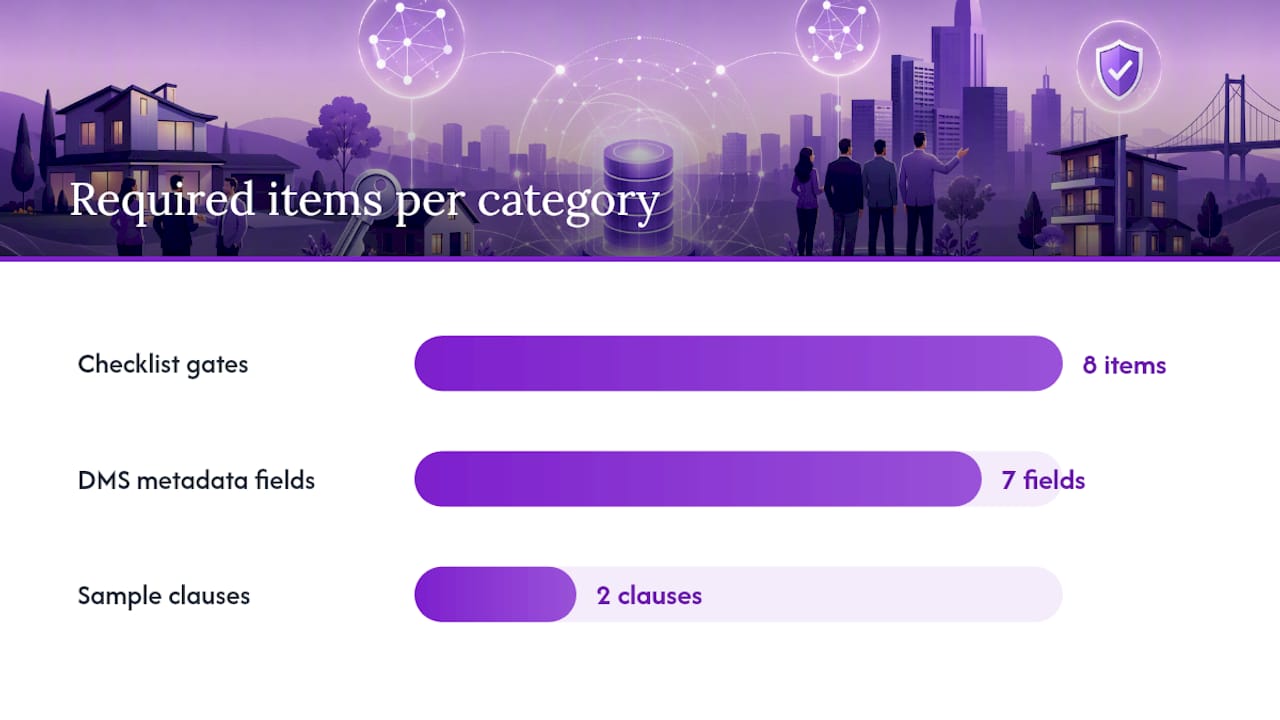
Copy this checklist into your transaction management system as a required completion gate before disbursement:
- [ ] Written agreement executed and broker-approved before payment
- [ ] Invoice on file, line-itemized with deliverable description and rate
- [ ] Dated proof of service delivery attached
- [ ] Payment trace document saved (ACH, check copy, or closing statement line)
- [ ] Internal broker approval memo or system record saved
- [ ] Communications thread archived
- [ ] File named per brokerage convention and metadata fields completed
- [ ] Retention flag set: five years from execution date
Sample Clause A — Referral fee for specified services: “Referring Broker shall receive a referral fee of [X]% of gross commission, payable upon closing, as compensation for the following services actually performed: [describe deliverable]. Payment shall be made by [Receiving Broker] through the brokerage ledger within [X] days of closing.”
Sample Clause B — Broker approval and payment routing: “No referral fee, split, or co-op payment shall be disbursed without prior written approval of the Designated Broker. All payments shall route through the brokerage trust account and be documented by an executed disbursement authorization referencing the transaction ID and closing date.”
Minimum DMS metadata per payment: transaction ID, closing date, parties, payment type, amount, broker approval date, and five-year retention expiration date.
What brokerages consistently get wrong — and how to fix it
The most common failure is not a missing document. It is a missing process. Brokerages that get cited typically have some records somewhere — but they are scattered across email inboxes, personal Dropbox folders, and agent phones. When an examiner asks for a complete file, no one can assemble it in time.
The fix is not a full systems overhaul. Three operational changes close most audit gaps:
Deny any payment that lacks a written agreement. Make it a hard stop in your disbursement process, not a reminder. If the agreement is not in the system, the payment does not move.
Require pre-approval for all third-party service payments. The broker signs off before the invoice is submitted, not after. That approval record is what separates a lawful split from a disguised kickback in an examiner’s eyes.
Standardize payment routing through one ledger. Every referral fee, split, and co-op payment flows through the brokerage account. No exceptions for “small” amounts or longtime partners.
For brokerages starting from scratch, a 30/60/90-day remediation plan works well. In the first 30 days: audit open files for missing agreements and close the gaps. Days 31–60: implement the written-agreement gate and the broker pre-approval step. Days 61–90: build the indexed audit packet template and train staff on file naming and metadata. Pairing that plan with brokerage operational efficiency improvements helps prioritize where to invest time and budget. Small brokerages with limited admin capacity may need a platform to enforce these controls automatically rather than relying on policy alone.
Brokerpay closes the recordkeeping gaps this checklist identifies
The checklist above describes what compliant recordkeeping looks like. Brokerpay is built to produce it automatically.
Every referral fee, agent split, and co-op commission processed through Brokerpay routes through the brokerage ledger — not a personal Venmo account. The platform stores written agreements alongside each transaction, generates an immutable audit trail with timestamped approval records, and reconciles payments against closing statements. When a CFPB examiner or state auditor asks for a file, the audit packet is already assembled. No scrambling through inboxes, no reconstructed records.
Brokerages that have been relying on manual spreadsheets or P2P apps can migrate to a compliant commission workflow without rebuilding their entire operation. Schedule a demo at Brokerpay to see how the platform maps to your current referral and split workflows.
Sources
- Real Estate Settlement Procedures Act (RESPA) FAQs — Consumer Financial Protection Bureau
- 12 CFR § 1024.14 — Prohibition against kickbacks and unearned fees — Legal Information Institute (Cornell Law School)
- Tips to give and get referrals in a RESPA-compliant way — NAR
- Section 1024.14 — Prohibition against kickbacks and unearned fees — Federal Reserve
This article provides general compliance information, not legal advice. Confirm current rules with the CFPB, your state real estate commission, or a qualified real estate attorney before implementing policy changes.
This article is general information, not a substitute for advice from a qualified lawyer. Consult a qualified legal professional about your own circumstances before acting on anything here.