How 1099 Filing Works for Real Estate Agents

Brokerages generally must issue Form 1099-NEC to every licensed agent who received $600 or more in nonemployee compensation during the calendar year. That means commissions, referral fees, and most other payments that flow from the brokerage to an independent contractor agent all count. The payer, which is almost always the brokerage, is responsible for issuing the form, not the agent. Recipient copies must reach agents by January 31, and the IRS filing deadline for Form 1099-NEC is also January 31.
Three things every broker admin should do right now:
- Confirm you have a signed, current Form W-9 on file for every agent you paid this year.
- Pull your commission ledger and reconcile gross payments to each agent against your internal records.
- Calendar January 31 as a hard deadline for both furnishing recipient copies and filing with the IRS.
Filing options are paper (with Form 1096 as a transmittal cover) or electronic. If you file 10 or more information returns, e-filing is mandatory.
Key Takeaways
Brokerages must issue Form 1099-NEC for every agent who received nonemployee compensation meeting or exceeding the IRS threshold during the year, reporting gross commissions in Box 1 and furnishing recipient copies by the IRS deadline, typically January 31.
| Point | Details |
|---|---|
| Use Form 1099-NEC for agent commissions | Report gross commissions paid to nonemployee agents who received $600 or more in the calendar year. |
| January 31 is a hard deadline | Both recipient copies and IRS filing for Form 1099-NEC are due January 31, paper or electronic. |
| E-file is mandatory at 10+ returns | Brokerages filing 10 or more information returns must use IRIS or FIRE; paper filing is not an option at that volume. |
| Collect W-9s before the first disbursement | A missing TIN triggers 24% backup withholding; requiring W-9s at onboarding prevents year-end gaps. |
| Brokerpay enforces compliance year-round | Brokerpay automates W-9 collection, split calculations, and ACH disbursements with a full audit trail, so 1099 reconciliation is a confirmation rather than a reconstruction. |
Table of Contents
- 1. Which 1099 form do you actually need for agent commissions?
- 2. Who actually needs to receive a 1099 from your brokerage?
- 3. How do different real estate payment types map to 1099 reporting?
- 4. How to collect Form W-9 and handle missing TINs
- 5. The end-to-end filing workflow for brokerage admins
- 6. What are the deadlines and penalties for late or incorrect 1099s?
- 7. Common 1099 mistakes brokerages make and how to prevent them
- 8. How to issue corrected 1099s and resolve agent disputes
- 9. How a compliant commission workflow reduces 1099 errors
- 10. A brokerage admin’s honest take on year-end 1099 work
- Brokerpay keeps your commission records 1099-ready all year
- Sources
1. Which 1099 form do you actually need for agent commissions?
Real estate brokerages encounter three 1099 variants regularly, and choosing the wrong one is one of the most common filing errors.
Form 1099-NEC is the standard form for nonemployee compensation. Use it when you pay a licensed agent, independent contractor, or referral partner $600 or more during the year for services. Because the IRS treats licensed real estate agents as statutory nonemployees, broker-to-agent commission payments almost always land here. Box 1 on the form captures the gross amount paid.
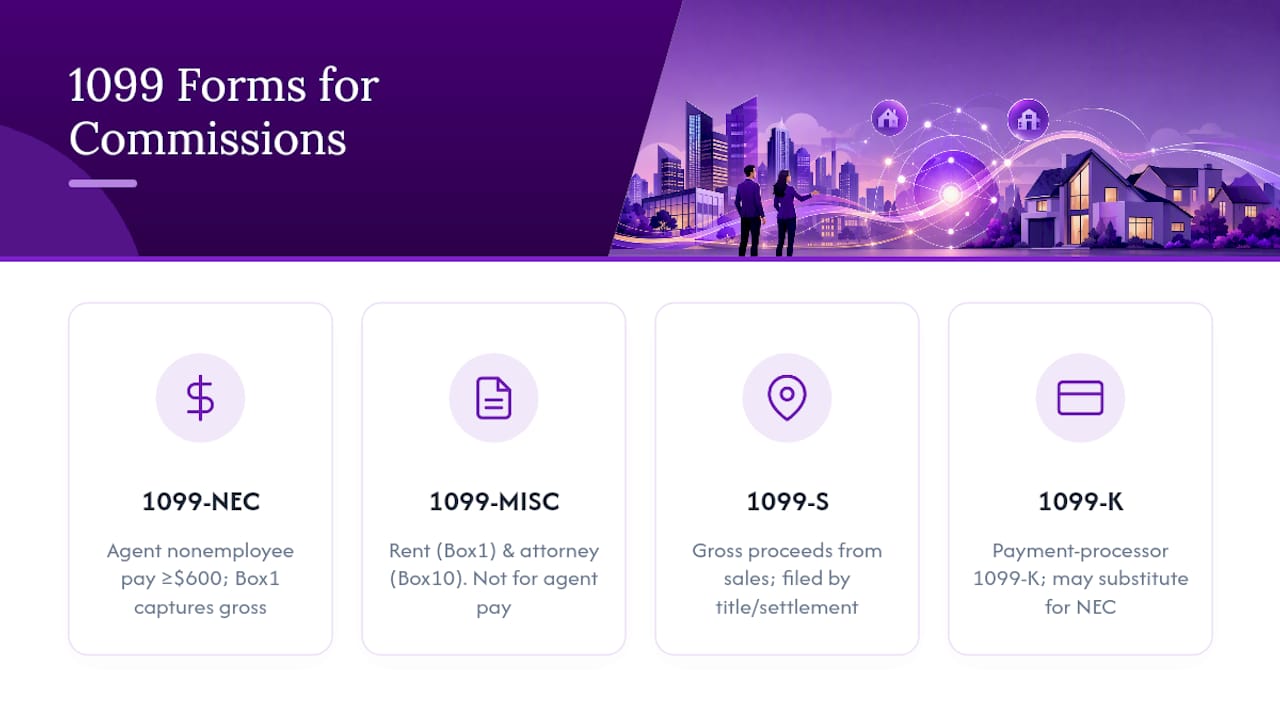
Form 1099-MISC still matters in real estate, but for different situations: rent passthroughs to property owners (Box 1), attorney gross proceeds (Box 10), and certain prizes or awards. It is not the right form for standard agent commissions.
Form 1099-S covers gross proceeds from real estate sales. Title companies and settlement agents typically file this one, not the listing or buyer’s broker. If you are a broker who also acts as the settlement agent, confirm who has the filing obligation in writing before closing.
Form 1099-K enters the picture when a third-party payment processor (think a payment app or platform) processes the payments. If your brokerage pays agents through a processor that issues its own 1099-K, you may not need to issue a separate 1099-NEC for those same amounts. Verify with your CPA before assuming the processor has covered your obligation, because the rules here are nuanced. For context on how payment gateways interact with commission disbursements, see what a real estate payment gateway actually does.
Filing mechanics at a glance:
When you do file on paper, Form 1096 is the transmittal cover sheet that accompanies the physical 1099s to the IRS. It is not required for electronic submissions. The IRS offers two e-file channels: IRIS (Information Returns Intake System), which accepts direct entry or .csv uploads, and FIRE (Filing Information Returns Electronically), which is better suited to high-volume filers. Both channels are described on the IRS e-file page. Third-party services like Tax Form Hero also support 1099 electronic filing if you prefer a guided interface.
2. Who actually needs to receive a 1099 from your brokerage?
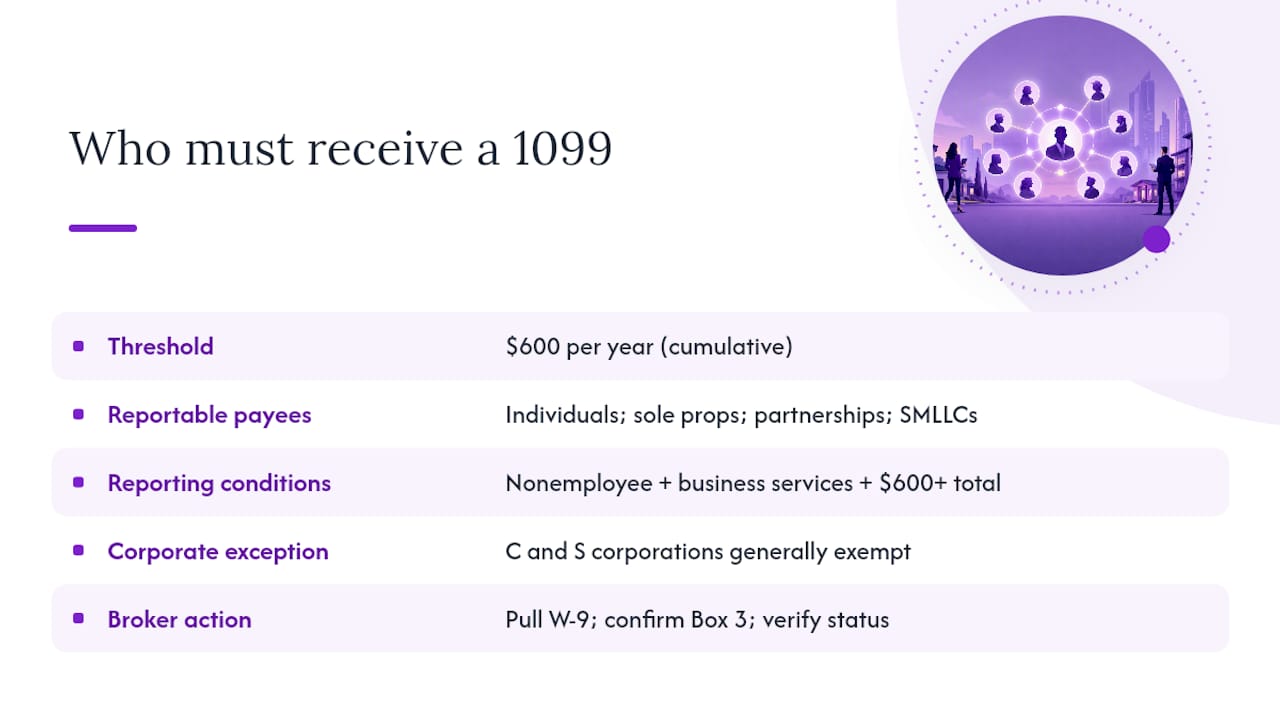
The $600 threshold is cumulative across the calendar year. An agent who receives multiple payments during the year that cumulatively meet or exceed the IRS filing threshold must receive a 1099-NEC, even if no single payment hits that threshold.
Reportable payees include individuals, sole proprietors, partnerships, and single-member LLCs. The IRS requires reporting payments to independent contractors when four conditions are met: the payment is made to someone who is not your employee, it is for services in the course of your trade or business, it is made to an individual, partnership, estate, or in some cases an LLC, and it totals $600 or more for the year.
The corporate exception is real but narrower than many brokers assume. Payments to C corporations and S corporations are generally exempt from 1099-NEC reporting. However, most real estate agents operate as sole proprietors or single-member LLCs, which are disregarded entities for tax purposes. A single-member LLC that has not elected corporate tax treatment is still reportable. Always check Box 3 on the W-9 before deciding to skip a 1099.
The statutory nonemployee classification is the key legal hook here. The IRS is explicit: licensed real estate agents whose income is substantially tied to sales output are treated as self-employed for federal tax purposes. That classification creates the default expectation of 1099-NEC reporting rather than W-2 issuance, regardless of how the agent structures their business entity.
Pro Tip: Before skipping a 1099 for any payee, pull their W-9 and confirm the entity type in Box 3. “LLC” on a business card means nothing without knowing the tax classification. A single-member LLC taxed as a disregarded entity still gets a 1099-NEC.
3. How do different real estate payment types map to 1099 reporting?
Not every payment your brokerage makes follows the same reporting path. Here is how the most common scenarios break down:
-
Agent commissions: Report gross commissions in Box 1 of Form 1099-NEC. Do not net out desk fees, E&O insurance, or other deductions the brokerage withholds. The agent deducts those expenses on their own Schedule C. Reporting net instead of gross is one of the most common brokerage errors, and it creates a mismatch with IRS automated matching programs.
-
Referral fees: Paid to a licensed agent or referral company for sending a client your way? If the recipient is a nonemployee individual or non-corporate entity and the total hits $600, it goes on a 1099-NEC. If the referral is paid to a corporation, the corporate exception typically applies.
-
Team splits and associate payments: This one trips up a lot of brokerages. The obligation follows the money. If the brokerage pays the lead agent the full commission and the lead agent then splits it with a buyer’s agent on their team, the brokerage issues one 1099-NEC to the lead agent for the full amount. The lead agent is then responsible for issuing a 1099-NEC to their associate if that associate is an independent contractor who received $600 or more. If the brokerage pays each agent directly, the brokerage issues separate 1099s to each.
-
Rent passthroughs: Property managers who collect rent and pass it to property owners report those payments on Form 1099-MISC, Box 1. This applies when the property manager pays $600 or more to a single owner during the year. The IRS guidance on Form 1099-MISC covers this scenario specifically.
-
Sale proceeds (1099-S): The gross proceeds from a real estate sale go on Form 1099-S, and the filing obligation typically sits with the title company or settlement agent. Brokers are generally off the hook here unless they are also acting as the closing agent.
-
Payments to corporations and LLCs: As noted above, payments to C corps and S corps are usually exempt. Single-member LLCs taxed as disregarded entities are not. Multi-member LLCs taxed as partnerships are reportable. When in doubt, the W-9 is your guide.
4. How to collect Form W-9 and handle missing TINs
A completed W-9 should be a precondition for cutting any commission check. Collecting it after the fact, or worse, at year-end, creates unnecessary scrambling and potential backup withholding liability. Here is the practical sequence:
-
Require W-9 completion at agent onboarding. Make it part of the same paperwork package as the independent contractor agreement. The IRS Form W-9 page provides the official form and instructions. Verify that the name, TIN (Social Security Number or EIN), and entity type in Box 3 are all complete before filing the form.
-
Verify the TIN before the first disbursement. The IRS TIN Matching program lets authorized payers verify that a name and TIN combination matches IRS records before filing. Catching a mismatch here is far less painful than receiving an IRS B-Notice after filing.
-
Handle refusals and missing TINs with backup withholding. If a payee refuses to provide a TIN or provides one that does not match IRS records, you are generally required to withhold 24% of each payment as backup withholding and remit it to the IRS. This is not optional. Document every attempt to collect the W-9 in writing.
-
At year-end, audit your W-9 file before you start generating 1099s. Cross-reference every payee in your commission ledger against your W-9 repository. Any gaps need to be resolved before you file. If a payee is unresponsive, document your outreach attempts and apply backup withholding retroactively if required.
-
Store W-9s in a central, dated repository. A shared drive folder organized by tax year works. A commission platform with built-in document storage works better. The key is that you can produce the W-9 quickly if the IRS ever questions a filing. Date-stamp every W-9 when you receive it.
5. The end-to-end filing workflow for brokerage admins
Getting 1099s right is mostly a year-round bookkeeping discipline, not a January sprint. Here is the full workflow:
Year-round (every transaction):
- Record gross commissions paid to each agent at the time of disbursement. Do not wait until year-end to reconstruct payment history.
- Flag referral fees, co-op payments, and any non-commission payments separately in your ledger so they can be reviewed individually at year-end.
- Confirm W-9 status for every new payee before the first payment clears.
Quarterly:
- Pull a commission ledger summary by payee and reconcile it to bank deposits and broker statements. Catching discrepancies quarterly means you fix one quarter’s worth of data, not twelve months.
- Review any new agents or contractors added during the quarter and confirm their W-9s are on file.
October through December:
- Run a full W-9 audit. Identify any payees who are missing W-9s or whose TINs have not been verified.
- Use the IRS TIN Matching program to validate name/TIN combinations for all payees you expect to file for.
- Reconcile your full-year commission ledger to your internal records and resolve any discrepancies before December 31.
- Confirm which payees crossed the $600 threshold and which forms apply to each.
January:
- Generate 1099-NEC forms for all qualifying payees. Report gross amounts in Box 1.
- Furnish recipient copies to agents by January 31.
- File with the IRS by January 31 (both paper and electronic for 1099-NEC). If you file 10 or more returns, e-filing through IRIS or FIRE is mandatory. E-filing also reduces transcription errors and supports corrections more cleanly than paper. Automated payouts tied to your commission records make this reconciliation significantly faster.
- If filing on paper, include Form 1096 as the transmittal cover sheet.
Pro Tip: Run your TIN matching in November, not January. The IRS TIN Matching program is free for authorized payers, and catching a mismatch six weeks before the filing deadline gives you time to request a corrected W-9 without triggering backup withholding obligations.
6. What are the deadlines and penalties for late or incorrect 1099s?
The deadlines for Form 1099-NEC are straightforward: January 31 for both furnishing recipient copies and filing with the IRS, whether you file on paper or electronically. Other 1099 forms (1099-MISC, 1099-S) have slightly different IRS filing deadlines depending on whether you file on paper or electronically, so verify current deadlines on the IRS website each year.
The IRS penalty schedule for information returns is tiered by how late the filing is:
Small businesses have lower annual maximums for the non-intentional tiers, but the per-return amounts are the same regardless of business size. A brokerage with 30 agents that misses the deadline entirely faces $330 per return in the highest non-intentional tier, which adds up fast. Intentional disregard carries no annual cap at all.
Extensions are available in limited circumstances. You can request a 30-day extension to furnish recipient copies by submitting a written request to the IRS before the January 31 deadline. Extensions for IRS filing are similarly limited and not automatic. The better strategy is to treat January 31 as non-negotiable and build your workflow backward from that date.
Corrected 1099s reduce penalty exposure when errors are caught and fixed promptly. Filing a corrected form before the IRS contacts you is treated more favorably than correcting after an audit or notice.
7. Common 1099 mistakes brokerages make and how to prevent them
Most 1099 errors in real estate fall into a handful of predictable categories. Knowing them in advance is most of the fix.
Reporting net instead of gross commissions. This is the most consequential mistake. When a brokerage deducts desk fees, transaction fees, or E&O premiums from a commission before reporting it on the 1099-NEC, the reported amount does not match what the IRS expects to see. Agents deduct their business expenses on Schedule C. The brokerage’s job is to report what it paid, not what the agent kept. Gross commission reporting is the standard, and deviating from it creates IRS matching problems for both parties.
Closing date confusion across calendar years. A transaction that closes December 30 but funds on January 3 can create genuine ambiguity about which tax year the commission belongs to. The general rule is that the payment date, not the closing date, controls the tax year. Document your policy and apply it consistently.
Double-counting referral fees. If a referral fee is paid out of a commission that is also being reported in full, you may end up reporting the same dollars twice. Track referral payments separately and confirm they are not already embedded in a gross commission figure you are reporting elsewhere.
Late W-9 collection. Waiting until December to chase W-9s from agents who joined in March is a self-inflicted problem. The fix is structural: no W-9, no commission disbursement.
Not using TIN matching before filing. The IRS Automated Underreporter (AUR) program and CP2000 notices are triggered by name/TIN mismatches. Running TIN matching before you file catches these before they become your problem. Commission tracking that prevents tax issues starts with clean payee data, not clean forms.
Prevention checklist:
- Require W-9 completion at onboarding, before any payment.
- Report gross commissions in Box 1, every time.
- Reconcile commission ledgers monthly, not annually.
- Run TIN matching in November.
- Document your closing-date-vs-payment-date policy in writing.
- Keep a correction policy on file so the team knows what to do when an error surfaces.
Pro Tip: If you use a spreadsheet to track commissions, add a column that flags each payee’s W-9 status as “collected,” “pending,” or “missing.” Running that filter in October tells you exactly who needs follow-up before year-end.
8. How to issue corrected 1099s and resolve agent disputes
Errors happen. The process for fixing them is straightforward if you move quickly.
-
Identify the error type. The correction process differs slightly depending on whether you reported the wrong amount, the wrong payee, or both. For amount errors, you file a corrected 1099-NEC with the right figure and check the “CORRECTED” box at the top of the form.
-
Prepare the corrected form. Generate a new 1099-NEC with the correct information. Check the CORRECTED box. Do not void the original and start over unless the payee information itself was wrong (wrong TIN or name), which requires a two-step process: first file a zero-amount corrected form for the original, then file a new original form with the correct payee data.
-
Re-transmit to the IRS. If you e-filed originally, submit the corrected form through the same channel (IRIS or FIRE). If you filed on paper, mail the corrected form with a new Form 1096 marked to indicate it is a correction.
-
Furnish the corrected copy to the agent. Send the corrected recipient copy promptly and keep a record of when it was sent. Email with read receipt or certified mail both work.
-
Document the dispute resolution trail. When an agent disputes the reported amount, reconcile your commission ledger against their records, identify the root cause (timing difference, routing error, or data entry mistake), and request corrected documentation from the title or settlement company if needed. Keep every email and note in the agent’s file. If the IRS later sends a CP2000 notice, a clean paper trail showing you identified and corrected the error proactively is your best defense.
A single incorrect 1099 can trigger IRS automated matching programs; resolving mismatches early by issuing corrected forms reduces audit risk and downstream tax notices for both the brokerage and the agent.
9. How a compliant commission workflow reduces 1099 errors
The root cause of most 1099 problems is not ignorance of the rules. It is fragmented recordkeeping. When commission payments flow through a mix of checks, ACH transfers, and peer-to-peer apps like Venmo or Zelle, reconstructing a clean year-end ledger becomes genuinely difficult. Amounts get lost in personal bank statements, W-9s never get collected because there was no formal disbursement process, and Box 1 on the 1099-NEC ends up being a best guess rather than a reconciled figure.
A centralized commission payment workflow solves this at the source. When every split, referral fee, and co-op payment runs through a single documented system, the year-end 1099 reconciliation is mostly already done. The ledger matches the disbursements because the disbursements were recorded in real time. For practical examples of how this works across different co-op scenarios, the compliant co-op payment workflow examples are worth reviewing.
Brokerpay enforces W-9 collection before any payout is processed, records every approval in an audit trail, and calculates agent splits automatically so Box 1 on each 1099-NEC reflects what the system actually paid. That audit trail is also what you produce if the IRS ever questions a filing or an agent disputes their reported amount.
Pro Tip: Require all agent payee setup, including W-9 submission and TIN verification, to be completed in your commission platform before any payout is approved. This single policy eliminates the most common source of year-end 1099 scrambling.
10. A brokerage admin’s honest take on year-end 1099 work
Year-end 1099 season is predictably painful for exactly one reason: most of the work that should have happened in March, June, and September gets compressed into three weeks in January. The agents who joined mid-year without submitting W-9s, the referral fees that were paid informally, the commission splits that were calculated on a whiteboard and never entered into the ledger — all of it surfaces at once, right before the deadline.
The brokerages that handle this well are not doing anything complicated. They collect W-9s before the first check clears. They reconcile monthly. They treat the commission ledger as a living document, not an annual project. When January arrives, they are mostly just generating forms from data that already exists.
The one process change that makes the biggest difference is centralizing disbursements. When every payment runs through a documented workflow with an approval step, the year-end reconciliation is a confirmation, not a reconstruction. That shift from reactive to predictable is what separates a clean filing season from a stressful one.
Brokerpay keeps your commission records 1099-ready all year
Chasing W-9s in January, reconciling informal Venmo payments, and manually calculating splits from a spreadsheet are the three things that make 1099 season harder than it needs to be. Brokerpay eliminates all three.
The platform requires W-9 collection before any payout is approved, calculates agent splits and referral fees automatically, and disburses via ACH with a full audit trail attached to every transaction. When January arrives, your commission records are already reconciled and your 1099-NEC Box 1 figures match your ledger exactly.
Platform features that map directly to 1099 compliance:
- W-9 collection enforced at agent onboarding
- Automated split and referral fee calculations
- ACH disbursements with timestamped approval records
- Full audit trail for every commission payment
- Cap tracking and earnest money documentation
Stop building your 1099 workflow around a spreadsheet. See how Brokerpay works and get your commission records compliant before the next filing deadline.
Sources
- About Form 1099-NEC | Internal Revenue Service
This article is general information, not a substitute for advice from a qualified financial advisor. Consult a qualified financial professional about your own circumstances before acting on anything here.