How Inaccurate Agent Splits Cause IRS Problems

Inaccurate agent splits create IRS reporting mismatches because information returns follow the money the payer actually disbursed, not the split allocation you intended. When your commission ledger says one thing and your 1099-NEC says another, the IRS automated matching program flags the discrepancy, and your brokerage absorbs the consequences: CP2000 notices, backup withholding obligations, and penalty exposure. Run a TIN/name match and a year-to-date gross-versus-agent-share reconciliation for every agent with $600 or more in payments before your next filing cycle.
The core reasons split errors become IRS problems:
- The payer of record is responsible for reporting the full gross amount disbursed, not the net after splits, unless the split is properly documented and the correct payee receives the correct 1099.
- Wrong or missing TINs trigger CP2100/CP2100A B-notices and mandatory 24% backup withholding under Form 1099-NEC and 1099-MISC rules.
- Off-ledger payments via Venmo or Zelle leave no IRS-matchable record, creating phantom income gaps.
- Referral fees paid through a team leader without a separate 1099 to the referring agent produce duplicate or missing reporting.
- Timing errors, such as a December closing disbursed in January, drop a payment into the wrong tax year entirely.
Pro Tip: Set a calendar alert for December 15 each year to audit any deals closing in the final two weeks. Year-end timing errors are the easiest split mistakes to prevent and among the most common triggers for amended returns.
Key Takeaways
Inaccurate agent splits cause IRS problems because information returns follow actual disbursements, and any gap between what the brokerage reports and what the recipient files triggers automated IRS matching notices, backup withholding obligations, and escalating penalties.
| Point | Details |
|---|---|
| Payor of record reports gross disbursed | The brokerage reports what it paid each agent, not the gross commission before splits. |
| 24% backup withholding applies without a valid W-9 | Collect W-9s at onboarding and verify TINs before releasing any payment. |
| Penalty tiers reward fast corrections | Errors corrected within 30 days carry the lowest penalty; intentional disregard has no cap. |
| Off-ledger P2P payments create IRS reporting gaps | Replace Venmo and Zelle with ACH to keep every commission payment on-ledger and reportable. |
| Brokerpay automates the core controls | W-9 collection, TIN matching, ACH payouts, and audit trails reduce mismatch exposure at the transaction level. |
Table of Contents
- Why inaccurate splits cause IRS issues: the mechanics
- Which IRS forms, rules, and deadlines apply to commissions and passthroughs
- Common split-related data errors and their IRS consequences
- Compliance checklist: controls and tasks to prevent IRS problems
- How to fix mistakes and respond to an IRS mismatch notice
- How technology reduces IRS exposure: Brokerpay as an example
- Legal and regulatory requirements governing agent splits and referral fees
- Best practices for documenting referral agreements and co-op arrangements
- The real cost of manual split tracking
- Brokerpay eliminates the split-tracking gaps that create IRS exposure
- Sources
Why inaccurate splits cause IRS issues: the mechanics
Information returns report what the payer disbursed. The IRS does not see your internal split agreement; it sees the dollar amount on the 1099 you filed and the dollar amount the recipient reported on Schedule C. When those numbers diverge without explanation, the IRS automated matching program generates a notice, typically a CP2000, proposing additional tax.
The payor-of-record concept is where most brokerages get tripped up. Under Treasury regulations, the entity that performs management or oversight functions or holds an economic interest in the payment becomes responsible for information reporting. A brokerage that collects the gross commission from escrow and then disburses agent shares is the payor of record. That means the brokerage reports what it paid each agent, not what the gross commission was before splits.
Gross versus net reporting is the most common mechanical error. Reporting $10,000 instead forces the agent to explain the $3,000 difference on Schedule C, and if they don’t, the IRS matching program treats it as unreported income.
Non-bank P2P transfers break the chain entirely. A Venmo payment to a co-op broker or a Zelle transfer to a referral partner never hits your commission ledger, so no 1099 gets issued. The recipient may or may not report it. Either way, your brokerage has a reporting gap the IRS can find.
The flow is straightforward: deal closes, broker disburses, 1099 is issued, IRS matches the 1099 to the recipient’s return, and a CP notice follows if there’s a discrepancy. The problem is that each step in that chain depends on accurate split data at the disbursement stage.
Pro Tip: Treat every off-ledger payment as a future audit liability. If it didn’t go through your commission system, it doesn’t exist for IRS purposes until someone gets a notice.
Which IRS forms, rules, and deadlines apply to commissions and passthroughs
The two forms that govern most brokerage reporting are Form 1099-NEC and Form 1099-MISC. Reporting requirements for independent contractors establish four conditions that generally require filing a 1099-NEC: the payment is for services, it goes to a non-employee, it reaches $600 or more in a calendar year, and it is paid in the course of your trade or business. Agent commissions, referral fees, and co-op commissions all meet these conditions.
Form 1099-MISC applies when rent payments flow through an agent to a property owner. Treasury regulations 1.6041-3(d) and 1.6041-1(e)(5) specify that the agent who passes rent to the property owner is responsible for issuing the 1099-MISC, not the tenant who originally paid. If your brokerage handles property management alongside sales, this passthrough obligation is a separate reporting requirement that sits outside the commission workflow.
For nonresident payees, Form 1042-S may apply. This is less common in residential brokerage but relevant for co-op commissions paid to foreign agents or referral partners.
Key deadlines and thresholds:
- January 31: Recipient copy of Form 1099-NEC due to agents and contractors.
- Electronic filing threshold: Brokerages filing 10 or more information returns must file electronically.
- Backup withholding: When a payee fails to provide a valid W-9 or TIN, the brokerage must withhold 24% and remit it to the IRS.
- TIN matching: Use the IRS TIN Matching program before issuing payments to confirm name/TIN combinations and avoid CP2100 B-notices.
Common split-related data errors and their IRS consequences
| Error | IRS Consequence |
|---|---|
| Wrong payee name or TIN on 1099 | CP2100/CP2100A B-notice; mandatory 24% backup withholding on future payments |
| Reporting gross commission instead of agent’s split share | CP2000 mismatch notice; agent must amend Schedule C or face proposed additional tax |
| Double-reporting referral fees (broker and team leader both issue 1099) | Duplicate 1099s; recipient confusion; potential IRS inquiry into inflated income |
| Off-ledger Venmo/Zelle payment with no 1099 issued | Unreported payment; IRS matching gap; potential accuracy-related penalty |
| Deal recorded in wrong calendar year | 1099 issued for wrong year; agent’s return doesn’t match; CP2000 or amended return required |
| Referral chain with no signed agreement | No documented split basis; ambiguous payor-of-record; audit exposure on both sides |
Penalty amounts under LegalClarity’s reporting rules summary scale with how quickly you correct: errors fixed within 30 days carry the lowest tier, corrections made between 31 days and August 1 carry a mid-tier penalty, and anything corrected after August 1 carries the highest standard penalty. Intentional disregard has no cap.
Pro Tip: Reconcile your commission ledger to issued 1099s monthly, not at year-end. Catching a wrong TIN in March costs you a corrected form. Catching it in February of the following year costs you a penalty tier.
Compliance checklist: controls and tasks to prevent IRS problems
Immediate controls (implement within 30 days):
- Require a completed W-9 from every agent, referral partner, and co-op broker before releasing any payment.
- Verify each TIN against the IRS TIN Matching program before the first disbursement.
- Prohibit off-ledger P2P transfers for any commission-related payment.
- Require signed referral agreements that specify the exact dollar amount or percentage split before a deal closes.
- Implement role-based access so only authorized personnel can edit split allocations after entry.
Operational controls:
- Digital approval workflows for any split change, with a timestamped audit trail.
- Immutable records of every split adjustment, including who changed it and when.
- Standardized referral agreement templates that capture TIN, split percentage, and payment timing.
- Integrated transaction systems that push deal data directly into your commission ledger, reducing manual re-entry errors. Tools like SendMLS can help connect MLS transaction data to your internal workflows.
Month-end reconciliation tasks:
- Compare ledger gross commissions to agent-level year-to-date disbursements.
- Flag any deal where the gross commission and the sum of agent shares don’t reconcile to zero.
- Document disputed or contested payouts separately with a written explanation.
Year-end tasks:
- Generate agent-level gross payment reports and run a 1099 preflight check before filing.
- Submit corrected 1099s as soon as errors are identified; don’t wait for a notice.
- Retain all commission records, W-9s, referral agreements, and audit trails for a minimum of three years, and six years if any return was filed late or omitted.
Missing the January 31 recipient deadline is consistently cited as the single most expensive administrative error for brokerages that issue a high volume of forms annually.
How to fix mistakes and respond to an IRS mismatch notice
Step-by-step correction process:
- Pull the original transaction records: commission ledger entry, W-9, escrow disbursement statement, and any signed referral agreement.
- Identify whether the error is on your 1099 (wrong amount, wrong TIN, wrong payee) or on the recipient’s return.
- If the 1099 is wrong, issue a corrected return by checking the CORRECTED box on a new Form 1099-NEC or 1099-MISC and retransmitting electronically to the IRS. Per Reed Corporation CPA guidance, quick corrections reduce penalties and often resolve CP notices before they escalate.
- If the 1099 is correct but the agent under-reported, notify the agent and provide documentation. The agent must amend their return.
- File the corrected return as early as possible to land in the lowest penalty tier.
Backup withholding remediation:
- If a payee has not provided a valid W-9, begin withholding 24% immediately and remit using Form 945.
- Document every attempt to obtain a W-9: date of request, method, and response. This documentation is your defense if the IRS questions why withholding started late.
Responding to CP2100 or CP2000 notices:
- Assemble an audit packet: payment trail, signed agreements, W-9s, internal approval records, and the original 1099.
- Draft a concise cover letter identifying the specific transaction, the correction made, and the supporting documents enclosed.
- Hit the response deadline on the notice. If the notice involves worker classification risk, escalate to tax counsel before responding.
How technology reduces IRS exposure: Brokerpay as an example
A commission-payment platform operationalizes the checklist above at the transaction level, before errors reach a 1099. Brokerpay is built specifically for this: it tracks agent splits, referral fees, and co-op commissions with a full audit trail, processes payments via ACH rather than P2P apps, and keeps brokerages RESPA-compliant by design.
The controls Brokerpay automates:
- W-9 collection at onboarding: agents and referral partners submit W-9s through the platform before any payment is released.
- TIN-match integration: name/TIN combinations are verified before disbursement, eliminating the most common source of CP2100 B-notices.
- Immutable split audit trail: every change to a split allocation is logged with a timestamp and user ID, giving compliance teams a defensible record.
- Controlled payout rails: ACH transfers replace Venmo and Zelle, so every payment is on-ledger and 1099-reportable.
- 1099 export and correction tools: year-end reporting pulls directly from the platform’s transaction history, reducing manual re-entry errors and simplifying corrected returns.
The practical result is fewer mismatches entering the IRS matching program, faster corrections when errors do occur, and a documented paper trail that holds up under audit scrutiny.
Pro Tip: The audit trail is only as good as the data that feeds it. Automate the input, not just the output. A platform that captures splits at the deal level and locks them before disbursement gives you a record the IRS can follow from closing to 1099.
Legal and regulatory requirements governing agent splits and referral fees
RESPA (the Real Estate Settlement Procedures Act) prohibits fee-splitting arrangements that involve a referral of settlement services without a corresponding service performed. For IRS purposes, this means a referral fee paid to a licensed agent who performed a genuine referral is reportable compensation. A kickback paid to someone who did nothing is both a RESPA violation and a tax reporting problem.
State licensing laws add another layer. Most states require that commission payments flow through the licensed broker, not directly between agents. This requirement reinforces the payor-of-record concept: the broker disburses, the broker reports. Payments made outside that chain, whether to unlicensed assistants or through informal P2P transfers, create both licensing exposure and IRS reporting gaps.
For co-op commissions, the listing broker and the buyer’s broker each have independent reporting obligations to their own agents. The listing broker does not issue a 1099 to the buyer’s agent; the buyer’s broker does. Misunderstanding this chain is a frequent source of double-reporting. Understanding how real estate commission structures work at the transaction level helps compliance teams map each payment to the correct reporting obligation.
Best practices for documenting referral agreements and co-op arrangements
A referral agreement that survives an audit has four elements: the names and TINs of both parties, the specific transaction or referral being compensated, the exact dollar amount or percentage split, and the signatures of both parties before the referral is made. Agreements drafted after the fact are defensible but weaker.
For co-op commissions, retain the MLS commission offer, the executed purchase agreement showing the commission split, and the escrow disbursement statement. These three documents together establish the gross commission, the agreed split, and the actual payment, which is everything the IRS needs to confirm your 1099 is accurate.
High-value transactions carry additional documentation risk because split errors are proportionally larger. Luxury transaction recordkeeping practices, including retaining all correspondence about commission adjustments and keeping a deal-level file with every signed amendment, apply equally to any transaction where a split dispute could arise.
Store all referral agreements and co-op documentation in a system that timestamps uploads and restricts edits. A PDF uploaded to a shared drive with no access log is not an audit trail. A document stored in a commission platform with a creation date, uploader ID, and version history is.
The real cost of manual split tracking
Most brokerages discover their split-reporting problems the same way: a CP2000 notice arrives 12 to 18 months after the tax year closes, proposing additional tax on income the agent says they already reported. By then, the original deal records may be scattered across email threads, spreadsheets, and a commission ledger that was rebuilt after a software migration.
The fix is not complicated, but it requires that the controls exist before the deal closes, not after the notice arrives. Automated W-9 collection, TIN matching, and on-ledger ACH payments are not premium features for large brokerages. They are the baseline for any brokerage that issues more than a handful of 1099s per year and wants to avoid the administrative cost of responding to IRS notices.
The compliance infrastructure that prevents these problems is the same infrastructure that makes year-end 1099 filing fast and defensible. Build it once, and it pays for itself the first time it catches an error before it becomes a notice.
Brokerpay eliminates the split-tracking gaps that create IRS exposure
Compliance teams that manage agent splits manually spend significant time at year-end reconciling ledgers, chasing W-9s, and hoping their 1099 numbers match what agents reported. Brokerpay removes that uncertainty by keeping every split, referral fee, and co-op commission on a single controlled platform from the moment a deal closes.
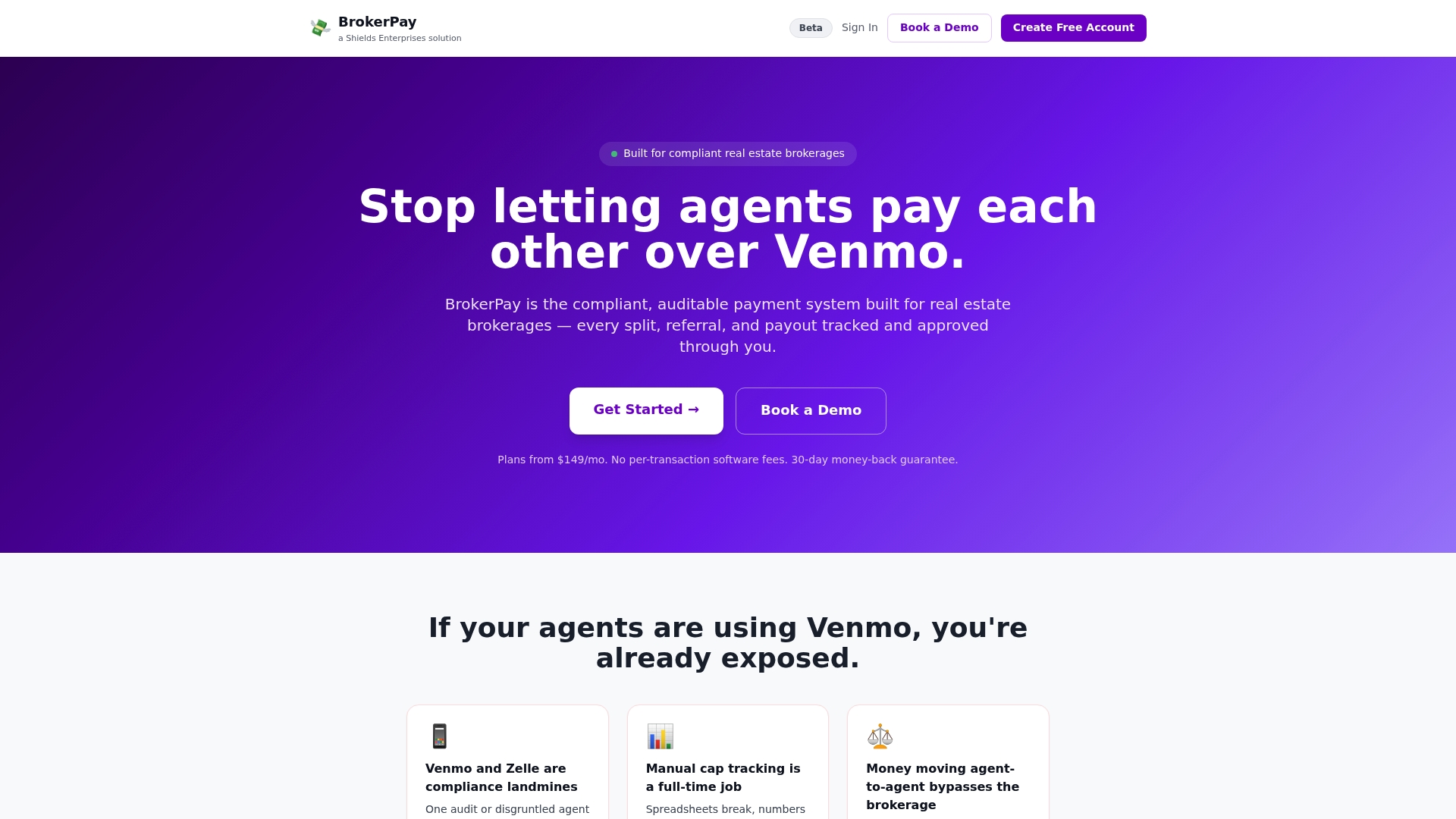
Every payment goes through ACH, every W-9 is collected at onboarding, and every split change is logged with an immutable timestamp. When January 31 arrives, your 1099 export reflects the actual transaction history, not a manual reconstruction. And if a CP notice does arrive, your audit packet is already assembled.
Schedule a demo at Brokerpay to see how the platform maps to the compliance checklist in this article and where it closes the gaps in your current process.
Sources
- Instructions for Forms 1099-MISC and 1099-NEC | Internal Revenue Service
- 1099 for Real Estate Commissions: Rules and Deadlines - LegalClarity
This article is general information, not a substitute for advice from a qualified financial advisor. Consult a qualified financial professional about your own circumstances before acting on anything here.