Why Commission Errors Cause Legal Disputes for Brokers

Commission errors escalate into legal disputes when ambiguity about what “earned” means, inconsistent rule application, or missing audit trails convert what started as an accounting mistake into a legally enforceable claim. The single highest-leverage fix: write clear earning conditions into every commission agreement, then preserve a timestamped, immutable audit trail that connects your CRM records to your compensation rules to your payroll output.
If you have an active dispute right now, do these four things before anything else:
- Freeze all disputed adjustments and clawbacks until you complete a documented investigation.
- Export time-stamped commission reports, CRM records, and payroll data immediately, before any system updates overwrite them.
- Pull the signed commission agreement and any written plan amendments the rep received.
- Open a written acknowledgment to the rep that you are investigating, without admitting liability or making verbal commitments.
Pro Tip: Create an immutable timeline before you communicate any changes or adjustments. Time-stamped exports and signed acknowledgments become your primary defense if the dispute reaches arbitration or court. Once records are altered or overwritten, reconstructing them is expensive and often impossible.
Key Takeaways
Commission errors become legal disputes when ambiguous earning definitions, missing audit trails, and inconsistent rule application convert operational mistakes into wage claims, breach-of-contract suits, and class-action exposure.
| Point | Details |
|---|---|
| Ambiguity is the primary trigger | Vague “earned” definitions are construed against the drafter; courts favor the employee when plan language is unclear. |
| Audit trails determine outcomes | Timestamped, immutable records connecting CRM data to commission rules to payroll are the difference between winning and losing a contested dispute. |
| Commissions are wages in most states | Once earned conditions are met, commissions carry wage-statute protections including statutory penalties, waiting-time penalties, and mandatory attorneys’ fees. |
| Prevention is a process problem | Clear written plans, signed acknowledgments, change-notice procedures, and automated rule application eliminate the root causes before disputes arise. |
| Brokerpay closes the evidence gap | Brokerpay’s compliant platform provides the audit trail, enforced approval workflows, and ACH payment records that replace the documentation gaps courts rely on to find liability. |
Table of Contents
- 1. What operational mistakes actually generate commission errors?
- 2. How do operational errors turn into actual legal claims?
- 3. What do claims actually cost, and how long do they take?
- 4. How do you prevent commission disputes before they start?
- 5. How do you handle a commission dispute that’s already active?
- 6. When should you bring in legal counsel?
- 7. How does an automated commission platform reduce your legal exposure?
- 8. What rights do employees and agents have in commission disputes?
- Brokerpay eliminates the documentation gaps that turn errors into disputes
- Sources
1. What operational mistakes actually generate commission errors?
The root causes of commission payroll errors are almost always the same five process failures, repeated across organizations of every size.
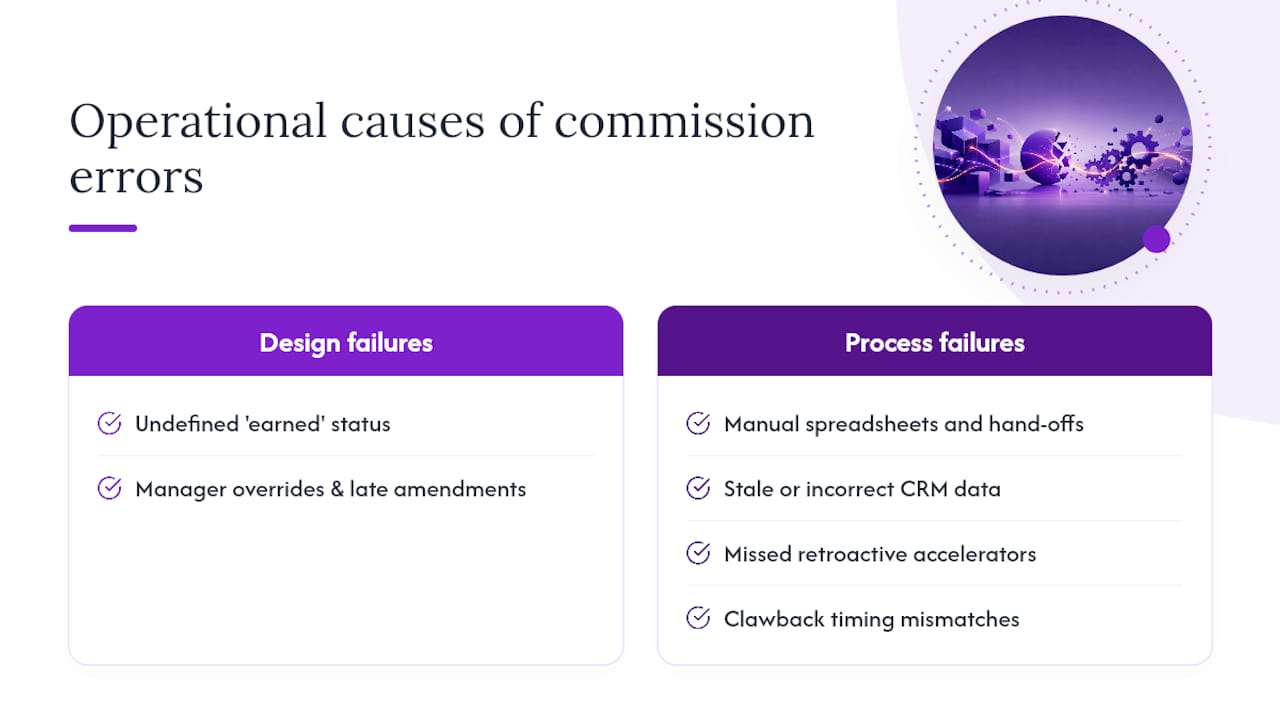
1. Undefined “earned” status. The plan says a rep earns commission “upon closing,” but nobody defines what closing means when a deal restructures, a buyer switches brokerages mid-transaction, or a referral partner claims partial credit. That gap is where litigation starts.
2. Manual spreadsheets and hand-off errors. Someone exports a CSV from the CRM, pastes it into a spreadsheet, applies a formula, and emails the result to payroll. Every step is a failure point. A transposed number, a stale export, or a formula that doesn’t account for a mid-year rate change produces a wrong payment, and there is no system of record to audit.
3. Stale or incorrect CRM data feeding calculations. If the CRM shows a deal at the wrong stage, the commission calculation runs on bad inputs. Retroactive corrections then require manual adjustments, which introduce their own errors and create the appearance of arbitrary treatment.
4. Missed retroactive accelerators. A rep hits a quota tier in month three that retroactively increases their rate on all prior deals. If the recalculation doesn’t run automatically, the rep is underpaid. If it runs inconsistently across the team, you have a discrimination exposure on top of the underpayment.
5. Clawback timing mismatches. A deal cancels 90 days after the commission paid out. The plan says clawbacks apply within 180 days, but the deduction hits the rep’s next paycheck without written notice. That sequence, common in real estate, violates several state wage-payment statutes regardless of whether the clawback itself was contractually valid.
6. Tax-withholding errors on supplemental wages. Commissions are supplemental wages under IRS rules. Withholding them at the regular rate instead of the flat supplemental rate, or failing to aggregate them correctly with base pay, creates IRS exposure and can trigger state tax agency audits.
7. Manager overrides and late amendments. A sales manager approves a one-time exception for a top rep, but the exception isn’t documented in the plan or acknowledged in writing. When a different rep in the same situation doesn’t receive the same treatment, you have an inconsistency that looks like discrimination or breach of contract.
The distinction worth drawing: causes 1 and 7 are contract and design failures that require legal and documentation changes. Causes 2 through 6 are process failures that automation and unified data pipelines can fix directly.
2. How do operational errors turn into actual legal claims?
The path from accounting mistake to courtroom is shorter than most brokerages expect. Each common error maps to a specific legal doctrine.
-
Ambiguous earning rules → breach of contract and interpretation disputes. When the plan doesn’t define “earned” precisely, courts fill the gap. Under contract interpretation principles applied in California and many other states, ambiguity is construed against the drafter. That means the brokerage that wrote the vague plan loses the interpretive battle before the merits are even argued.
-
Missing audit trail → employee-favoring contract interpretation. If you can’t produce a clear record of how a commission was calculated, courts and arbitrators tend to credit the employee’s version of events. The burden of proof effectively shifts.
-
Manual payroll errors → wage-payment statute violations. Most states have wage-payment acts that treat earned commissions as wages. Late payment, unauthorized deductions, and clawbacks without proper notice can trigger statutory penalties, waiting-time penalties, and attorneys’ fees that dwarf the original disputed amount.
-
Attribution disputes → procuring cause litigation. In real estate, when documentation is verbal or scattered across emails, multiple parties can assert entitlement to the same commission. Procuring cause litigation asks which broker was the primary, uninterrupted cause of the sale. Without a centralized, timestamped record of every step, that question becomes a credibility contest.
-
Unilateral retroactive changes → breach of contract and unlawful deductions. Changing commission rates on deals already in progress, without written notice and acknowledgment, is a breach in most jurisdictions. Several states also treat mid-period rate reductions as unlawful wage deductions.
-
Systemic inconsistency → class-action risk. When the same plan is applied differently across a sales team, the exposure multiplies. One underpaid rep is a single claim. A pattern of underpayment across a team is a class action.
Key legal terms, plain English:
Procuring cause: The broker whose efforts were the direct, uninterrupted cause of a completed sale. Determines who gets paid when multiple brokers claim the same deal.
Commissions as wages: The legal classification that triggers wage-payment statute protections. A New Jersey Supreme Court decision reinstated a $13 million suit after ruling that commissions qualified as wages under state law, expanding the remedies available to employees significantly.
Chargeback/clawback: A contractual right to recover a previously paid commission when a deal cancels or a condition fails. Enforceable when documented; a wage violation when applied without notice or outside the plan’s terms.
Waiting-time penalties: State-law penalties for failing to pay final wages, including commissions, promptly upon termination. California’s version can add up to 30 days of the employee’s daily wage.
Implied covenant of good faith and fair dealing: Courts read this into every contract. Manipulating deal timing, reassigning accounts, or changing territories specifically to deny a rep an earned commission violates it even when the plan’s literal language permits the action.
State variance matters. California’s Labor Code treats most commissions as wages and requires written commission plans. New York, Texas, and Florida have their own wage-payment frameworks with different notice and penalty structures. A plan that’s defensible in one state may create statutory liability in another.
3. What do claims actually cost, and how long do they take?
The cost figures above reflect general ranges reported in employment law commentary; actual costs vary by jurisdiction, claim complexity, and whether the case involves class claims.
Common claims and what plaintiffs ask for:
- Unpaid wages under state wage-payment acts: Back pay plus statutory penalties, interest, and attorneys’ fees. In states like California, penalties can equal the unpaid amount several times over.
- Breach of contract: The difference between what was paid and what the contract required, plus consequential damages in some jurisdictions.
- Unlawful deductions: Recovery of the deducted amount plus penalties for each violation.
- Overtime and wage-and-hour claims: When commission-based employees are misclassified or when commission payments push overtime calculations off, FLSA exposure adds federal liability.
- Procuring cause claims: The full commission amount the broker claims they earned, plus interest.
- Unjust enrichment: Available when no written contract governs, but one party clearly benefited from another’s work.
Poor documentation accelerates costs dramatically. When a brokerage can’t produce the original commission plan the rep signed, the calculation methodology, or the approval chain for an adjustment, discovery becomes a forensic exercise. Effective audit trails must capture every commission-related transaction, including rule versions, manager approvals, and timestamps. Without them, defense counsel spends billable hours reconstructing what a good system would have preserved automatically.
Document retention matters here. Most employment attorneys recommend keeping commission-related records for 3–7 years, depending on the applicable statute of limitations in your state. Federal wage claims under the FLSA carry a two-year statute of limitations (three years for willful violations). State claims often run longer.
4. How do you prevent commission disputes before they start?
Prevention is a documentation and process problem, not a legal problem. Most disputes are preventable if the right controls are in place before a deal closes.
Written agreements and acknowledgments
- Every commission plan must define “earned” with specificity: the triggering event (executed contract, closed escrow, funded loan), the conditions that must remain satisfied, and the timeline for payment.
- Reps sign and date the plan at hire and again at every amendment. Keep the signed copy in a system that timestamps the signature.
- Any verbal promise about compensation gets documented in writing within 24 hours.
Change management procedures
- Publish a written change procedure: minimum notice period (30 days is a common standard), effective date, and acknowledgment requirement before the new rate applies.
- Grandfathering rules must be explicit. Deals in progress at the time of a rate change should continue under the prior rate unless the rep acknowledges the new terms in writing.
- Require pre-change sign-off from finance, legal, and sales leadership before any plan amendment affects in-flight deals.
Pro Tip: Never apply a new commission rate to a deal that was already in the pipeline when the change was announced. Courts treat retroactive rate reductions as constructive wage theft in several states, and even where they’re technically legal, they destroy trust and invite litigation.
Technical controls
- Replace manual spreadsheets with a centralized rules engine that applies commission logic consistently across every rep, every deal, every period.
- Build a unified data pipeline from CRM to commission calculation to payroll. Every manual export or import is a failure point. Automatic application of retroactive accelerators and elimination of manual payroll handoffs are the most effective technical controls for recurring calculation errors.
- Generate immutable, timestamped audit logs for every calculation, adjustment, and approval. The log should show who changed what, when, and why.
Ongoing compliance
- Run a monthly commission reconciliation audit. Compare what the system calculated to what payroll paid. Investigate any variance before it compounds.
- Apply clawback rules prospectively and consistently. Document every clawback with the contractual basis, the notice sent to the rep, and the rep’s acknowledgment.
- Retain all commission-related records for at least 7 years. That covers most state statutes of limitations and the FLSA’s three-year willful-violation window.
- For real estate brokerages specifically, replace Venmo, Zelle, and other peer-to-peer payment workarounds with a compliant payment gateway that documents every split, referral fee, and co-op payment with a full audit trail.
5. How do you handle a commission dispute that’s already active?
Speed and documentation discipline determine whether an active dispute resolves internally or escalates to arbitration. Here is the sequence that works.
Step 1: Preserve evidence immediately. Before you do anything else, freeze all disputed adjustments and export time-stamped reports from your CRM, commission system, and payroll platform. If records exist only in a spreadsheet, save a read-only copy with a date stamp. Do not overwrite, delete, or modify any record related to the disputed transaction.
Step 2: Assemble the transaction packet. Gather the signed commission agreement, the deal’s CRM record, all email threads related to the transaction, the commission calculation with inputs shown, the payroll record, and any manager approvals or overrides. This packet is what counsel and arbitrators will ask for first.
Step 3: Acknowledge the dispute in writing. Send the rep a brief written acknowledgment within 48 hours. Something like: “We’ve received your concern about the commission on [deal]. We’re conducting a review and will respond with our findings by [date]. No adjustments will be made to the disputed amount during the review period.” This stops the clock on good-faith arguments and documents your responsiveness.
Step 4: Run a transparent audit. Assign someone not directly involved in the original calculation to reconcile the transaction from scratch using the original plan terms. Document every step of the reconciliation. If the audit reveals an error, note it in writing before you communicate the correction.
Step 5: Separate investigation from decision. The person collecting facts should not be the same person making the payment decision. Bring in finance, HR, or outside counsel before issuing a final determination. Inconsistent decisions across similar disputes are one of the fastest paths to class-action exposure.
Step 6: Propose a provisional remedy if liability is probable. If the audit shows the rep was underpaid, pay the undisputed portion immediately. Holding back money you know is owed while the investigation continues creates waiting-time penalty exposure in several states.
Step 7: Escalate when the dispute exceeds your internal capacity. Triggers for bringing in outside counsel include: disputed amounts above $10,000, a pattern of similar complaints across multiple reps, any indication the rep has retained an attorney, cross-state jurisdictional questions, or any allegation of discrimination or retaliation tied to the commission dispute.
For guidance on collecting records and escalating formally, a practitioner guide from WSLaw outlines the steps for gathering proof and initiating formal claims when internal remedies fail.
6. When should you bring in legal counsel?
Not every commission dispute needs an attorney on day one. But waiting too long is a more common and more expensive mistake than engaging early.
Non-negotiable triggers for immediate counsel engagement:
- Any dispute that includes an allegation of discrimination, retaliation, or hostile work environment alongside the commission claim.
- A rep who has already retained an attorney or sent a demand letter.
- Any indication that multiple reps are coordinating a joint claim.
- A disputed amount that exceeds $25,000 or involves a high-earning agent whose total claim (including penalties and fees) could multiply significantly.
- A cross-state situation where the rep worked in one state, the brokerage is incorporated in another, and the plan was signed in a third.
Documents to prepare before the first counsel meeting:
- The signed commission plan and every amendment, with dates.
- The full audit trail for the disputed transaction: CRM record, calculation inputs, approval chain, payroll record.
- All written communications between the brokerage and the rep about the disputed commission.
- A dispute log: a chronological record of every conversation, email, and decision related to the dispute, with dates and participants.
- Any prior disputes involving the same rep or the same plan provision.
- Your document retention policy and evidence that it was followed.
What to expect from counsel: An early-case assessment typically takes one to two weeks and produces a risk rating, a preservation letter to send to the rep, and a budget estimate for mediation versus contested arbitration versus litigation. In commission disputes, expert witnesses who can reconstruct calculation methodologies from raw data are common, and their fees add to the overall cost. Arbitration clauses in commission agreements, when properly drafted, can reduce both timeline and cost significantly compared to court litigation.
7. How does an automated commission platform reduce your legal exposure?
The evidence gaps that courts rely on to find liability are almost always documentation gaps. A platform that centralizes commission rules, enforces earning conditions, and generates immutable audit trails closes those gaps before a dispute arises.
Here is the record sequence a compliant platform preserves, and why it matters in a contested case:
Opportunity record → commission rule version → approval log → payroll export. When a brokerage can produce this chain for every transaction, the “we didn’t know” defense holds. When it can’t, courts fill the gap with the employee’s version of events.
Specific ways automation reduces legal risk:
- Single source of truth for splits and referrals. Every agent split, referral fee, and co-op payment runs through one system with one set of rules. There is no version of the spreadsheet that a manager edited differently for a different rep.
- Timestamped audit trail. Every calculation, adjustment, and approval carries a timestamp and a user ID. Retroactive manipulation is visible and attributable.
- Enforced sign-offs for adjustments. No adjustment posts without an approval workflow. That workflow is logged. The “I didn’t authorize that” defense disappears.
- Consistent clawback application. Clawback rules run automatically against the plan terms, not against a manager’s memory of what the plan says.
- Compliant payment rails. Replacing Venmo and Zelle with ACH transfers through a regulated payment flow eliminates RESPA exposure and creates a federal-compliant payment record for every transaction. The risks of peer-to-peer payment workarounds in real estate are well-documented, and the fix is straightforward.
Pro Tip: Commission tracking also prevents the withholding errors that trigger IRS and state tax agency scrutiny. A unified system that treats commissions as supplemental wages and applies the correct withholding method eliminates a category of error that’s entirely separate from the dispute risk covered here. See how commission tracking prevents tax issues for agents.
Most commission disputes trace back to ambiguous plan language and manual or inconsistent rule application. Automation doesn’t fix a badly written plan, but it eliminates the execution layer where most errors actually occur.
8. What rights do employees and agents have in commission disputes?
Agents and sales professionals have more legal protection in commission disputes than most brokerages assume, and those protections have expanded in recent years.
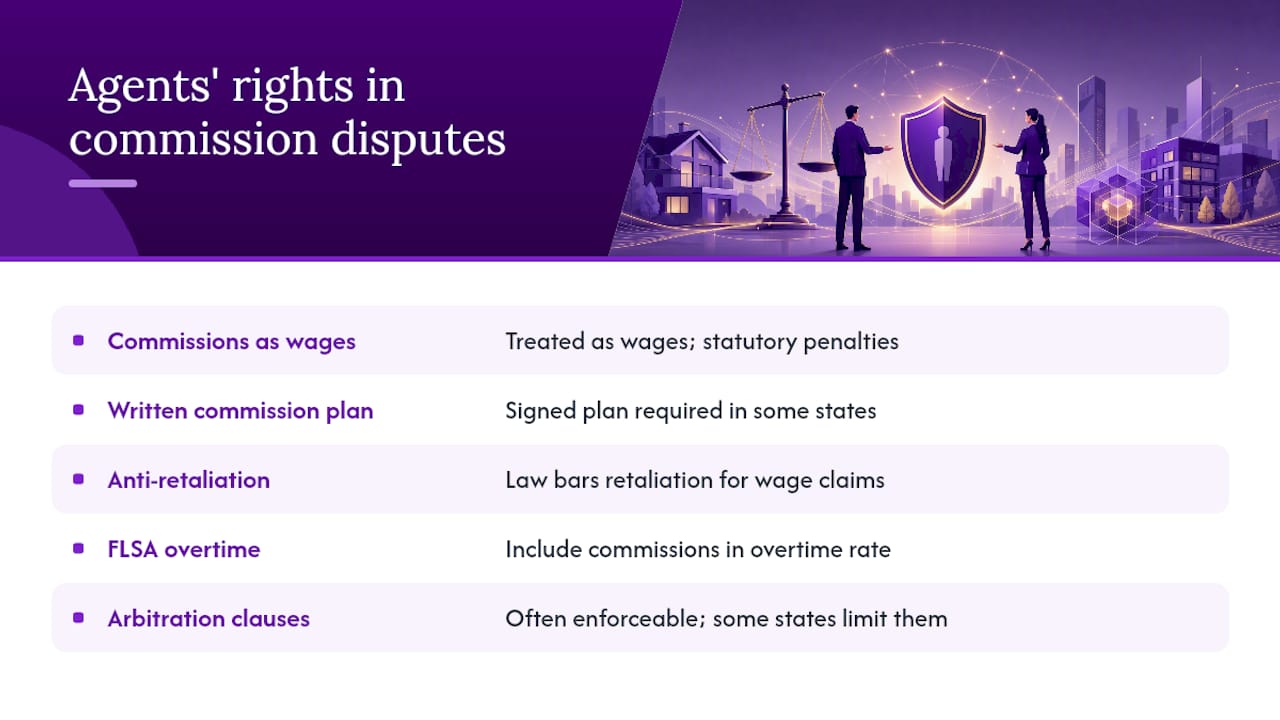
Commissions as wages. In most states, commissions are legally classified as wages once the conditions for earning them are met. That classification matters because wage-payment statutes carry remedies that contract law doesn’t: statutory penalties, waiting-time penalties, and mandatory attorneys’ fees. The New Jersey Supreme Court’s decision reinstating a $13 million suit on wage grounds is a clear signal that courts take this classification seriously. Labeling a payment as a “bonus” or “incentive” doesn’t change the analysis if the payment compensates specific labor or sales activity.
Right to a written commission plan. California requires employers to provide a written commission plan and obtain a signed acknowledgment. Several other states have similar requirements. Where the requirement exists, an unsigned or undated plan is a significant liability for the brokerage.
Protection against retaliation. Federal and state law prohibits retaliation against employees who assert wage claims. A rep who complains about an underpayment and is then terminated, demoted, or reassigned has a retaliation claim on top of the original commission dispute.
FLSA overtime implications. Commission-based employees who are non-exempt under the Fair Labor Standards Act must have their overtime calculated correctly, accounting for commission income. Misclassifying a commission-paid rep as exempt, or failing to include commission income in the regular rate for overtime purposes, creates federal wage-and-hour exposure.
Arbitration clauses. Many commission agreements include mandatory arbitration clauses. These are generally enforceable under the Federal Arbitration Act, but several states have enacted limitations, particularly for employment disputes. California, for example, has restricted mandatory arbitration for certain employment claims, though the law continues to evolve. Agents should read their agreements carefully and understand whether their dispute goes to arbitration or court.
Right to inspect records. In many states, employees have a statutory right to inspect their own payroll records, including commission calculations. Refusing or delaying that request during a dispute is itself a violation in some jurisdictions and signals bad faith to arbitrators and courts.
For a plain-English breakdown of how realtor fee structures and commission flows work in practice, that context helps agents understand where their entitlement begins and where disputes typically arise.
The part most brokerages get wrong about commission disputes
The conventional wisdom treats commission disputes as a legal problem to manage after the fact. That framing is backwards, and it’s expensive.
Every dispute I’ve seen investigated follows the same pattern: a verbal promise, a plan with a vague “earned” definition, a manager override that nobody wrote down, and a clawback applied without notice. None of those are legal failures at the moment they happen. They’re operational failures. The legal exposure comes later, when someone asks for documentation and there isn’t any.
Courts don’t give brokerages credit for good intentions. They look at what the written plan says, what the audit trail shows, and whether the ambiguity in the plan was the brokerage’s fault. Under the principle that ambiguity is construed against the drafter, a vague plan is a plan the brokerage loses. Every time.
The other thing that accelerates disputes: retroactive adjustments and verbal promises. Both are litigation accelerants. A retroactive rate change on a deal already in progress tells a rep that the rules change when the brokerage finds them inconvenient. A verbal promise that doesn’t make it into writing is a he-said-she-said dispute waiting to happen. Neither requires bad intent to create serious legal exposure.
The fix isn’t complicated. Write clear earning conditions. Document every change. Preserve the audit trail. The brokerages that do those three things spend their legal budget on growth, not defense.
Brokerpay eliminates the documentation gaps that turn errors into disputes
The prevention checklist in this article comes down to one operational reality: you need a single, auditable system of record for every commission calculation, adjustment, and payment. That’s exactly what Brokerpay is built to provide.
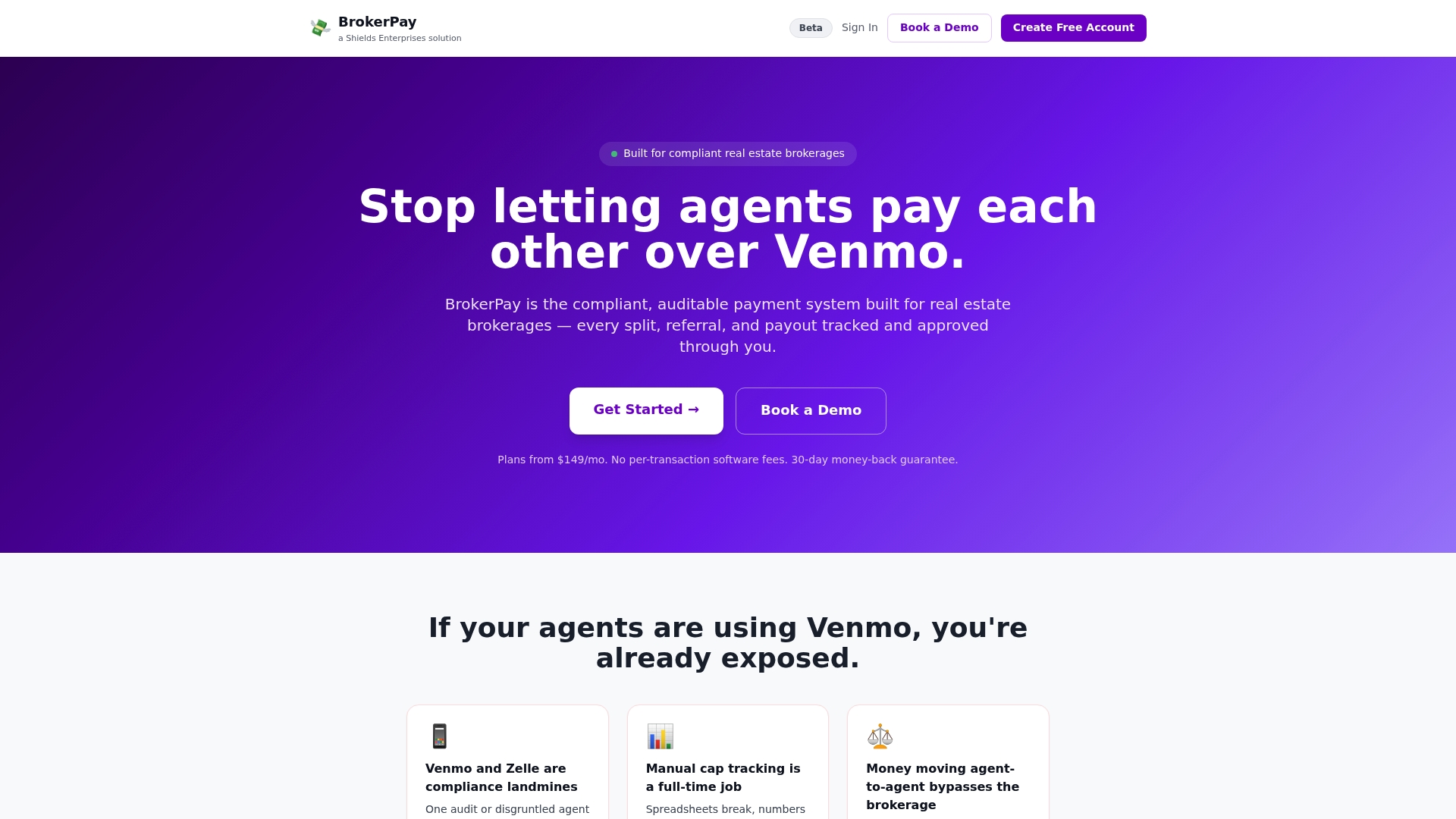
Brokerpay is a compliant commission payment platform for real estate brokerages. It replaces manual spreadsheets, Venmo/Zelle workarounds, and disconnected payroll handoffs with a single workflow that tracks agent splits, referral fees, and co-op commissions, generates timestamped audit trails for every transaction, enforces approval workflows before any adjustment posts, and processes ACH payments through compliant payment rails that keep your brokerage RESPA-compliant.
Every record Brokerpay creates is the kind of documentation that wins disputes: an immutable chain from the deal record to the commission rule version to the approval log to the payment confirmation. When a rep questions a calculation, you pull the audit trail and show your work in minutes, not days.
Book a demo at Brokerpay to see how the platform maps to your current commission workflow and where it closes your documentation gaps.
Sources
- California Commission Disputes, Unpaid Sales, & Chargebacks | Ruggles Law Firm
- Legal Risks From Inconsistent Sales Commission Policies | Aaron Hall, Attorney
- What causes payroll errors in commission-based teams: 5 proven fixes | Sequifi
- Law
This article provides general information about U.S. commission law and dispute prevention. It is not legal advice. Consult a qualified employment attorney in your jurisdiction before making decisions about specific commission disputes, plan design, or compliance obligations.
This article is general information, not a substitute for advice from a qualified lawyer. Consult a qualified legal professional about your own circumstances before acting on anything here.