Multi-Party Real Estate Transactions: A RESPA Compliance Guide

A multi-party real estate transaction, in the commission and payout sense, is any deal where two or more brokerages or agents share a commission, referral fee, or co-op split. The moment you identify that kind of payment, treat it as potentially settlement-related under RESPA and Regulation X — and do not release funds until you have confirmed what services were performed and that the payment reflects fair market value. The CFPB and the statute itself are the governing authorities here, and the penalties for getting it wrong run to civil liability and federal enforcement.
Key Takeaways
Multi-party real estate payouts carry RESPA exposure the moment a settlement-service provider or referral relationship enters the picture — document services and fair market value before every payment.
| Point | Details |
|---|---|
| Define the payment type first | Classify each payout as co-op commission, referral fee, MSA, or agent split before evaluating RESPA risk. |
| Run the two compliance questions | Confirm the recipient performed services beyond a referral and that payment reflects fair market value. |
| Document before you pay | Collect invoices, MSAs, market-value evidence, and named approvals before scheduling any payout. |
| Ban P2P apps for settlement payments | Venmo and Zelle create federal liability; ACH through a documented platform is the only compliant method. |
| Brokerpay automates the audit trail | Brokerpay enforces documentation, approval workflows, and ACH payouts to keep brokerages RESPA-compliant. |
Table of Contents
- Who participates and what payments flow through these deals
- What RESPA actually prohibits — and what it allows
- What illegal arrangements actually look like
- Compliance checklist before releasing any multi-party payout
- Operational controls that make compliant payouts repeatable
- Documentation checklist and timing for multi-party payouts
- Why audit trails are the product, not the feature
- Brokerpay keeps your multi-party payouts audit-ready
- Sources
Who participates and what payments flow through these deals
Most multi-party payout situations involve a predictable cast. The listing brokerage holds the commission from the seller. The cooperating (buyer’s) brokerage earns a co-op split from that pool. Individual agents on both sides receive their internal splits from their respective brokers. Affiliated settlement-service providers — lenders, title companies, escrow agents — sometimes enter the picture through marketing services agreements (MSAs) or other arrangements.
The payment types that flow between these parties are worth classifying carefully, because RESPA treats them differently:
- Agent splits: Internal payments from a brokerage to its own agents, based on agreed commission percentages or cap structures.
- Co-op commissions: Payments from the listing brokerage to the cooperating brokerage, typically a percentage of the gross commission.
- Referral fees: Payments to a referring licensee or brokerage for directing a client to another agent or brokerage.
- MSA payments: Fees paid to a settlement-service provider (lender, title) for documented marketing or promotional services.
- Cap and override payments: Brokerage-level adjustments once an agent hits a production threshold.
| Party | Typical Payment Received | Usually Paid By |
|---|---|---|
| Cooperating brokerage | Co-op commission | Listing brokerage |
| Referring licensee/brokerage | Referral fee | Receiving brokerage |
| Individual agent (listing side) | Agent split | Listing brokerage |
| Individual agent (buyer side) | Agent split | Cooperating brokerage |
| Settlement-service provider | MSA fee | Brokerage or lender |
Getting this classification right before you cut a check is the first operational control that keeps you out of trouble.
What RESPA actually prohibits — and what it allows
RESPA can make common co-op and referral payments illegal unless they qualify as compensation for bona fide services at fair market value. That is the baseline every brokerage manager needs to internalize.
Section 8(a) of RESPA (12 USC § 2607(a)) bars giving or receiving any “thing of value” in exchange for a referral of settlement-service business. Section 8(b) goes further: it prohibits splitting any charge for a settlement service unless each party actually performs a service for that portion of the fee. Regulation X defines “thing of value” broadly — cash, discounts, meals, marketing support, and even opportunities to participate in a money-making program all qualify. “Referral” is equally broad: any action that affirmatively influences a consumer’s choice of provider, including required-use language, counts.
The statutory exceptions under Section 8© are where lawful arrangements live. Cooperative brokerage among licensees is explicitly permitted. Bona fide employment relationships allow employers to pay employees for referrals. Properly structured MSAs are allowed — but only when payments are reasonably related to the market value of services actually performed and the arrangement is not structured or implemented to pay for referrals.
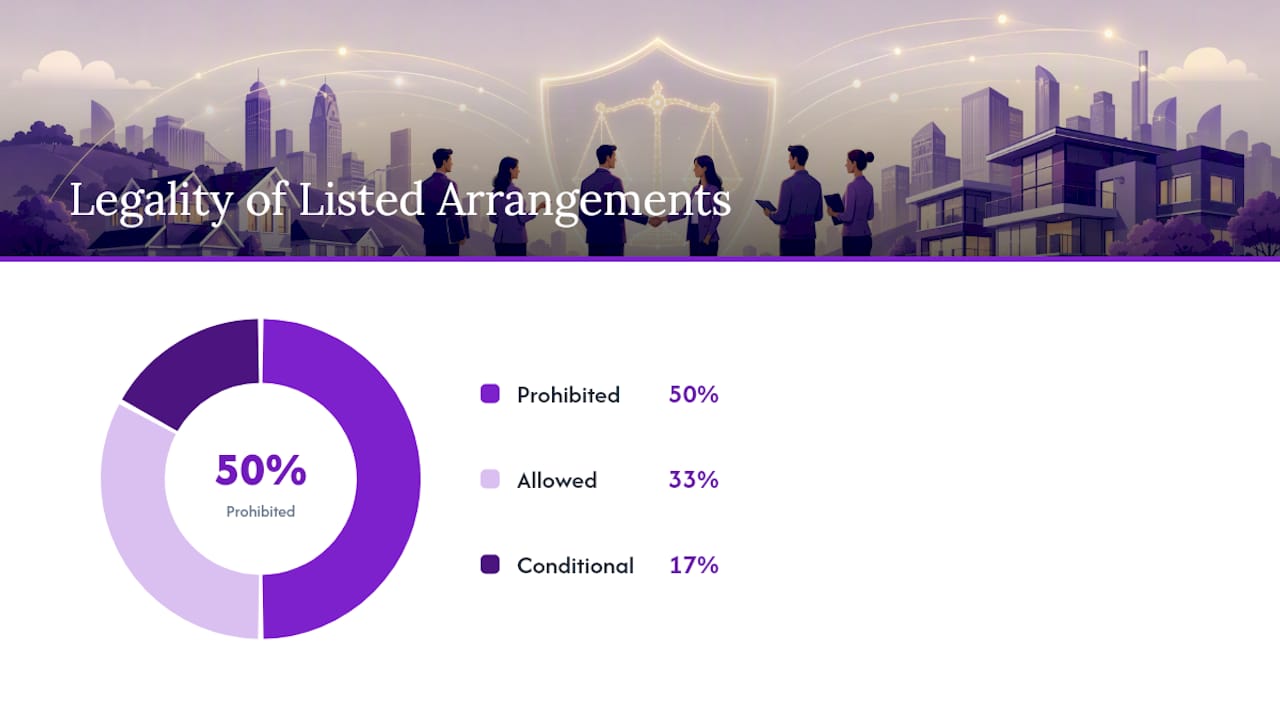
| Arrangement | Allowed? | Key Condition |
|---|---|---|
| Co-op commission, listing broker to cooperating broker | Yes | Both are licensed; services performed |
| Referral fee between licensees | Yes | Paid to licensed agent/broker only |
| MSA with lender or title company | Conditional | Services documented; payment at market value |
| Broker pays agent for referral to affiliated lender | Generally no | Agent is typically an independent contractor, not an employee |
| Fee split with no services performed | No | Unearned fee split under Section 8(b) |
| Payment above market value for nominal services | No | Excess treated as disguised referral payment |
Pro Tip: When setting MSA payment amounts, document your market-value analysis independently — get comparable quotes from at least two other vendors for the same scope of services. The CFPB looks at whether the payment could be justified without any referral relationship in the picture.
What illegal arrangements actually look like
The CFPB’s RESPA FAQ PDF gives enforcement-focused examples, and the patterns are consistent. A broker pays agents $20 per referral every time a client uses the affiliated lender — that is a prohibited kickback regardless of how it is labeled. A lender splits origination revenue with a brokerage but the brokerage performs no documented service — that is an unearned fee split under Section 8(b). A brokerage signs an MSA with a title company and receives $3,000 per month for “marketing,” but the deliverables are a few social media posts that the title company’s own team could have produced for a fraction of the cost — the excess payment is treated as a disguised referral fee.
NAR’s RESPA guidance flags a related trap: when two parties share advertising costs, each must pay only their pro rata share. Paying more than your proportionate share of a joint ad buy is evidence of a disguised referral payment.
Operational red flags to watch for:
- Payments tied to referral volume or transaction counts rather than services delivered
- Payments that exceed what an unaffiliated vendor would charge for the same work
- Use of Venmo, Zelle, or other peer-to-peer apps for settlement-related payouts
- MSAs with no written scope of services or no evidence of performance
- Broker payments to agents for steering clients to an affiliated mortgage company — agents are typically independent contractors, not employees, so the employer exception does not apply
If an arrangement looks tied to referral volume or involves a settlement-service provider, get counsel involved before the first payment goes out.
Compliance checklist before releasing any multi-party payout
NAR’s practical guidance distills the screening process to two questions. Run both before approving any payment:
- Is the recipient doing more than a referral? If the only thing they did was send a client your way, a payment is likely prohibited.
- Is the payment reasonably related to the fair market value of services performed? If the answer is no — or if the value of future referrals is factoring into the rate — the arrangement is non-compliant.
Once you have answered both, work through this evaluation sequence:
- Identify the payment type. Is this a co-op commission, referral fee, MSA payment, or agent split? Each carries different RESPA exposure.
- Confirm services performed. Collect the scope of work, deliverables, and evidence of completion before approval.
- Run a market-value analysis. Document comparable pricing from unaffiliated vendors. The value of referrals received cannot justify a higher rate.
- Route for approval. Require a named approver sign off on the payment, the service description, and the market-value evidence.
- Retain supporting documentation. Keep invoices, contracts, signed MSAs, proof of performance, and the approval record. Most compliance programs retain these for at least five years.
Pro Tip: Your audit trail needs to answer three questions at a glance: who approved this payment, what specific services were delivered, and how was market value determined? If any of those answers require digging through email threads, your documentation is insufficient.
Operational controls that make compliant payouts repeatable
Use systems that force service documentation, approval workflows, and archived payment evidence before funds move. That is the operational baseline — not a best practice, a requirement if you want a defensible audit trail.
The controls that matter most in a multi-party payout workflow:
- Approval routing: Every payment above a defined threshold requires a named approver before it can be scheduled.
- Invoice and attachment enforcement: The system should not allow a payment to proceed without an attached invoice or service agreement.
- Market-value evidence field: Require a documented justification for the payment amount, separate from the invoice.
- ACH payouts only: Peer-to-peer apps like Venmo and Zelle leave no compliant audit trail and create federal liability. A real estate payment gateway that processes ACH transfers keeps every transaction documented and timestamped.
- Cap and override tracking: Automated tracking prevents manual errors in agent split calculations and creates a clean record for each payout event.
- Audit logs: Every action — approval, edit, payment, reversal — should be timestamped and attributed to a named user.
Brokerpay is built around exactly these controls. It eliminates Venmo and Zelle workarounds, stores MSA documents alongside payment records, captures approvals, and timestamps every action in a searchable audit log. Compliant co-op payment workflows show how these controls work in practice across eight real brokerage scenarios.
Pro Tip: Require that any MSA or vendor invoice includes a line-itemed scope of services that maps each deliverable to a dollar amount. A lump-sum invoice for “marketing services” is not defensible under CFPB scrutiny.
For listing prep and marketing services that need to be documented as part of an MSA, real estate marketing services can provide the kind of itemized, vendor-level documentation that supports a market-value analysis.
Documentation checklist and timing for multi-party payouts
Collect these fields before any payout is scheduled:
- Transaction ID and closing date
- Names and license numbers of all parties receiving payment
- Payment type (co-op commission, referral fee, MSA, agent split)
- Signed service agreement or MSA, if applicable
- Invoice with line-itemed scope of services
- Market-value justification (comparable vendor quotes or rate documentation)
- Evidence of service performance (delivery confirmation, samples, reports)
- Named approver and approval date
- Payment method (ACH only — no P2P apps)
Recommended timeline:
- Close of escrow → hard documentation collected within 2 business days
- Compliance review completed within 3–5 business days of close
- Payment scheduled on next ACH run after review sign-off
Minimal acceptable documentation: signed co-op agreement, HUD-1 or closing disclosure showing commission split, broker approval on file.
Insufficient documentation: an email thread saying “send them their cut,” a Venmo payment with a memo line, or an MSA with no deliverables listed. Automated payouts replace these workarounds with a structured, audit-ready process.
Why audit trails are the product, not the feature
Most brokerages treat compliance documentation as paperwork — something that happens after the real work is done. That framing is exactly backward. The audit trail is the product. When a CFPB examiner or plaintiff’s attorney reviews a multi-party payout, they are not looking at your intent. They are looking at what you can prove: who approved the payment, what services were documented, and whether the amount was independently justified. A brokerage that cannot produce those records in 48 hours is already in a weak position, regardless of whether the underlying arrangement was lawful.
Brokerpay’s design reflects that reality. Approval workflows, required attachments, and ACH-only payouts are not convenience features — they are the mechanism that converts a compliant intent into a defensible record. Eliminating Venmo and Zelle workarounds matters not because those apps are inherently dishonest, but because they produce no evidence that survives scrutiny.
Brokerpay keeps your multi-party payouts audit-ready
Brokerpay gives brokerage managers a single platform to track, document, and pay co-op commissions, referral fees, and agent splits — with every payment tied to an approval, an invoice, and a timestamped audit log.
The platform enforces documentation before funds move, routes payments through ACH instead of peer-to-peer apps, and stores MSA agreements alongside payment records so your compliance file is complete at close. Cap tracking and override calculations are automated, removing the manual errors that create disputes and gaps in your records. Commission tracking also reduces downstream tax issues for agents — a detail that matters when agents ask why the process changed.
If your brokerage is still managing co-op and referral payouts through email threads and Venmo, the liability exposure is real and the fix is straightforward. Visit Brokerpay to see how the platform works and request a demo for your office.
This article is general information, not a substitute for advice from a qualified lawyer. Consult a qualified legal professional about your own circumstances before acting on anything here.
Sources
- § 1024.14 Prohibition against kickbacks and unearned fees. | Consumer Financial Protection Bureau
- RESPA Frequently Asked Questions | Consumer Financial Protection Bureau (PDF)
- 12 CFR § 1024.14 - Prohibition against kickbacks and unearned fees. | Electronic Code of Federal Regulations (e-CFR) | US Law | LII / Legal Information Institute
- Real Estate Settlement Procedures Act (RESPA)
- Staying RESPA-compliant: referrals | Florida Realtors
This article is general information, not legal advice. Confirm current rules with a qualified real estate attorney or compliance professional before implementing any payment arrangement.