How to Build a RESPA-Compliant Brokerage Disbursement Workflow

Run an automated, rules-driven brokerage escrow disbursement workflow that enforces approval gates, immutable audit trails, good-funds rails, and RESPA-safe documentation. That single sentence is the whole answer. Everything below is the implementation.
Five things to do before your next commission payment:
- Stop all Venmo, Zelle, and P2P app disbursements immediately. These rails are not good funds, they are reversible, and they create federal liability.
- Lock your payment rails to bank wires, RTP, or FedNow for final disbursements.
- Map every approval gate in your current workflow and identify where payments can be triggered without a second reviewer.
- Confirm your platform writes an immutable audit log for every calculation, approval, and payment event.
- Collect current security attestations from any vendor handling commission or escrow funds to validate their system controls.
Pro Tip: The fastest risk reduction available to any brokerage today is a one-page policy memo banning P2P payment apps for all agent and vendor disbursements. Send it before you finish reading this article.
Key Takeaways
A compliant brokerage escrow disbursement workflow requires approval gates, immutable audit trails, good-funds rails, and documented MSAs, with all controls verified by a SOC 2 Type II vendor attestation.
| Point | Details |
|---|---|
| Stop P2P disbursements now | Venmo and Zelle are reversible, non-good-funds rails that create direct RESPA and federal liability. |
| Enforce good-funds rails | Use bank wires, RTP, or FedNow for final disbursements; require a bank settlement confirmation before releasing commissions. |
| Document every MSA | Services must be actually performed and priced at fair market value; contemporaneous delivery records are required, not optional. |
| Automate with audit trails | Every calculation, approval, and payment event must be logged in an immutable, exportable record. |
| Brokerpay as the compliant platform | Brokerpay automates splits, cap tracking, co-op commissions, and earnest-money ledgering with approval workflows and bank-grade audit logs. |
Table of Contents
- Why your disbursement workflow must be RESPA-aware
- Core components every automated disbursement workflow must include
- RESPA compliance checklist for your policies, MSAs, and disbursements
- Which payment rails qualify as good funds for final disbursements
- How to translate commission rules into automated disbursement logic
- What your compliance team should require from any disbursement vendor
- Step-by-step rollout plan from pilot to full production
- Operational mistakes that trigger RESPA exposure and how to prevent them
- How Brokerpay maps to the compliance and technical checklist
- What actually changes on day one after you automate
- Brokerpay gives your brokerage a compliance-first foundation
- Sources
Why your disbursement workflow must be RESPA-aware
RESPA and its implementing rule, Regulation X (12 CFR §1024.14), prohibit any person from giving or accepting a “thing of value” in exchange for a referral of settlement-service business. The definition of “thing of value” is deliberately broad: cash, credits, discounts, services, and even meals qualify. Payments not reasonably related to the market value of goods or services actually performed are evidence of a violation.
Enforcement is not theoretical. The CFPB can pursue civil money penalties, disgorgement of fees, and injunctive relief. Criminal exposure under 12 U.S.C. §2607 includes fines up to $10,000 and up to one year in prison per violation. Beyond federal exposure, operational consequences compound quickly: clawbacks on paid commissions, reconciliation disputes with co-op agents, and reputational damage that affects recruiting.
The practical risk areas for a brokerage’s internal disbursement procedure:
- Referral fees paid to unlicensed parties or structured as “marketing” payments without documented services.
- MSAs priced above fair market value, which the CFPB treats as disguised kickbacks regardless of contract language.
- Co-op commission splits that include undisclosed add-ons or volume-based bonuses.
- Earnest-money handling that commingles client funds with operating accounts.
Core components every automated disbursement workflow must include
A compliant real estate escrow workflow is not just a payment button. It is a sequence of controls, each one creating evidence that the disbursement was authorized, calculated correctly, and funded by cleared money.
- Approval gates: Configurable thresholds that route standard splits for one-click approval and flag exceptions (overrides, cap adjustments, referral fees above a set dollar amount) for multi-tier review.
- Immutable audit trail: Every input value, calculation snapshot, approver identity, timestamp, and payment-trigger event must be written to a log that cannot be edited after the fact.
- Escrow segregation: Internal escrow ledgers must be separate from operating accounts. Agent payables are tracked as liabilities until funds are cleared and disbursement is authorized.
- Payment-rail controls: The system enforces which rails are permitted and requires a bank settlement confirmation before marking a disbursement complete.
- Integration points: Transaction intake (MLS or contract data), commission calculator, accounting system, and bank or payment API must all exchange data without manual re-entry.
| Component | Why it matters | What to demand from a vendor |
|---|---|---|
| Approval gates | Prevents unauthorized payments and creates a reviewable decision record | Configurable thresholds, role-based permissions, exception routing |
| Immutable audit trail | Provides evidence for CFPB inquiries and internal audits | Tamper-evident logs, exportable calculation snapshots |
| Escrow segregation | Prevents commingling and supports trust-account compliance | Separate ledger per transaction, balance reconciliation reports |
| Payment-rail controls | Ensures finality and eliminates reversible-rail risk | Whitelist of approved rails, settlement confirmation flag |
| SOC 2 Type II / SAE 16 | Validates vendor security posture | Current attestation report, annual renewal |
RESPA compliance checklist for your policies, MSAs, and disbursements
The CFPB’s RESPA FAQs make one point repeatedly: contract language alone does not make an MSA lawful. Auditing implementation matters as much as the written agreement.
Holly Bunting of Mayer Brown offers a two-question test that operations teams can apply to any payment: Is the payment for something other than a referral? And is the compensation equal to fair market value? If either answer is no, the payment is likely an illegal referral fee.
Apply that test through this checklist:
- Services actually performed: Every MSA must specify deliverables (ad placements, open-house materials, social posts) with measurable scope. Vague “marketing support” language fails the test.
- Fair market value basis: Document how you priced the service. A rate card, comparable vendor quotes, or an independent appraisal all work. Volume-based compensation does not.
- Non-exclusive scope: MSAs should not require the brokerage to refer business exclusively to the paying party.
- Written contract and disclosure: Consumers must receive required disclosures where applicable. Keep signed copies.
- Contemporaneous service logs: Invoices, delivery confirmations, time records, and screenshots of published materials must be retained alongside the payment record.
Pro Tip: Date-stamp every service-delivery record at the time of delivery, not retroactively. A CFPB examiner will check whether evidence of services was created before or after a payment inquiry.
Which payment rails qualify as good funds for final disbursements
ALTA’s digital funds transfer best practices are direct: escrow transfers should be bank-to-bank, final on receipt, and meet state good-funds requirements. Consumer-facing rails invite recall risk and break those requirements.
Good-funds guidance identifies the rails that are generally accepted as irrevocable and immediately disbursable:
- Bank wires (Fedwire): final on receipt, no clawback window.
- RTP (Real-Time Payments) and FedNow: instant settlement, final on receipt.
- Cashier’s or certified checks: accepted in most states when verified; confirm state law before relying on them.
Rails to avoid for any final commission or escrow disbursement:
- Standard ACH: subject to a return window of up to two business days, meaning funds are not final on receipt.
- Credit cards: chargeback rights make them non-final by definition.
- Venmo, Zelle, Cash App, and similar P2P apps: not bank-to-bank instruments, not covered by good-funds statutes, and reversible in fraud or dispute scenarios.
State law adds a layer of variance. Several states have specific good-funds statutes that govern which instruments a title company or escrow agent may disburse against. Your compliance team should confirm the applicable state rule for every market the brokerage operates in.
Pro Tip: Build an automated finality check into your workflow: the system should not trigger a commission payout until a bank settlement confirmation flag is set. A cleared-wire confirmation or RTP settlement receipt is the trigger, not the payment initiation event.
For a deeper look at how payment rails connect to brokerage systems, the real estate payment gateway primer covers the technical integration layer.
How to translate commission rules into automated disbursement logic
Automating the escrow disbursement process means converting your commission plan into deterministic rules the system executes the same way every time.
Start by inventorying your plan types:
- Flat percentage splits (e.g., 70/30 until cap)
- Graduated caps with split changes at GCI thresholds
- Team splits with override payments to team leaders
- Referral fees to outside brokerages (fixed percentage of gross commission)
- Co-op commissions to buyer’s agents
Each plan type becomes a calculation rule. Define exception rules separately: manual overrides, negative adjustments for chargebacks, and cap resets at the anniversary date. Any exception should route to a human approver before payment.
The automated rule flow for a standard transaction:
- Detect closed status from the transaction intake or MLS feed (tools like SendMLS can push contract data directly into the workflow).
- Verify documents and funds finality: confirm HUD/ALTA settlement statement, escrow clearance, and lien payoffs are on file.
- Calculate splits using the agent’s current plan, year-to-date GCI, and applicable cap position.
- Route for approval: standard splits auto-approve; exceptions go to the designated reviewer.
- Trigger payment on the approved rail (wire or RTP) after the finality flag is set.
- Write to the accounting ledger with a full calculation snapshot attached.
Cap tracking deserves specific attention. Year-to-date GCI must sync in real time so the split percentage switches at the correct threshold, not one transaction late. A one-transaction lag on a high-volume agent can mean a four-figure overpayment. Accurate commission tracking also prevents the downstream tax-reporting errors that create agent disputes at year-end.
What your compliance team should require from any disbursement vendor
Minimum security and audit requirements for a vendor handling commission or escrow funds:
- SOC 2 Type II or SAE 16 Type II attestation, current within 12 months, covering the systems that process payment data.
- Encryption in transit and at rest, with documented key-management practices.
- E&O and cyber insurance at limits appropriate to the transaction volumes the vendor processes.
- Bank-to-bank settlement confirmations logged and exportable per transaction.
- Searchable, exportable audit trail with user access logs and a documented retention policy.
Pro Tip: Ask the vendor for their incident-response runbook before you sign. Specifically: how do they handle suspected fraud, a disputed disbursement, or a regulatory inquiry? A vendor that cannot produce a written runbook is not ready to handle your compliance exposure.
Step-by-step rollout plan from pilot to full production
- Phase 0 (Week 1–2): Policy and gap analysis. Document every current payment flow. Identify noncompliant rails, undocumented MSAs, and approval gaps.
- Phase 1 (Weeks 2–4): Pilot. Select one office or 10–20 agents. Connect transaction intake, commission calculator, accounting system, and bank sandbox. Run live transactions in parallel with your existing process.
- Phase 2 (Weeks 4–6): Validation. Reconcile every pilot transaction. Run exception scenarios (cap crossover, referral fee, co-op split). Confirm audit exports are complete and readable.
- Phase 3 (Weeks 6–8): Training and SOP update. Train finance and operations staff. Update standard operating procedures. Issue consumer disclosures where required.
- Phase 4 (Weeks 8–16): Full production and monitoring. Roll out by office. Schedule quarterly compliance checks, periodic SOC report reviews, and annual MSA audits.
| Phase | Duration | Key milestone |
|---|---|---|
| Policy and gap analysis | 1–2 weeks | Current-state map complete |
| Pilot | 2–4 weeks | Live transactions on compliant rails |
| Validation | 2 weeks | Reconciliation and exception testing passed |
| Training | 1–2 weeks | SOPs updated, staff certified |
| Full production | 4–8 weeks | All offices live, monitoring active |
Operational mistakes that trigger RESPA exposure and how to prevent them
- P2P app disbursements: Venmo and Zelle are not good-funds instruments. They are reversible, they commingle payment flows, and they leave no bank-grade audit trail. Replace them with wires or RTP for final disbursements. ACH is not recommended for any final payment, as it is not considered good funds under most state statutes and exposes the brokerage to recall risk.
- Undocumented or nominal MSAs: An MSA with no service log is indistinguishable from a kickback arrangement to a CFPB examiner. The CFPB’s RESPA FAQs are explicit that implementation, not contract language, determines legality.
- Commingling escrow and operating funds: Keep a separate ledger for every transaction’s escrow balance. Mixing client funds with operating accounts is a trust-account violation independent of RESPA.
- Volume-based MSA payments: Compensation that scales with referral volume is a prohibited kickback regardless of how the contract labels it.
- Undisclosed splits: Any payment between licensees that is not disclosed to the consumer where required creates both RESPA and state-licensing exposure.
Pro Tip: Require pre-approval for every new MSA or payment flow before it goes live. Quarterly, pull a random sample of paid MSAs and verify that service-delivery evidence exists for each payment. That sampling discipline is what separates a defensible compliance program from a paper one.
For practical co-op and referral payment examples, the compliant co-op payment workflow guide walks through eight real-world scenarios.
How Brokerpay maps to the compliance and technical checklist
Brokerpay is built specifically for the controls this article describes. The platform automates agent splits, referral fees, co-op commissions, cap tracking, and earnest-money tracking, with approval workflows and an immutable audit trail attached to every transaction.
Feature-by-feature alignment:
- Approval gates: Configurable thresholds route standard splits automatically and flag exceptions for human review before payment is triggered.
- Immutable audit logs: Every calculation, approval decision, and payment event is logged with timestamps and approver identity. Logs are exportable for regulatory inquiries.
- Cap and split automation: Year-to-date GCI syncs in real time so split percentages switch at the correct threshold without manual intervention.
- Escrow ledgering: Internal escrow balances are tracked separately from operating accounts, with per-transaction reconciliation reports.
- Bank settlement confirmations: Payments run on bank-grade rails, and settlement confirmations are logged before a disbursement is marked complete.
- Documentation exports: MSA records, service logs, and commission calculation snapshots are exportable in formats compliance teams and auditors can use directly.
Brokerpay’s vendor assurances include SOC-level security controls, E&O and cyber insurance coverage, and bank-to-bank payment infrastructure designed to meet good-funds requirements. The platform eliminates the Venmo and Zelle workarounds that create federal liability for brokerages operating without a purpose-built system.
What actually changes on day one after you automate
Most brokerages underestimate how much time their finance team spends on reconciliation disputes. After automation, the disputes do not disappear, but they become resolvable in minutes rather than days, because every calculation has a timestamped snapshot attached to it. An agent who questions their split gets a PDF showing exactly which inputs produced which number. That alone changes the tone of the conversation.
For compliance officers, the bigger shift is psychological. Before automation, a CFPB inquiry or state audit means scrambling to reconstruct payment histories from spreadsheets and email threads. After automation, you export the audit log and hand it over. The evidence was being built in real time, every transaction.
The rollout checklist in this article is not theoretical. The sequence matters: policy first, then pilot, then validation, then training. Brokerages that skip the gap analysis phase and go straight to a system deployment tend to automate their existing noncompliant flows rather than fix them.
Brokerpay gives your brokerage a compliance-first foundation
Every manual workaround your team uses today, whether a spreadsheet split calculation or a Zelle payment to a co-op agent, is a gap in your audit trail and a potential RESPA exposure. Brokerpay closes those gaps with a purpose-built platform that enforces approval gates, runs payments on bank-grade rails, and writes an immutable record for every disbursement.
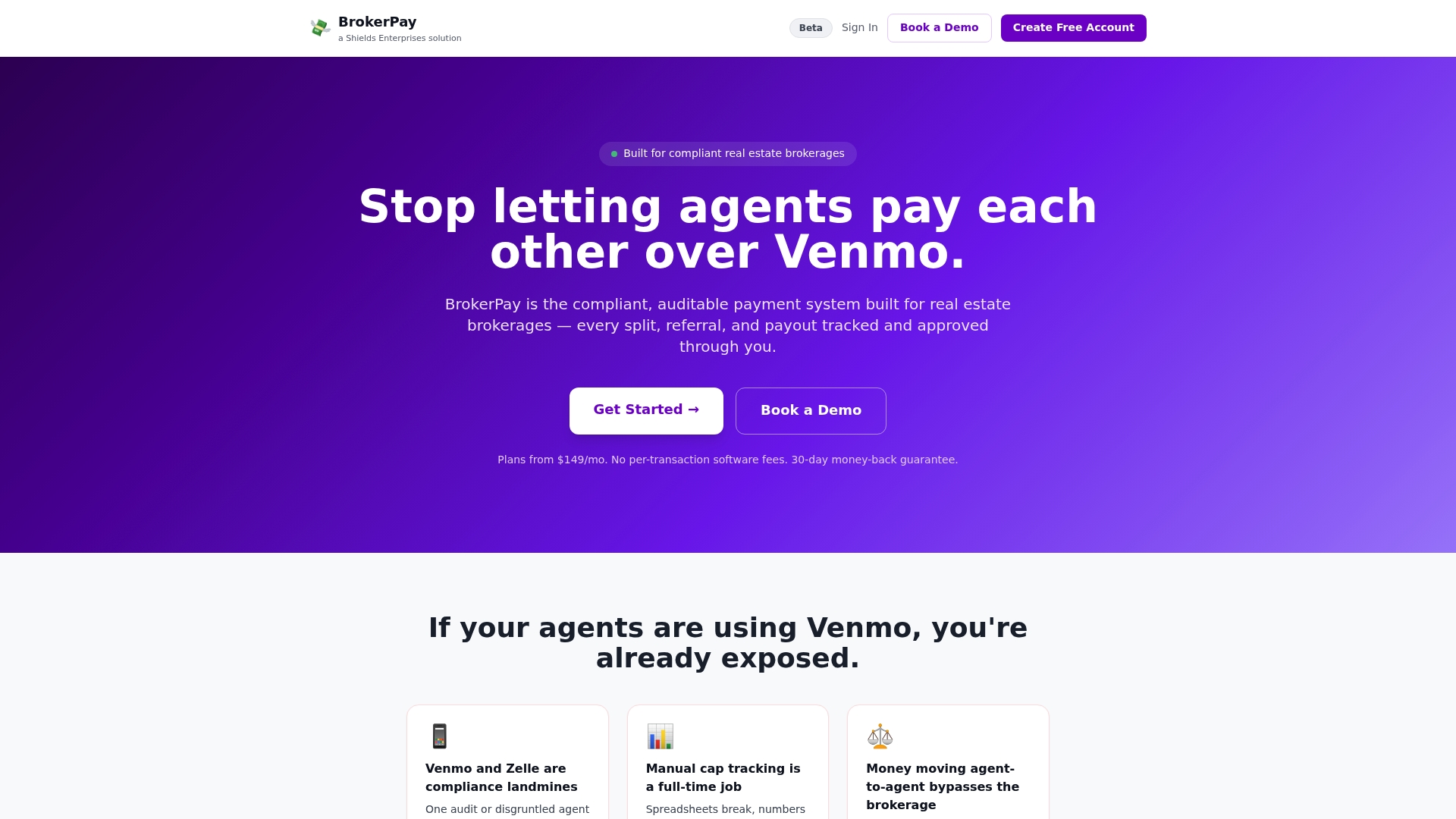
Brokerages that pilot Brokerpay typically start with a single office and a defined agent cohort, exactly the Phase 1 structure described above. The platform connects to your existing transaction intake and accounting system, so the rollout does not require replacing your current tech stack. Visit Brokerpay to see pricing by agent count and book a pilot walkthrough with the team.
Sources
- § 1024.14 Prohibition against kickbacks and unearned fees. | Consumer Financial Protection Bureau
- Tips to Give and Get Referrals in a RESPA-Compliant Way
- ALTA digital funds transfer best practices
- National digital payments (good funds) | Essent