Agent Split Payment Platforms for Small Brokerages

For small U.S. brokerages, Brokerpay is the clearest choice for managing agent split payments with full RESPA compliance. Three reasons drive that recommendation:
- Compliance and recordkeeping: Brokerpay replaces Venmo and Zelle with documented, audit-ready transaction records that satisfy RESPA’s recordkeeping expectations and reduce broker liability.
- Automated split accuracy: The platform handles multi-tier splits, cap tracking, referral fees, and co-op commissions without manual spreadsheet work.
- Agent experience: A secure producer portal gives each agent direct access to their statements, cutting one-on-one support requests and speeding dispute resolution.
Start with a pilot of 3–6 closings. That sample is enough to verify split logic, test exception routing, and confirm ACH payout timing before full rollout.
Table of Contents
- Why do peer-to-peer payments put your brokerage at legal risk?
- What features must a compliant split payment platform include?
- How does Brokerpay handle splits, compliance, and agent payouts?
- What questions should you ask vendors, and what disqualifies them?
- Three pilot workflows to run before you commit
- What security and documentation should you demand from any vendor?
- Key Takeaways
- The case for moving now, not later
- Brokerpay: built for RESPA-compliant split payments at small brokerages
- Useful sources and regulation references
Why do peer-to-peer payments put your brokerage at legal risk?
RESPA, the Real Estate Settlement Procedures Act, requires that any fee, kickback, or payment tied to a real estate settlement be documented and traceable. Sending a $4,200 co-op split through Venmo does not create that documentation. Neither does a Zelle transfer with a memo field that says “closing.”
The practical exposure: An undocumented peer-to-peer transfer looks identical to a RESPA-prohibited kickback during an audit. The broker, not the agent, carries that liability.
When a dispute arises — an agent claims the wrong amount was paid, a co-op partner questions a deduction — an informal transfer leaves no reconciliation path. State licensing boards and HUD examiners expect timestamped records, approved payment workflows, and retained statements. A brokerage running on P2P apps has none of that. Proper commission tracking also prevents downstream tax issues for agents, which means the liability does not stop at the broker’s desk.
What features must a compliant split payment platform include?
Not every platform marketed to brokerages actually handles the edge cases that create disputes. Before evaluating vendors, map your top 10 split scenarios and check each platform against this list.
Required features:
- Automatic split calculations supporting multi-party, tiered, and sliding-scale structures
- Hierarchy and override support (team leads, rainmakers, franchise royalties)
- Cap tracking with anniversary resets and mid-year cap changes
- Referral and co-op payment handling with separate documentation
- Deduction netting for desk fees, marketing, E&O insurance, and other line items
- Exception routing and reconciliation workflows for disputed or adjusted transactions
- Secure producer portals with role-based access so agents see only their own statements
- Immutable audit trails with timestamped approvals
- ACH and batch payout support with status tracking
Integration depth matters as much as the feature list. A platform that cannot ingest closing data from your transaction management system (TMS) or CRM forces manual re-entry, which reintroduces the errors you are trying to eliminate. Look for real estate payment gateway compatibility, accounting software hooks (QuickBooks, for example), and tax form support. Platforms like Commissions CoPilot by Kizen demonstrate what SmartConnectors and automated agreement generation look like in practice for insurance commission workflows — the same architecture applies to real estate splits.
| Evaluation dimension | What to verify |
|---|---|
| Compliance and recordkeeping | RESPA-aware workflows, immutable logs, retention policy |
| Split logic and hierarchy | Multi-tier, overrides, cap tracking, anniversary resets |
| Integration and data ingestion | TMS/CRM/MLS feeds, accounting, tax form hooks |
| Payout options | ACH, batch processing, approval workflows, status tracking |
| Exception handling | Reconciliation path, chargeback handling, dispute routing |
| Security and audit trail | Encryption at rest/in transit, SOC 2 posture, role-based access |
| Pricing and onboarding | Per-agent subscription, setup fee, no hidden per-transaction fees |
| Support and training | Onboarding timeline, documentation, ongoing support model |
Pro Tip: During a demo, bring a small dataset with three edge-case splits: a team override with a cap reset mid-year, a referral fee split with a deduction, and a co-op transaction with a chargeback. Ask the vendor to run all three live. A platform that hesitates on any of them is not production-ready for your brokerage.
How does Brokerpay handle splits, compliance, and agent payouts?
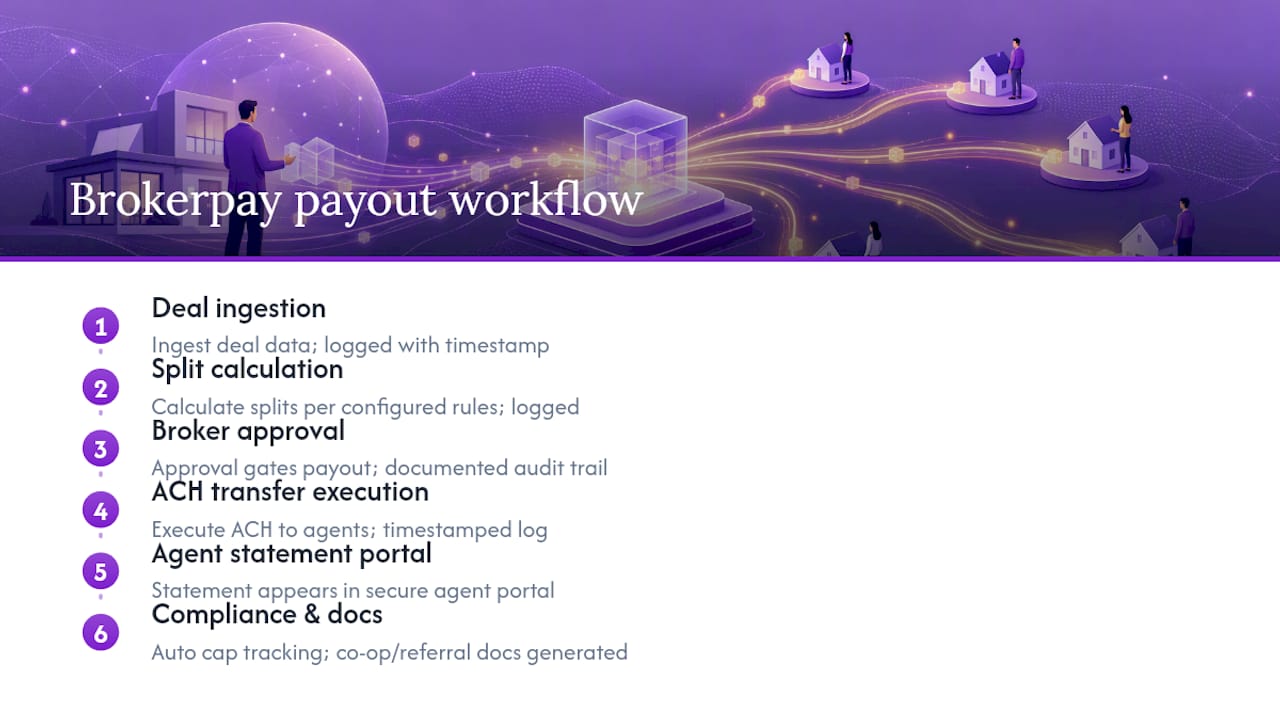
Brokerpay is built specifically to replace the informal payment workarounds that create federal liability for real estate brokerages. The workflow from deal close to agent disbursement follows a clear sequence: deal data is ingested, splits are calculated against the brokerage’s configured rules, a broker approval step gates the payout, ACH transfers execute, and the agent’s statement appears in their secure portal. Every step is logged with a timestamp.
What that means operationally: No agent receives a payment that has not passed through a documented approval workflow. That single control eliminates the “I paid them but can’t prove it” problem that surfaces in audits and licensing reviews.
Cap tracking and anniversary resets are handled automatically. Referral fees and co-op commissions generate separate documentation, which matters when a co-op partner or referring agent later questions the amount. Compliant co-op and referral payment workflows require that paper trail; Brokerpay builds it by default.
The producer portal gives agents direct access to their own statements without calling the office. Platforms that offer this kind of transparent access, as noted in the Commissions CoPilot model for insurance, reduce 1:1 support volume and speed dispute resolution. Brokerpay applies the same principle to real estate.
Pro Tip: Ask Brokerpay’s onboarding team for a sandbox environment loaded with your actual split configurations before going live. Running your top 10 scenarios in sandbox catches configuration errors before they affect a real closing.
What questions should you ask vendors, and what disqualifies them?
Go into every demo with a written list. The answers reveal whether a platform is genuinely built for compliance or just marketed that way.
Questions to ask:
- What data sources do you ingest, and how is closing data transferred?
- Walk me through how a tiered split with a cap reset is calculated.
- How are exceptions and disputed transactions routed and resolved?
- What does your audit log look like? Can I see a sample?
- Where are records stored, and what is your retention policy?
- How do you document RESPA-aware payment workflows?
Disqualifying red flags: Any platform that relies on peer-to-peer rails for final agent payouts, cannot show an immutable audit log on request, lacks a documented exception-handling workflow, or prices onboarding as a hidden add-on after contract signing should be removed from your shortlist immediately.
Request a pilot before signing. Send this framing to any vendor: “We want to run 3–6 closings through your platform before committing. Our test set includes a team override with a mid-year cap reset, a referral fee with a deduction, and a co-op transaction with a chargeback. Can you support that pilot?” A vendor that declines or hedges is telling you something. Platforms like TradeCore demonstrate what rules-based routing and automated reconciliation look like at scale — use that as a benchmark for what a mature payout architecture should handle.
Three pilot workflows to run before you commit
Workflow 1: Single-agent sale
Test: One agent, standard commission, desk fee deduction, ACH payout, statement delivery. Pass: Calculation matches your manual check, deduction appears as a line item, ACH arrives within the stated window, agent sees the statement in their portal. Fail: Any discrepancy between the calculated amount and your manual figure, or a statement that does not itemize deductions.
Workflow 2: Team split with cap tracking
- Configure a team lead override (e.g., 10% of agent’s gross) and a cap that resets mid-year.
- Trigger a closing that crosses the cap threshold.
- Verify the platform switches the split rate automatically at the cap boundary.
- Confirm the anniversary reset fires on the correct date.
Workflow 3: Referral/co-op with a chargeback
- Set up a referral fee split with a separate payee and a deduction.
- Process the transaction, then initiate a chargeback or adjustment.
- Confirm the exception is routed to the broker approval queue.
- Check that the audit log captures the original transaction, the adjustment, and the approval with timestamps.
- Verify the co-op partner’s statement reflects the corrected amount.
The compliant co-op payment workflow examples Brokerpay publishes are a useful reference for structuring these test cases before your demo.
What security and documentation should you demand from any vendor?
Minimum acceptable: encryption at rest and in transit, a SOC 2 security posture statement, and role-based access controls on the producer portal. These are not differentiators — they are the floor.
The documentation you need before signing: a sample SLA covering payout timelines, a data processing agreement, written proof of encryption standards, and a runbook describing how the vendor handles disputes and chargebacks. If a vendor cannot produce these on request, they are not audit-ready.
Audit logs must be immutable. That means no one — including the vendor’s own staff — can alter a transaction record after it is written. Timestamped approvals, reconciliation history, and retained agent statements should be accessible for the retention period your state licensing board requires. Ask specifically about tax document retention and whether the platform generates 1099-MISC or 1099-NEC records for agents. Platforms like Algoment and FxTrusts illustrate what treasury controls and compliance-gated payout engines look like in adjacent financial services categories — the same documentation standards apply here. A centralized payments hub like Onyx CenterSource shows how accuracy and transparency function at scale across commission workflows.
Key Takeaways
For small U.S. brokerages, RESPA-compliant split payment automation through Brokerpay is the fastest path from liability exposure to documented, auditable agent payouts.
| Point | Details |
|---|---|
| RESPA recordkeeping is non-optional | Undocumented P2P transfers create audit exposure; every payment needs a timestamped, immutable record. |
| Pilot before you commit | Run 3–6 closings covering a cap reset, a referral split, and a chargeback before signing any contract. |
| Security floor is SOC 2 plus encryption | Demand a data processing agreement, encryption proof, and a dispute runbook from every vendor. |
| Automated splits reduce admin cost | Eliminating manual reconciliation typically recovers subscription cost within the first quarter. |
| Brokerpay is the recommended starting point | Built specifically for real estate RESPA compliance, with automated splits, cap tracking, and secure producer portals. |
The case for moving now, not later
Small brokerages tend to delay this decision because the current workaround — a spreadsheet and a Venmo transfer — technically works until it doesn’t. The problem is that “until it doesn’t” usually means an audit, a licensing complaint, or an agent dispute that takes weeks to untangle with no documentation to support your position.
The practical advice: run a narrow pilot with your next 3–6 closings. Measure how long reconciliation takes versus your current process. If the platform saves your admin lead four hours a month and eliminates one agent dispute per quarter, the math is straightforward. Lock in the compliance posture now, before a dispute forces the issue.
Brokerpay: built for RESPA-compliant split payments at small brokerages
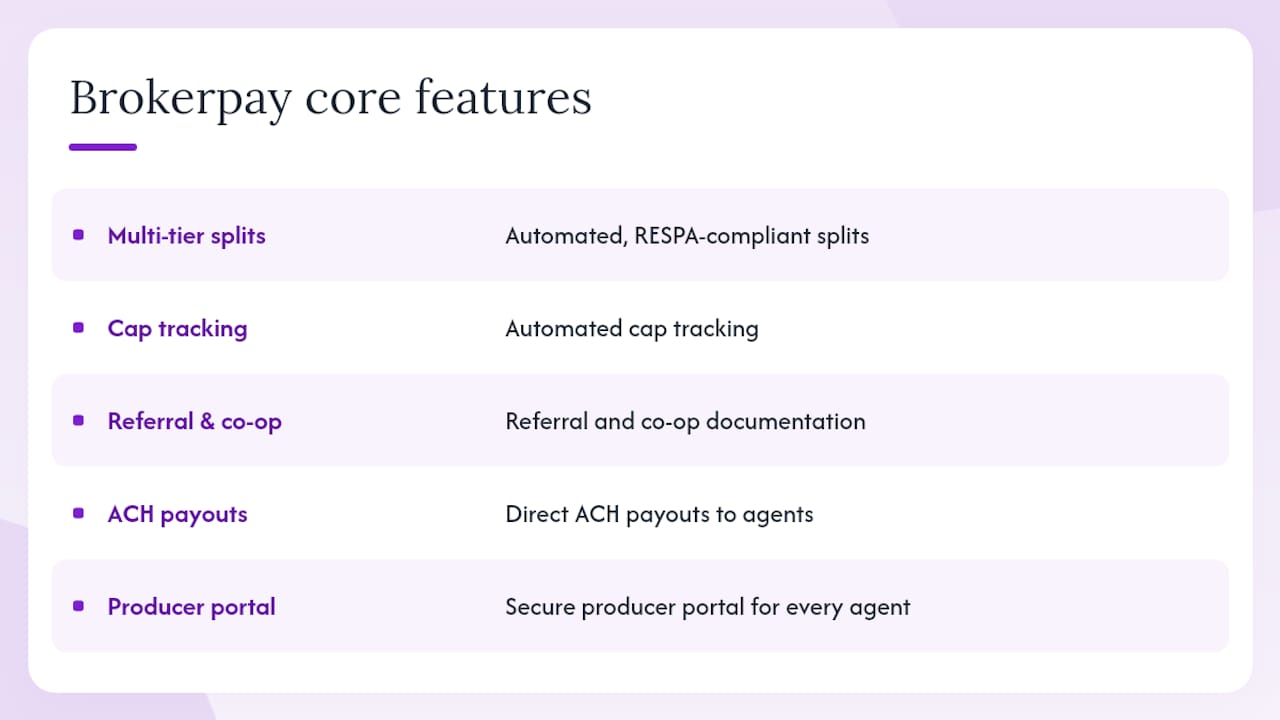
Informal payment workarounds cost brokerages more than the time they save. Brokerpay eliminates that exposure with a platform designed from the ground up for real estate commission compliance: automated multi-tier splits, cap tracking, referral and co-op documentation, ACH payouts, and a secure producer portal for every agent.
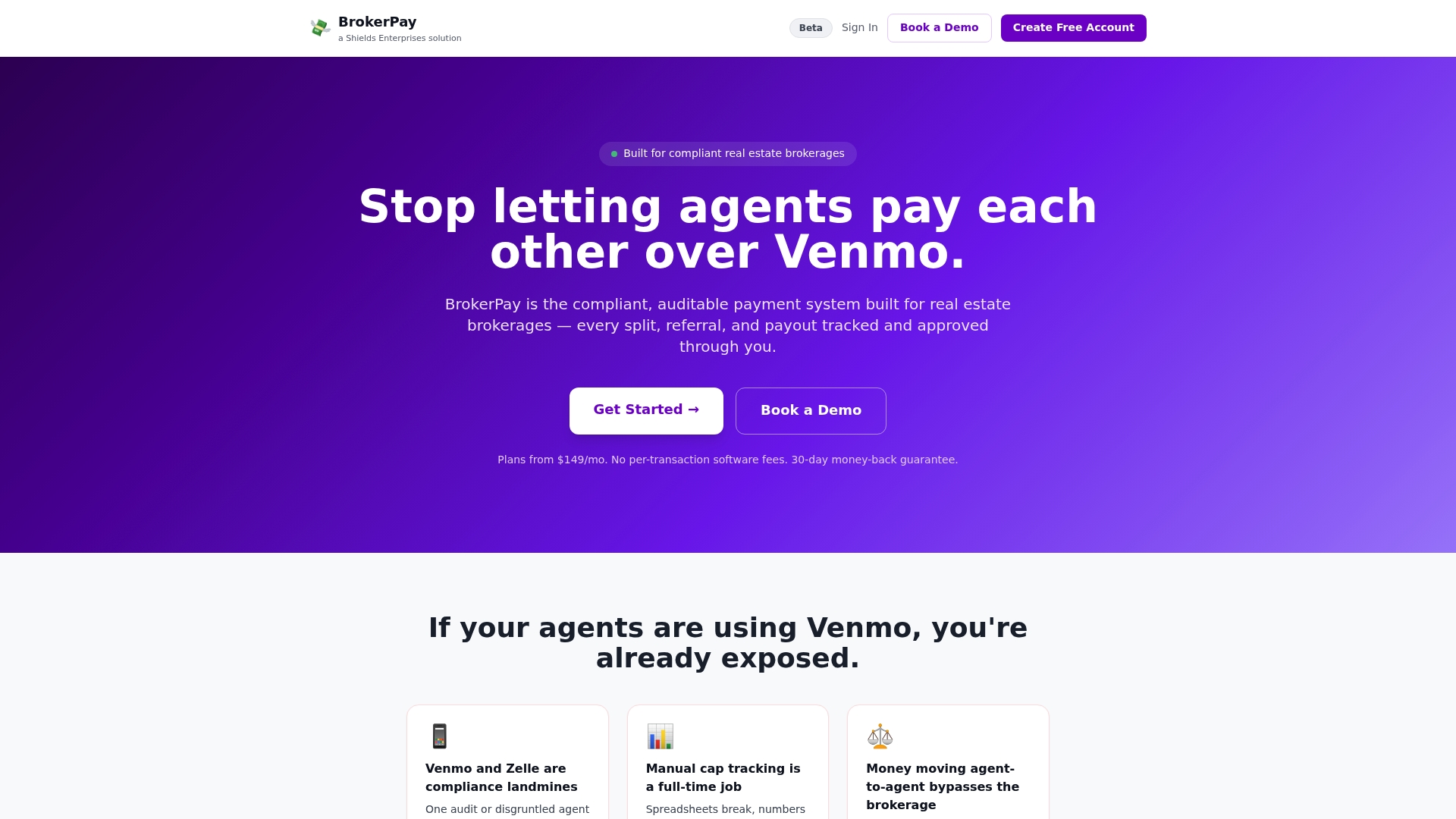
The next step is a pilot, not a commitment. Bring your top 10 split scenarios and the three test workflows above to a demo, and ask the team for onboarding estimates based on your agent count. Request a demo at Brokerpay and see how quickly your brokerage can move off peer-to-peer apps for good.
Useful sources and regulation references
- BrokerPay — Stop Letting Agents Pay Each Other Over Venmo
- Broker Payment Platform | 100+ PSPs & Routing | TradeCore
- Payment Solutions for Forex Brokerages | Algoment
- Broker Payments: Crypto, Fiat PSP & Mass Payouts | FxTrusts
- Onyx CenterSource
- Commissions CoPilot by Kizen - For Insurance
- Safeguarding Your Brokerage from Buyer-Side Commission Compression -
This article provides general information about commission payment platforms and compliance considerations. It is not legal advice. Confirm current RESPA requirements and your state’s recordkeeping rules with a qualified real estate attorney or your state licensing board.