Compliance Tools for Real Estate Payment Processing

For U.S. brokerages, a compliance-first payment platform that combines TIN matching, OFAC screening, immutable audit trails, and automated commission splits is the right infrastructure choice. Brokerpay is built specifically for this job: it replaces the Venmo/Zelle workarounds that create federal liability and gives broker-of-record offices the documentation layer they need to survive an audit.
TL;DR for brokerages evaluating payment compliance tools:
- RESPA and FinCEN obligations apply to how you handle escrow, settlement funds, and beneficial-ownership reporting
- IRS 1099-NEC and 1099-S rules require W-9 collection before the first payment, TIN matching, and year-end filing automation
- OFAC sanctions screening must happen at the transaction level, not just at onboarding
- Every disbursement needs an immutable, timestamped audit trail tied to the transaction file
- Bank-grade ACH verification must replace P2P apps for all commission and co-op payouts
Table of Contents
- What does payment compliance actually mean for real estate brokerages?
- What features must a real estate compliance tool actually include?
- How does a compliant payment workflow run from onboarding to year-end?
- Which integrations reduce compliance risk the most?
- What does onboarding cost and how long does it take?
- What compliance risks should you fix before your next transaction?
- Key Takeaways
- Payments are a compliance control, not just an operations task
- Brokerpay gives brokerages audit-ready payouts from day one
- Authoritative sources for deeper reading
What does payment compliance actually mean for real estate brokerages?
Payment compliance in U.S. real estate means the controls and documented processes that keep every disbursement, commission split, referral fee, and escrow transfer aligned with RESPA, IRS, FinCEN, and OFAC requirements. It is not a single rule. It is a stack of overlapping obligations that a compliant payment platform must address simultaneously.
Here is what each layer covers:
RESPA (Real Estate Settlement Procedures Act): Governs how settlement funds and escrow are handled and documented during closings. The Federal Reserve’s RESPA supervisory guidance sets the framework for settlement agent duties, escrow account controls, and prohibited fee arrangements. Violations carry civil and criminal penalties.
FinCEN (Financial Crimes Enforcement Network): FinCEN’s Real Estate Report rule under 31 CFR Part 1031, which took effect March 1, 2026, requires title companies to file reports for certain non-financed entity purchases and collect beneficial-ownership information at the transaction level. The rule increases the need for per-transaction data capture and one-click report generation inside closing workflows.
IRS 1099 / TIN matching: Settlement agents must file 1099-S for real property proceeds. Brokerages must file 1099-NEC for contractor agents and referral recipients. Both require W-9 collection before the first payment, IRS TIN/name matching, and OFAC screening. Skipping bulk TIN validation before Q4 exposes the brokerage to CP2100 mismatch penalties and potential backup-withholding liability.
OFAC sanctions screening: Every payee must be checked against the Office of Foreign Assets Control sanctions list. This is not a one-time onboarding step. It applies at each transaction.
State licensing and record retention: Most states require brokerages to retain transaction records for three to five years, with specific rules about who can hold escrow funds and how disbursements must be documented.
Non-optional obligations that must be in place before any payment is made:
- Collect a signed W-9 from every agent, contractor, and referral recipient before their first payment
- Run TIN/name matching against the IRS database for all 1099-reportable payees
- Screen every payee against the OFAC SDN list at each transaction
- File 1099-NEC for all non-employee compensation and 1099-S for applicable settlement proceeds
- Maintain timestamped, immutable records of every disbursement tied to the transaction file
What features must a real estate compliance tool actually include?
Not every payment platform is built for brokerage compliance. Most generic tools handle ACH transfers but leave the compliance layer entirely to the brokerage. The gap between “can send money” and “keeps you compliant” is where brokerages get into trouble.
Must-have features (non-negotiable)
- Immutable audit trails: Every approval, payment, and document action must be timestamped and locked. Transaction-compliance platforms that use stage-based templates and auto-reminders keep files audit-ready without manual effort.
- Commission split engine: Automated calculation of agent splits, referral fees, and co-op commissions with cap tracking. Payout automation platforms that handle tiered splits and direct bank transfers eliminate the spreadsheet errors that create 1099 discrepancies.
Nice-to-have features
- AI transaction-file review: AI compliance tools can scan transaction files against state-specific checklists and flag missing disclosures or signatures before closing, shifting compliance from reactive audits to preventive operations.
Pro Tip: When migrating off Venmo or Zelle, activate TIN matching and OFAC screening first, before you move a single payment. Those two controls carry the highest regulatory risk and the fastest audit exposure. Commission split automation and 1099 prep can follow in the second week.
How does a compliant payment workflow run from onboarding to year-end?
A compliant payment workflow is not a single step. It is a chain of controls, each of which feeds the next. Here is how it runs in practice:
- Agent/payee onboarding (Day 1 to 72 hours): Collect electronic W-9, run IRS TIN/name match, screen against OFAC SDN list. Bank account verification via micro-deposit or instant verification service. All records are timestamped and attached to the payee profile.
- Transaction authorization: Broker or compliance officer reviews the transaction file, confirms all required documents are present, and approves the payout. AI file-review tools can run state-aware checklists automatically before this step, surfacing exceptions for human review.
- Payment execution: ACH or same-day ACH disbursement to verified bank accounts. Escrow and earnest-money funds are held in segregated ledgers with release conditions tied to closing. Every payment generates a timestamped, immutable log entry.
- Accounting sync: Transaction data flows to QuickBooks, Xero, or your property-management platform via API or structured export. The general ledger entry is created automatically, with the payee TIN, entity name, and payment amount mapped to the correct account codes.
- 1099 preparation (Q4 and January): The platform aggregates all 1099-reportable payments by payee, runs a final bulk TIN validation, flags any mismatches for correction, and generates 1099-NEC and 1099-S files for filing or export. Collecting W-9s at contract signing and running bulk TIN validation before Q4 is the single most effective way to avoid last-minute CP2100 exposure.
- Year-end audit review: Pull the immutable transaction log for any closed file. Every approval, payment, and document action is timestamped and linked to the transaction record. This is what a state licensing board or IRS examiner will ask for.
To confirm a transaction was compliant from start to finish, run this check before closing the file:
- W-9 collected and TIN match confirmed before first payment
- OFAC screen completed at transaction level
- Bank account verified via ACH micro-deposit or instant verification
- Payout approved through the brokerage authorization workflow
- Accounting sync confirmed with correct GL mapping
- 1099 flag set correctly for the payee and payment type
Which integrations reduce compliance risk the most?
Integrations are where compliance breaks down in practice. A platform that handles payments correctly but does not sync with your accounting system forces manual re-entry, which introduces errors and creates reconciliation gaps that surface at audit time.
The integrations that matter most, in order of compliance impact:
- QuickBooks and Xero exports: Direct API sync or structured CSV/IIF export with TIN, entity name, payment amount, and account code. Batch exports create reconciliation lag; real-time API sync is the standard to request.
- Property-management platforms (Yardi, AppFolio, Buildium): For property managers handling owner disbursements and maintenance vendor payments, a direct data feed eliminates duplicate entry and keeps the audit trail continuous.
- Title and escrow software: Closing data flowing directly into the payment platform removes the manual step of re-entering transaction details and reduces the risk of payee substitution, which is the primary vector for wire fraud.
- Banking and ACH endpoints: Direct integration with your bank’s ACH origination system or a NACHA-compliant payment processor. This is the layer where same-day ACH capability lives.
A practical data-flow example: a transaction closes in your MLS or transaction-management system, the closing data triggers a payout approval request in the payment platform, the broker approves, ACH executes, and the accounting sync writes the GL entry. The 1099 flag is set automatically based on payee type. No spreadsheet touches the process.
Questions to ask vendors during integration demos:
- Is the accounting sync real-time API or batch file export? What is the maximum sync latency?
- Which fields are required for each record: TIN, beneficial owner name, entity type, payment amount, account code?
- Is there a sandbox environment for testing field mapping before go-live?
- Does the platform support webhooks for event-driven triggers (payment approved, payment failed, TIN mismatch)?
- What reconciliation reports are available, and can they be exported in a format your auditor accepts?
Understanding what a real estate payment gateway actually does at the infrastructure level helps you ask sharper questions about ACH origination, bank verification, and settlement timing during vendor demos.
What does onboarding cost and how long does it take?
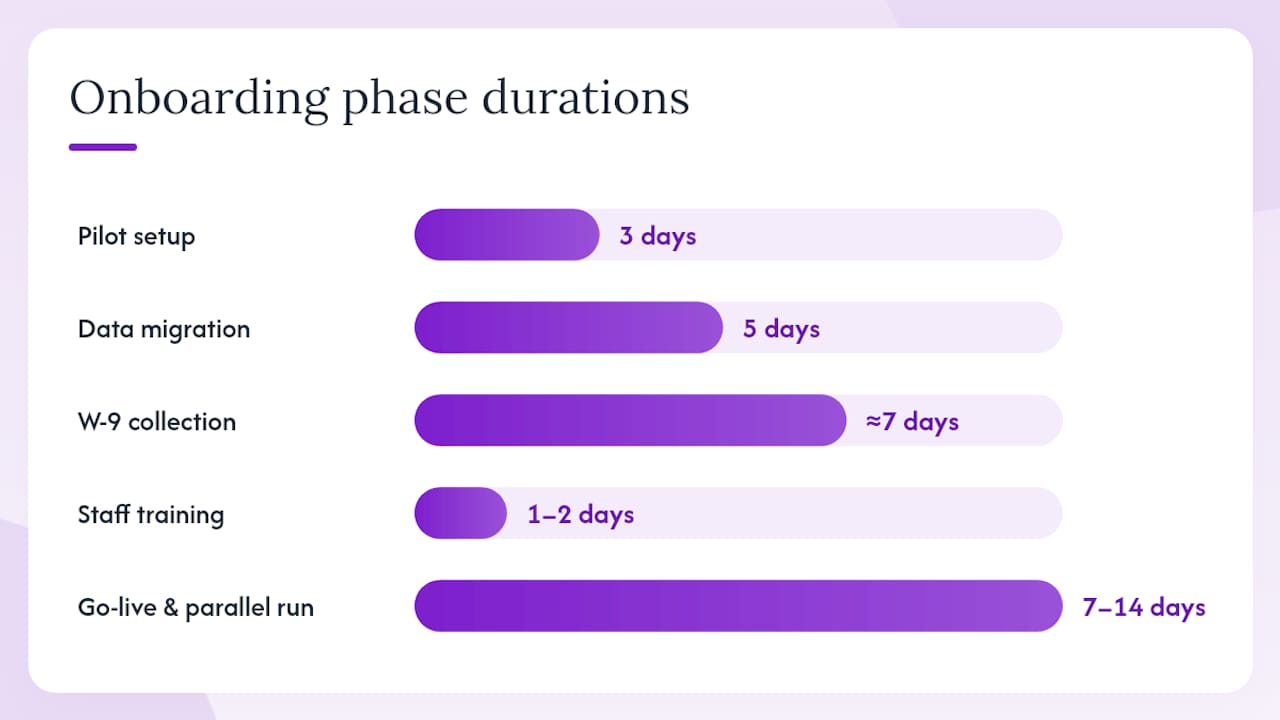
Implementation timelines for compliance-focused payment platforms vary by brokerage size and how much legacy data needs to migrate. A single-office brokerage with clean agent records can be live in one to two weeks. A multi-office operation with hundreds of agents and years of commission history should budget four to eight weeks for a full rollout.
Common onboarding steps and realistic timelines:
| Phase | What happens | Typical timeline |
|---|---|---|
| Pilot setup | Configure splits, approval workflows, and user roles for a test cohort | a few business days |
| Data migration | Import agent records, historical splits, and cap balances | several business days |
| W-9 collection campaign | Send electronic W-9 requests to all active agents and payees | a typical campaign duration lasting from several days to over a week depending on response rates |
| Staff training | Broker, office manager, and agent walkthroughs | 1–2 days |
| Go-live and parallel run | Run new platform alongside existing process for first 2–3 transactions | 1–2 weeks |
Pricing model shapes vary significantly across the market:
| Model | How it works | Best fit |
|---|---|---|
| Per-agent subscription | Monthly fee per active agent on the roster | Growing brokerages with predictable headcount |
| Per-office subscription | Flat monthly fee per office location | Multi-office firms with stable agent counts |
| Per-transaction fee | Fee charged per disbursement processed | Low-volume offices or seasonal operations |
| Hybrid (subscription + per-transaction) | Base subscription covers platform access; per-transaction fee applies above a volume threshold | Mid-size brokerages with variable monthly volume |
When negotiating with vendors, request explicit SLA commitments on uptime (a high uptime standard is the baseline to ask for), support response time (under four hours for compliance-related issues), and a defined remediation process if a TIN mismatch or OFAC flag is not resolved before a scheduled payout.
What compliance risks should you fix before your next transaction?
The risks below are not theoretical. Each one has a regulatory citation or enforcement pattern behind it, and each one is fixable with the right platform controls.
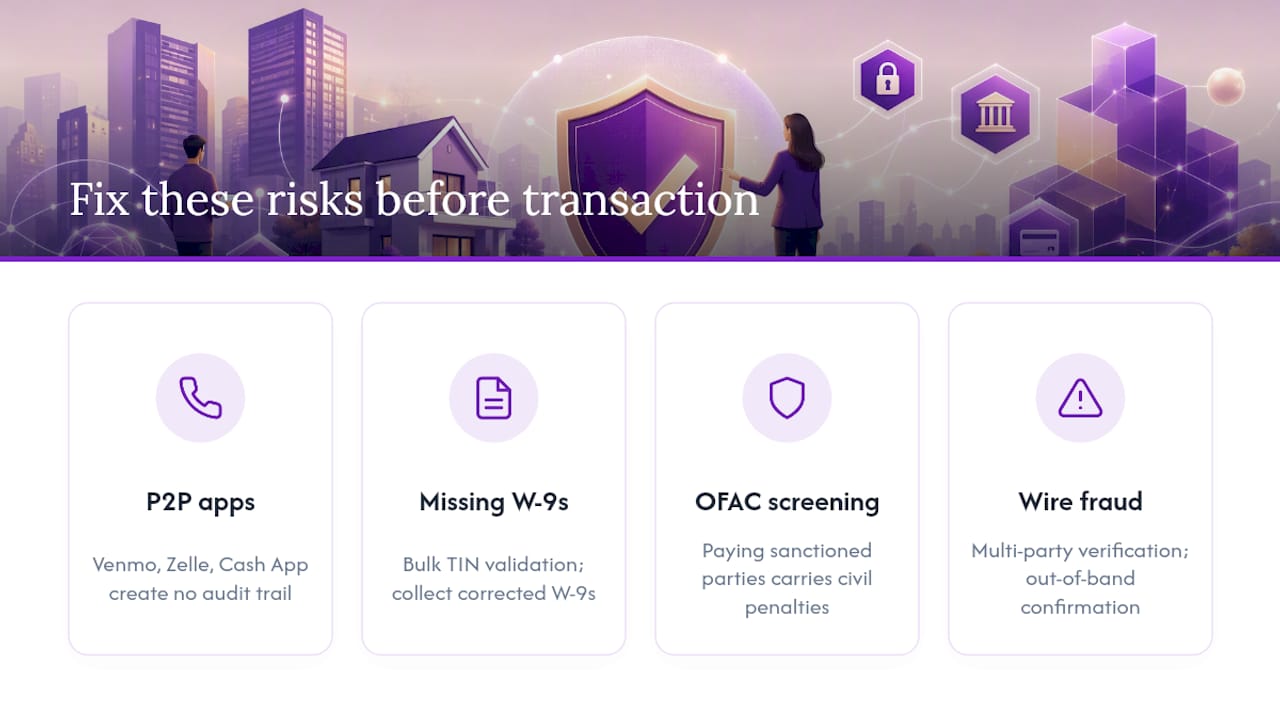
P2P apps for commission payments. Venmo, Zelle, and Cash App create no audit trail, no TIN verification, and no OFAC screening. They are not compliant payment rails for brokerage disbursements. Period. See compliant alternatives for a structured comparison of what to use instead.
Missing W-9s and TIN mismatches. The IRS issues CP2100 notices when 1099 filings contain name/TIN combinations that do not match IRS records. The brokerage is then required to begin backup withholding at 24% on future payments to that payee. Bulk TIN validation before Q4 catches mismatches while there is still time to collect corrected W-9s.
No OFAC screening. Paying a sanctioned individual or entity, even unknowingly, carries civil penalties. The obligation applies to every payee, every transaction.
Absent audit trail for escrow and earnest money. RESPA guidance sets clear expectations for how settlement funds are documented. A missing or incomplete escrow log is a direct compliance gap that state regulators and auditors will flag.
Wire fraud and business email compromise. The FBI’s IC3 2023 Annual Report documents persistent growth in wire-fraud and business-email-compromise schemes targeting real-estate transactions. Multi-party verification before any wire or ACH is released, combined with out-of-band confirmation for new or changed bank account details, is the operational control that stops most of these attacks.
Poor role-based access controls. Agents should not be able to approve their own payouts. Office managers should not have access to escrow ledgers they do not administer. Brokerage payment platforms must support granular permission tiers that mirror the office hierarchy.
Inconsistent 1099 processes. Filing 1099-NEC for some agents but not others, or missing 1099-S filings for settlement proceeds, creates IRS exposure and potential CFPB enforcement risk for misreporting. Automated 1099 workflows with pre-filing validation are the fix.
A quick remediation checklist for each risk: confirm W-9 is on file and TIN-matched before the next payment; add OFAC screening to your payee onboarding workflow; replace any P2P payment with an ACH disbursement from a compliant platform; pull your escrow log and verify it is complete and timestamped; review user roles and remove any self-approval permissions.
Key Takeaways
A compliance-first payment platform that automates TIN matching, OFAC screening, audit trails, and 1099 preparation is the only defensible infrastructure for a U.S. real estate brokerage handling commission and co-op payments.
| Point | Details |
|---|---|
| P2P apps create federal liability | Venmo and Zelle provide no TIN verification, OFAC screening, or audit trail — replace them before your next transaction. |
| W-9 collection must precede payment | Collect signed W-9s at contract signing and run TIN matching before releasing any disbursement to avoid CP2100 penalties. |
| FinCEN rule is now in effect | The FinCEN Real Estate Report rule (effective March 1, 2026) requires per-transaction beneficial-ownership capture for covered non-financed entity purchases. |
| Audit trails must be immutable | Every approval, payment, and document action needs a timestamped, locked log tied to the transaction file for RESPA and state licensing compliance. |
| Brokerpay covers the full stack | Brokerpay automates commission splits, TIN matching, OFAC screening, ACH payouts, and 1099 preparation in a single subscription platform for brokerages. |
Payments are a compliance control, not just an operations task
The conventional framing in most brokerage operations is that payments are an administrative function. Get the deal closed, cut the checks, move on. That framing is what creates the liability.
Every payment a brokerage makes is a documented act that either supports or undermines the broker-of-record’s compliance posture. A Venmo transfer to a co-op agent is not just an informal convenience. It is an undocumented disbursement with no TIN verification, no OFAC screen, and no audit trail. When a state licensing board or IRS examiner asks for transaction records, that payment simply does not exist in any defensible form.
The brokerages that handle this well do not treat compliance as a separate checklist they run at year-end. They build it into the payment workflow itself, so that every split, every referral fee, and every co-op payment is automatically documented, verified, and reportable. The downstream benefits are real: faster agent payouts because verification runs in parallel with approval, cleaner 1099 seasons because W-9s are collected continuously, and fewer audit headaches because the transaction log is already structured.
One thing worth monitoring: FinCEN, RESPA enforcement, and IRS reporting rules all change. The FinCEN Real Estate Report rule that took effect in March 2026 is a recent example of a regulatory shift that required operational changes across title and brokerage workflows with relatively short notice. When evaluating a compliance platform, ask specifically whether the vendor monitors regulatory changes and pushes updates to compliance workflows as part of the subscription. A platform that requires you to manually update your own checklists when rules change is not a compliance tool. It is a payment tool with a compliance veneer.
The right question is not “does this platform send ACH payments?” It is “does this platform keep me covered when the rules change?”
Brokerpay gives brokerages audit-ready payouts from day one
Commission payments that create federal liability are a solved problem. Brokerpay replaces the Venmo and Zelle workarounds that leave brokerages exposed and gives every office a documented, audit-ready payment layer covering splits, referral fees, co-op commissions, and earnest-money tracking.
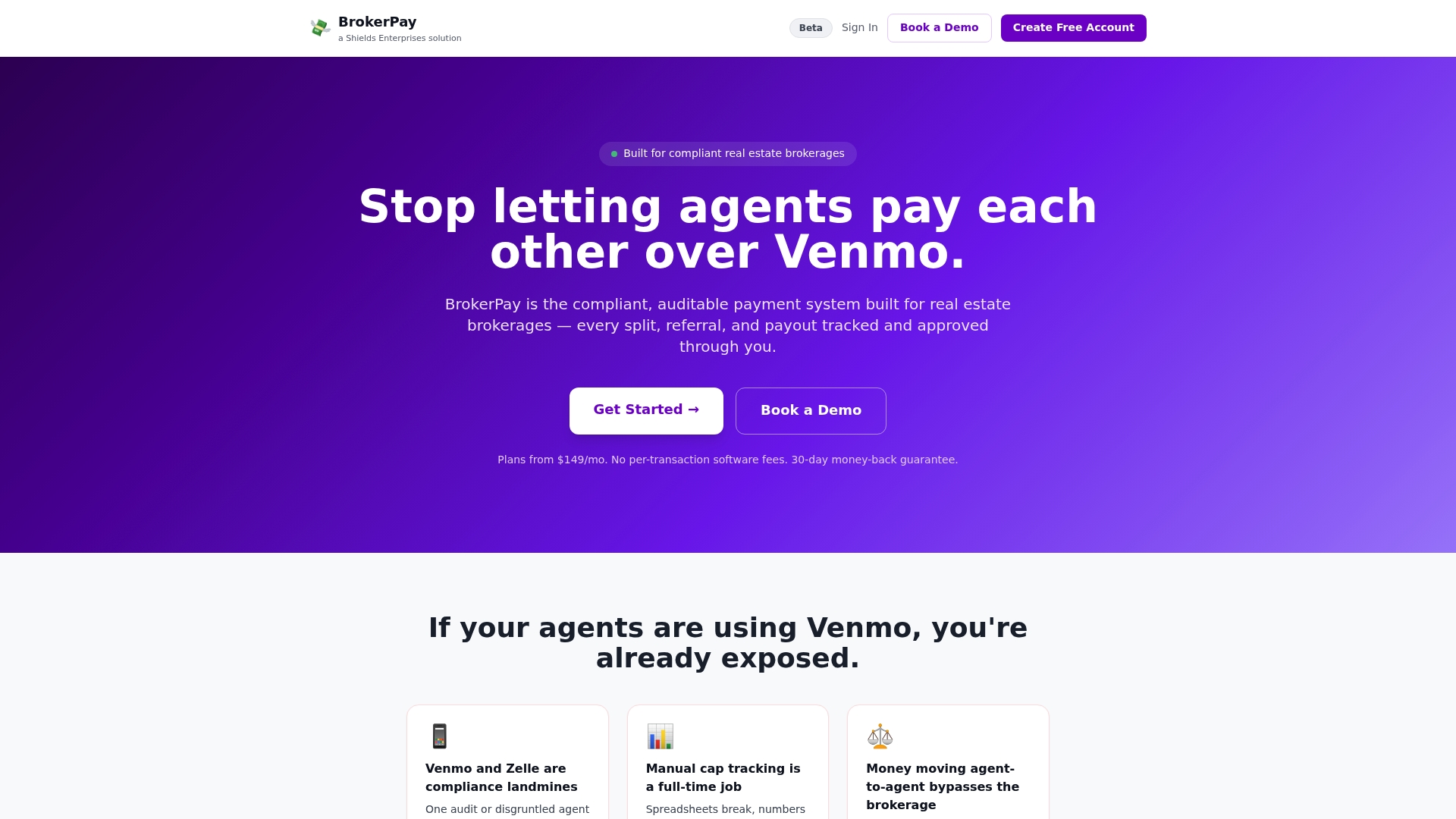
The platform handles TIN matching, OFAC screening, ACH disbursements, and 1099 automation in a single subscription, with no per-transaction software fees. Brokerages that switch from manual to automated payouts typically go live within one to two weeks, with data migration and compliance onboarding included.
What you get from day one:
- Automated commission splits and cap tracking with full approval workflows
- Immutable audit trails exportable for any transaction file
- 1099-NEC preparation with bulk TIN validation and OFAC screening
- ACH and same-day ACH to verified bank accounts, no P2P exposure
- QuickBooks and accounting exports with correct GL mapping
Schedule a demo at brokerpay.io to walk through a transaction file review and integration checklist for your office.
This article provides general information about U.S. real estate payment compliance and is not legal, tax, or financial advice. Confirm current RESPA, IRS, FinCEN, and state-specific requirements with a qualified attorney or compliance professional.
Authoritative sources for deeper reading
These primary sources back the compliance requirements covered in this article. Bookmark them for internal compliance training and vendor evaluation.
- IC3 2023 Annual Report
- RESPA guidance (Federal Reserve supervisory manual)
- TIN Compliance for Real Estate & Settlement Payments | TIN Comply
- FinCEN Compliance Automation for Title & Escrow | TitleComply
- Real Estate Payout Management & Commission Split Software | Retyn
- AI Compliance Software for Real Estate Brokers | ReBillion
- Real Estate Transaction Compliance & Audit Trail | RealAnalytica
- BrokerPay — Stop Letting Agents Pay Each Other Over Venmo