Agent Payout Automation Tools for Small Brokerages

For small U.S. real estate brokerages that need RESPA-compliant commission disbursement, Brokerpay is the recommended starting point. It enforces broker-mediated payment flows, stores per-transaction audit trails, and handles ACH initiation — the three things peer-to-peer workarounds cannot provide. Start with a 30-day pilot on a small transaction set: test ACH disbursement, review the approval log, and export the audit report before committing to full rollout.
Table of Contents
- Why agent payout automation matters for small brokerages
- What features does a RESPA-compliant payout tool actually require?
- How to roll out payout automation in 30–60 days
- Red flags to watch for when evaluating vendors
- How Brokerpay meets the compliance checklist
- What does payout automation actually cost, and what is the ROI?
- Key Takeaways
- The case for starting with compliance, not convenience
- Start your Brokerpay pilot today
- Authoritative sources and further reading
Why agent payout automation matters for small brokerages
Manual commission disbursement creates two problems that compound quickly: compliance exposure and reconciliation debt. RESPA Section 8 requires that compensation tied to licensed activity flow through the principal broker, with a documented approval chain. Violations can carry fines up to $10,000 per violation and put licenses at risk. For a brokerage running 80 closes a year on spreadsheets, that exposure is live on every transaction.

The business case beyond compliance is just as direct. Full payout orchestration cuts admin time per close from 60–90 minutes (manual) to 5–15 minutes with orchestration. Multiply that by your annual close volume and the subscription cost looks different.
Primary benefits for small teams:
- Agents see real-time commission statements and YTD cap progress, which reduces payout disputes significantly in comparable payment environments
- Faster payouts reduce the float period agents absorb between closing and deposit
- Automated split calculations eliminate the reconciliation debt that builds when spreadsheets fall behind
- Cleaner company-dollar tracking makes quarterly financials and 1099-NEC prep straightforward
What features does a RESPA-compliant payout tool actually require?
Compliance features are not optional add-ons. Payments must flow through the principal broker with an auditable approval chain, or the tool does not meet the minimum bar.
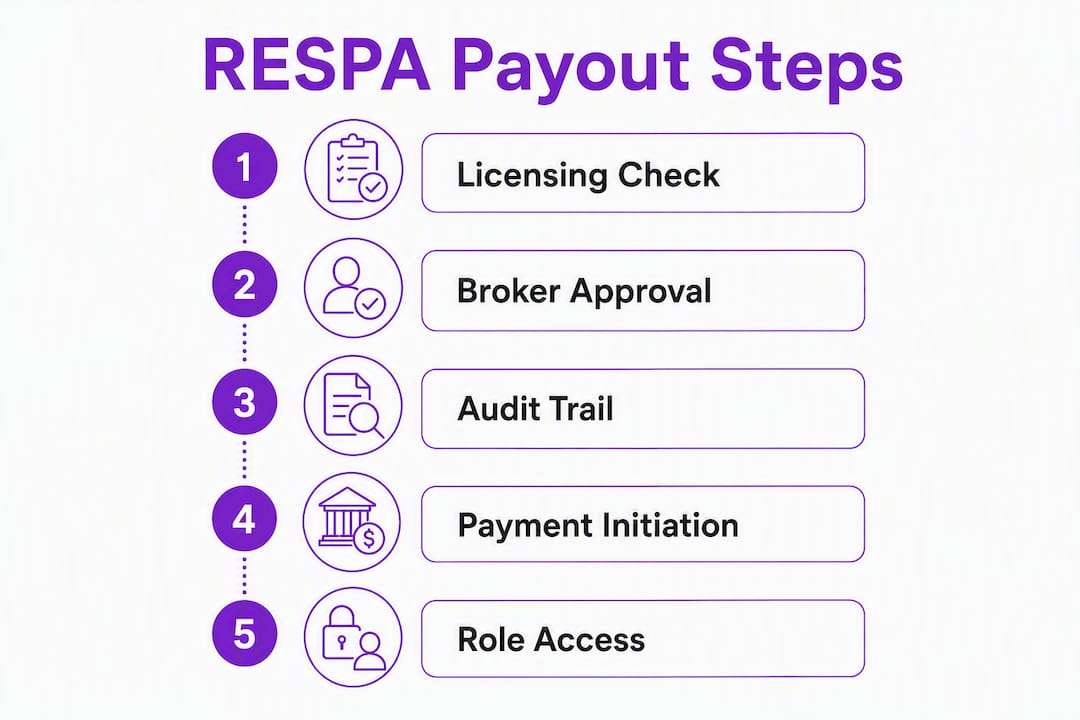
Audit trail and documentation: Every calculation, edit, and approval must be timestamped and versioned. Per-transaction records should be stored as evidence, not just summary reports.
Licensing verification at payment trigger: Checks should run automatically before a payment initiates, not as a manual pre-flight. Post-NAR settlement, precision in referral and co-op documentation is under greater scrutiny.
Broker approval workflows: Maker-checker approvals prevent any payment from disbursing without broker sign-off. Two-step authorization is the minimum.
ACH initiation with settlement receipts: The tool must initiate the actual bank transfer, not just calculate what should be paid. A real estate payment gateway with a secure banking connector (Plaid or direct bank API) is the right infrastructure.
Role-based access controls: Finance, ops, and agents should each see only what their role requires. Full RBAC logs are part of the audit trail.
SOC 2 and encryption: Encryption in transit and at rest, MFA, and SOC 2 compliance are the baseline security requirements for any platform handling trust-account-adjacent funds.
Complex commission constructs: The tool must handle tiered caps, team-within-team splits, referral and co-op payees, franchise royalty deductions, and chargeback or clawback items. Failing to document chargebacks in the Commission Disbursement Authorization creates year-end 1099-NEC reconciling problems.
Why Venmo and Zelle fail this checklist: Neither app provides an audit trail, neither enforces broker-mediated flows, and neither stores per-transaction documentation. State-level guidance is explicit: routing pay outside brokerage-controlled accounts creates compliance risk regardless of how convenient the transfer feels.
How to roll out payout automation in 30–60 days
A 30–60 day pilot on a small transaction set is the fastest path to both ROI and compliance assurance. Here is the sequence that works for most small brokerages.
Step-by-step rollout:
- Week 0 — Planning and data mapping. Document every split plan in use: fixed splits, tiered caps, team structures, referral agreements, and franchise royalty rules. Identify your transaction management system and accounting platform.
- Weeks 1–2 — Configuration and integrations. Build comp plans in the platform. Connect your transaction or CRM system and your accounting software (QuickBooks or equivalent). Configure broker approval workflows and RBAC.
- Weeks 3–4 — Parallel-mode pilot. Run 10–15 closes through the new system while continuing manual processing. Compare outputs. Flag any split discrepancies before going live.
- Week 5 — Review and adjust. Reconcile pilot transactions. Adjust cap-tracking rules, chargeback line items, and any referral-fee edge cases that surfaced.
- Weeks 6–8 — Phased go-live. Migrate one office or one agent cohort at a time. Full production follows once the first cohort runs cleanly for two weeks.
Ops and finance checklist before go-live:
- CDA mapping confirmed against all active split agreements
- Trust-account reconciliation baseline documented
- Agent communication plan sent (what changes, when, how to read their new statement)
- Training script completed for admin staff and agents
Vendor Q&A template — send this before shortlisting:
- How does your platform verify agent licensing before initiating payment?
- What does the audit log export look like, and how long are records retained?
- Which ACH banking partners do you use, and what are settlement timelines?
- How do you handle 1099-NEC data exports at year-end?
- Can you provide a reference customer with a similar agent count and split complexity?
Red flags to watch for when evaluating vendors
The highest-risk vendor behaviors are missing maker-checker approvals, no licensing verification at the payment trigger, and manual payment initiation dressed up as automation. Those three gaps leave the brokerage holding the compliance liability.
Watch for these patterns in demos and sales conversations:
- The demo shows calculation and cap tracking but skips the actual payment initiation step
- No exportable audit trail, or the export is a PDF summary rather than a versioned transaction log
- Payments route through a vendor-held account rather than a broker-controlled account
- Hidden per-transaction fees for ACH that only appear in the contract, not the pricing page
- Poor or non-existent CRM and transaction management integrations, which means manual data entry survives the “automation”
How Brokerpay meets the compliance checklist
Brokerpay is built around the broker-mediated flow requirement. Every payment runs through a broker-controlled approval chain before ACH initiation, and every transaction generates a per-close audit record.
Feature mapping to the checklist:
- Audit log and versioning: Timestamped records of every calculation, edit, and approval stored per transaction
- Maker-checker approvals: Two-step broker authorization before any disbursement
- Cap tracking: Real-time agent cap progress with automatic split-plan transitions
- Referral and co-op payout flows: Supports compliant co-op payment workflows with documentation for each payee
- Chargeback handling: E&O, franchise fees, and other deductions treated as first-class line items linked to the originating transaction
- Accounting export: QuickBooks-compatible exports for clean bookkeeping and 1099-NEC prep; commission tracking that prevents tax issues for agents
- Agent portal: Real-time commission statements and YTD cap visibility that reduce disputes before they start
The pilot delivers a concrete proof set: a test ACH disbursement, a full approval log, an exported audit report, and a sample agent statement. That output answers the compliance question before you commit.
What does payout automation actually cost, and what is the ROI?
ROI comes from three places: reclaimed admin hours, fewer payout disputes, and reduced error costs. The subscription is the easy number. The savings require a quick calculation.
Primary cost drivers:
- Subscription fee (per-agent or tiered by office size)
- Setup and integration (one-time, varies by CRM and accounting complexity)
- ACH banking costs (often absorbed in the subscription; confirm in the contract)
- Optional premium integrations or accounting sync modules
- Training and ongoing support
Simple ROI framing:
| Cost or Saving | How to Estimate |
|---|---|
| Admin hours saved | (Minutes saved per close ÷ 60) × closes/year × admin hourly rate |
| Dispute reduction | Estimated hours per dispute × dispute frequency × hourly rate |
| Error correction | Average reconciliation cost × annual error count |
| Annual subscription | Vendor quote based on agent count |
| Net savings | Sum of savings rows minus annual subscription and ACH fees |
For a brokerage doing 100 closes a year, saving even 60–75 minutes per close at a $30 admin rate returns $3,000–$3,750 annually in labor alone, before counting dispute resolution and year-end reconciliation time.
Ask vendors for their average admin-time-per-close figures before and after automation, their reference customers at similar scale, and their typical error-rate reduction. Those three data points let you run the table above with real numbers rather than estimates.
Key Takeaways
RESPA-compliant payout automation for small brokerages requires broker-mediated flows, per-transaction audit trails, and ACH initiation — not just split calculation.
| Point | Details |
|---|---|
| Run a 30–60 day pilot | Test on capped-plan and team-split transactions to surface reconciliation debt before go-live. |
| Require audit logs in every RFP | Insist on an exportable, versioned transaction log — not a PDF summary — as a minimum vendor requirement. |
| Map comp rules before the demo | Document every split plan, cap tier, and referral structure so vendors configure against real data, not generic examples. |
| Keep payments through broker accounts | Any tool that routes disbursements outside broker-controlled accounts fails the RESPA broker-mediation requirement. |
| Brokerpay for compliance-first teams | Brokerpay enforces broker-mediated flows, per-transaction audit trails, cap tracking, and ACH initiation in one platform. |
The case for starting with compliance, not convenience
Most brokerages adopt payout automation to save time. That is a fine reason. But the brokerages that get the most out of it are the ones that frame the decision around auditability first and efficiency second.
Here is why that order matters: a tool that saves 45 minutes per close but cannot produce a timestamped approval log on demand is a liability, not an asset. The audit trail is the brokerage’s defense in a dispute, a licensing inquiry, or a RESPA enforcement action. Efficiency without documentation just moves the risk from your calendar to your license.
The conventional wisdom says “automate the calculation.” The better move is to automate the entire chain: trigger, approval, disbursement, documentation, and notification. Dedicated commission platforms often stop at calculation and leave payment initiation as a manual step. That gap is where compliance exposure lives.
Small brokerages also tend to underestimate how quickly split complexity compounds. At roughly 15–20 agents or three distinct split-plan types, spreadsheets start creating reconciliation debt that builds quietly until year-end. The time to automate is before that ceiling, not after.
Start your Brokerpay pilot today
Compliance-first payout automation does not require a six-month implementation. Brokerpay gets small brokerages from spreadsheets to auditable ACH disbursements in 30 days, with a pilot that proves the system before you commit.
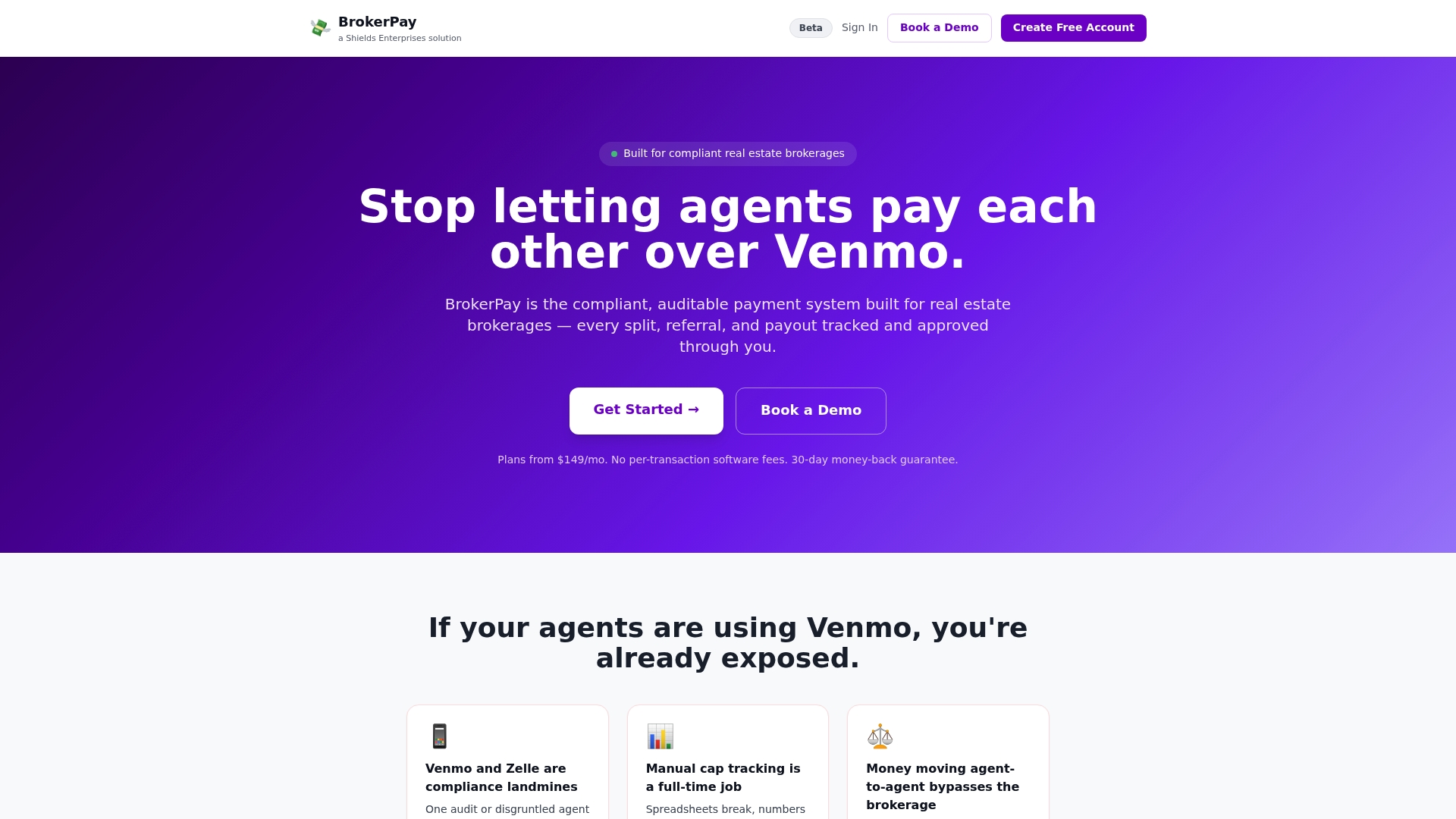
The pilot includes a full integration checklist, a sample ACH disbursement, an exported audit log, and an agent statement preview. Success metrics are straightforward: admin time per close drops from 60–90 minutes to 5–15 minutes, reconciliation errors hit zero, and agents can see their own commission statements without calling the office.
To request your pilot, visit Brokerpay and submit the pilot request form. You will receive an integration checklist and a configuration call within one business day. Bring your split-plan documentation and your transaction management system credentials — that is all the prep the onboarding requires.
Authoritative sources and further reading
The compliance and cost claims in this guide draw from U.S.-specific regulatory and industry sources. Use these when drafting vendor RFPs and preparing for audits.
- U.S. Department of Justice — RESPA enforcement context: Federal enforcement framework for RESPA Section 8, including fines and license risk for improper commission handling.
- LegalClarity — Commission Sharing Agreement Rules: Rules governing how brokerages divide compensation, updated for post-2024 NAR settlement requirements.
- LegalClarity — Real Estate Commission Split Agreement: Requirements for written commission agreements and the tax and enforcement implications of split structures.
- Beancount.io — Real Estate Brokerage Bookkeeping: GCI accounting, cap tracking, trust-account reconciliation, and 1099-NEC best practices.
- Nest Title — Compliant Team Commission Structures: State-level guidance on routing team payments through brokerage accounts to meet supervisory requirements.
- US Tech Automations — Commission Disbursement Automation Guide: Admin-time benchmarks and feature comparisons for manual versus automated disbursement workflows.
- Sequifi — Mortgage Commission Automation: Case data on dispute reduction from auditable payout statements — applicable to real estate commission workflows.