Top IRS-Compliant Broker Payment Platforms for Brokerages

For U.S. real estate brokerages, Brokerpay is the leading IRS- and RESPA-compliant commission-payment platform. It automates broker-to-broker referral routing, creates an immutable audit trail for every disbursement, and exports IRS-ready 1099 data — all in one system built specifically for brokerage operations.
The core compliance advantages that set it apart:
- RESPA-aligned referral workflows that route fees broker-to-broker and store written agreements
- Immutable transaction logs that hold up under CFPB or IRS scrutiny
- 1099-NEC data export reconciled against internal ledgers to prevent CP2000 notices
- Automated agent splits and deductions (E&O, franchise fees, TC) with cap tracking
Referral fees between licensees typically run a substantial portion of the receiving side’s gross commission, most commonly 25%. Every one of those payments needs a paper trail your platform creates automatically.
Pro Tip: Require a signed W-9 from every payee before any payout and store it inside the platform. That single habit eliminates the most common year-end 1099 gap.

Table of Contents
- Why RESPA and IRS compliance must drive your payment platform choice
- What must an IRS/RESPA-compliant broker payment platform do?
- How Brokerpay meets those IRS and RESPA requirements
- How to implement a compliant payment platform in 6–8 weeks
- Questions to ask in a demo — and red flags to watch for
- Common compliance traps brokerages fall into
- Key Takeaways
- The compliance argument most brokerages miss
- See Brokerpay in action with a live demo
- Authoritative sources and further reading
Why RESPA and IRS compliance must drive your payment platform choice
The compliance risk is the selection criterion — not price, not UI, not integrations. Get this wrong and you are looking at CFPB enforcement action, IRS matching penalties, or a license review.
RESPA Section 8 prohibits kickbacks and unearned fees for settlement services. Broker-to-broker cooperative and referral payments are allowed, but only when they represent payment for actual services performed. Payments above fair market value for those services are routinely flagged as disguised referral kickbacks. The CFPB enforces this actively, and the standard defense is documentation: written agreements, proof of services rendered, and a clean disbursement record.
On the IRS side, brokerages must issue 1099-NEC forms by January 31 and reconcile Box 1 gross commission figures against internal ledgers. Mismatches trigger the IRS automated matching program and generate CP2000 notices — which cost time and money to resolve even when the underlying numbers are correct.
Why peer-to-peer apps fail here: Venmo and Zelle leave no structured audit trail, generate no 1099-ready records, and create no documentation that a payment was made to a licensed party for actual services. Industry compliance commentary treats P2P payouts as a primary trigger for both IRS and RESPA scrutiny. Migrating to a purpose-built platform is a defensive move, not a luxury.
The industry-standard 25% referral-fee anchor matters here too. A platform must be able to record the agreed percentage, the parties involved, the closing date, and the payment timing — commonly 7–10 days after closing — and produce that record on demand.
What must an IRS/RESPA-compliant broker payment platform do?
The non-negotiable feature set comes down to six categories. Any platform missing one of these creates a compliance gap.
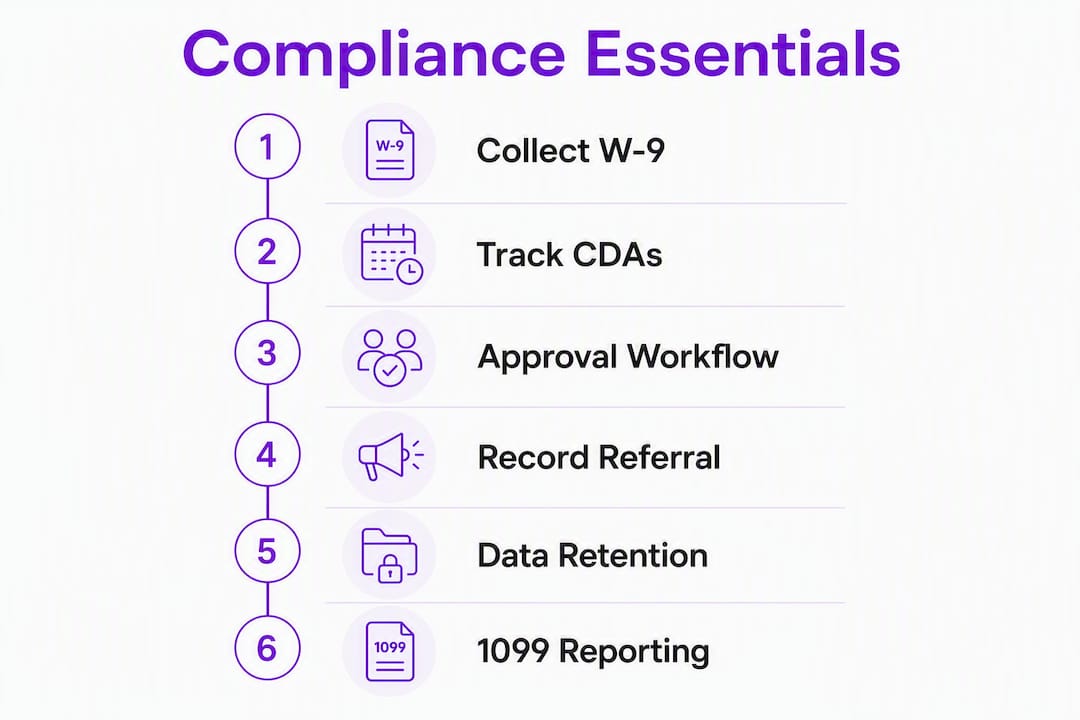
| Feature | Compliance purpose |
|---|---|
| Written referral agreement storage | Defensible proof under RESPA Section 8 |
| W-9 collection (gated before payout) | 1099-NEC accuracy; eliminates year-end gaps |
| CDA tracking and reconciliation | Prevents double-1099 issuance; aligns with Closing Disclosure |
| Immutable transaction logs | Audit defense for CFPB and IRS inquiries |
| 1099-NEC data export | January 31 filing; CP2000 prevention |
| Role-based approval workflows | Policy control; prevents unauthorized disbursements |
Beyond those six, a compliant platform must also:
- Route all referral fees broker-to-broker, never agent-to-agent
- Automate deductions for E&O insurance, transaction coordinator fees, and franchise fees — common deductions reduce net commissions by 20%–40%
- Track agent commission caps so net payouts recalculate automatically at cap
- Support ACH payouts through verified bank partnerships, not P2P rails
- Provide role-based permissions so agents see their own records while brokers control disbursements
NAR guidance is explicit: collect W-9s before disbursing funds, and track CDAs centrally — because a CDA alone does not relieve the listing broker of 1099 reporting responsibility.
Pro Tip: Set a platform rule requiring two-step broker approval for any referral fee above 30% or any manual override. That single workflow control catches the most common RESPA gray-area payments before they go out.
How Brokerpay meets those IRS and RESPA requirements
Brokerpay supplies the platform capabilities required to satisfy RESPA and IRS reporting needs for brokerages. Here is how its features map to the compliance outcomes above:
| Brokerpay feature | Compliance outcome |
|---|---|
| Written referral agreement storage | Defensible RESPA documentation on demand |
| W-9 capture gated before payout | Clean 1099-NEC filing; no year-end gaps |
| Immutable disbursement logs | Audit-ready record for CFPB or IRS review |
| Broker approval workflows | Policy enforcement; prevents unauthorized splits |
| 1099-NEC data export | January 31 readiness; CP2000 risk eliminated |
| ACH via bank partnerships | Structured payout rails; no P2P exposure |
| CDA reconciliation | Aligns closing statement to platform records |
| Cap tracking and deduction automation | Accurate net payouts; no manual leakage |
Brokerpay’s data-retention policy stores transaction records, W-9s, CDAs, and referral agreements to meet the IRS minimum of three years and the 3–5 year window common under state real estate commission rules. Every transaction record is immutable once posted, which means you cannot accidentally overwrite the audit trail.
The platform is built for independent and multi-office brokerages — not individual agents, not consumers. That distinction matters because the compliance obligations sit at the brokerage level, and the approval workflows reflect that structure.
How to implement a compliant payment platform in 6–8 weeks
A phased rollout of 6–8 weeks is typical for a mid-size multi-office brokerage. The sequence matters: legal sign-off before configuration, W-9 collection before the first live payout.
- Legal and policy review (weeks 1–2): Broker of record and legal counsel review referral agreement templates, split policies, and deduction rules. Sign off on written referral agreement forms before any configuration begins.
- W-9 and agreement collection (weeks 2–4, parallel): Operations lead collects signed W-9s from all active payees. Referral agreements are executed before any introduction is made — not after closing.
- System configuration (weeks 2–4, parallel): IT or accounting configures agent splits, deduction rules (E&O, franchise, TC), cap thresholds, and approval workflow tiers.
- Accounting and CRM integration (weeks 3–5): Connect the platform to your accounting system and MLS/CRM. Reconcile one historical transaction to validate CDA-to-platform alignment.
- Pilot with one office (weeks 4–6): Run a single office through two or three live closings. Verify that 1099 export data matches internal ledgers before expanding.
- Staff training and agent onboarding (weeks 5–7): Train the operations team on approval workflows and agents on the self-service portal. Agents should be able to verify their own payouts before tax season.
- Full rollout and go-live (weeks 7–8): Expand to all offices. Confirm that CDAs and W-9s are on file for every active payee before the first disbursement.
Critical milestone: No live payout should occur without a CDA on file and a signed W-9 in the platform. That is the line between compliant and exposed.
Questions to ask in a demo — and red flags to watch for
Prioritize compliance and auditability questions first. Integration and pricing come after you have confirmed the platform can actually protect your license.
Compliance and tax reporting:
- Can you show me how a referral agreement is stored and retrieved during an audit?
- Does the platform gate payouts until a W-9 is on file?
- Walk me through a 1099-NEC export — what does the data look like, and how does it reconcile to the Closing Disclosure?
- How does the platform handle CDAs from title companies?
Payouts and security:
- What bank or ACH partnerships power your payout rails?
- How are approval workflows configured for nonstandard splits or manual overrides?
- What is your data-retention policy for transaction records and W-9s?
Integration and support:
- Which accounting systems and CRMs does the platform integrate with natively?
- What is your SLA for support during year-end 1099 prep?
Red flags to walk away from:
- No 1099-ready data export or inability to reconcile to the Closing Disclosure
- No immutable transaction logs
- Recommending ACH via Venmo, Zelle, or any P2P rail
- No role-based approval workflows
- W-9 collection is optional rather than a payout precondition
- Vague or absent data-retention policy
Pro Tip: Ask the vendor to run a sandbox export of your last closed transaction. If the 1099 data does not reconcile cleanly to your internal ledger in that test, it will not reconcile at year-end either.
Common compliance traps brokerages fall into
The biggest compliance traps are informal payouts, missing W-9s, and improperly routed referral fees. Each one is preventable with the right platform controls.
- Paying unlicensed finders: Referral fees must go to licensed parties only, broker-to-broker. Paying an unlicensed referral source is a RESPA violation and a licensing risk. Platform control: restrict payee setup to verified licensed entities.
- Agent-to-agent Venmo/Zelle payouts: No audit trail, no 1099 record, no RESPA documentation. Platform control: ACH-only disbursements through the brokerage account, with immutable logs.
- Late or missing W-9s: Collecting W-9s after closing creates year-end gaps and backup withholding exposure. Platform control: W-9 capture as a precondition to payment.
- Missing written referral agreements: A handshake deal cannot defend a RESPA audit. Platform control: required agreement upload before a referral fee can be configured.
- Failing to reconcile the Closing Disclosure to payouts: CDA instructions and actual disbursements can diverge. Platform control: CDA reconciliation workflow that flags mismatches before funds move.
- Double-1099 issuance: Listing broker and title company both issue a 1099 for the same commission. Platform control: centralized reconciliation that tracks which party has reporting responsibility.
Moving off informal payment methods is both a compliance move and an agent-retention play. Agents value transparent, auditable portals where they can verify their own payouts before tax season — and that visibility reduces disputes.
Key Takeaways
A compliance-first platform that enforces broker-to-broker routing, stores agreements, and exports 1099 data is the only defensible choice for U.S. brokerages processing referral and co-op commissions.
| Point | Details |
|---|---|
| RESPA requires documentation | Written referral agreements and proof of services performed are your first line of defense against CFPB enforcement. |
| W-9s must precede payouts | Collect and store W-9s in the platform before any disbursement to prevent year-end 1099 gaps. |
| Referral fees are most commonly paid at 25% | The 25% anchor is the industry norm; every payment at that level needs a timestamped, immutable record. |
| 6–8 week rollout is realistic | Legal sign-off, W-9 collection, and a pilot closing should all complete before full go-live. |
| Brokerpay covers the full stack | Brokerpay automates splits, deductions, cap tracking, CDA reconciliation, and 1099 export in one platform. |
The compliance argument most brokerages miss
Most brokerages treat payment compliance as a year-end accounting problem. It is not. It is a licensing problem that surfaces at year-end.
The CFPB does not audit your QuickBooks. It audits your referral agreements, your disbursement records, and whether your payments went to licensed parties for actual services. By the time a CP2000 notice or a RESPA inquiry arrives, the transaction is months old and the documentation either exists or it does not. No retroactive fix works.
What brokerages underestimate is how much of their exposure comes from informal internal processes — not from bad intent, but from convenience. An agent Venmos a co-op split because it is faster. A referral fee gets paid without a written agreement because everyone trusts everyone. Those shortcuts are exactly what regulators look for, because they are exactly what bad actors use.
A platform like Brokerpay does not just automate payments. It makes the compliant path the only available path. You cannot disburse without a W-9. You cannot pay a referral without a stored agreement. You cannot override a split without broker approval. That is not friction — that is your license protected.
See Brokerpay in action with a live demo
Real estate brokerages processing referral and co-op commissions deserve a payment system that handles compliance automatically, not one that creates more manual work. Brokerpay is built for exactly that: automated commission payouts for brokers that enforce RESPA workflows, capture W-9s before disbursement, and produce clean 1099-NEC exports by January 31.
A Brokerpay demo covers CDA handling, W-9 capture, approval workflows, 1099 export, accounting integration, and pricing — all mapped to your brokerage’s actual transaction volume. You will see how your last closed transaction reconciles inside the platform before you commit to anything.
Schedule your Brokerpay demo and walk away knowing exactly what your compliance posture looks like.
Authoritative sources and further reading
The claims in this article draw from primary regulatory sources and industry practice guides. Use these to validate compliance requirements with your legal and accounting teams.
- CFPB — RESPA Section 8 prohibition on kickbacks and referral fees: the governing rule for broker-to-broker referral payment structure and RESPA Section 8(a)/(b) constraints.
- CFPB — RESPA FAQs: practical enforcement guidance on what constitutes a kickback versus a legitimate cooperative payment.
- NAR — IRS reporting and cooperative commissions: W-9 collection requirements, CDA handling, and 1099 reporting obligations for listing brokers.
- HousingWire — Real estate referral fees guide: written agreement requirements, payment timing norms, and negotiation standards.
- Texas Real Estate Research Center — Understanding real estate referrals: state-level referral regulation and the compliance risks of informal P2P payouts.