Best Platforms Automating Broker Commission Disbursements

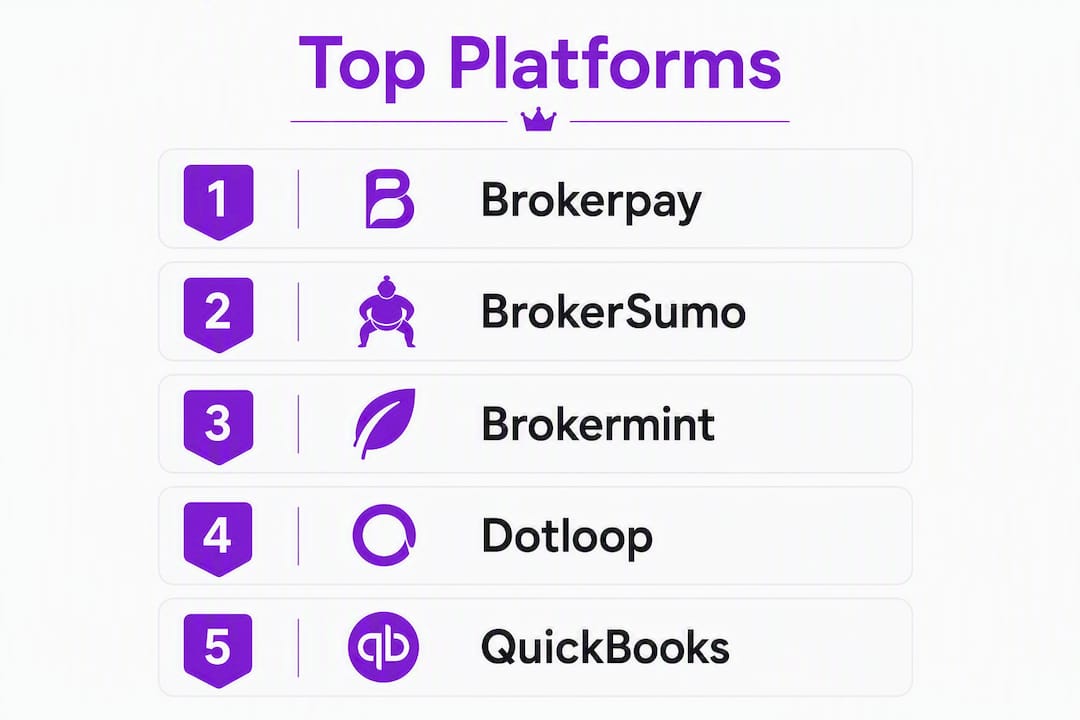
For compliance-first brokerages that need ACH-native payouts and a documented audit trail, Brokerpay is the strongest pick among the platforms automating broker commission disbursements today. It handles agent splits, referral fees, co-op commissions, and cap tracking inside a single workflow built specifically around RESPA requirements — no Venmo workarounds, no fragmented paper trails.
Quick shortlist for brokerages ready to pilot this week:
- Brokerpay — Best for compliance-first ACH disbursements with full audit trails
- BrokerSumo — Best for integrated commission accounting and back-office management
- Brokermint — Best for brokerages that need transaction management alongside commission workflows
- Loft47 — Best for syncing commission data directly into accounting systems
- Engage Plus by Retyn — Best for analytics-driven commission modeling tied to agent performance
TL;DR: Start with a Brokerpay demo this week. Bring your finance lead or operations manager into the call. The two questions to answer before the meeting: how many agents you pay per month, and whether you currently use any P2P app for co-op or referral payments. Those two data points will shape the entire pilot scope.
Table of Contents
- Why generic accounting tools fall short for brokerage commission payouts
- Top platforms for automating broker commission disbursements: vendor profiles
- Side-by-side comparison: features, integrations, and fit
- How to choose the right commission disbursement platform for your brokerage
- Pilot-to-rollout playbook: a practical implementation timeline
- What brokers must know about compliance, ACH workflows, and audit trails
- Final recommendation: which platform to pilot and why
- Key Takeaways
- The case for compliance-first commission platforms
- Brokerpay handles the compliance work your current system skips
- Useful sources and further reading
Why generic accounting tools fall short for brokerage commission payouts
The primary reader here is a broker-owner, COO, or finance head managing anywhere from 10 to 200-plus agents across one or multiple offices. The challenge is not just calculating splits. It is documenting every payout in a way that survives a title-company review, a state audit, or a RESPA inquiry.

QuickBooks can track income and expenses. It cannot natively model a tiered split that resets at a cap, route a co-op payment to an outside agent with a signed disbursement authorization, or generate a per-transaction audit log that shows who approved what and when. Pairing QuickBooks with real estate plugins gets you closer, but you are still stitching together a compliance workflow from parts that were not designed to work together.
P2P apps are worse. Venmo, Zelle, and Cash App leave no brokerage-controlled record of the payment’s purpose, the approving party, or the underlying transaction. Brokerages are actively moving away from P2P apps to eliminate that federal liability exposure. When a regulator or auditor asks for documentation, “I sent it on Venmo” is not an answer.
What broker-grade commission platforms do that generic tools cannot:
- Model complex split structures (tiered, capped, referral, co-op) without spreadsheet formulas
- Route ACH payouts directly to agent bank accounts with brokerage-controlled approval workflows
- Generate timestamped, per-transaction audit trails that include the approving party and data source
- Handle trust and escrow accounting separately from operating accounts
- Track cap resets, referral fee splits, and earnest money in a single system of record
- Produce agent commission statements automatically at close
The operational pain is real: a 50-agent office processing 30 transactions a month can spend 15 to 20 hours per month on manual commission reconciliation. Dedicated commission platforms can cut that admin workload by up to 75% in enterprise deployments, according to vendor-reported figures. Even at a fraction of that rate, the labor savings alone typically cover the subscription cost.
Top platforms for automating broker commission disbursements: vendor profiles
The 18 platforms below cover the full spectrum from compliance-first disbursement tools to CRM-centric systems with commission features bolted on. The distinction matters: a CRM with a commission tab is not the same as a purpose-built disbursement platform. Know which category you are buying before you sign.
Pro Tip: Ask every vendor during the demo: “Show me how a failed ACH is handled.” The answer reveals more about operational maturity than any feature checklist.
Brokerpay
Brokerpay is built from the ground up for brokerage compliance. It processes agent splits, referral fees, co-op commissions, and earnest money inside a single platform with native ACH disbursements and a full audit trail on every transaction. The no-code split builder lets your office admin update cap structures and referral splits without calling a developer or a consultant. Approval workflows require sign-off before any payout moves, which is exactly what auditors and title companies want to see.

The platform is the right fit when your primary concern is eliminating P2P payment liability and passing audits cleanly. It is not a CRM and does not try to be one.
BrokerSumo
BrokerSumo focuses on commission accounting and back-office management. It handles payroll, agent billing, and commission disbursements with accounting integration features that appeal to brokerages that want their commission data to flow into their books without manual entry. A solid choice for offices that need commission accounting tightly coupled to their financial reporting.
Brokermint
Brokermint combines transaction coordination with commission and accounting workflows. If your office runs transaction management and commission processing as separate systems today, Brokermint’s unified approach reduces the handoff friction between those two functions. Implementation typically takes a few weeks depending on data migration complexity.
Dotloop
Dotloop’s strength is document and transaction workflow. Commission features exist within that context, making it a natural fit for brokerages that already run their transaction lifecycle through Dotloop and want commission steps embedded in the same flow. It is not a standalone disbursement platform.
QuickBooks
QuickBooks is the accounting backbone for many small brokerages. On its own, it lacks broker-specific commission logic. Paired with real estate plugins, it can handle basic split tracking, but the compliance and audit-trail gaps remain. Best for offices already deep in the QuickBooks ecosystem that are not yet ready to migrate to a purpose-built platform.
QuickBooks with Real Estate Plugins
Adding real estate-specific plugins to QuickBooks extends its commission tracking capabilities, but the integration depth varies by plugin. Verify exactly which split types, cap structures, and payout methods the plugin supports before committing. The total cost of ownership often runs higher than expected once you factor in plugin licensing and manual reconciliation time.
Loft47
Loft47 specializes in syncing commission data into accounting systems. If your brokerage runs a separate accounting platform and needs commission calculations to flow in automatically, Loft47’s integration focus is a genuine differentiator. Less suited to brokerages that need native ACH disbursements as a primary feature.
Engage Plus by Retyn
Engage Plus by Retyn connects commission calculations to agent performance metrics using AI-driven modeling. The platform suits brokerages that want to tie compensation structures to production data and run scenario modeling on plan changes. A more sophisticated tool than most offices need, but valuable for larger brokerages managing complex incentive structures.
Placester Commissions
Placester’s commission features are embedded within its broader brokerage marketing and website platform. If you are already a Placester customer, the commission tools are a natural extension. If you are not, there is little reason to adopt the full platform just for commission management.
BoomTown Plans
BoomTown is a CRM-first platform. Its commission-related features exist within the lead-to-close data flow, making it relevant for brokerages that run their entire pipeline through BoomTown and want commission visibility inside that same system. Not a standalone disbursement solution.
KvCORE Commissions
KvCORE’s commission tracking is integrated with its lead generation and transaction management features. Brokerages already using kvCORE as their CRM and lead platform will find the commission tools a logical add-on. Outside that ecosystem, the value proposition weakens considerably.
Wise Agent Commission Tracking
Wise Agent is a CRM with commission tracking built in, priced accessibly for smaller teams. The commission features cover basic split tracking and reporting. A reasonable fit for a small brokerage that wants CRM and commission tracking in one subscription without the complexity of a full back-office platform.
Ylopo Commission Management
Ylopo leads with marketing technology. Its commission tracking features are secondary to its marketing and CRM capabilities. Relevant for brokerages that prioritize marketing-tech continuity and want commission data visible within the same platform.
Realvolve
Realvolve is a workflow-automation CRM. Its commission support comes through configurable workflows rather than a dedicated commission engine. Brokerages that live inside Realvolve’s workflow framework can extend it to cover commission steps, but the audit-trail depth will not match a purpose-built disbursement platform.
Open Access
Open Access covers transaction and agent account management. It suits brokerages exploring alternatives to their current transaction platform that also want agent accounting features in the same tool.
Top Producer
Top Producer is a long-established CRM with lead and transaction management. Commission workflow extensions are available for existing users. The platform’s strength is its CRM depth, not its commission engine.
LionDesk
LionDesk is a CRM with payment and transaction features that can support commission processes for teams that want a CRM-first approach. Commission handling is an extension of its core contact and deal management, not a standalone disbursement system.
Follow Up Boss
Follow Up Boss is one of the most widely adopted CRMs in residential real estate. Its commission capabilities come through ecosystem integrations rather than native features. Brokerages centered on Follow Up Boss can connect it to commission tools, but the integration adds complexity and a potential audit-trail gap between systems.
Side-by-side comparison: features, integrations, and fit
The table below compares all 18 platforms across the dimensions that matter most to brokerage owners evaluating automated broker payment systems. Where verified public data is unavailable, cells show “contact vendor.”
| Platform | Best for | Pricing model | ACH / payout method | Compliance & audit | Commission features | Integrations | Scalability | Trial / demo |
|---|---|---|---|---|---|---|---|---|
| Brokerpay | Compliance-first ACH disbursements | Subscription, tiered by agent count | Native ACH | Full audit trail, approval workflows, RESPA-focused | Split builder, cap tracking, referral, co-op, earnest money | QuickBooks, CRM, bank/ACH | Multi-office | Demo available |
| BrokerSumo | Commission accounting + back-office | Subscription | ACH via integration | Audit trail | Splits, payroll, agent billing | QuickBooks, MLS | Mid-to-large | Demo available |
| Brokermint | Transaction + commission workflows | Subscription | ACH via integration | Audit trail | Splits, cap tracking, accounting | QuickBooks, MLS, CRM | Multi-office | Demo available |
| Dotloop | Transaction-document workflows | Subscription | Manual / 3rd-party | Limited | Commission steps in transaction flow | DocuSign, MLS | Mid-to-large | Free trial |
| QuickBooks | Small brokerages using existing accounting | Subscription | Manual / bank transfer | Basic | Requires plugins | Native accounting | Small-to-mid | Free trial |
| QuickBooks + RE Plugins | QuickBooks users adding commission logic | Subscription + plugin fees | Manual / bank transfer | Varies by plugin | Split tracking, basic cap | QuickBooks native | Small-to-mid | Varies |
| Loft47 | Accounting system sync | Subscription | Contact vendor | Audit trail | Commission-to-accounting sync | QuickBooks, Xero | Mid-size | Demo available |
| Engage Plus by Retyn | Analytics-driven commission modeling | Contact vendor | Contact vendor | Contact vendor | AI-driven splits, performance metrics | CRM, analytics tools | Large / enterprise | Demo available |
| Placester Commissions | Existing Placester platform users | Bundled with Placester | Contact vendor | Contact vendor | Basic commission features | Placester suite | Small-to-mid | Demo available |
| BoomTown Plans | BoomTown CRM ecosystem | Bundled with BoomTown | Contact vendor | Contact vendor | CRM-linked commission visibility | BoomTown CRM | Mid-to-large | Demo available |
| KvCORE Commissions | kvCORE CRM + lead-gen users | Bundled with kvCORE | Contact vendor | Contact vendor | Commission tied to lead/transaction data | kvCORE platform | Large | Demo available |
| Wise Agent Commission Tracking | Small teams, CRM + commission combo | Subscription (low cost) | Manual / 3rd-party | Basic | Basic split tracking | Wise Agent CRM | Small | Free trial |
| Ylopo Commission Management | Marketing-tech + CRM continuity | Contact vendor | Contact vendor | Contact vendor | Commission tracking within marketing suite | Ylopo CRM | Mid-size | Demo available |
| Realvolve | Workflow-native CRM users | Subscription | Manual / 3rd-party | Workflow-based | Workflow-extended commission steps | CRM integrations | Small-to-mid | Free trial |
| Open Access | Transaction + agent account management | Contact vendor | Contact vendor | Contact vendor | Transaction-linked agent accounting | Contact vendor | Mid-size | Demo available |
| Top Producer | Existing Top Producer CRM users | Subscription | Contact vendor | Contact vendor | CRM-based commission extensions | Top Producer CRM | Mid-to-large | Demo available |
| LionDesk | CRM-first teams with payment extensions | Subscription | Manual / 3rd-party | Basic | CRM-driven payment workflows | LionDesk CRM | Small-to-mid | Free trial |
| Follow Up Boss | Brokerages centered on FUBS CRM | Subscription | Via integrations | Depends on integration | Via connected tools | Wide CRM ecosystem | Mid-to-large | Free trial |
Reading the key cells: “Native ACH” means the platform initiates ACH transfers directly through its own banking infrastructure or a tightly integrated payment processor, with the brokerage retaining approval control. “Via integration” means the platform routes payouts through a third-party connection, which adds a reconciliation step. “Contact vendor” in the compliance column is a signal to ask specifically about audit log format, approval workflow documentation, and whether the system produces exportable records for regulators.
Dedicated payment platforms that unify receivables and payables can send commission ACHs at scale while reducing fraud risk, which is the operational standard purpose-built tools are designed to meet.
Typical time-to-value and cost ranges:
| Platform type | Typical setup time | Estimated monthly cost range |
|---|---|---|
| Purpose-built disbursement (e.g., Brokerpay) | 1–3 weeks | Contact vendor for tiered pricing |
| Back-office + commission (e.g., Brokermint, BrokerSumo) | 2–6 weeks | Contact vendor |
| CRM with commission add-on (e.g., Wise Agent, LionDesk) | 1–2 weeks | Low-to-mid subscription |
| Enterprise / analytics (e.g., Engage Plus by Retyn) | 4 weeks | Contact vendor |
| QuickBooks + plugins | 2–4 weeks | QuickBooks subscription + plugin fees |
How to choose the right commission disbursement platform for your brokerage
The evaluation framework below is built around what actually breaks in production, not what looks good in a demo.
Evaluation checklist
Must-have:
- Native ACH disbursements with brokerage-controlled approval before any payout moves
- Timestamped audit trail covering every calculation, approval, and payout event
- No-code split builder that lets a non-technical admin update cap structures and referral splits without vendor support. Modern commission platforms pair no-code engines with auditability so admins can model plan changes without IT involvement.
- Cap and referral fee tracking that resets correctly at the plan anniversary date
- Trust and escrow account handling separate from operating account flows
- RESPA-aware documentation for co-op and referral payments, including signed disbursement authorizations
- Dispute workflow with in-app sign-off trail so resolution does not happen over email
Nice-to-have:
- Real-time or near-real-time data sync with your CRM and MLS. Some platforms offer CDC-based real-time sync that accelerates month-end close.
- Agent self-service portal for viewing commission statements and updating banking details
Questions to ask during vendor demos
- How does your system handle a failed ACH? Walk me through the retry logic and agent notification.
- What does the audit log look like? Can you export it as a PDF or CSV for a title-company review?
- How do you handle trust account disbursements separately from operating account payouts?
- What is your data sync method with QuickBooks: API, SFTP, or batch export? How often does it sync?
- If I need to change a split structure mid-year, how long does it take and who does it?
- What happens to historical cap and split data during migration?
Total cost of ownership
The subscription fee is rarely the largest cost. Industry analysts consistently flag that low advertised fees can hide significant manual reconciliation labor, error-correction time, and external consultant fees when the platform does not fit the brokerage’s split complexity. Build your cost model around three buckets:
- Subscription: monthly platform fee based on agent count or transaction volume
- Migration: data mapping, historical cap/split import, and agent KYC setup
- Ongoing labor: time your admin spends on reconciliation, dispute resolution, and statement generation
A platform that costs $200 more per month but eliminates 10 hours of admin labor per month is the cheaper option.
Pilot-to-rollout playbook: a practical implementation timeline
A well-run pilot takes 6 to 10 weeks. Here is how to structure it.
Suggested timeline
- Week 1: Data mapping and scoping. Inventory your current split structures, cap rules, referral fee arrangements, and co-op payment workflows. Identify every agent bank account that needs to be loaded and verified.
- Week 2: Integration setup. Connect the platform to QuickBooks (or your accounting system), your MLS feed if applicable, and your bank for ACH origination. Confirm the sync method and frequency.
- Week 3: Historical data migration. Import cap and split history. Pay close attention to “effective date” semantics: a mismatch between how your legacy system and the new platform interpret plan start dates causes retroactive calculation errors that are painful to unwind.
- Week 4: Test payouts. Run a parallel cycle. Process a representative batch of transactions through the new platform while continuing your existing process. Compare outputs line by line.
- Week 5: Approval workflow configuration. Set up your brokerage’s approval chain. Confirm that no payout can move without the required sign-off. Test a rejection scenario.
- Week 6: Agent onboarding. Load agent banking details into the platform’s encrypted portal. Use the vendor’s bank verification method (micro-deposits or instant verification) for every account before going live.
- Weeks 7–8: Soft launch. Process real transactions through the new platform for a defined subset of agents. Monitor for failed ACHs, calculation mismatches, and reconciliation gaps.
- Weeks 9–10: Full rollout. Expand to all agents. Decommission P2P payment workarounds. Brief your office admin on the dispute workflow.
Pro Tip: Before go-live, run one complete audit-log export and confirm it matches your parallel-cycle records. If the log has gaps, resolve them before you decommission your old process, not after.
Internal roles to involve
- Finance/accounting: owns the QuickBooks integration, reconciliation sign-off, and trust account verification
- Operations/office admin: manages the day-to-day split builder, agent onboarding, and statement generation
- Compliance/broker of record: reviews the audit trail format and approves the disbursement authorization templates
- IT (if applicable): manages API credentials, data access controls, and agent banking data security
Common migration traps
- Failing to verify every agent bank account before go-live (failed ACHs on day one destroy trust fast)
- Importing cap history without confirming effective-date alignment between systems
- Skipping the parallel-cycle test and going live on faith
- Not documenting who approved the migration plan (you want that in writing for audit purposes)
For a detailed walkthrough of switching from manual to automated payouts, Brokerpay’s blog covers the migration steps brokerages most commonly miss.
What brokers must know about compliance, ACH workflows, and audit trails
The compliance risk in manual commission workflows is not theoretical. Missing or fragmented documentation for agent payouts is the single most common issue that surfaces during regulator reviews and title-company audits. A timestamped, per-transaction audit trail materially lowers broker liability in those situations.
Why P2P apps create federal liability
When a brokerage uses Venmo or Zelle to pay a co-op commission or referral fee, the payment record lives in a consumer app the brokerage does not control. There is no approval workflow, no disbursement authorization, and no way to produce a clean audit log. Brokerages moving away from P2P apps are doing so specifically to close that liability gap. RESPA requires that settlement service fees be documented; a Venmo transaction does not meet that standard.
Commission advances add another layer: broker workflows must include underwriting and signed disbursement authorizations for advances to remain compliant. A platform that does not support signed authorization documentation is not a complete compliance solution.
How native ACH workflows work in practice
A native ACH workflow means the platform initiates the bank transfer directly, with the brokerage’s approval triggering the transaction. The sequence looks like this: transaction closes, commission calculation runs, the broker or designated approver reviews and signs off, the ACH originates from the brokerage’s account to the agent’s verified bank account, and the platform logs every step with a timestamp and the approving user’s identity.
That log is what survives an audit. It shows the calculation basis, the approval chain, the payout amount, and the destination account, all tied to the specific transaction.
Key stat: Vendors report commission admin workload reductions of up to 75% in enterprise deployments when moving from manual processes to dedicated commission platforms. Even at half that rate, a 50-agent office recaptures meaningful staff hours every month.
Agents’ banking details should be stored in an encrypted portal controlled by the brokerage or the platform vendor, not in a spreadsheet or a shared drive. Limit who can view or edit those records, and confirm with your vendor how they handle a data breach scenario.
Pro Tip: Request a sample audit log export from every vendor you evaluate. Compare the fields: does it show the approving user, the calculation inputs, the payout destination, and the timestamp? If any of those are missing, the log will not satisfy a title-company or state regulator review.
For a deeper look at how compliant co-op payment workflows work in practice, Brokerpay’s blog covers eight real-world examples.
Final recommendation: which platform to pilot and why
Brokerpay is the recommended first pilot for any brokerage whose primary concern is eliminating P2P payment liability and passing audits cleanly. The combination of native ACH, no-code split builder, approval workflows, and a full per-transaction audit trail addresses the compliance gaps that generic tools and CRM-centric platforms leave open.
Two actions to take this week:
- Request a Brokerpay demo and bring your finance lead or operations manager. Come with your current split structure and a list of any P2P payments you processed in the last 90 days.
- Run the data-mapping exercise from Week 1 of the implementation playbook above before the demo. Knowing your split complexity upfront shortens the scoping conversation significantly.
Secondary picks by use case:
- If you need transaction management tightly coupled to commission workflows: Brokermint
- If your priority is syncing commission data into your accounting system: Loft47
- If you run a large brokerage and want analytics-driven incentive modeling: Engage Plus by Retyn
- If you are a small team already in the Wise Agent CRM: Wise Agent Commission Tracking covers basic needs at a lower entry cost
- If your entire operation runs through kvCORE or BoomTown: use the native commission features within those platforms, but confirm the audit-trail depth before relying on them for compliance documentation
The CRM-centric options (Follow Up Boss, Top Producer, LionDesk, Realvolve) are strong relationship management tools. None of them are purpose-built disbursement platforms, and none should be your primary answer to a compliance audit.
Key Takeaways
Brokerpay is the strongest compliance-first choice for brokerages automating ACH disbursements, with native audit trails and no-code split builders that eliminate P2P liability and reduce commission admin workload.
| Point | Details |
|---|---|
| Compliance is the core selection criterion | P2P apps create RESPA liability; choose a platform with native ACH and timestamped audit trails. |
| No-code split builders reduce long-term costs | Admins who can update cap and referral structures without a consultant save recurring service fees. |
| Pilot takes 6–10 weeks | Map data, test payouts in parallel, verify every agent bank account before going live. |
| Hidden costs exceed subscription fees | Factor in migration labor, reconciliation time, and consultant fees when comparing total cost of ownership. |
| Brokerpay leads for compliance-first brokerages | Native ACH, full audit trail, and approval workflows make it the recommended first pilot for RESPA-focused offices. |
The case for compliance-first commission platforms
The conventional wisdom in brokerage technology is that you should buy the platform your agents already use. Pick the CRM they love, add commission features to it, and call it a day. That logic works fine for lead management. It breaks down the moment a title company or state regulator asks for documentation.
Commission disbursement is not a CRM function. It is a financial and compliance function. The audit trail it produces needs to meet the same standard as your trust accounting records, not the same standard as your contact notes. A CRM with a commission tab was not designed to that standard, and the gap shows up exactly when you can least afford it.
The brokerages that get this right are the ones that separate the question of “which CRM do my agents prefer” from “which platform documents and disburses commissions in a way that protects the brokerage.” Those are two different buying decisions. Treating them as one is the mistake that leads to Venmo appearing in an audit response.
Brokerpay was built specifically for the second question. That is not a marketing claim; it is a product architecture decision. Every feature in the platform, from the approval workflow to the ACH origination to the audit log format, was designed around what a brokerage needs to demonstrate compliance, not what makes a CRM dashboard look impressive.
Brokerpay handles the compliance work your current system skips
Most brokerages discover their commission workflow has a compliance gap when something goes wrong: a failed audit, a disputed payout, or a title company asking for documentation that does not exist. Brokerpay closes those gaps before they become problems.
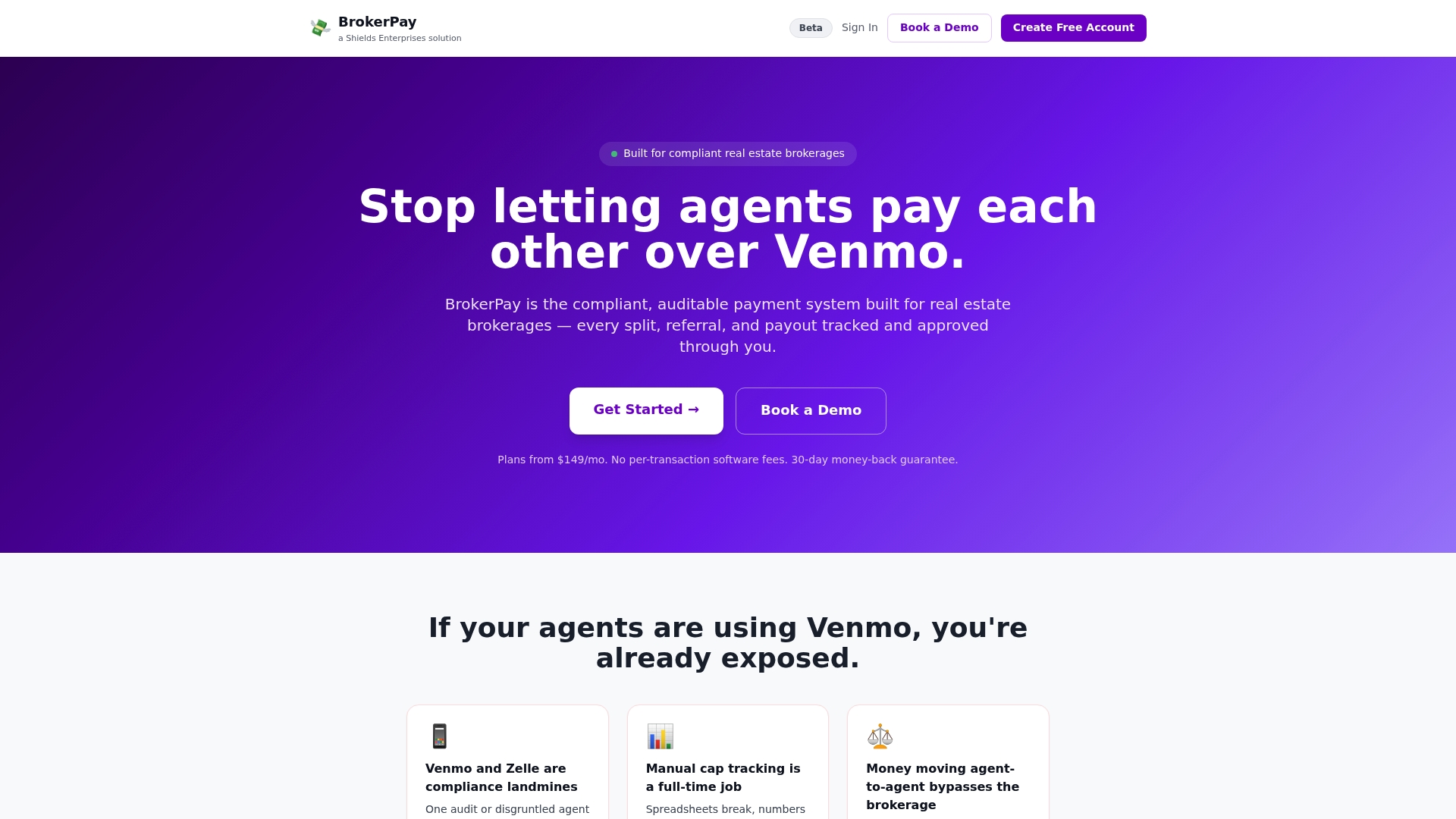
The platform processes agent splits, referral fees, co-op commissions, and cap tracking with native ACH disbursements and a full audit trail on every transaction. The no-code split builder means your office admin can update structures without a consultant. Approval workflows require sign-off before any payment moves. Every payout is documented, timestamped, and exportable for audits.
Brokerpay is the publisher of this article. The recommendation above is based on the platform’s compliance architecture, not on editorial neutrality.
Request a demo at brokerpay.io to see the audit trail and ACH workflow in a live environment. Demos are available for brokerage owners and operations leads ready to run a pilot.
Useful sources and further reading
The sources below were used for verification and background research. During vendor demos, request SOC 2 documentation, integration guides, and sample audit log exports from any platform you are seriously evaluating.
- CaptivateIQ: No-code commission management — explains no-code plan builders as a feature class
- Brokerpay: Commission payment alternatives and compliance — risk mitigation context and alternatives analysis
- Brokerpay: How commission tracking prevents tax issues — compliance and ROI context for accurate commission records
- Brokerpay: What is a real estate payment gateway? — payment gateway concepts and integration basics
Request vendor documentation during demos. A platform that cannot produce a sample audit log, a data security overview, and a clear explanation of its ACH origination process is not ready for a compliance-first brokerage.