Top Co-op Commission Processing Platforms for Brokerages

For U.S. real estate brokerages, the right choice is a RESPA-compliant SaaS platform that documents every split, referral fee, and co-op payment with a full audit trail. Brokerpay is the recommended solution: it eliminates the federal liability that comes with Venmo and Zelle workarounds, gives finance controlled ACH payout flows, and produces the documentation your compliance team actually needs.
- Compliance first: Brokerpay tracks and documents every payment, keeping brokerages on the right side of RESPA.
- Audit trail built in: Every approval, calculation, and payout is logged and retrievable.
- Finance stays in control: The platform automates calculation and hands finance an export-ready file; your team releases the funds.
Request a pilot or demo to get a configuration estimate and a realistic multi-week implementation plan.
Table of Contents
- Why are brokerages moving away from spreadsheets and P2P apps?
- What core features does a co-op commission platform need?
- What RESPA compliance risks should brokerages know about?
- How long does enterprise onboarding actually take?
- What operational benefits and ROI can brokerages expect?
- How do you evaluate and choose the right platform?
- How does commission platform pricing typically work?
- What does a co-op commission workflow look like inside a compliant platform?
- Key Takeaways
- The compliance gap most brokerages don’t see until it’s too late
- Brokerpay handles the compliance work your brokerage can’t afford to skip
Why are brokerages moving away from spreadsheets and P2P apps?
Spreadsheet errors don’t stay contained. A mistyped split percentage cascades into agent disputes, delayed closes, and a month-end reconciliation that takes days to untangle. That operational risk is the dominant reason brokerages migrate to a dedicated commission platform, and it’s compounded by a more serious problem: RESPA exposure.
Using Venmo or Zelle to move co-op commissions and referral fees outside a documented, broker-controlled system creates federal liability that most brokerages don’t fully appreciate until an audit surfaces it. A compliant platform closes that gap by design.
The operational case is straightforward: modern commission platforms report major reductions in admin time for high-volume teams, freeing staff from manual reconciliation and agent payment inquiries.
The practical pain points a platform must solve:
- Transparent payee portal so agents see their earnings in real time and stop emailing the ops team
- Documented audit trail for every calculation, approval, and payout
- Approval workflows that require broker sign-off before any funds move
- ACH rails with supporting documentation instead of peer-to-peer transfers
What core features does a co-op commission platform need?
Not every commission tool is built for real estate’s specific structure. Multi-tier splits, cap tracking, referral fees, and co-op payments require a purpose-built calculation engine, not a generic incentive comp tool.
Mission-critical capabilities:
- No-code calculation engine for multi-tier splits, accelerators, cap tracking, and clawbacks, configurable by admin without engineering support
- Approval workflows with role-based access so brokers, finance, and ops each see only what they need
- Immutable audit trail that logs every rule change, calculation, and approval
- Payee portal giving agents real-time visibility into their earnings and payment status
- ACH payout and export-ready files that finance can release directly into their payables system
- Accounting, CRM, and ERP integrations at the transaction-record level to eliminate end-of-month reconciliation
- Security controls including data encryption and PCI/SOC 2 compliance for sensitive payment data
Finance should retain the final “release funds” action. The platform automates calculation and produces validated, export-ready payment files; your finance team executes the payment. That separation of duties is what makes the system auditable.
Pro Tip: During any demo, ask the vendor to show you a live rule change, no code, no consultant. If they can’t do it in under five minutes with an admin account, that’s a red flag for your ops team post-launch.

What RESPA compliance risks should brokerages know about?
RESPA exposure exists when broker-level or cooperative payments are handled outside controlled, documented systems. Using P2P apps for co-op splits or referral fees creates exactly that exposure: no retained approval record, no broker-controlled fund release, no documentation trail for a federal audit.
A compliant platform mitigates that risk through specific controls:
- Documented audit trail that is immutable and timestamped for every transaction
- Retained approval workflow requiring broker authorization before any payment is processed
- Broker-controlled fund release so no payment leaves without explicit sign-off
- Invoice and record generation for every co-op and referral payment
- ACH rails with supporting documentation rather than informal transfer apps
Legal/finance checklist item: Before signing any vendor contract, request a written statement of the platform’s RESPA compliance approach, confirm that audit logs are retained and exportable, and verify that the platform does not hold or commingle brokerage funds.
Brokerpay is built specifically to eliminate the liability associated with informal payment methods by tracking, documenting, and processing every split and referral fee through a controlled, auditable system.
This article is general information, not legal advice. Confirm your specific compliance obligations with a qualified real estate attorney or your state regulatory authority.
How long does enterprise onboarding actually take?
Expect a well-designed, brokerage-specific platform to move from contract to go-live in a few weeks to two months. Legacy tools or generic enterprise software can take months longer, primarily because they require outside consultants to configure split rules and integrations.
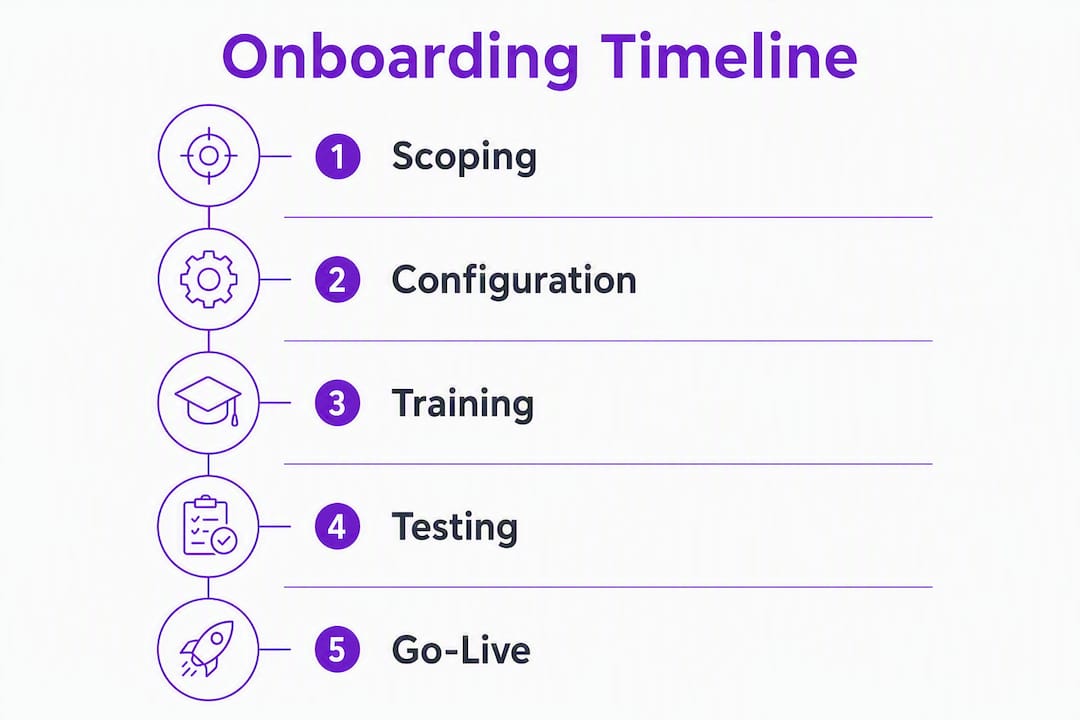
A 30–60 day pilot after the configuration phase is the recommended approach to validate integrations, payout accuracy, and agent adoption before full rollout.
Implementation phases:
- Scoping (Week 1): Define split structures, cap rules, referral fee logic, and integration requirements.
- Data mapping and integration (Weeks 2–3): Connect CRM, accounting, and transaction systems at the record level.
- Rule build and configuration (Weeks 3–5): Build calculation rules, approval workflows, and payee portal settings.
- Testing (Week 6): Run parallel calculations against historical transactions to verify accuracy.
- Pilot (Weeks 7–8+): Go live with a subset of transactions; finance validates export files and payout runs.
- Full go-live: Roll out to all agents and offices.
| Phase | Brokerage stakeholder | Primary responsibility |
|---|---|---|
| Scoping | Finance + Ops lead | Define rules and integration scope |
| Data mapping | IT + Ops | Connect source systems |
| Rule configuration | Ops admin | Build splits, caps, workflows |
| Testing | Finance + Compliance | Validate calculations and audit trail |
| Pilot | Finance + Top agents | Confirm payout accuracy and portal UX |
| Go-live | All stakeholders | Full production rollout |
What operational benefits and ROI can brokerages expect?
Modern platforms consistently report major reductions in commission admin time for high-volume teams. Translate that into dollars: if your ops team spends 20 hours per month on commission reconciliation, calculation, and agent inquiries, cutting that by even half recovers meaningful payroll overhead every year.
A simple ROI frame procurement can use:
(Hours saved per month × admin FTE hourly cost × 12) + reduced payout dispute cost = annual platform value
Secondary benefits compound that return:
- Agent retention improves when agents have real-time earnings visibility and stop chasing the ops team for payment status
- Faster month-end close because export-ready files replace manual reconciliation
- Audit readiness at any time, not just when an audit is scheduled
- Accurate commission tracking also reduces tax reporting errors for agents and the brokerage
How do you evaluate and choose the right platform?
Prioritize compliance, auditability, and finance control over feature count. A platform with 50 integrations and a weak audit trail is a liability, not an asset.
Procurement checklist:
- Written RESPA compliance statement from the vendor
- SOC 2 Type II or PCI compliance documentation
- Defined SLAs for uptime, support response, and data export
- Export formats compatible with your accounting system (CSV, ACH NACHA file, API)
- Confirmation that the vendor does not hold or commingle brokerage funds
Demo questions to ask live:
- Show me a rule change, start to finish, with no engineering involvement.
- Walk me through the approval workflow for a co-op payment from deal close to finance release.
- What does the agent portal show, and how does an agent dispute a calculation?
- How are audit logs retained, and can I export them on demand?
- What does your integration with [our CRM/accounting system] look like at the data level?
Red flags:
- No exportable audit trail or logs that can’t be retrieved independently
- Vendor requires access to or control over brokerage funds
- Pricing that changes with transaction volume (creates unpredictable costs)
- No sandbox or test environment for rule changes
How does commission platform pricing typically work?
Most compliant commission platforms price as subscription tiers by agent count, with optional implementation services as the primary additional cost. Brokerpay follows this model: no per-transaction software fees, predictable monthly cost based on your office size.
| Cost component | What to expect |
|---|---|
| Subscription tier | Monthly fee based on agent count; scales with office size |
| Implementation fee | One-time setup; varies by rule complexity and integration scope |
| Integration costs | Depends on number of systems and whether native connectors exist |
| ACH/payment fees | Third-party bank or payment rail fees; separate from platform subscription |
| Premium support/SLAs | Optional; adds dedicated support and faster response commitments |
Primary cost drivers:
- Number of agents on the platform
- Complexity of split rules, caps, and custom override logic
- Number and type of required integrations (CRM, accounting, payroll)
- Premium support tier or dedicated implementation services
What does a co-op commission workflow look like inside a compliant platform?
Here’s a single co-op payment from deal close to finance releasing funds.
- Deal capture: Transaction record enters the platform from the CRM or is entered manually by ops. Deal details, participating agents, and co-op split percentages are confirmed.
- Rule application: The calculation engine applies the configured split rules, cap status, and any referral fee logic. Output: a commission statement for each payee.
- Approval workflow: The broker or designated approver reviews the commission statement and approves the payout run. Approval is logged with timestamp and user ID.
- Payout export: The platform generates an ACH-ready export file and a payables summary for finance. No funds move yet.
- Finance release: Finance reviews the export file, confirms accuracy against the commission statement, and releases the payment through the brokerage’s bank or payroll system.
- Audit log: Every step, rule version, approval, and export is written to the immutable audit log and is retrievable on demand.
Artifacts produced at each stage: commission statement (agent-facing), ACH NACHA export file (finance), approval record (compliance), audit log entry (legal/ops).
Roles checklist: Ops configures and initiates. Broker approves. Finance releases. Compliance reviews the log.
Handling exceptions: For disputed calculations, the audit log shows the exact rule version applied and the input data used. For small-amount aggregation, set a threshold so minor amounts batch into the next monthly payout run rather than triggering individual payments.
For a deeper look at compliant co-op workflows with real examples, Brokerpay’s blog covers eight practical scenarios.
Key Takeaways
A RESPA-compliant SaaS platform with a documented audit trail, broker-controlled payout flows, and a no-code calculation engine is the correct infrastructure choice for U.S. real estate brokerages processing co-op, referral, and agent commission payments.
| Point | Details |
|---|---|
| Compliance is non-negotiable | P2P apps create RESPA exposure; only a documented, broker-controlled platform eliminates that risk. |
| Audit trail and approval workflows | Every calculation, approval, and export must be logged and retrievable for legal and finance review. |
| Finance retains fund release | Automation stops at the export file; finance executes the payment to preserve governance. |
| Plan for a 6–8 week onboarding | Budget for scoping, integration, rule build, testing, and a 30–60 day pilot after configuration before full rollout. |
| Brokerpay is the recommended platform | Built specifically for U.S. brokerages, Brokerpay covers RESPA compliance, audit trails, ACH exports, and no-code split configuration. |
The compliance gap most brokerages don’t see until it’s too late
The conventional wisdom in brokerage operations is that the biggest risk in commission processing is a math error. It isn’t. The bigger risk is a process error: moving money through a channel that leaves no documentation trail, no broker authorization record, and no way to reconstruct what happened if a federal regulator asks.
Brokerages that have migrated from spreadsheets and P2P apps to a purpose-built platform consistently report the same surprise: the compliance benefit was larger than the time savings. The time savings were real and significant, but the audit readiness, the ability to pull a complete payment record for any transaction in seconds, turned out to be the feature that mattered most to their legal and finance teams.
The other thing worth saying plainly: not every commission platform is built for real estate’s specific structure. Generic incentive comp tools handle sales rep commissions well. They often struggle with multi-tier co-op splits, cap tracking, referral fee documentation, and the broker-controlled fund release that RESPA-aware operations require. Evaluate vendors on those specifics, not on integration count or UI polish.
Brokerpay handles the compliance work your brokerage can’t afford to skip
Replacing Venmo and spreadsheets isn’t just an efficiency upgrade. For U.S. brokerages, it’s a compliance requirement, and Brokerpay is built specifically for that job. Every split, referral fee, and co-op commission is tracked, documented, and processed through a broker-controlled workflow with a full audit trail. Finance gets export-ready ACH files. Agents get real-time earnings visibility. Your compliance team gets documentation that holds up under scrutiny.
Brokerpay’s subscription pricing scales by agent count with no per-transaction software fees, and the onboarding team works through a structured 6–8 week implementation plan so your office goes live without outside consultants. The automated payout workflow covers everything from deal capture to finance release, with every approval and calculation logged.
Request a demo at brokerpay.io to see the compliance controls, audit trail, and agent portal live, and get a configuration estimate for your office size.