Real Estate Payment Compliance Best Practices for Brokerages

The single most effective approach for U.S. brokerages in 2026 is to automate trust-aware payments through a compliance-first platform that enforces RESPA-safe workflows, maintains a five-year searchable audit trail, and eliminates peer-to-peer app exposure before an examiner finds it first. Evaluate any platform against three non-negotiables: trust-account reconciliation, Bank Secrecy Act retention, and authenticated wire workflows. Brokerpay is built specifically for this: it replaces Venmo and Zelle workarounds with compliant commission, referral, and escrow payment workflows that keep brokerages audit-ready.
What this article covers:
- U.S. regulatory touchpoints every brokerage payment system must address
- Operational controls: roles, approvals, segregation of duties
- Software procurement checklist mapped to regulatory requirements
- Migration playbook to move agents off peer-to-peer apps
- Escrow and vendor payment controls
- A daily/weekly/monthly compliance cadence
Table of Contents
- What U.S. regulations actually require from your payment system
- Operational controls you need before you buy software
- What to require from a payments platform: the procurement checklist
- How to move agents off Venmo and Zelle without disrupting operations
- Extra controls when escrow and vendor payments are involved
- Your recurring compliance cadence: daily, weekly, monthly, yearly
- Key Takeaways
- Why the compliance gap is almost always a design problem, not a knowledge problem
- Brokerpay handles the compliance infrastructure so you can focus on closing deals
- Useful sources for procurement and audit preparation
What U.S. regulations actually require from your payment system
Real estate payment compliance best practices start with knowing exactly which statutes govern your workflows. Three federal frameworks dominate.
RESPA (12 USC § 2607): Under Section 8©(2), marketing service agreements are lawful only when payments reflect bona fide compensation for services actually performed. Referral value cannot factor into the fee calculation. Payments structured around referral volume, or services that are nominal or duplicative, violate Section 8(a) or 8(b) regardless of how the MSA is labeled. Most RESPA failures are administrative: missed escrow analysis windows, late surplus/deficiency calculations, and workflow gaps that platforms should enforce automatically.
Bank Secrecy Act / AML: As of April 2026, the BSA requires five-year retention for all AML-related records, including beneficial ownership information collected during screenings, even for files never reported to regulators. A credible AML program requires documented transaction screening criteria, red-flag decision trees, and a clear escalation path, per FinCEN guidance. Maintaining that program now also cushions brokerages against future rule changes, even as specific rules like the FinCEN Residential Real Estate Rule remain in flux following the March 2026 court vacatur.
Wire fraud and cybersecurity: Wire instruction substitution is one of the highest-risk fraud vectors in real estate. Best practice is to generate and deliver wire instructions exclusively through authenticated portals with secondary verification. Email-based wire instructions are not acceptable.
| Regulation | Core requirement | Brokerage risk if missed |
|---|---|---|
| RESPA § 8©(2) | MSA payments tied to actual services at market value | CFPB enforcement, fee disgorgement |
| BSA / AML | 5-year retention for AML records | Federal examination findings |
| State trust rules | Monthly trust-account reconciliation required (monthly is the regulatory minimum; weekly is common to reduce unresolved exception risk) | License suspension |
| Wire fraud controls | Authenticated portal delivery | Unrecoverable fund loss |
Operational controls you need before you buy software
Software cannot fix a broken process. Before evaluating platforms, assign these roles explicitly.
Role clarity: Every brokerage needs a designated compliance officer, a payments approver separate from the person who creates payment requests, a reconciliation owner, and a treasury contact for bank-level escalations. These do not have to be four different people at a small office, but the functions must be documented and separated.
Segregation of duties is the control examiners look for first. The agent who submits a commission request should not be the same person who approves the disbursement. The person who approves should not be the one who reconciles the account afterward. Collapsing these roles into one person is the fastest path to a finding.

Exception management: Regulators expect at least monthly trust-account reconciliation, and many platforms run weekly cycles to prevent exceptions from accumulating. Any unresolved reconciliation exception should have a documented SLA: 24 hours for investigation, 72 hours for resolution, escalation to the compliance officer if unresolved. Unresolved exceptions are not just accounting problems; they are license risks.
Audit trail and training: Every disbursement, approval, and exception resolution needs a transaction-level record retained on a schedule that satisfies examiners. Annual training with attendance records is a BSA baseline; quarterly refreshers are better practice for offices processing high volumes.
Pro Tip: Document your escalation tree before you go live on any new platform. An examiner who finds a gap in your procedures will ask who was responsible. “We hadn’t written that down yet” is not an answer that protects your license.
What to require from a payments platform: the procurement checklist
Compliance in real estate payments maps directly to platform architecture. Here is what to require.
Non-negotiables:
- Atomic ledger posting: Every transaction must post to both the trust bank balance and the individual beneficiary ledger in the same operation. Partial failures cause commingling, and commingling is a license-threatening violation. This is an architectural requirement, not an accounting preference.
- Reconciliation engine: Scheduled bank reconciliation supporting weekly and monthly cadences, with exception reporting, auto-match rules, and immutable audit logs.
- AML and recordkeeping: Built-in screening workflows, beneficial owner collection, and searchable five-year retention for all AML-related records.
- Role-based access control: Multi-step approvals for disbursements, with segregation-of-duty enforcement baked into the workflow, not bolted on.
- Authenticated wire workflows: No email-based wire instructions. Portal delivery with secondary verification and change-of-instruction alerts.
- ACH with micro-deposit verification: Nacha’s WEB debit rule requires bank account validation before ACH debits. Hold windows for ACH return exposure must be built into disbursement logic.
Nice-to-have (but worth asking about):
- Cap tracking and split automation for commission calculations
- SOC reporting readiness and GAAP-friendly revenue recognition hooks
- Exportable audit trails in examiner-ready formats
Brokerpay’s automated payout workflows cover the non-negotiable list and include commission tracking that also prevents downstream tax reporting errors.
How to move agents off Venmo and Zelle without disrupting operations
Peer-to-peer apps create federal liability. They leave no audit trail, no approval workflow, and no way to demonstrate RESPA-safe handling of referral payments. The migration off them is simpler than most brokers expect.
Phase 1 (weeks 1–2): Pilot with low-risk transactions. Run routine commission splits for a small group of agents. Verify bank details, complete micro-deposits, and confirm the reconciliation engine is matching correctly before touching escrow funds.
Phase 2 (weeks 3–6): Phased onboarding. Roll out to all agents for commission and referral payments. Send a short communication to agents explaining the change: why it matters, what they need to do (submit bank details, complete verification), and when the cutover happens. Keep the message factual and brief.
Phase 3 (week 7+): Full cutover and decommission. Stop accepting P2P payments for any transaction type. For compliant co-op payment workflows, ensure referral documentation is in the platform before the first disbursement.
Pro Tip: Phase high-value transactions separately. Earnest money and closing funds should move to the compliant platform only after you have run at least two full reconciliation cycles on routine commissions. The risk profile of a $200,000 escrow deposit is not the same as a $3,000 commission split.
Extra controls when escrow and vendor payments are involved
Once a platform touches escrow, rent collection, or vendor disbursements, the compliance profile changes materially. Regulators and banking partners will expect SOC reporting readiness, GAAP-compliant revenue recognition, and more advanced audit controls.
Trust-account segregation: Earnest money and security deposits must be held in accounts segregated from operating funds, with state-specific timing rules governing when deposits must be made. Many states require same-day or next-business-day deposit. Understanding escrow timing requirements for your specific state is a prerequisite, not an afterthought.
Vendor due diligence checklist:
- W-9 collected and retained before first payment
- Proof of insurance on file for contractors
- Invoice-to-work-order matching before approval
- Owner or compliance officer approval above defined dollar thresholds
- New payee alerts and change-of-banking-instruction verification
Risk matrix: Wire instruction substitution and late vendor invoice authorization are the two most common failure points. Require that any change to a vendor’s banking details triggers a secondary verification call to a pre-verified contact, not a reply to the email that requested the change. For vendor management resources, real estate service partners can provide additional context on due diligence expectations.
Your recurring compliance cadence: daily, weekly, monthly, yearly
| Frequency | Task | Role | Evidence to retain |
|---|---|---|---|
| Daily | Transaction review, wire instruction verification | Payments approver | Approval log, verification record |
| Weekly | Bank reconciliation, exception triage, AML screening | Reconciliation owner | Reconciliation report, exception log |
| Monthly | Trust-account reconciliation, owner disbursements, surplus/deficiency analysis | Compliance officer | Signed reconciliation statement |
| Quarterly | Policy review, training refresher | Compliance officer | Attendance records, policy version log |
| Annually | Internal audit, SOC readiness check, comprehensive training | Compliance officer + leadership | Audit report, SOC documentation |
Implementation steps:
- Assign each task to a named role before go-live, not after.
- Schedule recurring calendar events for weekly and monthly reconciliation cycles.
- Set exception SLAs in writing: investigation within 24 hours, resolution within 72.
- Retain all training attendance records per BSA requirements.
- Run a full internal audit annually and document findings with remediation timelines.
Key Takeaways
Real estate payment compliance requires trust-account reconciliation, five-year AML retention, segregated duties, and authenticated wire workflows, all enforced at the platform level before an examiner asks for them.
| Point | Details |
|---|---|
| Reconciliation cadence | Monthly trust-account reconciliation is the regulatory minimum; weekly cycles are common practice to reduce unresolved exception risk. |
| AML retention | BSA requires five-year retention for all AML-related records as of April 2026. |
| Segregation of duties | Payment creation, approval, and reconciliation must be assigned to separate roles. |
| Wire fraud controls | Deliver wire instructions only through authenticated portals; never via email. |
| Brokerpay | Covers the non-negotiable checklist: atomic ledger, reconciliation engine, AML workflows, RBAC, and authenticated wire delivery. |
Why the compliance gap is almost always a design problem, not a knowledge problem
Most brokerages that get cited by examiners already knew the rules. The problem was not ignorance; it was that their payment process depended on someone remembering to do the right thing. A spreadsheet reconciliation that works when one person is in the office fails the week they are out. A Venmo payment that “just this once” covers a referral fee becomes a pattern that shows up in an audit two years later.
The brokerages that stay clean are the ones that made compliance the default, not the exception. Atomic ledger posting, mandatory approval workflows, and five-year searchable retention are not features you add later. They need to be the foundation. Brokerpay was designed around that premise: the compliant path should be the only path the platform offers, so agents and staff cannot accidentally create liability by taking a shortcut.
Brokerpay handles the compliance infrastructure so you can focus on closing deals
Peer-to-peer apps cost brokerages more than convenience. They cost audit trails, approval records, and the ability to demonstrate RESPA-safe handling of every referral and co-op payment. Brokerpay replaces that exposure with a purpose-built platform that enforces the controls examiners actually look for.
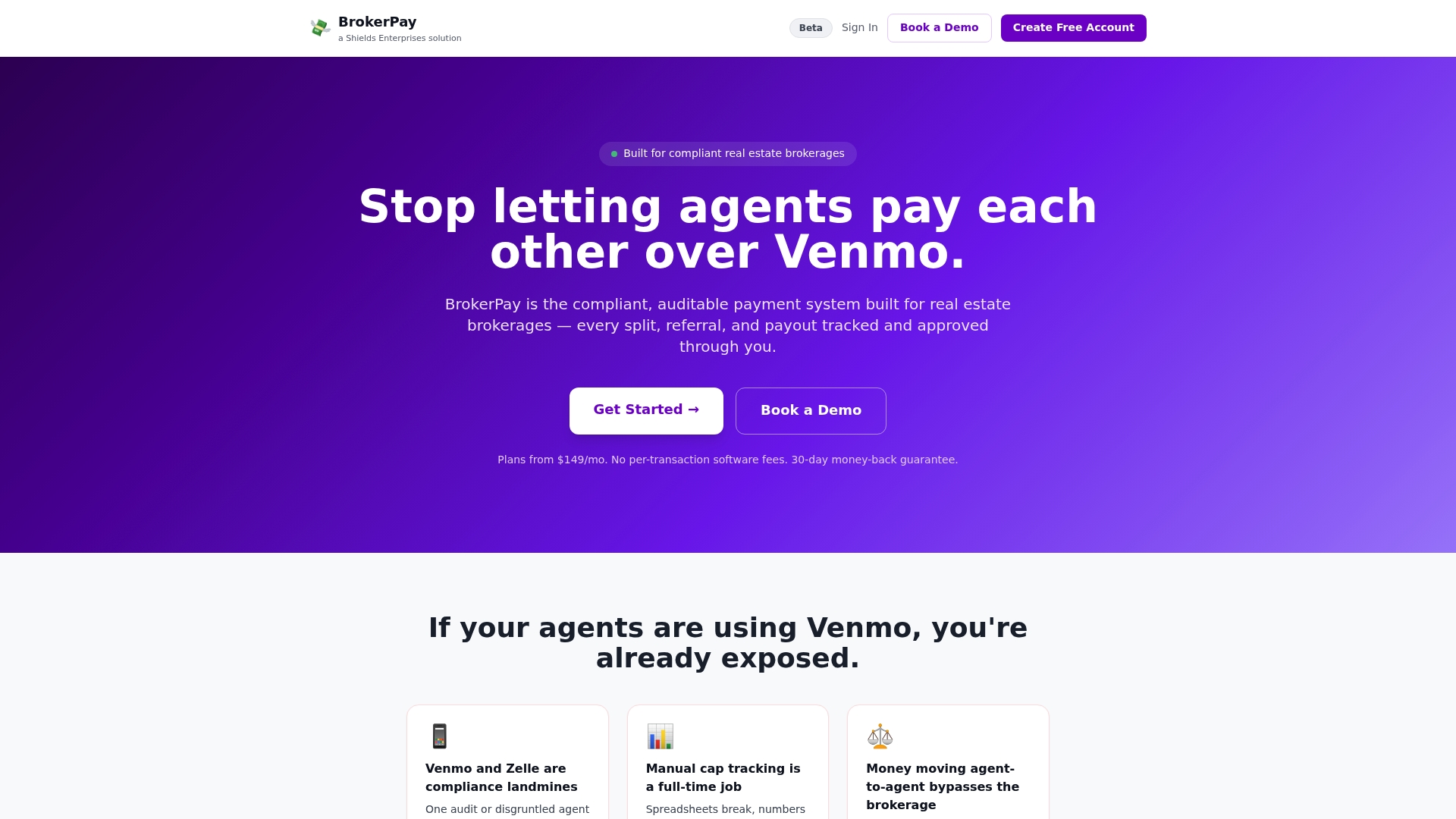
The platform covers every item on the non-negotiable checklist: atomic trust ledger posting, a reconciliation engine that runs weekly or monthly, AML screening workflows with five-year searchable retention, role-based access control with multi-step disbursement approvals, and authenticated wire delivery through a secure portal. For procurement teams, Brokerpay can provide SOC-ready compliance notes, a retention policy document, and sample AML procedures to support your due diligence review.
Onboarding typically runs four to six weeks, with data migration support included. Schedule a demo to see the reconciliation engine and audit trail in a live environment, or start a 30-day pilot with real transactions to validate the workflow before full cutover.
Useful sources for procurement and audit preparation
- CFPB — RESPA FAQs and MSA guidance
- OCC — RESPA Comptroller’s Handbook
- FFIEC BSA/AML InfoBase — recordkeeping and retention guidance
- FinCEN — AML program requirements
- North Carolina Real Estate Commission — trust account guidance
- Texas Real Estate Commission — trust accounting requirements
- FDIC — RESPA examination manual
- GTC Software — payments and escrow architecture
Use these sources as the basis for your RFP requirements and for legal or compliance review during procurement. State real estate commission websites for your specific market should be consulted alongside federal guidance, as trust-account timing rules and reconciliation requirements vary by state.
This article is general information, not legal or compliance advice. Confirm current requirements with your state real estate commission, a qualified attorney, or a licensed compliance professional before making procurement or policy decisions.