Commissions Management for Real Estate Brokerages

The right approach for a U.S. brokerage is a compliance-first, automated commissions management platform that produces a timestamped audit trail, connects to your CRM and payroll systems, and eliminates peer-to-peer payout workarounds entirely.
Stop using Venmo, Zelle, or ad-hoc spreadsheets for commission settlements. Each creates federal liability exposure and leaves you without the documented decisioning trail that auditors and RESPA-related reviews require. The immediate steps:
- Require a timestamped audit log for every payment event before signing any vendor contract.
- Confirm ACH payout capability is native, not bolted on through a third party.
- Prohibit peer-to-peer apps for any commission, referral, or co-op settlement, effective immediately.
Pro Tip: Mandate role-based approval workflows so every payout requires a documented sign-off. That approval record is your first line of defense in a RESPA inquiry or payer-liability dispute.
Table of Contents
- What does commissions management actually cover for a brokerage?
- Core features every brokerage must require from commission software
- Why peer-to-peer apps and spreadsheets create serious risk
- What integrations should your brokerage require?
- What ROI can you realistically expect from automation?
- What does implementation look like, and what does it cost?
- How do you evaluate vendors and spot red flags?
- Brokerpay: built for compliant brokerage commission management
- Change management and training for staff and agents
- Key Takeaways
- Why compliance-first commission automation matters right now
- Brokerpay gives your brokerage a compliant commission process today
- Sources and further reading
What does commissions management actually cover for a brokerage?
Commission management is the system of record for every deal, split, referral fee, co-op payment, cap calculation, and payout your brokerage processes, with full auditability from transaction close to agent bank account. It is brokerage-level B2B software, not a peer-to-peer payment app.
The transaction types and business rules in scope:
- Agent splits: percentage or flat-fee divisions between listing and buyer agents, team leads, and the brokerage.
- Referral fees: documented payments to referring agents or outside brokerages, with the paper trail RESPA expects.
- Co-op commissions: buyer-side brokerage payments that require their own compliant co-op workflows and audit records.
- Cap tracking: monitoring each agent’s annual commission cap and triggering post-cap split rules automatically.
- Draws, clawbacks, and retroactive adjustments: corrections that must propagate across periods without manual recalculation.
The users are finance, RevOps, and office managers who configure and approve, plus agents who access view-only statements or self-service earnings dashboards.
Core features every brokerage must require from commission software
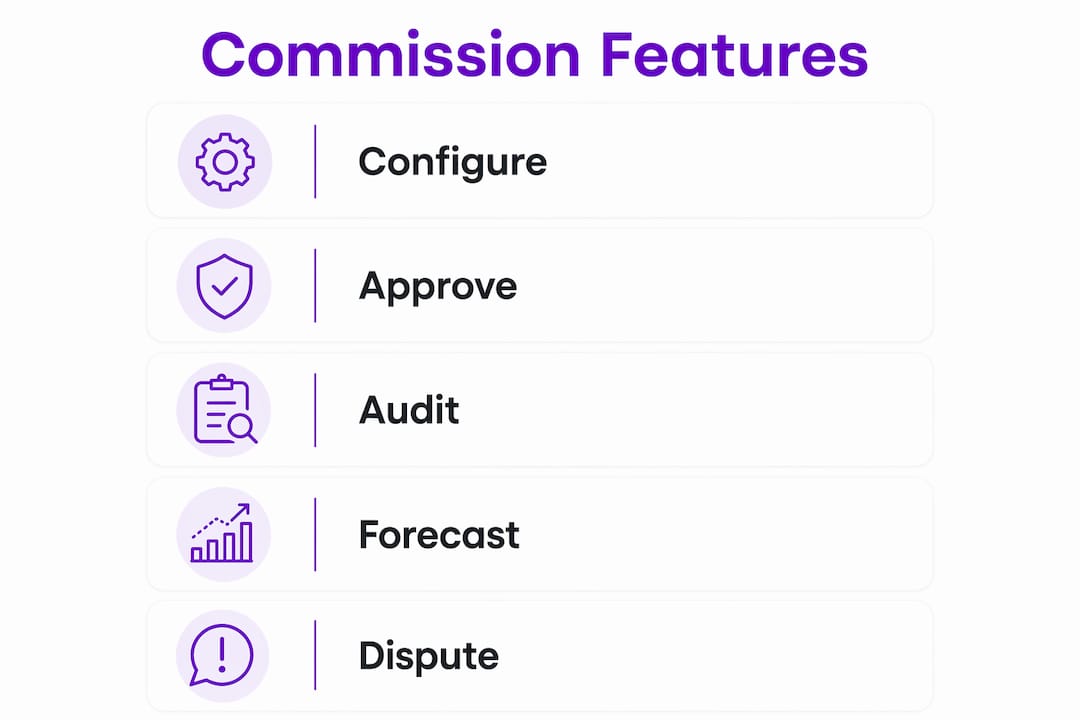
Ask for these capabilities first. Missing any one of them creates either a compliance gap or an operational bottleneck.
Must-have:
- Timestamped audit trail for every calculation, approval, and payout event.
- No-code plan modeling so RevOps can build and version commission rules without filing a developer ticket. The best systems let admins operate independently, which eliminates vendor dependency and accelerates plan changes.
- Multi-role split handling covering agent, team lead, brokerage, and referral payees in a single transaction.
- ACH payout capability with encrypted rails, not a redirect to a third-party app.
- Approval workflows with role-based access so finance can require sign-off before any disbursement.
- Commission statements generated automatically each period, filterable by deal, agent, or plan type.
Nice-to-have: earnings forecasting for agents, mobile statement access, and dispute routing inside the platform.
Compliance-required: immutable logs, exportable audit evidence, and versioned plan definitions that show exactly which rule applied to which deal on which date.

Agent visibility into real-time earnings is the most effective way to reduce finance-team inquiries and keep agents motivated. Build it into your requirements from day one.
Why peer-to-peer apps and spreadsheets create serious risk
Spreadsheets and peer-to-peer apps lack the security and governance controls required for commission payout workflows at scale. They increase federal compliance liability and leave your brokerage without a defensible record when questions arise.
RESPA governs how real estate settlement service fees, including referral payments, are documented and disclosed. A Venmo transfer produces no transaction-level evidence tied to a specific deal, no approval record, and no audit trail. That gap is the problem. A purpose-built platform creates a comprehensive, timestamped record for every commission payment, which is what accurate financial reporting and regulatory review require.
On the security side, require role-based access controls, encrypted ACH rails, and immutable logs. SOC 2 Type II certification is the benchmark worth asking about during vendor evaluation. Switching from manual to automated payouts also eliminates the cascading formula errors that spreadsheets produce quietly over time, often surfacing only at month-end when the damage is expensive to trace.
Automating commission management significantly reduces the administrator’s workload and cuts time spent on commission tasks, freeing finance teams for higher-value work.
Pro Tip: Ask every vendor to show you a sample audit log and a dispute escalation trail from a real closed period. If they cannot produce it in the demo, they cannot produce it for your auditor.
What integrations should your brokerage require?
Require real-time or near-real-time connections to your CRM, transaction/closing system, payroll or ERP, general ledger, and bank/ACH rails. Payouts must be based on verified, closed revenue, not a manually exported spreadsheet from last Tuesday.
The critical data flows:
- Closed deal amounts and closing dates from your transaction management system.
- Agent assignment changes and mid-period corrections that update commission calculations automatically.
- Refunds and adjustments that propagate retroactively without manual recalculation.
- Ledger posting confirmations that reconcile with your general ledger in real time.
Integration standards to require: Change Data Capture (CDC) or event-based syncs for CRM data, open API and webhook support, and SFTP as a fallback for legacy systems. Modern commission software integrates directly with CRM, ERP, and payroll to establish a single source of truth, ensuring payouts run on verified data rather than disconnected manual files.
Operationally, require a test environment, data validation checks, reconciliation reports, and a documented ownership model that names who owns source-of-truth data. The brokerage integration best practices guide recommends validating pilots against at least one past closed period before go-live.
For a technical primer on secure payment rails, the real estate payment gateway overview covers ACH integration specifics worth reviewing before your vendor conversations.
What ROI can you realistically expect from automation?
Automation converts commission administration from a cost center into a revenue-supporting function. Using automation to increase brokerage productivity reduces manual reconciliation work and accelerates decision cycles. When agents trust that calculations are accurate and transparent, motivation and performance outcomes improve.
| Outcome | KPI | How to measure |
|---|---|---|
| Admin hours saved | Hours per commission cycle | Compare pre/post cycle close time |
| Fewer payout errors | Error rate per period | Disputes and corrections logged |
| Faster month-end close | Days from close to payout | Track average days-to-payout |
| Lower dispute volume | Disputes per period | Platform dispute log |
| Higher agent satisfaction | Retention and survey scores | Agent retention rate, pulse surveys |
What does implementation look like, and what does it cost?
Expect an implementation window of a few weeks to a few months depending on your brokerage’s complexity. Small single-office brokerages can go live faster; multi-office operations with complex split structures and multiple integrations take longer.
A typical timeline:
- Discovery: data mapping, plan documentation, and stakeholder alignment (1–2 weeks).
- Plan modeling: building commission rules in the platform (1–2 weeks).
- Integration and testing: connecting CRM, closing system, and payroll; validating data flows (2–4 weeks).
- Pilot: running one closed period end-to-end before go-live (1–2 weeks).
- Go-live and training: agent onboarding and admin sign-off.
Pricing is almost universally subscription-based, tiered by agent count, with no per-transaction software fee. Ask about setup fees, implementation services, and ongoing support costs to understand total cost of ownership. The people who must participate in testing: your data owners, RevOps lead, finance, and any third-party escrow or closing partners whose data feeds the system.
How do you evaluate vendors and spot red flags?
Evaluate on compliance features first, then integration depth, admin configurability, auditability, and day-one support quality.
RFP and demo checklist:
- Timestamped, immutable audit logs with exportable evidence.
- No-code plan builder that handles splits, caps, clawbacks, and retroactive adjustments.
- Native ACH payout with encrypted rails.
- Role-based access and multi-step approval workflows.
- Dispute routing inside the platform with a full resolution history.
- API/CDC integration with your CRM and closing system.
- SOC 2 Type II certification or equivalent.
Red flags: core logic lives in spreadsheets, no audit logs, ACH requires a third-party workaround, plan changes require a support ticket or consultant, and no test environment for pilot validation.
Demo questions to ask: Can you show me a line-by-line audit trail for a closed deal? How does a retroactive adjustment propagate across periods? Who owns plan changes after go-live?
Pro Tip: Require vendors to run a proof-of-concept on a slice of your historical data before you sign. A vendor confident in their platform will do it. One who hesitates is telling you something.
Brokerpay: built for compliant brokerage commission management
Brokerpay is built specifically for U.S. real estate brokerages. It automates agent splits, referral fees, co-op commissions, and ACH payouts while producing the timestamped audit trails that reduce RESPA-related risk and replace risky Venmo/Zelle workarounds with a documented, compliant process.
Key capabilities mapped to the requirements above:
- Admin configurability: office managers configure commission rules without developer involvement.
- Audit logs: every payment event is timestamped and exportable for auditors.
- Approval workflows: multi-step sign-off before any disbursement leaves the brokerage.
- ACH transfers: native, encrypted payout rails, not a redirect to a third-party app.
- Compliance documentation: payout records tied to transaction data, ready for RESPA-related review.
Brokerpay eliminates the peer-to-peer payment workaround problem at its root. Instead of agents settling co-op or referral payments over consumer apps with no paper trail, every payment flows through a system that documents who approved it, when, and why.
Change management and training for staff and agents
The platform you choose is only as good as the adoption it gets. The most common failure mode is not a technical one: it is finance and agents reverting to old habits because the new system was never properly introduced.
For office managers and finance teams, the priority is configuring approval workflows and understanding the audit trail before go-live, not after. Run at least one full dry-run on a closed period so the team sees how corrections and retroactive adjustments actually work in the system.
For agents, the single most important thing is self-service statement access. When agents can see exactly how their commission was calculated, deal by deal, the volume of “why is my check wrong?” calls drops sharply. Schedule a short walkthrough, not a long training session, and make the statement view the centerpiece.
Change management works best when it is tied to a concrete win agents can feel immediately: faster payouts and a clear earnings view. Lead with that in your rollout communication.
Key Takeaways
Compliance-first, automated commissions management is the only approach that protects U.S. brokerages from RESPA exposure, eliminates peer-to-peer payment risk, and gives agents the transparency that drives retention.
| Point | Details |
|---|---|
| Stop peer-to-peer payments now | Venmo and Zelle create federal liability; replace them with ACH-native commission software immediately. |
| Audit trail is non-negotiable | Every payment must carry a timestamped, exportable log tied to transaction data for RESPA and auditor review. |
| Admin configurability matters | RevOps must be able to change commission rules without developer tickets or consultant fees. |
| Pilot before you sign | Run a proof-of-concept on one closed historical period to validate reconciliation, splits, and ledger posting. |
| Brokerpay fits the brief | Brokerpay automates splits, referral fees, co-op commissions, and ACH payouts with full audit trails for U.S. brokerages. |
Why compliance-first commission automation matters right now
The brokerages I see struggling with commission disputes and month-end bottlenecks almost always share one trait: they are still running payouts through a combination of spreadsheets and consumer payment apps, held together by institutional memory rather than documented process. That works until it doesn’t, and when it breaks, it breaks expensively.
The shift to compliance-first automation is not about technology for its own sake. It is about having a defensible record when a referral payment gets questioned, an agent disputes a split, or a regulator asks how a co-op fee was calculated and approved. Brokerpay was built precisely for that moment. As brokerage structures grow more complex and compliance expectations continue to evolve, having a platform that documents every decision automatically is the kind of operational foundation that pays for itself.
Brokerpay gives your brokerage a compliant commission process today
Brokerages that have moved off spreadsheets and peer-to-peer apps to Brokerpay report faster payouts, fewer agent disputes, and audit-ready records without the manual reconciliation work. The concrete difference: every split, referral fee, and co-op payment flows through an approval workflow, hits an ACH rail, and lands in a timestamped log, all without a developer or a spreadsheet formula in sight.
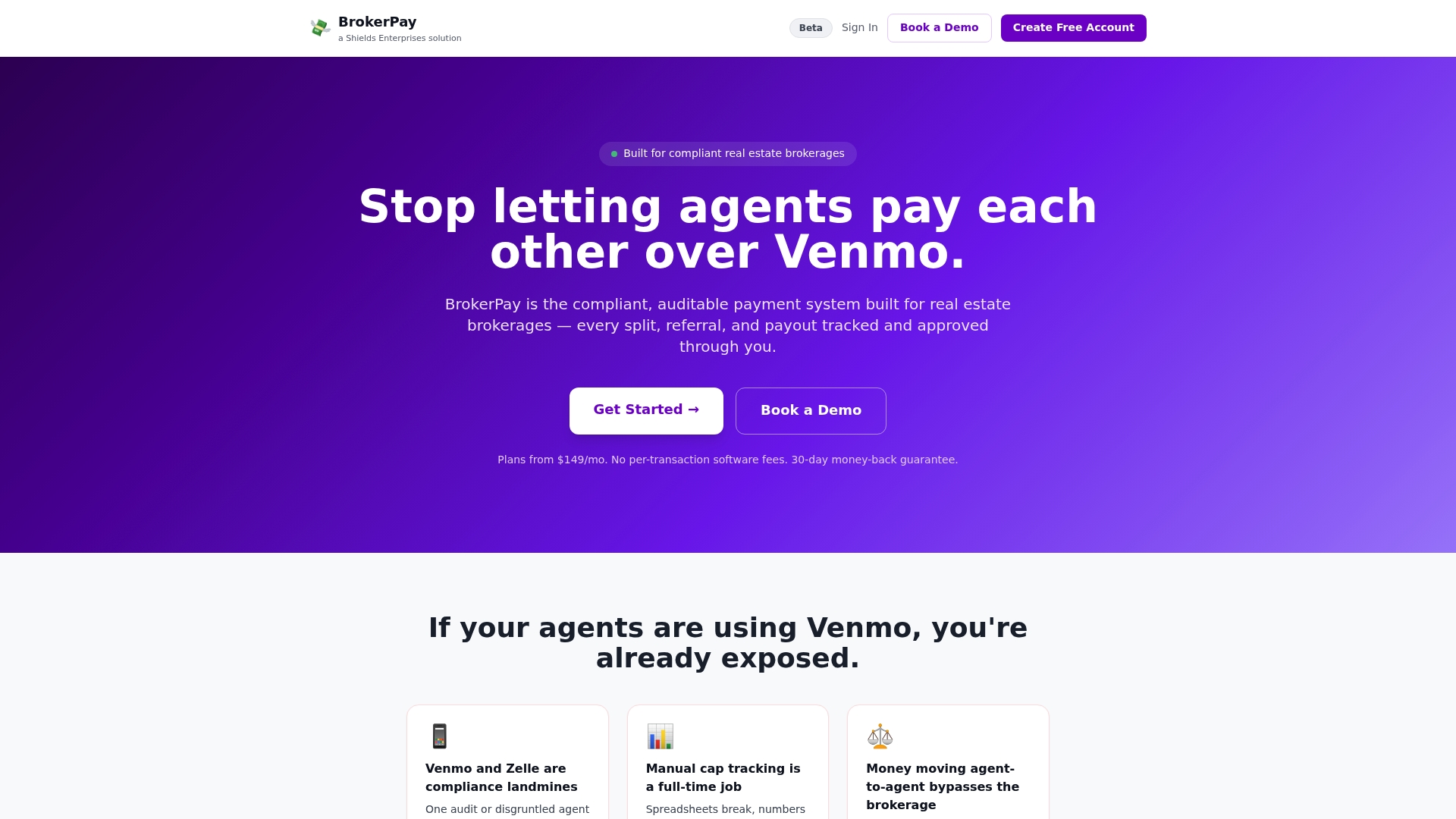
If your brokerage is still settling commissions over Venmo or managing splits in Excel, the compliance exposure is real and growing. Request a demo at Brokerpay to see the audit trail, approval workflow, and ACH payout process on your own transaction data, and get a clear picture of what onboarding actually looks like for your office size.
Sources and further reading
- Brokerpay — compliant commission payment platform for real estate brokerages
- Why commission tracking prevents tax issues for agents
- Compliant co-op payment workflows: 8 real examples
- Switch from manual to automated payouts for brokers
- Commission payment alternatives and governance trade-offs
- Using AI to increase brokerage productivity — C3 Dynamic Solutions
- Brokerage integration best practices — C3 Dynamic Solutions
- Forbes: commission-tracking platforms and agent motivation