Virtual Broker for Real Estate: Compliance Guide 2026

In U.S. real estate, a “virtual broker” usually means one of two things: a cloud-based brokerage firm agents join remotely, or a B2B software platform that automates commission payments and compliance workflows. If you run a brokerage and you’re still disbursing commissions through Venmo or Zelle, stop now. The recommended next step is a purpose-built, RESPA-compliant platform like Brokerpay.
Two things to clarify upfront:
- In consumer finance, “virtual broker” and online trading broker almost always refer to SEC/FINRA-regulated stock-trading platforms, not real estate software.
- In real estate, the term splits into two distinct categories: (A) a cloud-based brokerage firm agents affiliate with, and (B) commission-payment automation software a brokerage buys to manage splits, referral fees, and audit trails.
Table of Contents
- What “virtual broker” actually means in real estate
- Why Venmo and Zelle create serious legal and audit risk
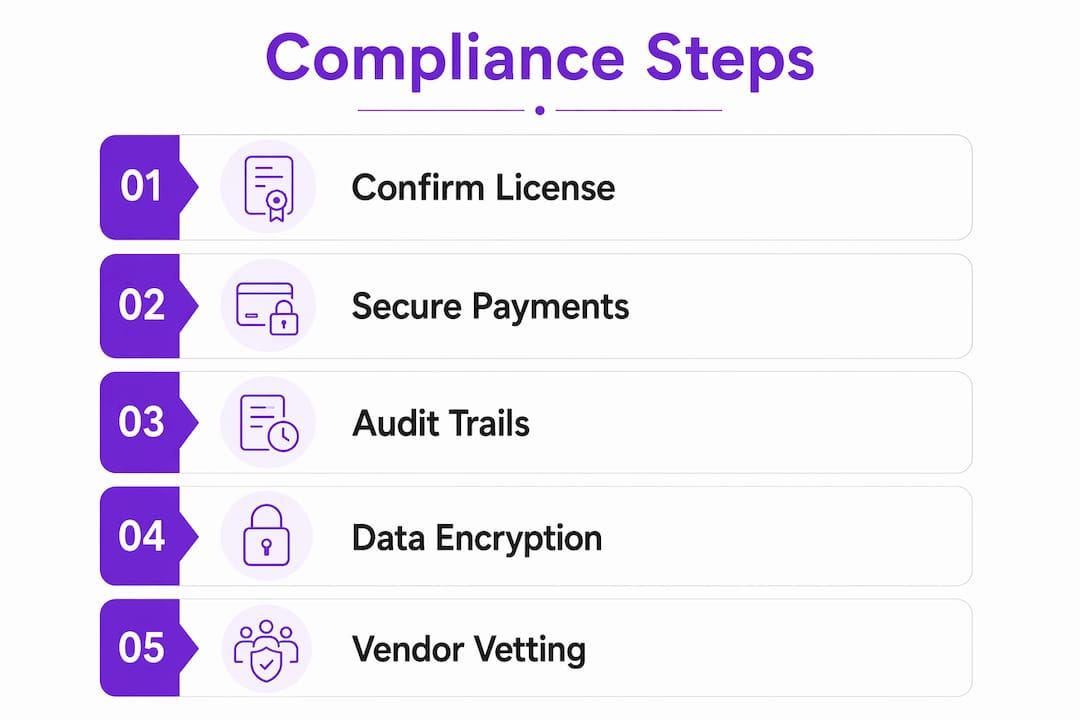
- What a compliant commission-payment platform must include
- How to choose a virtual broker platform: a vendor scorecard
- How Brokerpay maps to the compliance checklist
- Key Takeaways
- The compliance gap most brokerages don’t see until it’s too late
- Brokerpay: compliant commission payments without the workarounds
- Useful sources and further reading
What “virtual broker” actually means in real estate
The phrase creates genuine confusion because it carries different meanings depending on who’s using it. A brokerage owner searching for a “virtual broker” might land on stock-trading platform reviews, cloud-brokerage recruiting pages, or commission-software vendors, all in the same search results page.
Two distinct real estate meanings drive most of the confusion:
- Cloud-based brokerage firm (employer model): Agents join the brokerage remotely. The firm provides splits, caps, revenue share, and a tech bundle. Evaluation criteria here center on recruiting economics, lead generation support, and training. Cloud brokerages commonly package competitive caps and revenue-share structures to attract agents.
- Commission-payment automation software (B2B SaaS tool): The brokerage buys software to process agent splits, referral fees, co-op commissions, and earnest money. Evaluation criteria shift entirely to audit trails, ACH disbursements, approval workflows, and RESPA documentation.
These two categories have almost nothing in common from a procurement standpoint. Conflating them wastes time and creates real risk. A brokerage owner who needs commission-payment software and ends up evaluating cloud brokerage firms is solving the wrong problem entirely.
Why Venmo and Zelle create serious legal and audit risk
Consumer P2P apps lack the controls, reporting, and workflows required for RESPA-compliant commission payments. That’s not a technicality. It’s a federal liability exposure that auditors flag immediately.
Concrete compliance gaps when using P2P apps:
- No audit trail: Transactions carry no brokerage-level documentation, approval records, or time stamps.
- No record retention: Consumer apps don’t retain transaction data in formats suitable for state or federal audit requests.
- No tiered approval workflows: A principal broker cannot enforce a review-and-approve step before funds move.
- No ACH settlement for business payouts: P2P transfers don’t generate the bank-to-bank ACH records that accounting and tax filings require.
- 1099 documentation gaps: Without a centralized ledger, year-end 1099 preparation becomes a manual reconciliation nightmare.
Operational risks compound the compliance exposure. Manual split calculations introduce errors, especially when caps reset mid-year or referral fees involve multiple parties. Reconciliation slows down, and when an auditor asks for transaction-level proof, you’re assembling screenshots from a consumer app.
Brokerages that rely on consumer payment apps for commission disbursements are not just taking an operational shortcut. They are creating a documented compliance gap that state regulators and federal auditors can act on.
Pro Tip: Run a 30-day reconciliation test before your next audit: pull every commission transaction from the past month and verify that each one has a time-stamped approval record, a split calculation log, and a corresponding ACH confirmation. If any of those three elements is missing for even one transaction, you have an audit exposure.
Any vendor you evaluate should provide SOC 2 or equivalent security certification, encryption in transit and at rest, exportable audit reports, and direct bank-to-bank ACH capability. These aren’t premium features. They’re the baseline for a real estate payment gateway that handles regulated disbursements.

What a compliant commission-payment platform must include
Not every feature a vendor pitches belongs on your must-have list. Here’s how to separate what’s required from what’s optional.
Must-haves:
- Audit trail with time-stamped, transaction-level records
- Brokerage-level approval workflows before funds disburse
- ACH disbursements to agent bank accounts
- Automated split, cap, and referral fee calculations
- Tax reporting exports (1099-ready ledgers)
- Role-based user permissions (principal broker, office manager, agent)
Nice-to-haves (evaluate after must-haves are confirmed):
- API integrations with CRM, MLS, or accounting platforms
- Multi-state broker-of-record support
- White-label agent-facing portals
- Earnest money tracking
Auditors look for three specific outputs: transaction-level proof tied to a specific closing, time-stamped approval records showing who authorized each disbursement, and exported ledgers that reconcile against bank statements. A platform that can’t produce all three on demand isn’t audit-ready, regardless of what its marketing page says. Practitioners consistently advise against opaque all-in-one solutions that hide fee math; prefer platforms with explicit reporting and exportable audit ledgers.
How to choose a virtual broker platform: a vendor scorecard
Start every vendor evaluation with a short scorecard across five dimensions: compliance, integrations, reporting, security, and support. Editorial evaluations of financial platforms routinely assess 50+ data points including fees, integrations, and support quality. Apply the same rigor here.
Vendor evaluation checklist:
- Can the platform export a full audit ledger in CSV or PDF on demand?
- Does it support multi-party splits, caps, and referral fee calculations natively?
- What ACH bank relationships does it use, and what are the settlement timelines?
- Can you configure tiered approval workflows by transaction type or dollar threshold?
- Does it hold SOC 2 Type II certification or equivalent?
- What are the integration endpoints (QuickBooks, Salesforce, MLS systems)?
- How does it handle 1099 generation and year-end tax reporting?
- What onboarding support is included, and what’s the typical go-live timeline?
Typical onboarding timeline:
| Phase | Activities | Typical Duration |
|---|---|---|
| Discovery | Requirements gathering, data mapping, bank account setup | Week 1–2 |
| Pilot | Sample transactions, split logic validation, approval workflow testing | Week 3–4 |
| Full rollout | Agent onboarding, back-office training, live transaction processing | Week 5–6 |
| Stabilization | Reconciliation review, reporting audit, support handoff | Week 7–8 |
Pricing model guidance:
- Subscription per-agent tiers are the standard model for compliant commission-payment platforms. No per-transaction software fees.
- Budget for implementation support, data migration (if moving from spreadsheets or another system), and initial training for back-office staff.
- Avoid platforms that charge per transaction at the software level; that model creates incentives misaligned with your compliance needs.
Brokerage operations guides for 2026 consistently highlight automation as the primary lever for reducing manual data entry and tightening audit trails during agent onboarding.
How Brokerpay maps to the compliance checklist
Brokerpay provides the audit trails, approval workflows, ACH disbursements, and reporting required to remove the federal and operational risks of P2P payment workarounds. It’s built specifically for U.S. real estate brokerages, not adapted from a general-purpose payments tool.
Feature mapping against the must-have checklist:
- Audit trail: Every transaction is time-stamped with approval records and split calculation logs.
- Approval workflows: Principal brokers configure review steps before any disbursement moves.
- ACH disbursements: Direct bank-to-bank transfers with settlement confirmation.
- Split/cap/referral math: Automated calculations handle complex multi-party splits and mid-year cap resets.
- Tax reporting: Exportable 1099-ready ledgers for year-end compliance.
- Security: SOC 2-aligned controls with encryption in transit and at rest.
Brokerpay onboarding timeline:
| Phase | Brokerpay Activities | Typical Duration |
|---|---|---|
| Discovery | Account setup, split logic configuration, bank verification | Week 1–2 |
| Pilot | Live transactions with sample closings, approval workflow validation | Week 3–4 |
| Full rollout | All agents onboarded, back-office staff trained, reporting live | Week 5–6 |
Brokerpay’s subscription pricing is tiered by agent count with no per-transaction software fees. For brokerages evaluating commission-payment alternatives, the combination of RESPA-focused documentation and automated split logic is what separates purpose-built platforms from general payment tools.
Key Takeaways
Brokerages that replace P2P apps with a purpose-built commission-payment platform eliminate audit exposure, reduce split errors, and produce RESPA-compliant documentation on every transaction.
| Point | Details |
|---|---|
| Stop P2P apps immediately | Venmo and Zelle create documented compliance gaps that auditors and state regulators can act on. |
| Require five must-haves | Audit trail, approval workflows, ACH, split/cap math, and 1099 exports are non-negotiable before signing any vendor. |
| Use the vendor scorecard | Evaluate compliance, integrations, reporting, security, and support across eight checklist questions before any demo. |
| Expect an 8-week rollout | Discovery through stabilization typically runs 7–8 weeks; pilot with real transactions before full agent onboarding. |
| Brokerpay is the recommended option | Brokerpay maps directly to every must-have checklist item with RESPA-compliant workflows and no per-transaction software fees. |
The compliance gap most brokerages don’t see until it’s too late
The conventional wisdom in brokerage operations is that compliance is a back-office problem. Get the deal closed, sort out the paperwork later. That framing is exactly backwards, and it’s why so many brokerages are still running commission payments through consumer apps in 2026.
The real risk isn’t the occasional Venmo payment. It’s the cumulative audit exposure from hundreds of transactions with no approval records, no split documentation, and no ACH confirmation. When a state regulator or a disgruntled agent’s attorney asks for transaction-level proof, “we sent it through Zelle” is not an answer.
What I find underappreciated is how much easier cap tracking becomes once you automate disbursements. Cap resets during agent transitions are one of the most common sources of split errors, and they’re almost impossible to catch manually mid-year. A platform that tracks cap progress in real time catches those errors before they become disputes.
The 30-day reconciliation test in this article isn’t just a diagnostic. Run it as a pilot with any vendor you’re evaluating. If the platform can’t produce clean, exportable records for every transaction in that window, you have your answer before you’ve committed to anything.
Brokerpay: compliant commission payments without the workarounds
Every brokerage that’s still using P2P apps for commission disbursements is carrying federal liability it doesn’t need to carry. Brokerpay eliminates that exposure with a platform built specifically for U.S. real estate: automated splits, RESPA-compliant documentation, and ACH disbursements that produce audit-ready records on every transaction.
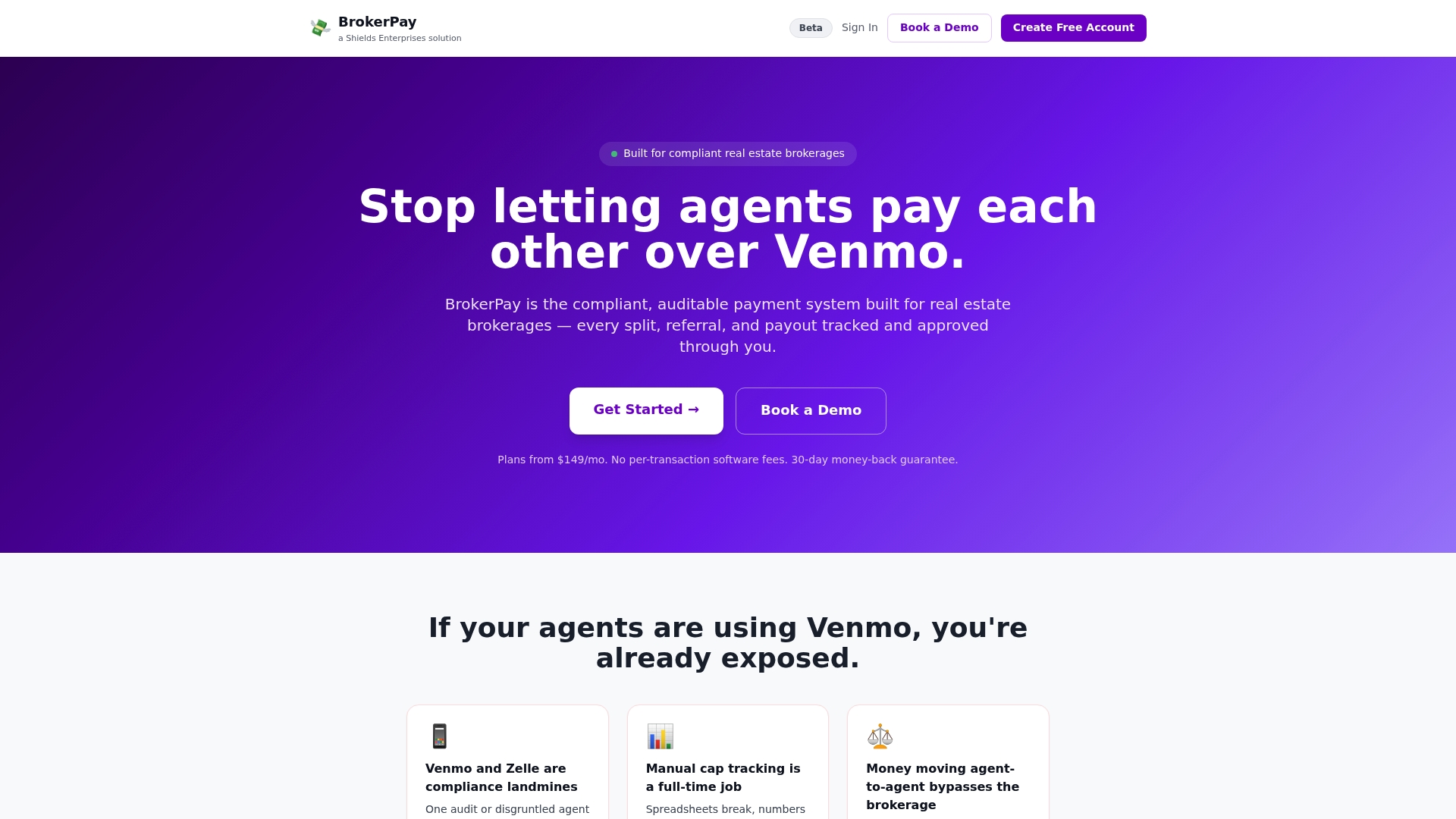
The pilot is straightforward. You bring real transactions, Brokerpay configures your split logic, and you validate approval workflows before a single agent is fully onboarded. Most brokerages complete discovery and pilot in four weeks.
- Pilot includes: Split logic setup, approval workflow configuration, sample transaction processing, and exportable audit report review.
- Typical commitment: Four weeks from kickoff to pilot completion, with full rollout support available.
Start your Brokerpay pilot and get your commission payments off consumer apps for good.
Useful sources and further reading
Authoritative U.S.-focused resources for validating the compliance and operational claims in this article:
- U.S. Securities and Exchange Commission (SEC) — Regulatory context for broker definitions, FINRA oversight, and why “virtual broker” in finance refers to SEC-regulated trading platforms, not real estate software.
- Forbes Advisor: Best Online Brokers and Trading Platforms — Vendor evaluation methodology showing how multi-point scoring frameworks apply to financial platform procurement.
- RoofAI: Cloud-Based Real Estate Brokerages — Market overview of cloud brokerage models, cap structures, and tech bundles for context on the employer-model meaning of “virtual broker.”
- ListToSellATL: Full-Service Real Estate Brokerage 2026 Guide — Operational guidance on automation, agent onboarding, and audit trail requirements for U.S. brokerages.
- Friendly Financial Group — Financial and operational advisory resource for brokerages building unified payment and accounting ecosystems.
- Brokerpay — Product capabilities, RESPA-compliant commission automation, and pilot/demo signup for U.S. real estate brokerages.