Solo Brokerage Agent Pay Process: Compliant Automation Guide

The solo brokerage agent pay process has one non-negotiable legal foundation: the brokerage receives the commission first, and then disburses the agent’s share under a written Independent Contractor Agreement (ICA) and a Commission Disbursement Authorization (CDA). Skip that sequence and you are not just disorganized — you are exposed to RESPA liability, IRS audit risk, and agent disputes that cost real money.
Stop using Venmo or Zelle for commission settlements. Adopt an automated, audit-ready payout platform that supports CDAs, ACH disbursements, cap tracking, and 1099-ready reporting. Brokerpay is built specifically for this.
Three starter tasks:
- Document ICA terms for every affiliated agent before the next closing
- Require a signed CDA at every settlement
- Pilot an automated payout workflow on your next two to three transactions
Table of Contents
- How does commission money actually flow in a U.S. solo brokerage?
- What are the legal and compliance requirements every U.S. solo brokerage must meet?
- How do commission models change your pay process and operational requirements?
- Why are manual calculations and peer-to-peer payments risky for a brokerage?
- What must a compliant commission automation platform actually do?
- How do you move from manual pay runs to automated, compliant payouts?
- Key Takeaways
- Why compliance-first payout automation matters more than brokerages realize
- Brokerpay handles the compliance work your manual process cannot
- Authoritative sources and further reading
How does commission money actually flow in a U.S. solo brokerage?
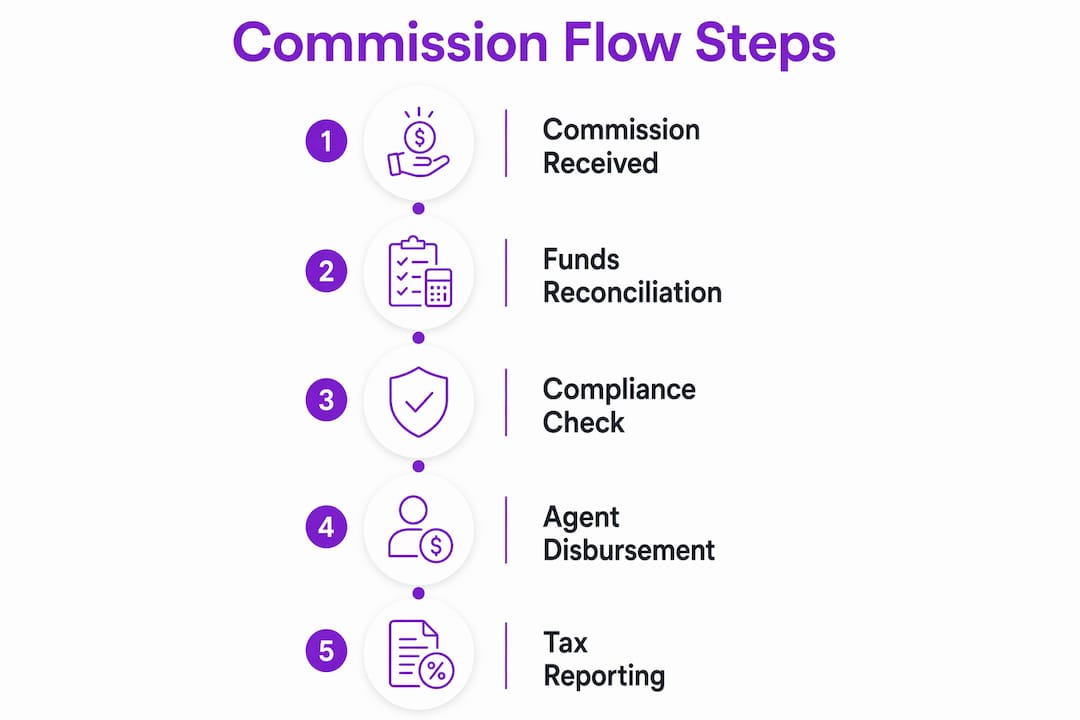
The money moves through a defined sequence. Each step has a document or approval that must exist before the next one starts.
- Listing or buyer agreement signed. The ICA and agreed commission split are already on file before any transaction opens.
- Transaction closes; title or escrow pays the brokerage. The commission is paid to the brokerage first—not to the agent directly. The CDA instructs the closing entity on how to route funds.
- Brokerage posts the transaction. Finance logs the gross commission, applies the split formula, deducts any franchise fees, referral fees, or cap-related adjustments, and calculates the agent’s net.
- Approval workflow runs. A designated approver (broker of record or operations manager) reviews the disbursement calculation before any funds move.
- ACH disbursement to agent. Once approved, the agent’s net is transferred. Any retained amounts (desk fees, E&O, transaction fees) are itemized and documented.
- Reconciliation closes the transaction record. The final record includes the gross commission received, every deduction, the agent’s net, and the CDA reference. This is the audit trail.
Typical timing: most brokerages receive funds at closing, complete reconciliation within 24–48 hours, and disburse to agents within one to three business days. The CDA is the document that makes step two legally clean; the ICA is what makes step five defensible to the IRS.
Solo agent baseline operating costs — CRM, E&O, MLS access, e-sign — commonly incur annual expenses before marketing. Showing agents their net-per-deal inside an automated system, with deductions itemized, reduces disputes before they start.
What are the legal and compliance requirements every U.S. solo brokerage must meet?
The legal structure is straightforward: the brokerage holds the license, receives the commission, and pays the agent as an independent contractor. Treating that payment as anything else creates problems.

RESPA and settlement routing. RESPA governs how settlement funds are handled. Routing commission directly from a closing entity to an agent—bypassing the brokerage—can constitute improper diversion of escrow funds. The CDA is the correct mechanism: it authorizes the closing entity to pay specified parties at settlement under the brokerage’s direction, not around it.
IRS independent contractor requirements. Most U.S. agents operate as independent contractors, which means the brokerage must collect a signed W-9 before the first payment, issue a 1099-NEC for any agent paid $600 or more in a calendar year, and retain documentation supporting those filings. The ICA is the underlying contract; the payment records are the evidence.
Pro Tip: Run a mock 1099 export in October each year. If your platform cannot produce a clean, agent-by-agent earnings summary with W-9 status flags, you will be scrambling in January. Commission tracking that supports 1099 reporting is not optional — it is the minimum.
How do commission models change your pay process and operational requirements?
The model you choose determines how complex your disbursement logic needs to be. Three structures dominate the market, and each one creates different operational demands.
Split models (50/50, 70/30, 85/15). The brokerage takes a percentage of every transaction. Calculation is straightforward until you add franchise fees or referral deductions on top. A 70/30 split on a $15,000 commission means the agent nets $10,500 and the brokerage retains $4,500 — but if a 25% referral fee applies to the gross first, the math changes before the split even runs.
Capped split models. The agent pays the split until hitting an annual dollar cap, then keeps 100% for the rest of the year. Caps across brokerages vary substantially depending on the model. An 85/15 split with a $12,000 annual cap means the brokerage collects 15% per transaction until the agent has contributed $12,000 total — after that, the agent pays only a flat per-transaction fee. Tracking exactly where each agent sits relative to their cap, in real time, is where manual systems break down.
100% models with per-transaction fees. The CDA can route commission directly to the agent when the brokerage authorizes it, which is how 100% models work operationally. The brokerage funds itself through monthly fees and per-transaction charges rather than a split. This shifts administrative burden: the brokerage must invoice and collect fees separately, and agents carry more of their own operating costs.
Special cases that require multi-line disbursement logic:
-
Co-op commissions: Buyer’s agent and listing agent sides must be calculated and disbursed separately, often to different agents or even different brokerages. See compliant co-op payment workflows for structured examples.
-
Referral fees: Paid off the gross commission before the split runs; require their own documentation and often a separate 1099.
-
Multiple agents on one deal: Each agent’s split, cap status, and deductions must be calculated independently from the same gross commission line.
Why are manual calculations and peer-to-peer payments risky for a brokerage?
Manual processes fail in predictable ways. The risk is not theoretical.
Brokerages relying on manual commission calculations are consistently exposed to human error, especially when co-op commissions or multi-agent splits are involved. A missed cap reset, a referral fee applied after the split instead of before, or a franchise fee calculated on the wrong base amount—each one creates an agent dispute or an accounting correction that takes hours to unwind.
Industry commentary consistently warns that P2P apps create RESPA and escrow diversion exposure when funds bypass brokerage controls. Beyond compliance, they produce incomplete tax records. If the IRS questions a 1099 filing and your documentation is a Venmo transaction history, that is not a defensible paper trail.
Layered fees and caps — franchise pass-throughs, per-transaction processing fees, first-dollar deductions — require programmatic enforcement. Manual tracking is the primary source of cap disputes, and cap disputes are the primary source of agent attrition.
What must a compliant commission automation platform actually do?
A platform that handles commission payouts for a U.S. brokerage must do more than move money. The non-negotiables: immutable audit trail, CDA support, 1099-ready reporting, segregation-of-duties approvals, and encrypted ACH payouts.
Feature checklist:
- CDA ingestion and enforcement at the transaction level
- ICA metadata storage (agent name, split terms, cap amount, reset date)
- Real-time cap tracking with automatic post-cap fee switching
- Multi-line split engine for co-op, referral, and multi-agent transactions
- Approval workflows with role-based access (approver vs. processor)
- Reconciliation tied to each transaction record
- Integrations with transaction management and accounting platforms
- Data retention policies that satisfy state real estate record-keeping requirements
| Evaluation dimension | What to look for |
|---|---|
| Compliance & audit trail | Immutable transaction logs, CDA storage, timestamped approvals |
| Approval/workflow controls | Segregation of duties, configurable approval chains |
| Payout methods & timing | ACH and check support, same-day or next-day ACH options |
| Split, cap & referral handling | Automated cap tracking, multi-line disbursement, referral fee logic |
| Integrations | Transaction management, accounting (QuickBooks, etc.), title |
| Reporting & 1099 output | Agent-level earnings summaries, W-9 status flags, exportable 1099 data |
| Security | Role-based access, encryption at rest and in transit, access logs |
| Cost model | Subscription vs. per-transaction; total cost at your agent count |
Pro Tip: Before committing to any platform, run a sample transaction end-to-end: enter a co-op deal with a referral fee, trigger the approval workflow, export the audit log, and generate a mock 1099 summary. If any of those steps requires a workaround, the platform is not ready for your brokerage.
How do you move from manual pay runs to automated, compliant payouts?
Migration does not have to be disruptive. A phased approach lets you validate the platform before it touches live agent pay.
| Phase | Activities | Typical duration |
|---|---|---|
| Discovery | Audit current ICA terms, document split rules, cap amounts, fee structures | 1–2 weeks |
| Configuration | Set up platform rules, load agent profiles, configure approval chains | 1–2 weeks |
| Pilot | Run 2–4 closings in parallel (manual + platform); compare outputs | 2–4 weeks |
| Full launch | Decommission manual process; move to live ACH payouts | Ongoing |
Roles and responsibilities during rollout:
- Broker of record: signs CDAs, approves disbursements, owns compliance sign-off
- Operations manager: configures platform rules, manages agent onboarding, handles exceptions
- Finance: reconciles platform output against trust account ledger, validates 1099 data
- Agents: provide signed W-9, acknowledge ICA terms in the platform, confirm payout method
When switching to automated payouts, require explicit agent consent in writing and give agents visibility into their disbursement calculations before funds move. Transparency at this step prevents disputes and builds trust in the new process. For a practical migration checklist, the switch from manual to automated payouts guide covers the sequencing in detail.
Key Takeaways
A compliant solo brokerage agent pay process requires the brokerage to receive commission first, disburse under a signed ICA and CDA, and maintain 1099-ready records — automation is the only reliable way to enforce all three simultaneously.
| Point | Details |
|---|---|
| Brokerage receives commission first | Routing funds directly to agents bypasses RESPA controls and breaks the audit trail. |
| CDAs are mandatory, not optional | A signed CDA at every closing is the legal mechanism that keeps disbursements defensible. |
| 1099 compliance requires documentation | Collect W-9s before first payment; maintain agent-level earnings records for every transaction. |
| Cap tracking must be automated | Manual cap tracking is the leading cause of agent disputes and accounting corrections. |
| Brokerpay covers the full requirement set | Brokerpay supports CDAs, cap tracking, ACH payouts, approval workflows, and 1099-ready exports in one platform. |
Why compliance-first payout automation matters more than brokerages realize
The brokerages I see struggle most with agent pay are not the ones with complicated commission structures. They are the ones that built their process around convenience — a shared spreadsheet, a Venmo payment at closing, a 1099 assembled from bank statements in January. It works until it does not, and when it breaks, it breaks expensively: an agent dispute over a missed cap, an IRS inquiry about mismatched 1099 figures, or a state audit that finds no CDA on file for a transaction that closed two years ago.
Brokerpay is a compliant commission payment platform that eliminates those P2P workflows entirely. It tracks splits, referral fees, and co-op commissions with a full audit trail, so every disbursement is documented before it moves. The platform is built for brokerages that need to get this right — not just faster, but defensibly correct.
Brokerpay handles the compliance work your manual process cannot
Every brokerage that has outgrown spreadsheets and P2P apps faces the same gap: the compliance requirements are clear, but the tools to enforce them have not been in place. Brokerpay closes that gap directly.
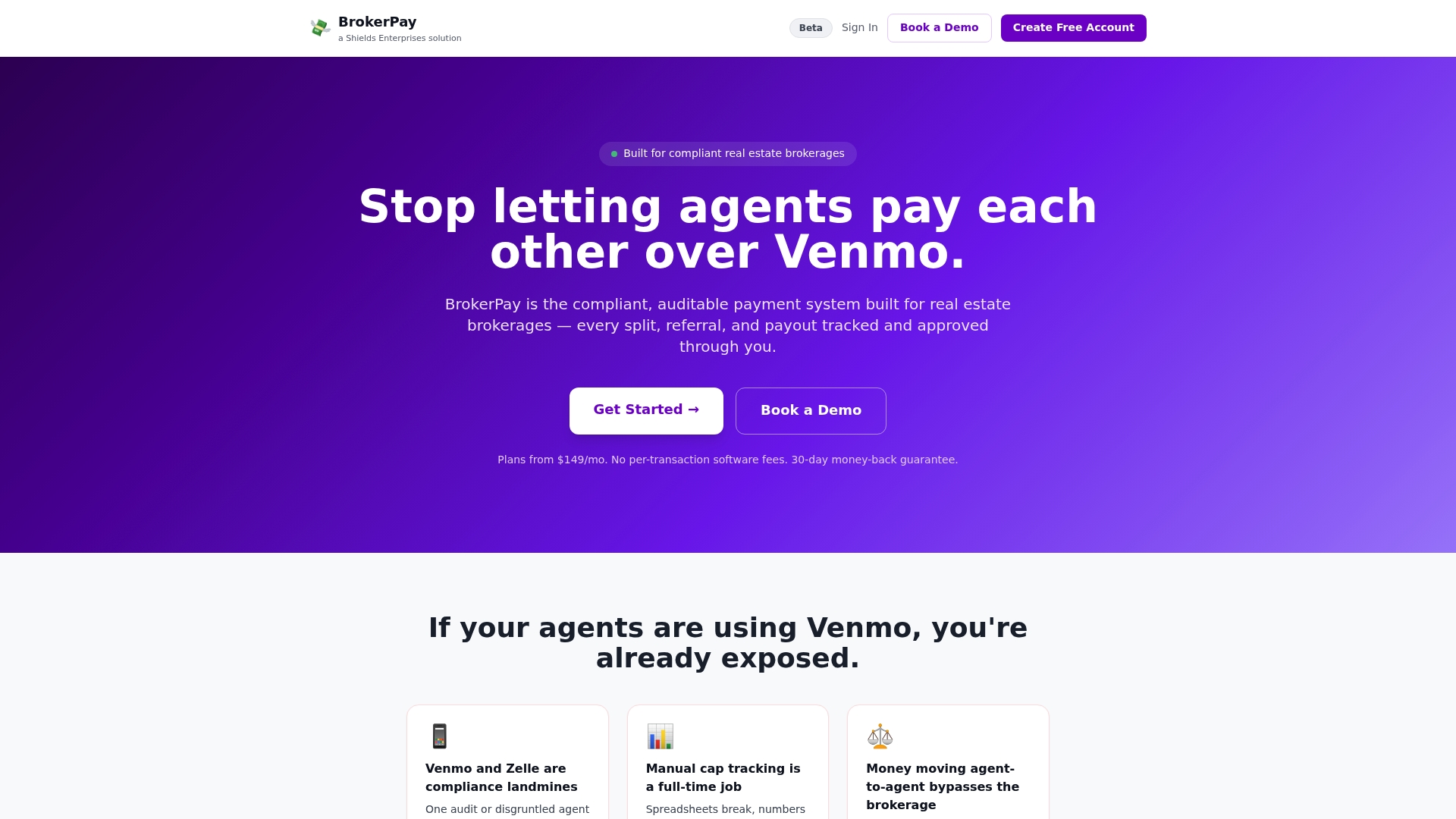
Brokerpay automates the full solo brokerage agent pay process: CDA enforcement, real-time cap tracking, multi-line split calculations for co-op and referral transactions, ACH payouts, brokerage approval workflows, and 1099-ready reporting. The cost model is a tiered monthly subscription based on agent count — no per-transaction software fees that penalize a productive month. Every disbursement produces an immutable audit log, role-based access controls limit who can approve or modify a payout, and data is encrypted at rest and in transit.
Before going live, require each agent to acknowledge their ICA terms and confirm their payout method inside the platform. That single step creates the consent record that protects both sides.
Schedule a demo at Brokerpay and see the full workflow on a sample transaction — including the audit log export and 1099 summary — before you commit.
Authoritative sources and further reading
These are the primary references used throughout this article. Each one covers a specific aspect of the U.S. brokerage payment process.
- Real Estate Agent Commissions: How Do Realtors Get Paid? — Use this to verify the legal sequence (brokerage receives first) and CDA mechanics. Covers RESPA context and independent contractor documentation requirements.
- 100% Commission Real Estate Brokerage Model Explained — Use this to model 100% and flat-fee structures, understand CDA routing options, and review P2P payment risks.
- How Do Real Estate Agents Get Paid? — Zillow Premier Agent — Use this to verify 1099-NEC obligations, W-9 collection requirements, and independent contractor classification.
- Real Estate Commission Splits by Brokerage — Use this to model cap ranges ($4,000–$35,000) and compare split structures across brokerage types.
- 8 Ways to Earn Income at Real US Agents — Use this to understand layered fee structures, franchise fee pass-throughs, and cap-tracking complexity.
- Solo Agent vs. Real Estate Team — Texas — Use this to benchmark solo agent operating costs ($5,000–$8,000 annually) and understand why net-per-deal transparency matters.
- 7 Real Estate Compensation Models, Explained — Use this to compare split-plus-cap, split-no-cap, flat-fee, and salary-plus-bonus structures and their operational implications.