What Is a Commission Escrow Account for Brokerages?

A commission escrow account is a temporary arrangement where a neutral third party holds commission funds until specific contractual conditions, typically closing, are satisfied. Think of it as a legal holding pen: the money is earned but not yet released, and nobody touches it until the agreed trigger fires. For U.S. brokerages, this structure matters because it removes the gap between when a commission is earned and when the right to collect it is legally perfected. State statutes like New York’s Commission Escrow Act formalize this protection, RESPA sets the federal floor for compliant fund handling, and platforms like Brokerpay exist precisely because informal workarounds create real liability.
Core elements every commission escrow arrangement must include:
- A neutral, licensed escrow agent (not the brokerage itself)
- Written escrow instructions signed by the principals (buyer and seller)
- Clearly defined release triggers (closing date, deed recordation, financing clearance)
- Full documentation of the earned commission and disbursement authorization
Table of Contents
- How a commission escrow account differs from other escrow types
- How the money actually moves through escrow
- When brokerages actually use commission escrow accounts
- Legal and compliance considerations U.S. brokerages must know
- How to set up a commission escrow arrangement
- Recordkeeping, timelines, and fees
- Alternatives to traditional commission escrow
- Tax implications for commission escrow funds
- Sample escrow agreement clauses for commission accounts
- Handling deal cancellations and commission disputes
- Risks and common disputes in commission escrow accounts
- Key Takeaways
- The part most brokerages skip until it costs them
- Brokerpay keeps your commission workflow compliant by default
- Useful sources for your compliance team
How a commission escrow account differs from other escrow types
Most brokerages encounter the word “escrow” in two very different contexts, and conflating them causes compliance problems.
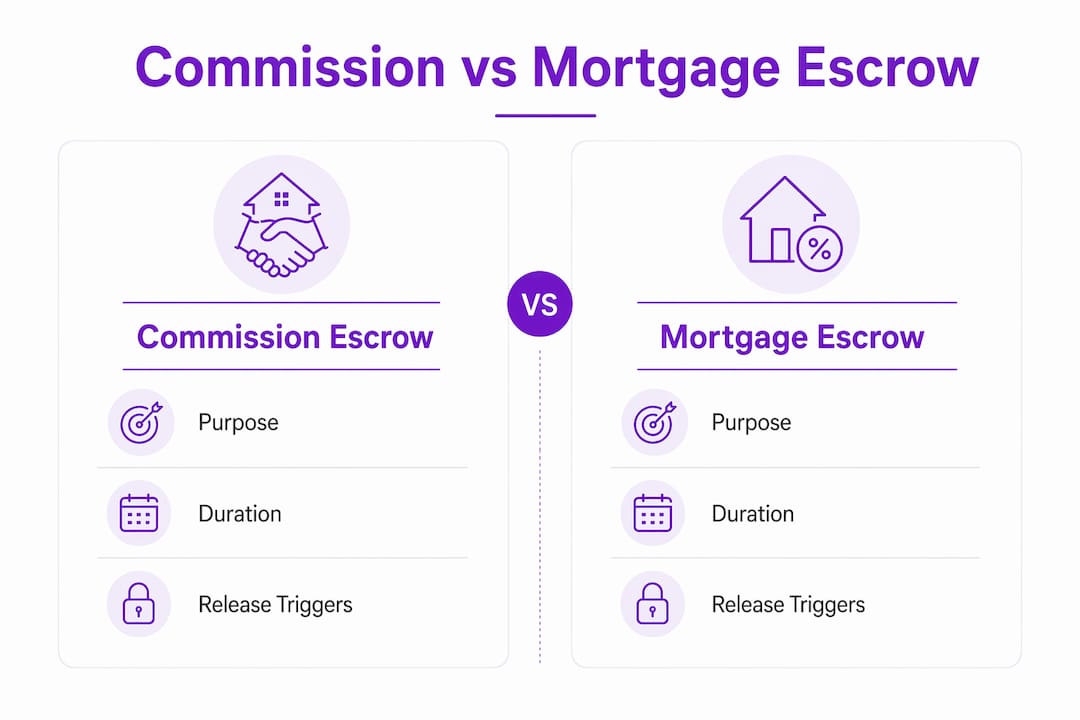
| Feature | Commission Escrow | Mortgage/Homeowner Escrow |
|---|---|---|
| Purpose | Hold earned commission until closing conditions are met | Manage recurring property taxes and insurance payments |
| Duration | Transactional and temporary | Long-term, tied to loan repayment |
| Who instructs disbursement | Principals (buyer/seller), per written instructions | Lender or loan servicer |
| Payer/beneficiary | Brokerage or cooperating broker receives funds at release | Taxing authority or insurer receives funds on due dates |
As industry commentary notes, mortgage escrow manages recurring homeownership expenses while commission escrow is a one-time transactional safeguard. Commission escrow accounts should never hold payroll, routine vendor payments, or operating expenses. Those belong in separate accounts entirely.
Pro Tip: If your brokerage is using the same escrow account for commissions and operating costs, that is a compliance red flag. Regulators expect clear separation.

How the money actually moves through escrow
Escrow is a legal arrangement where a neutral third party holds assets until the parties’ agreed-upon instructions are satisfied. In a commission context, the flow works like this:
- Deposit: Commission funds are wired or deposited into the escrow account, typically by the buyer’s lender or the closing attorney, per the purchase contract.
- Verification: The escrow agent confirms funds have cleared. Checks may require a holding period before disbursement is permitted.
- Instruction review: The escrow agent reviews the written instructions signed by the principals. Brokers are generally not principals to the escrow transaction and cannot unilaterally change disbursement instructions.
- Trigger confirmation: The release trigger fires, most commonly deed recordation or confirmed closing.
- Disbursement: Funds are released to the brokerage, cooperating broker, or referral partner per the instructions.
- Documentation: The escrow agent provides a disbursement receipt; the brokerage retains it in the transaction file.
Common release triggers to specify in your escrow instructions: closing and funding confirmation, deed recorded with the county, financing contingency cleared, or written notice of escrow termination if the deal falls through.
When brokerages actually use commission escrow accounts
Not every commission payment needs a formal escrow arrangement. Here is where it genuinely earns its place:
- Co-op commission distributions: When a listing brokerage owes a split to a cooperating broker, escrow holds the cooperating broker’s share until closing is confirmed, protecting both sides.
- Referral fees contingent on closing: A referral agreement that pays only upon a successful close is a natural fit for escrow. The funds sit until the condition is met.
- Holdbacks for seller concessions: If a seller concession is tied to a post-closing condition, escrow holds those funds until the condition is verified.
- Contingent performance payouts: Some agent incentive structures tie a bonus to a specific closing milestone. Escrow keeps the funds neutral until that milestone is reached.
For compliant co-op payment workflows, the escrow structure prevents disputes about whether funds were actually available at closing.
Legal and compliance considerations U.S. brokerages must know
This is where most brokerages get into trouble, and the stakes are not small.
“Escrow agents must disburse funds only according to written instructions of the principals and cannot alter those instructions unless all signatories agree. The Escrow Law prohibits escrow agents from permitting any person to add to, delete from, or alter an escrow instruction unless all previously signing persons sign the change.” — California DFPI/DRE Joint Advisory
Key compliance requirements for U.S. brokerages:
- Use an impartial, licensed escrow agent. The brokerage cannot serve as its own neutral party.
- Escrow instructions must be signed by the principals, not the broker.
- New York’s Commission Escrow Act provides a statutory model for securing commissions until closing. Know your state’s equivalent.
- RESPA prohibits fee arrangements that look like kickbacks. Escrow structures that obscure the payer/beneficiary relationship can trigger federal scrutiny.
- Using Venmo or Zelle to pass commission funds creates regulatory exposure and possible federal liability.
Compliance checklist:
- Confirm escrow agent is a licensed corporate holder with surety bonding and independent audits.
- Obtain principal-signed written escrow instructions before any funds are deposited.
- Document the earned commission with a Commission Disbursement Authorization (CDA).
- Retain all records per your state’s retention schedule (commonly three to five years).
- Disclose whether the account is interest-bearing and which party receives accrued interest.
How to set up a commission escrow arrangement
- Select a licensed escrow agent. Look for a corporate licensee with surety bonding, independent trust-account audits, and written policies against pre-closing disbursements. Escrow companies must be incorporated and financially solvent in most states.
- Draft escrow instructions. An escrow agreement must clearly outline the escrow agent’s identity, the asset description, release conditions, and the duties of the holder.
- Get principal signatures. Both buyer and seller must sign. No exceptions.
- Add a commission clause to the purchase contract addendum. Specify the deposit amount, the release trigger, and the named beneficiary.
- Notify the cooperating broker in writing of the escrow arrangement and expected disbursement timeline.
- Set up the escrow account with the agent and confirm the deposit method (wire preferred over check for speed).
- Reconcile at closing. Match the disbursement receipt to the CDA and retain both in the transaction file.
For buyer-agent communication best practices around settlement, clear written notice of escrow terms prevents last-minute disputes at the closing table.
Recordkeeping, timelines, and fees
| Item | Detail |
|---|---|
| Deposit-to-clearance | 3–10 business days for checks; wire transfers typically same or next day |
| Closing to disbursement | Usually shortly after confirmed closing and deed recordation |
| Records to retain | Escrow instructions, principal signatures, CDA, disbursement receipts, reconciliation reports |
| Retention period | Per state rules, commonly three to five years |
| Typical escrow fee | Flat fee per transaction or per-check disbursement fee; varies by provider |
| Interest-bearing accounts | Must disclose which party receives accrued interest at consummation or termination |
Commission tracking that ties directly to tax reporting is worth building into your workflow from day one. Accurate records prevent the scramble at year-end and support commission tracking for tax compliance for both agents and the brokerage.
Alternatives to traditional commission escrow
Traditional escrow works, but it is not always the right tool. Here is a quick decision framework:
- Broker trust accounts suit longer-term holdings and have different regulatory requirements. They are not a substitute for transaction-specific escrow.
- Licensed third-party escrow firms are the gold standard for high-value or disputed transactions but add cost and processing time.
- Ad-hoc payment apps (Venmo, Zelle, PayPal) are never appropriate for commission funds. The regulatory exposure is real and documented.
- Compliant payments platforms like Brokerpay handle splits, referral fees, and co-op disbursements with a built-in audit trail, removing the need for informal workarounds.
The decision comes down to complexity and risk. A single co-op split at a straightforward closing may not need a formal escrow firm. A disputed commission, a multi-party referral arrangement, or any situation where the right to payment is contested does.
Pro Tip: Review your last 10 commission disbursements. If any were paid via personal payment app or without a signed CDA, that is your compliance gap. Fix it before an audit does.
Tax implications for commission escrow funds
Funds held in escrow are not taxable until they are actually disbursed to the recipient. The IRS applies the constructive receipt doctrine: income is recognized when it is available to the taxpayer without restriction, not when it is merely deposited into escrow. For agents and cooperating brokers, this means the taxable event is the disbursement date, not the deposit date. Brokerages should issue 1099-NEC forms based on actual payment dates, not escrow deposit dates. If an escrow arrangement spans a tax year (funds deposited in December, released in January), the recipient reports income in the year of release.
Sample escrow agreement clauses for commission accounts
These clause templates give your attorney a starting point. Always have counsel review for your state’s requirements.
Deposit clause: “Buyer and Seller hereby instruct Escrow Holder to accept the sum of $[amount] representing the cooperating broker’s commission, to be held in escrow pending satisfaction of the release conditions set forth herein.”
Release trigger clause: “Escrow Holder shall disburse the escrowed commission funds to [Cooperating Broker Name] upon confirmation of closing, defined as recordation of the grant deed with [County] Recorder’s Office and receipt of lender funding confirmation.”
Amendment clause: “These escrow instructions may not be altered, amended, or revoked except by written agreement signed by all parties who executed the original instructions.”
Failed condition clause: “In the event the transaction fails to close by [date], Escrow Holder shall return all escrowed commission funds to the depositing party within [X] business days of written notice of termination, unless a written dispute notice has been received.”
Handling deal cancellations and commission disputes
When a deal falls apart, the escrow arrangement does not automatically resolve who gets the money. The escrow agent cannot make that call. Here is how to handle it:
- If both parties agree on the disposition of funds, they submit a signed mutual cancellation instruction to the escrow agent, who then disburses accordingly.
- If the parties dispute who is entitled to the commission, the escrow agent holds the funds and will not release them without either a joint written instruction or a court order.
- Brokerages should include a dispute resolution clause in the escrow instructions specifying the process (mediation, arbitration, or litigation) and the jurisdiction.
- Document every communication during a disputed escrow. Emails, letters, and signed notices all matter if the dispute escalates.
The worst outcome is an escrow agent caught between conflicting verbal instructions. Written instructions, signed by principals, prevent that scenario entirely.
Risks and common disputes in commission escrow accounts
The most common failure points are predictable and preventable:
- Premature disbursement requests: Brokers sometimes pressure escrow agents to release funds before closing. Escrow agents are prohibited from disbursing prior to closing per written instructions.
- Unsigned or incomplete instructions: An escrow instruction without all principal signatures is unenforceable. The escrow agent cannot act on it.
- Wrong beneficiary named: A typo in the cooperating broker’s name or account number can delay disbursement by days. Verify before submitting.
- Informal payment channels: Using Venmo or Zelle to “bridge” a commission payment while escrow clears is not a workaround. It is a separate compliance violation.
- No dispute clause: Without a written dispute resolution process, a contested commission can freeze funds indefinitely.
Mitigation is straightforward: use a licensed escrow agent, get everything in writing, and never treat the brokerage as a neutral party in its own commission transaction.
Key Takeaways
A commission escrow account protects earned but unpaid commissions by holding funds with a neutral agent until closing conditions are met, keeping brokerages RESPA-compliant and audit-ready.
| Point | Details |
|---|---|
| Use an impartial escrow agent | The brokerage cannot serve as its own neutral party; use a licensed, bonded corporate escrow holder. |
| Principal-signed instructions are mandatory | Escrow instructions must be signed by buyer and seller; brokers cannot unilaterally change disbursement terms. |
| Venmo and Zelle create federal liability | Ad-hoc payment apps violate escrow law and can trigger RESPA scrutiny; use compliant channels only. |
| Document everything | Retain escrow instructions, CDAs, disbursement receipts, and reconciliation reports per your state’s retention schedule. |
| Brokerpay removes the compliance gap | Brokerpay tracks splits, referral fees, and co-op commissions with a built-in audit trail, eliminating informal payment workarounds. |
The part most brokerages skip until it costs them
The compliance conversation around commission escrow almost always focuses on the legal mechanics, and that is correct as far as it goes. But the real operational risk is not that brokerages do not know the rules. It is that they know them and still use Venmo for a quick co-op split because the formal process feels slow.
That shortcut is where liability actually lives. A single informal payment that looks like a referral fee paid outside of closing can draw RESPA scrutiny, regardless of intent. The fix is not more legal training. It is removing the friction that makes the informal channel tempting in the first place. When the compliant path is as fast as the noncompliant one, brokerages stop cutting corners.
The other thing worth saying plainly: most commission disputes that end up in litigation were preventable with one document. A signed CDA and a written dispute clause in the escrow instructions would have resolved the disagreement before it became a lawsuit. The paperwork is not bureaucracy. It is the evidence you need when someone changes their story at closing.
Brokerpay keeps your commission workflow compliant by default
Replacing informal payment workarounds with a documented, audit-ready process is exactly what Brokerpay was built for. Every co-op split, referral fee, and agent payout runs through a single platform that tracks the transaction, generates the documentation, and keeps your disbursements off Venmo and out of regulatory gray zones.
Brokerpay automates agent splits and co-op disbursements, produces Commission Disbursement Authorizations for every transaction, and gives your finance team a reconciliation report that holds up under audit. Monthly reconciliations that used to take hours take minutes. Referral payouts that used to require a phone call and a wire confirmation happen inside the platform with a full paper trail attached.
If your brokerage is still routing commissions through personal payment apps or managing splits in a spreadsheet, the compliance exposure is real. See how Brokerpay works and get your commission workflow off informal channels for good.
Useful sources for your compliance team
- Legal Information Institute — Escrow: Clean statutory definition of escrow and the neutral-agent requirement. Good for internal training materials.
- California DFPI/DRE Joint Advisory on Commission Disbursements: The clearest regulatory statement on what escrow agents can and cannot do with commission funds. Cite this in your SOPs.
- California DRE Reference Book, Chapter 8: Detailed escrow law mechanics, including bonding, audit, and trust-account requirements for escrow holders.
- Massachusetts FAQs on Escrow Accounts: Covers interest-bearing account disclosure rules and prohibited payment channels. Useful even outside Massachusetts as a model for what regulators expect.
- New York Commission Escrow Act (AGM BLAW summary): State statute example showing how commission escrow protection is codified at the legislative level.
- Investopedia — Escrow Agreements: Plain-language breakdown of escrow agreement components. Useful for drafting clause checklists.
For model Commission Disbursement Authorization language and sample escrow instructions, the California DRE Reference Book and state bar association form libraries are the most reliable starting points. Have your real estate counsel review any template before it goes into a live transaction file.