Broker Commission Disbursement: A Quick Guide for Brokers

A Commission Disbursement Authorization (CDA) is a written instruction issued by the Principal Broker that tells title or escrow exactly how to split and pay commissions from escrowed funds at closing. The legal responsibility for its accuracy sits squarely with the Principal Broker — not the transaction coordinator, not the agent. Before you read another word, here are the three things you need to do right now:
- Prepare an accurate CDA with correct payee names, tax IDs, and dollar amounts that match the contract.
- Get the broker’s signature (or a documented authorized signer’s signature) before the CDA leaves your office.
- Confirm title or escrow has received and accepted the CDA before funding.
Table of Contents
- What a Commission Disbursement Authorization actually is — and what it isn’t
- Why CDAs matter to your brokerage — delays, disputes, and compliance
- What a CDA includes: required fields, payee formatting, and a sample line item
- Who prepares the CDA and who must sign it
- How the CDA fits into the closing timeline
- How title or escrow actually disburses commission funds
- Common CDA problems and how to avoid or fix them
- Step-by-step: how to prepare, sign, and submit a CDA
- Compliance and best practices: DRE, DFPI, RESPA, and record retention
- Key Takeaways
- Why tightening your CDA process pays off operationally
- Brokerpay keeps your commission disbursements compliant and documented
- Useful sources and references
What a Commission Disbursement Authorization actually is — and what it isn’t
A CDA is a broker-issued written instruction. Its sole job is to tell the title or escrow company how to divide and pay commissions out of the funds held in trust. That’s it. It is not a general-purpose payment order, and it is not a vehicle for paying personal expenses, business overhead, or unlicensed third parties.
Brokers sometimes blur this line, and regulators have noticed. The DRE and DFPI have explicitly warned that using a CDA to direct escrow funds toward a broker’s personal or business expenses — or toward unlicensed recipients — violates Real Estate and Escrow laws. The CDA is also not the same document as the HUD-1 or the Closing Disclosure. Those belong to the lender and settlement agent. The CDA belongs to the brokerage.
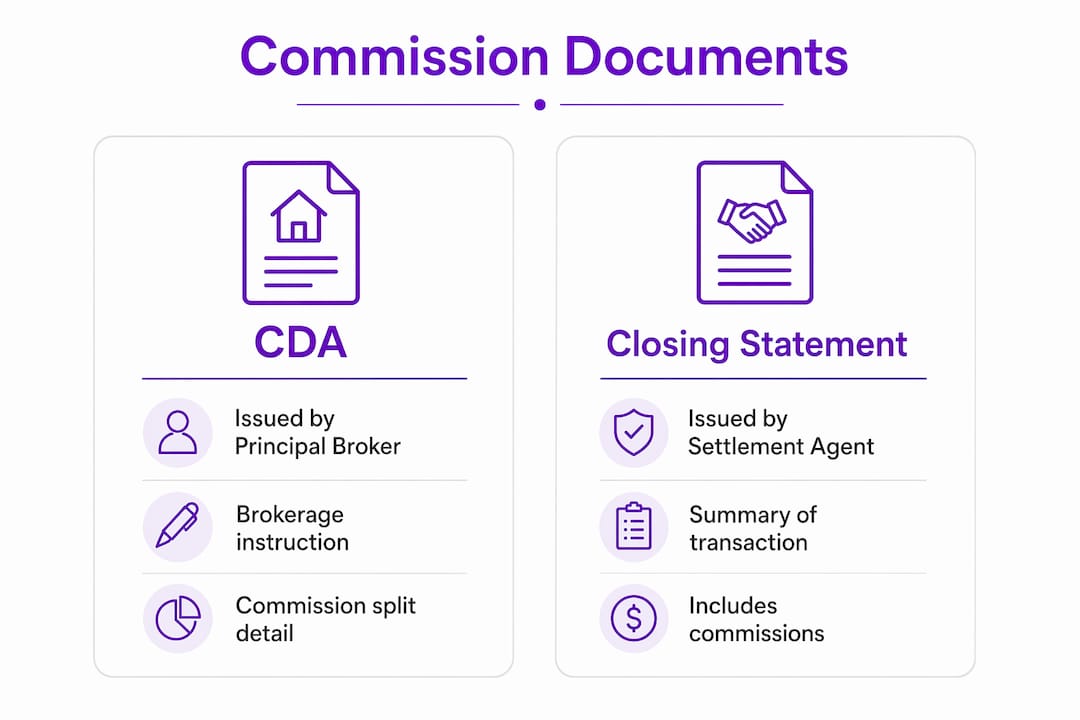
CDA vs. Closing Statement at a glance:
- CDA: Issued by the broker; instructs escrow on commission splits; signed by Principal Broker or authorized signer; brokerage’s internal record.
- Closing Statement (CD/HUD): Issued by the settlement agent or lender; covers all transaction debits and credits for buyer and seller; not a commission-management document.
| Feature | CDA | Closing Statement |
|---|---|---|
| Issued by | Principal Broker | Settlement agent / lender |
| Purpose | Commission split instructions | Full transaction accounting |
| Who signs | Broker or authorized signer | Settlement agent, buyer, seller |
| Timing | Before funding | At or after closing |
| Scope | Commission payees only | All transaction funds |
Why CDAs matter to your brokerage — delays, disputes, and compliance
The CDA functions as both an audit trail and a compliance firewall. When a commission dispute surfaces three months after closing, the CDA is the document that settles it. It shows who was owed what, who authorized the payment, and when the instruction reached escrow. Without a clean CDA on file, you are reconstructing that history from emails and memory.
The financial stakes are real. Residential brokerage commissions have historically averaged around 5%–6% of the sale price. On a sale at that standard commission rate, the gross commission is split between listing and buyer brokerages, and then each brokerage splits its share with its agent per the internal agreement. By the time the agent sees a check, the amount has been reduced after splits and any referral fees. Every one of those deductions needs to be documented on the CDA before escrow moves a dollar.

Pro Tip: Treat the CDA as the authoritative record for every commission dispute and reconciliation. If your CDA and your accounting software don’t match at month-end, the CDA wins — fix the books, not the CDA.
What a CDA includes: required fields, payee formatting, and a sample line item
Title and escrow companies expect specific information on every CDA. Missing or misformatted fields are the single most common reason a CDA gets kicked back or held up. Here is what a complete CDA should contain:
- Transaction identifier: MLS number, escrow number, or internal file number
- Property address: Full street address matching the purchase contract
- Gross commission amount: Dollar figure, not just a percentage
- Split breakdown: Each payee’s share in both percentage and dollar terms
- Payee name: Licensed entity name or individual agent name exactly as it appears on their license
- Tax ID: EIN for a brokerage entity; SSN or EIN for an individual agent (collected via W-9)
- Payment instructions: Check payable to, or wire routing and account number
- Authorized signature and date: Principal Broker or documented authorized signer
Payee name formatting matters more than most brokers realize. If the agent operates under a licensed entity (an LLC or S-Corp), the check or wire must go to that entity, not the agent’s personal name. Mismatches between the CDA payee name and the W-9 on file are a common trigger for IRS 1099 discrepancies.
Sample CDA line item:
Payee: Sunrise Realty Group LLC | EIN: 82-XXXXXXX | Amount: $8,750.00 | Payment: Wire to Routing 021XXXXXX / Acct 00XXXXXXXX | Memo: Buyer-side commission, 123 Oak Street, Anytown, TX 78701
Who prepares the CDA and who must sign it
The people who typically prepare the CDA and the person who must sign it are not the same, and confusing the two creates real liability gaps.
Common preparers:
- Transaction coordinator (TC): Pulls contract details, calculates splits, and populates the CDA template.
- Office manager or commission administrator: Reviews figures, checks W-9s on file, and routes the document for signature.
- Listing or buyer’s agent: Sometimes prepares a draft in smaller offices, but should never be the final signatory.
The legal signer is the Principal Broker or a formally designated authorized signer. Broker signature is required before the CDA is valid for submission to title or escrow. An unsigned CDA is not a CDA — it’s a draft.
Pro Tip: Document delegated signing authority in writing. A signed internal delegation log or a Board resolution naming the authorized signer protects you if a CDA is ever challenged. Keep that log with your compliance records, not just in someone’s email inbox.
How the CDA fits into the closing timeline
Timing is where most CDA problems actually start. The document needs to reach title or escrow before funding — not the morning of closing, not the afternoon after. Preparation typically happens immediately before closing, but “immediately before” should mean at least 24–48 hours ahead, not 20 minutes.
Here is the sequence that keeps closings clean:
- Prepare the CDA as soon as the closing date is confirmed and final figures are available from the settlement statement.
- Reconcile CDA figures against the purchase contract, listing agreement, buyer-broker agreement, and any referral agreements before the broker signs.
- Obtain authorized broker signature and date the document.
- Deliver to title or escrow via the method they specify (email, fax, or portal upload) and request written confirmation of receipt.
- Follow up after funding to confirm disbursement amounts and payees match the CDA exactly.
If anything changes after the CDA is submitted — a commission adjustment, a corrected payee name — every original signer must initial and date the revision. Escrow cannot act on a unilateral change.
How title or escrow actually disburses commission funds
Once escrow has a signed, accepted CDA, the disbursement mechanics follow one of two paths depending on state rules and how the CDA is written.
Common disbursement flows:
- Net-to-office: Escrow issues the full commission as a single check or wire to the Principal Brokerage. The brokerage then cuts individual checks or wires to agents and co-op parties from its own account.
- Direct-pay: Where state rules allow, escrow disburses directly to each named payee on the CDA — agent, co-op brokerage, referral party — without routing funds through the brokerage first. This cuts administrative overhead and reduces the risk of the brokerage handling large sums internally.
Understanding how mortgage escrow works more broadly helps clarify why escrow companies follow written instructions so strictly — they are fiduciaries to the transaction principals, not to the broker.
The sequence in a net-to-office scenario: funds received at closing → escrow references CDA → escrow issues check or wire to brokerage → brokerage processes internal splits per agent agreements → agents receive payment.

Pro Tip: Always verify wiring instructions by calling the title or escrow officer directly at a phone number you already have on file — never from a number in an email. Wire fraud in real estate closings is a documented and growing problem, and a fraudulent CDA wiring instruction is one of the vectors attackers use.
Common CDA problems and how to avoid or fix them
Most CDA errors fall into a short list of recurring categories. Knowing them in advance is cheaper than fixing them after funding.
Frequent errors:
- Incorrect payee name or TIN: The name on the CDA doesn’t match the W-9 or the licensed entity name.
- Unsigned CDA: Submitted without the Principal Broker’s signature; escrow will (or should) reject it.
- Mismatched amounts: CDA totals don’t reconcile with the closing statement commission line.
- Non-commission expenses on the CDA: Attempting to pay marketing fees, desk fees, or personal expenses through escrow via the CDA.
- Missing referral details: A referral fee is owed but the referring party’s name, license number, and amount aren’t on the CDA.
- Late submission: CDA arrives after funding has already occurred.
Fixes:
- Incorrect payee TIN discovered after funding: Contact the title company immediately. Request a stop payment on the issued check if it hasn’t been cashed. Re-issue a corrected CDA with the accurate TIN, obtain broker signature, and submit to title for a replacement check or wire. Document the entire correction sequence in your file.
- Unsigned CDA: Recall the document, obtain the required signature, and resubmit before escrow processes disbursement. If funding has already occurred, the brokerage must handle the split internally and document why the CDA was deficient.
- Mismatched amounts: Pull the final closing statement and the original commission agreement. Identify which figure is wrong, prepare a corrected CDA, and get all original signers to initial the change before resubmitting.
For compliant co-op payment workflows, having a pre-closing checklist that cross-references the CDA against every referral and co-op agreement eliminates most of these errors before they reach escrow.
Step-by-step: how to prepare, sign, and submit a CDA
Follow these steps in order. Skipping one usually means redoing several.
- Gather contract documents: Purchase agreement, listing agreement, buyer-broker agreement, any referral agreements, and W-9s for all payees.
- Calculate gross commission: Apply the agreed commission rate to the final sale price.
- Allocate splits and referral fees: Break down each payee’s share in both percentage and dollar terms. Confirm referral fees are paid only to licensed parties.
- Complete all CDA fields: Transaction ID, property address, gross commission, each payee’s name (matching their license and W-9), TIN, payment instructions, and split amounts.
- Internal review: Have the office manager or TC verify figures against the closing statement before routing for signature.
- Obtain authorized broker signature: Principal Broker or documented authorized signer signs and dates.
- Deliver to title or escrow: Use their preferred method and request written confirmation of receipt.
- Confirm post-funding disbursement: After closing, verify that each payee received the correct amount and document the confirmation.
Short fillable template example:
CDA — [Escrow/File #]
Property: [Full address]
Closing date: [Date]
Gross commission: $[Amount]

Payee 1: [Licensed entity or agent name] | TIN: [EIN/SSN] | Amount: $[X] | Payment: [Check/Wire details]
Payee 2: [Co-op brokerage name] | TIN: [EIN] | Amount: $[X] | Payment: [Check/Wire details]
Referral (if applicable): [Referring broker name, license #] | TIN: [EIN] | Amount: $[X]

Authorized signature: _________________________ Date: _________
Principal Broker: [Name, License #]
Supporting documents to attach:
- Executed listing agreement
- Buyer-broker agreement
- Any referral agreements
- W-9 for each payee
Compliance and best practices: DRE, DFPI, RESPA, and record retention
The regulatory framework around CDAs is more specific than most brokers realize, and the consequences of getting it wrong go beyond a rejected disbursement.
The DFPI and DRE joint bulletin documents cases where escrow companies issued checks from trust accounts to pay third parties for broker personal and business expenses based on CDA instructions. That practice can violate both Escrow Law and Real Estate Law. The DRE advisory is explicit: a CDA must only distribute earned commissions to licensed professionals.
“Escrow agents must follow written escrow instructions of principals — buyer and seller. Because brokers are not principals to the escrow transaction, CDAs must be carefully drafted and backed by the parties’ written commitments to avoid Escrow Law violations.” — DFPI/DRE Joint Bulletin
RESPA adds another layer. Paying referral fees or kickbacks to unlicensed parties through a CDA is a potential RESPA Section 8 violation, which carries federal penalties. The rule is simple: if the recipient isn’t licensed and didn’t perform a real, documented service, the payment doesn’t belong on a CDA.
Best-practice checklist:
- Verify broker signature on every CDA before submission — no exceptions.
- Collect a current W-9 from every payee before closing.
- Build an internal approval workflow: preparer → reviewer → broker sign-off.
- Retain CDAs and all supporting documents for a minimum of three years (check your state’s specific requirement; some states require longer).
- Reconcile every CDA to the closing statement and your accounting records within five business days of closing.
- Never include personal expenses, desk fees, or marketing costs on a CDA.
Accurate commission tracking also reduces 1099 discrepancies at year-end — a downstream benefit of getting the CDA right every time. Platforms like Brokerpay document the full chain of approval, from preparer through broker sign-off to disbursement confirmation, which reduces manual re-issue risk and gives brokerages a clean audit trail without building it from scratch in a spreadsheet.
Key Takeaways
A broker commission disbursement (CDA) is only as reliable as the broker who signs it, the figures it contains, and the timing of its delivery to title or escrow.
| Point | Details |
|---|---|
| Legal signer responsibility | Only the Principal Broker or a formally documented authorized signer can execute a valid CDA. |
| Submit before funding | The CDA must reach title or escrow and be confirmed accepted before closing funds are disbursed. |
| Payee and TIN accuracy | Payee names must match the licensed entity and W-9 exactly; mismatches cause 1099 errors and payment delays. |
| CDA scope is commission-only | Never use a CDA to pay personal expenses, desk fees, or unlicensed parties — DRE and DFPI treat this as a violation. |
| Brokerpay as compliance tool | Brokerpay tracks, documents, and processes agent splits and referral fees, providing a full audit trail from approval to disbursement. |
Why tightening your CDA process pays off operationally
Most brokerages treat the CDA as paperwork. The ones that treat it as a process control point are the ones with fewer post-closing disputes, faster agent payouts, and cleaner books at year-end.
The argument for tightening CDA procedures isn’t primarily about avoiding regulatory trouble — though that matters. It’s about the operational drag that loose CDA workflows create. A mis-typed TIN means a stop payment, a re-issue, and a phone call to escrow. A missing referral detail means a delayed payout and an unhappy referring broker. An unsigned CDA means the whole disbursement is on hold while someone tracks down the Principal Broker. Each of those events costs time and credibility.
The single point of failure in most brokerage CDA workflows is manual sign-off. The broker is the bottleneck. Map your internal process and ask: what happens when the broker is traveling? Who is the documented backup? Is that delegation in writing? If the answer to any of those questions is “we figure it out,” you have found your risk.
Operational benefits of a tighter CDA process: fewer post-closing disputes, faster agent payouts, reduced reconciliation time, and stronger audit readiness when a state regulator or auditor asks for records. Switching from manual to automated payouts addresses the bottleneck directly — not by removing the broker from the approval chain, but by making that chain visible, documented, and repeatable.
Brokerpay keeps your commission disbursements compliant and documented
Brokerages that still rely on spreadsheets, email threads, and Venmo to manage commission splits are carrying federal liability they may not fully see yet. Brokerpay is built specifically for this problem: it tracks agent splits, referral fees, and co-op commissions in one place, documents every approval step, and keeps your brokerage RESPA-compliant without the manual re-issue cycle that drains staff time after every closing.
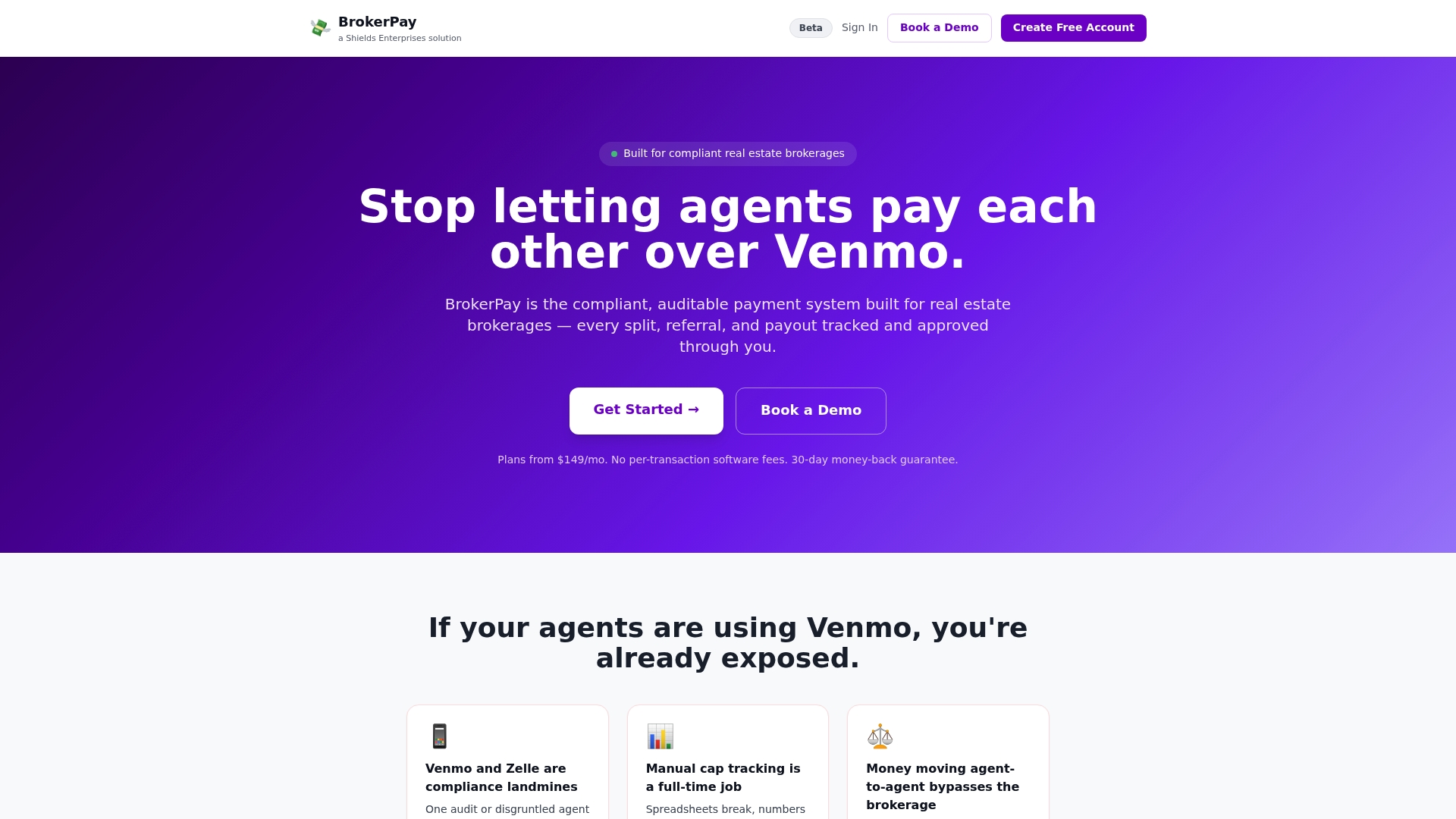
The platform eliminates the Venmo and Zelle workarounds that create federal liability and replaces them with a documented, auditable payout workflow. Every disbursement carries a paper trail from the moment the CDA is prepared through broker sign-off to final payment confirmation. For brokerages processing multiple closings a month, that audit trail is the difference between a clean compliance review and a regulatory headache. Visit brokerpay.io to see how it works or request a demo.
Useful sources and references
These are the primary sources used in this article. All are U.S.-focused; check your specific state’s DRE or real estate commission for local variations.
- DRE Licensee Advisory — Commission Disbursements: The California DRE’s advisory on what a CDA can and cannot be used for; essential reading for compliance sections.
- DFPI / DRE Joint Bulletin on CDAs: Documents real cases of CDA misuse and explains the Escrow Law and Real Estate Law provisions at risk; the most authoritative source on regulatory pitfalls.
- LegalClarity — Commission Disbursement Process: Practical explainer on CDA preparation, timing, and broker signature requirements.
- LegalClarity — How Realtor Commission Works: Covers commission negotiation, splits, and how funds flow from escrow through brokerage to agent.
- LegalClarity — Brokerage Commissions Breakdown: Explains gross commission rates and how headline numbers translate to agent take-home after splits.
- Brokerpay — Compliant Commission Payment Platform: The Brokerpay landing page describing the platform’s documentation and compliance features for real estate brokerages.
This article is general information for educational purposes, not legal or regulatory advice. Confirm current rules with your state’s real estate regulatory authority or a qualified real estate attorney for your specific situation.