How to Track Referral Partner Payments at Your Brokerage

Compliant referral payment tracking in U.S. real estate brokerages means more than logging a check. Every referral arrangement needs a signed agreement capturing the fee terms, counterparty details, client identification, and expected closing date before any money moves. You collect a W-9 from the referring party before payment, issue IRS Form 1099-NEC for any referral fees totaling $600 or more in a calendar year, and route every dollar through brokerage accounting — never directly between agents.
The core requirements for tracking referral partner payments at a brokerage break down like this:
- Referral agreement on file: Signed document with fee percentage or flat amount, counterparty license number, client name, and projected close date
- W-9 before payment: Verify entity status and taxpayer ID before disbursing any funds
- 1099-NEC at year-end: Required for any referring party who received $600 or more annually
- RESPA compliance: Fees must reflect fair market value for actual services; simple referrals between licensees are permitted, but payments above market value are not
- Brokerage routing only: All referral fees must flow through brokerage accounting — Venmo, Zelle, and direct agent-to-agent transfers create federal liability
- Audit trail: Timestamped records of agreements, correspondence, and payment logs for every transaction
- Automated reminders: Status-tracked records with follow-up triggers at 7, 14, and 30 days post-closing to prevent uncollected fees
Table of Contents
- What are the legal requirements for tracking referral payments?
- Best practices for automating and managing referral payment workflows
- How Brokerpay makes referral payment tracking compliant and manageable
- Key Takeaways
- Brokerpay keeps your referral fees compliant and collected
What are the legal requirements for tracking referral payments?
U.S. real estate brokerages operate under a layered compliance framework when it comes to referral fees. Getting any one layer wrong can mean IRS penalties, RESPA violations, or both.
IRS reporting obligations are straightforward but frequently missed in manual systems. Brokerages must issue Form 1099-NEC to any referring party who receives $600 or more in referral fees during the tax year, and a completed W-9 must be on file before the first payment goes out. Without the W-9, you cannot verify whether you’re paying an individual, an LLC, or an S-corp — each of which has different withholding implications.
RESPA’s Section 8 is where brokerages most often stumble. The law prohibits kickbacks for settlement services but explicitly permits referral fees between licensed real estate brokers when state law allows and compensation reflects fair market value. Holly Bunting, a partner at Mayer Brown and a recognized RESPA authority, puts it plainly: “If a broker is paid above fair market value for a service, that’s an example of an illegal referral fee.” A simple referral of business, with no actual service performed, does not qualify as a compensable service under the law.
The CFPB enforces this standard by examining whether payments exceed reasonable market value for the services claimed. Arrangements that look like service agreements on paper but lack genuine substance are exactly what CFPB investigators target. Violations of RESPA Section 8 carry penalties of up to $10,000 per offense, up to one year of imprisonment, or both — and a harmed party can sue for triple the improper fee amount plus attorney fees.
Key stat: According to NAR data, agents who maintain visible referral pipeline stages collect 91% of owed referral fees, compared to 64% for those using informal tracking methods.
State-level licensing rules add another layer. Most states require that referral agreements be entered into between brokerage firms, not individual agents, and that the referring broker hold an active license at the time the referral is made. Colorado’s Division of Real Estate, for example, requires both RESPA compliance and reasonable cause for payment, and mandates referral of potential violations to the CFPB. Your state’s real estate commission rules govern whether and how fees can be paid to brokers who have since moved firms.
Paying an unlicensed individual a referral fee — even a past client who sends you business — is prohibited under RESPA Section 8 for federally related mortgage transactions. Gift cards, dinners, and charitable donations made in exchange for referrals fall under the same prohibition.
Best practices for automating and managing referral payment workflows
The biggest source of lost referral income is not bad actors. It’s manual follow-up failures — a deal closes, the referring broker expects payment, and nothing in your system triggers the disbursement process.
Capture the agreement at the moment it’s made. Every referral record should include the fee terms, the counterparty’s brokerage name and license number, the client’s name, and the expected closing date. Waiting until close to document the arrangement means you’re reconstructing details from memory, which creates both accuracy problems and compliance exposure.

Use status-tracked records. Assign each referral a stage: “active,” “pending payment,” or “paid.” This single practice is what separates the brokerages that recover the majority of owed fees from those that don’t. When a deal moves to closing, the status change triggers your payment workflow automatically.
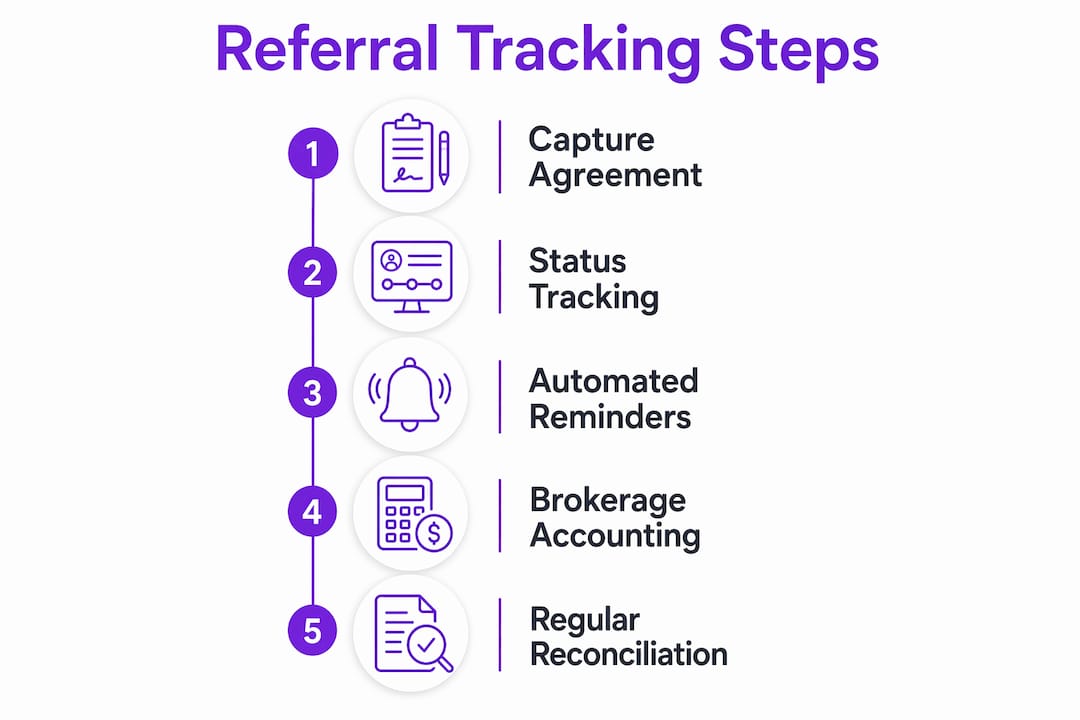
Automate reminders with escalation. Set follow-up triggers at 7, 14, and 30 days post-closing. If a payment hasn’t been confirmed at 30 days, the system should escalate to a manager or flag the record for direct outreach. Proactive escalation policies not only secure payments faster but create a documented record of your collection efforts — useful if a dispute arises later.
Route everything through brokerage accounting. No exceptions. Direct agent-to-agent payments via Venmo, Zelle, or personal checks bypass the accounting controls that make tax reporting and RESPA compliance possible. A real estate payment gateway built for brokerages enforces this routing automatically.
Reconcile regularly. Monthly reconciliation of referral fees against your accounting system catches discrepancies before they compound. A fee recorded as “pending” for 60 days is a red flag worth investigating — it could be a processing error, a dispute in progress, or a payment that was made outside the system.
Pro Tip: Integrate your referral payment tracking software directly with your brokerage management platform. When referral records, commission splits, and accounting entries share a single data source, you eliminate the manual re-entry that causes most discrepancies — and your audit trail builds itself.
Maintaining timestamped audit trails — signed agreements, payment confirmations, and all correspondence — reduces dispute resolution time significantly compared to unstructured record keeping. When a referring broker questions a payment amount or timing, you can pull the complete history in seconds rather than reconstructing it from emails.
Understanding how buyer’s agent referral networks structure their agreements can also sharpen how you document your own arrangements, particularly for cross-market referrals where fee terms and timing expectations differ.
How Brokerpay makes referral payment tracking compliant and manageable
Manual tracking leaves money on the table and creates compliance gaps. Brokerpay is built specifically for U.S. real estate brokerages that need to automate commission payments without sacrificing the documentation that keeps them on the right side of IRS and RESPA requirements.
- Automated referral fee capture: Brokerpay records fee terms, counterparty details, and client information at the point of agreement, eliminating the manual data entry that causes most tracking failures
- Brokerage-routed payments only: The platform enforces payment through brokerage accounting, removing the temptation — and the risk — of direct agent-to-agent transfers via informal apps
- Digital W-9 collection: Brokerpay prompts for W-9 completion before any disbursement, so your 1099-NEC preparation at year-end is based on verified taxpayer data
- 1099-NEC preparation support: The platform organizes payment records by payee and amount, making year-end tax reporting straightforward rather than a scramble through spreadsheets
- Audit trail logging: Every agreement, payment, and communication is timestamped and stored, giving you a complete record for compliance reviews or dispute resolution
- Reminder and escalation workflows: Automated follow-ups at defined intervals post-closing mean overdue referral fees get flagged before they fall through the cracks
- Integration with brokerage platforms: Brokerpay connects with existing brokerage management and accounting systems, so referral records, agent splits, and co-op commissions all live in one place
The result is a system where commission tracking prevents tax issues and compliance documentation happens as a byproduct of normal workflow — not as a separate, manual task.
Key Takeaways
Compliant referral payment tracking requires signed agreements, W-9 collection before payment, 1099-NEC issuance for fees of $600 or more, strict brokerage routing, and automated follow-up workflows to prevent revenue loss.
| Point | Details |
|---|---|
| Capture agreements immediately | Record fee terms, counterparty license, client name, and expected close date at the moment of referral. |
| W-9 before any disbursement | Collect a completed W-9 to verify entity status before releasing referral funds. |
| 1099-NEC for $600+ annually | Issue Form 1099-NEC to any referring party who received $600 or more in the calendar year. |
| RESPA fair market value rule | Referral fees must reflect actual services at fair market value; payments above that threshold risk federal penalties. |
| Brokerpay automates compliance | Brokerpay enforces brokerage routing, collects W-9s, logs audit trails, and triggers payment reminders automatically. |
Brokerpay keeps your referral fees compliant and collected
Spreadsheets and informal payment apps are not a referral management system. They’re a liability. Brokerages that rely on manual processes leave fees uncollected, expose themselves to IRS scrutiny, and create the exact paper trail gaps that RESPA enforcement actions exploit.
Brokerpay gives your brokerage a purpose-built platform that tracks every referral from agreement to disbursement, enforces compliant payment routing, and generates the documentation your accountant and compliance counsel actually need. W-9 collection, 1099-NEC preparation, audit logs, and automated reminders are built into the workflow — not bolted on at year-end.
If your brokerage is still routing referral fees through Venmo or managing payment tracking in a spreadsheet, the exposure is real and the fix is straightforward. Get started with Brokerpay and put a compliant, automated referral payment system in place before the next closing hits your desk.