Why P2P Apps Create Federal Liability for Real Estate Brokerages

Why P2P apps create federal liability when used for agent commissions
Using consumer payment apps to pay agent commissions is not a gray area. It is a federal compliance problem. The core issue is that P2P platforms like Venmo and Zelle were built for splitting dinner bills, not for commercial real estate transactions, and federal regulators treat them accordingly.
The liability stems from two converging pressures. First, the Electronic Fund Transfer Act (EFTA) and its implementing rule, Regulation E, draw a hard line between unauthorized transactions and scams. Unauthorized transfers carry refund rights; payments a user was deceived into authorizing do not. When an agent or brokerage staff member is tricked into sending a commission payment to the wrong party, that transaction is almost certainly a scam under Regulation E, not an unauthorized transfer. No automatic reimbursement follows.
Second, nonbank payment companies that handle money transmission must register with the U.S. Department of Treasury as Money Services Businesses (MSBs) and comply with anti-money laundering (AML) and Know Your Customer (KYC) rules. A brokerage that routes commission payments through an unregistered or noncompliant platform can be pulled into that enforcement exposure.
Key federal liability risks for brokerages using P2P apps:
- No EFTA scam protection when agents authorize fraudulent transfers
- Potential MSB registration violations if the platform lacks Treasury registration
- Stored funds on P2P apps are often uninsured and at risk if the platform fails
- Violation of platform Terms of Service, which typically prohibit commercial use
- No audit trail for IRS 1099 reporting or RESPA compliance documentation
What federal regulations actually say about P2P payment liability
The EFTA and Regulation E distinction that catches brokerages off guard
Regulation E applies to all P2P payment transactions that qualify as electronic fund transfers. The CFPB confirmed in December 2021 that P2P services must reimburse consumers when a third party steals account access and initiates a transfer. But the guidance is silent on scams where the account holder authorizes the payment. Courts have reinforced this gap. In Wilkins v. Navy Federal Credit Union (D.N.J. 2023), a plaintiff who transferred funds to a fraudster via Zelle after being deceived had her case dismissed because she had, in the court’s words, “authorized the transaction” herself.
MSB registration and AML/KYC obligations
Nonbank payment companies functioning as MSBs must register with Treasury and maintain AML and KYC programs. DOJ enforcement has targeted nonbank payment firms that lack proper registration, including platforms that structurally resemble P2P services. The Tornado Cash prosecution, where a co-founder was convicted on an unlicensed money transmitting business charge, illustrates how broadly courts apply the money transmitter definition regardless of how a platform labels itself.

Regulators apply a substance-over-form principle. The Financial Stability Board and legal commentators consistently note that P2P platforms are treated as financial intermediaries once they hold or route consumer funds, regardless of whether the company calls itself a technology provider.
Sovereign risk and regulatory lag
The digital payments space moves faster than Congress. State and federal laws written for traditional banking are being applied retroactively to P2P scenarios with no clear precedent, creating what legal scholars call sovereign risk. Brokerages operating in multiple states face compounding uncertainty because state money transmitter laws vary widely and are still catching up to app-based payment models.
The American Bankers Association has cautioned that shifting full liability to platforms for P2P scams could compromise transaction speed and user convenience, signaling that the industry does not expect blanket consumer protection to arrive soon. Brokerages cannot wait for that policy debate to resolve.
Operational risks brokerages face when using P2P apps for commissions
Terms of Service violations and frozen funds
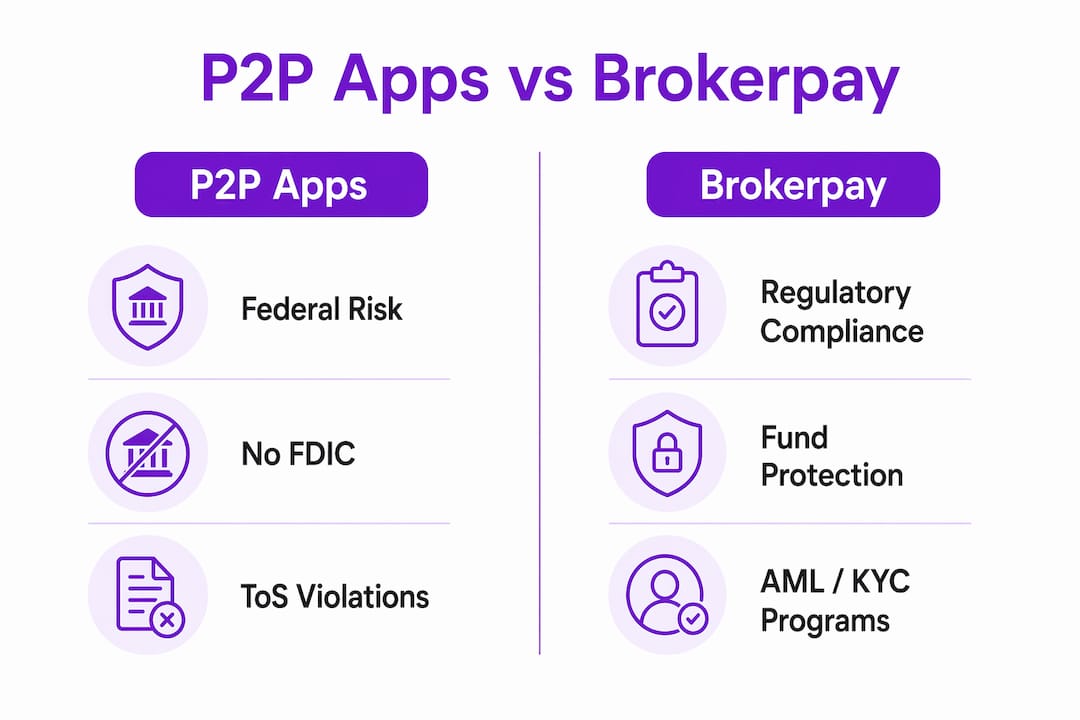
Consumer P2P apps explicitly prohibit commercial use in their Terms of Service. A brokerage using these platforms to pay agent splits is violating that agreement. The consequence is account freezes with no appeal path and no SLA-backed commercial support to recover locked funds. Unlike a purpose-built commission platform, consumer apps offer no recourse when a business account gets flagged.
No FDIC insurance on stored balances
Funds sitting in a P2P app balance are not FDIC insured unless the user holds a specific prepaid card or sponsored account product. A brokerage holding commission funds in a P2P app balance before disbursing to agents has no federal deposit protection if that platform becomes insolvent. The CFPB estimates that U.S. consumers hold substantial funds in these uninsured balances.
Key operational compliance risks for brokerages:
- Account freezes from ToS violations with no commercial recourse
- Uninsured stored balances exposed to platform insolvency
- No automated commission split documentation for IRS 1099 filings
- AML/KYC sending limits that restrict business-scale transfers without verified business accounts
- No RESPA-compliant audit trail for referral fees and co-op commissions
- Retroactive regulatory exposure as state laws tighten around P2P business use
Real estate transactions involve AML scrutiny by design. Mortgage lenders and title companies already operate under strict AML and KYC requirements that touch every party in the transaction chain. A brokerage paying commissions through an unverified consumer app introduces a compliance gap that can surface during a lender audit or federal examination.
How Brokerpay mitigates the federal liability risks P2P apps create
Brokerpay was built specifically to replace the Venmo and Zelle workarounds that put brokerages at legal risk. Its core function is tracking, documenting, and processing agent splits, referral fees, and co-op commissions through a RESPA-compliant workflow that generic consumer apps cannot replicate.
Key compliance features Brokerpay provides:
- Automated commission tracking with a full audit log for every transaction
- Agent split documentation that satisfies RESPA disclosure requirements
- IRS 1099 reporting integration so year-end filing does not require manual reconciliation
- Compliant payment structures that avoid the unauthorized-versus-scam liability trap
- Business-grade account support with no consumer ToS restrictions on commercial use
Pro Tip: Set up Brokerpay’s documentation workflow before your next transaction cycle, not after an audit notice. Having a complete audit log from day one is the difference between a clean examination and a costly remediation.
Unlike consumer P2P apps, Brokerpay does not expose brokerage funds to uninsured platform balances or retroactive ToS enforcement. The platform’s internal controls align with AML and KYC standards, which matters when a transaction is reviewed as part of a broader real estate compliance examination. Brokerages operating in states with tightening mortgage compliance requirements will find that documented commission workflows are increasingly expected, not optional.
Key Takeaways
P2P apps create federal liability for real estate brokerages because they lack the regulatory structure, documentation, and business-use protections that commission payments legally require.
| Point | Details |
|---|---|
| EFTA scam gap | Regulation E protects unauthorized transfers but not scam-induced payments brokerages authorize themselves. |
| MSB registration risk | P2P platforms without Treasury registration expose brokerages to DOJ enforcement as unlicensed money transmitters. |
| Uninsured stored funds | Balances held in consumer P2P apps are not FDIC insured, putting commission funds at risk if the platform fails. |
| ToS violations | Consumer P2P apps prohibit commercial use; violations lead to frozen accounts with no appeal or commercial recourse. |
| Brokerpay compliance | Brokerpay replaces P2P workarounds with RESPA-compliant commission tracking, audit logs, and IRS 1099 integration. |
Brokerpay is built for what P2P apps cannot do
Real estate brokerages managing agent commissions need more than a fast payment app. They need a platform that documents every split, survives a federal audit, and keeps the brokerage on the right side of RESPA, EFTA, and IRS reporting requirements.
Brokerpay does exactly that. It replaces the Venmo and Zelle workarounds that create federal liability with a purpose-built commission payment system that tracks agent splits, automates documentation, and generates the records your brokerage needs at tax time and during compliance reviews. No frozen accounts, no uninsured balances, no ToS violations.
Get started with Brokerpay and process your next commission cycle with a complete audit trail already in place.